
Suppose you plan to sell a work bag in Saudi Arabia. A local factory quotes SAR 72 per unit; a factory abroad quotes SAR 40 for the same specifications. Have you saved SAR 32? Not yet. And should you lower your selling price? That depends on the customer, the sales channel, and the full cost per unit.
This is a fictional teaching example, not investment or financial advice or an estimate of actual duties and taxes.
1. Start with the market and set a cost ceiling
Segment the market by what buyers value. Some want the lowest price; others will pay more for durability and a dependable warranty. Choose a segment and decide how you want those buyers to see your product relative to alternatives. Here, the target is daily commuters who need a durable bag that protects a laptop. Compare genuinely similar products and test the price with prospective buyers or retailers before committing to a large order.
Assume a realistic direct selling price of SAR 120 after discounts, before variable selling costs. If each sale needs to contribute SAR 25 toward fixed costs and eventual profit, your variable cost ceiling is SAR 95: 120 − 25. This ceiling includes production, freight, distribution, and other variable selling expenses. The SAR 25 is contribution margin per unit, not net profit.
2. Compare the full cost of a unit ready for sale
| Cost per unit, SAR | Local | Abroad |
|---|---|---|
| Factory quote | 72 | 40 |
| Transport, insurance, clearance, and assumed duties and fees | 3 | 18 |
| Inspection, packaging, and expected allowance for defects and returns | 5 | 10 |
| Cost per unit ready for sale | 80 | 68 |
| Direct selling and distribution | 12 | 12 |
| Contribution margin at a price of 120 | 28 | 40 |
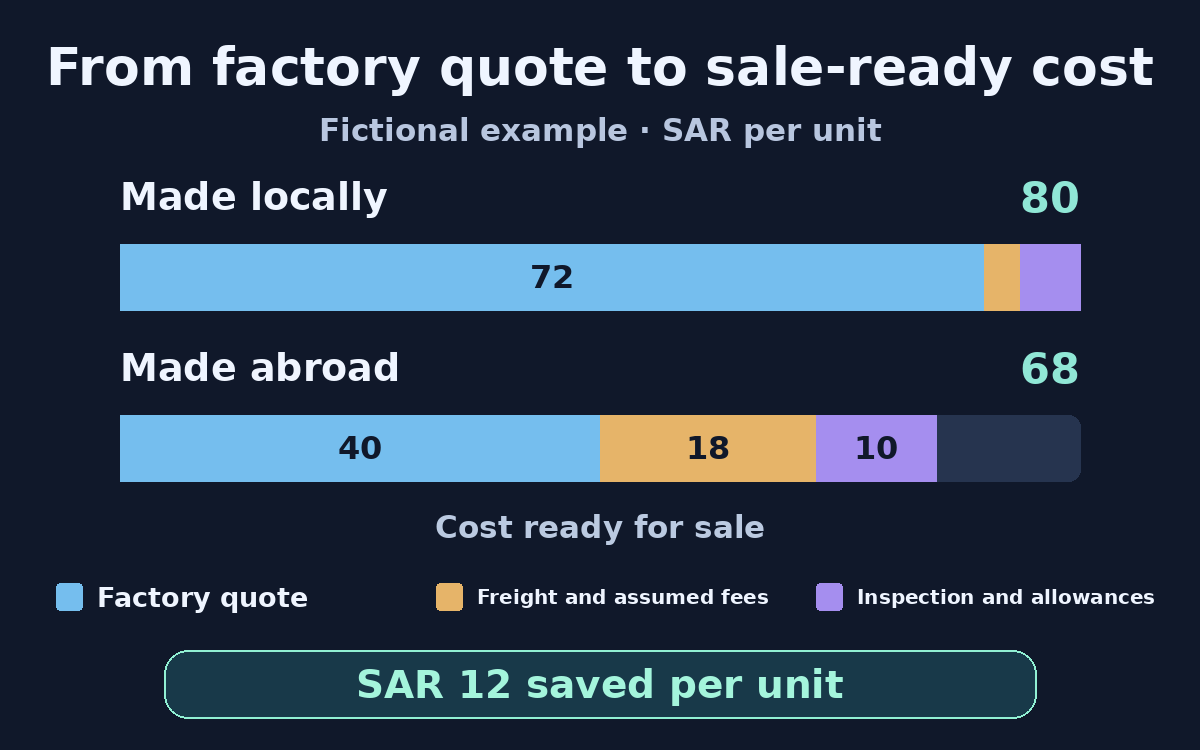
Original teaching figure. The SAR 32 factory quote gap becomes a SAR 12 sale-ready saving per unit. Figures are fictional and exclude direct selling costs.
These are fictional numbers, not estimates of actual duties. The saving is SAR 12 per unit, not SAR 32. If manufacturing abroad adds a one-time setup cost of SAR 6,000, you need to sell 500 units for the two options to break even against each other, assuming unchanged prices and unit costs. If import costs rise by SAR 6 per unit, the saving falls to SAR 6 and the threshold rises to 1,000 units. Also check deposit terms, minimum order quantities, and how long your cash will be tied up in inventory. Trade.gov on landed cost
Before placing a large order, separate supply validation from demand validation. Inspect a sample against the agreed specifications, request a full landed-cost quote, and check lead times and reorder terms. Then test paid demand or a small order from retailers before committing more cash. The crossover above compares manufacturing options; it is not the whole business’s break-even point, which would include other fixed costs outside this example.
3. Where marketing comes in: four decisions
- Product: Hold on to the specifications that support your promise. If it is laptop protection, inspect the stitching, padding, and zipper on a production sample. Do not cut the feature that gives the customer a reason to buy.
- Price: You could hold at SAR 120 and use some of the saving for a better warranty, or test a lower price for a price-sensitive segment. Judge the change by total contribution, not just units sold.
- Place: The shelf price is not your revenue. If a retailer keeps 25% of a SAR 120 shelf price, it retains SAR 30 and you receive SAR 90. Subtract the SAR 68 imported product cost and SAR 22 remains before other retail-channel costs. Model those costs separately rather than carrying over your direct-distribution figure.
- Promotion: Customers do not need to hear that the bag was cheap to make. Give them a claim you can substantiate: better protection, a clear warranty, or reliable availability. An in-store sample or a distributor trial can test it. Digital channels can help test messaging and demand, but they cannot fix a weak product or the wrong distribution channel. OpenStax on the 4Ps
4. Is manufacturing abroad really arbitrage?
In the strict sense, arbitrage involves buying and selling the same or equivalent asset nearly simultaneously to capture an existing price gap. Manufacturing abroad is better described here as taking advantage of a production-cost difference. You pay to make the bags before you know how many will sell, and you still face quality, inventory, and exchange-rate risks. A cost gap is not a locked-in profit. Federal Reserve explanation of arbitrage
Exercise: Should you cut the price?
One vote per browser profile on this site. Results appear after your vote is accepted.
Checking for a saved vote…
Takeaway: A lower factory cost gives you room to make a marketing decision. The competitive advantage comes from using that room to offer a product a defined customer wants, at a price they will pay, through a channel that leaves enough margin to sustain the business.
Comments
No published comments yet.