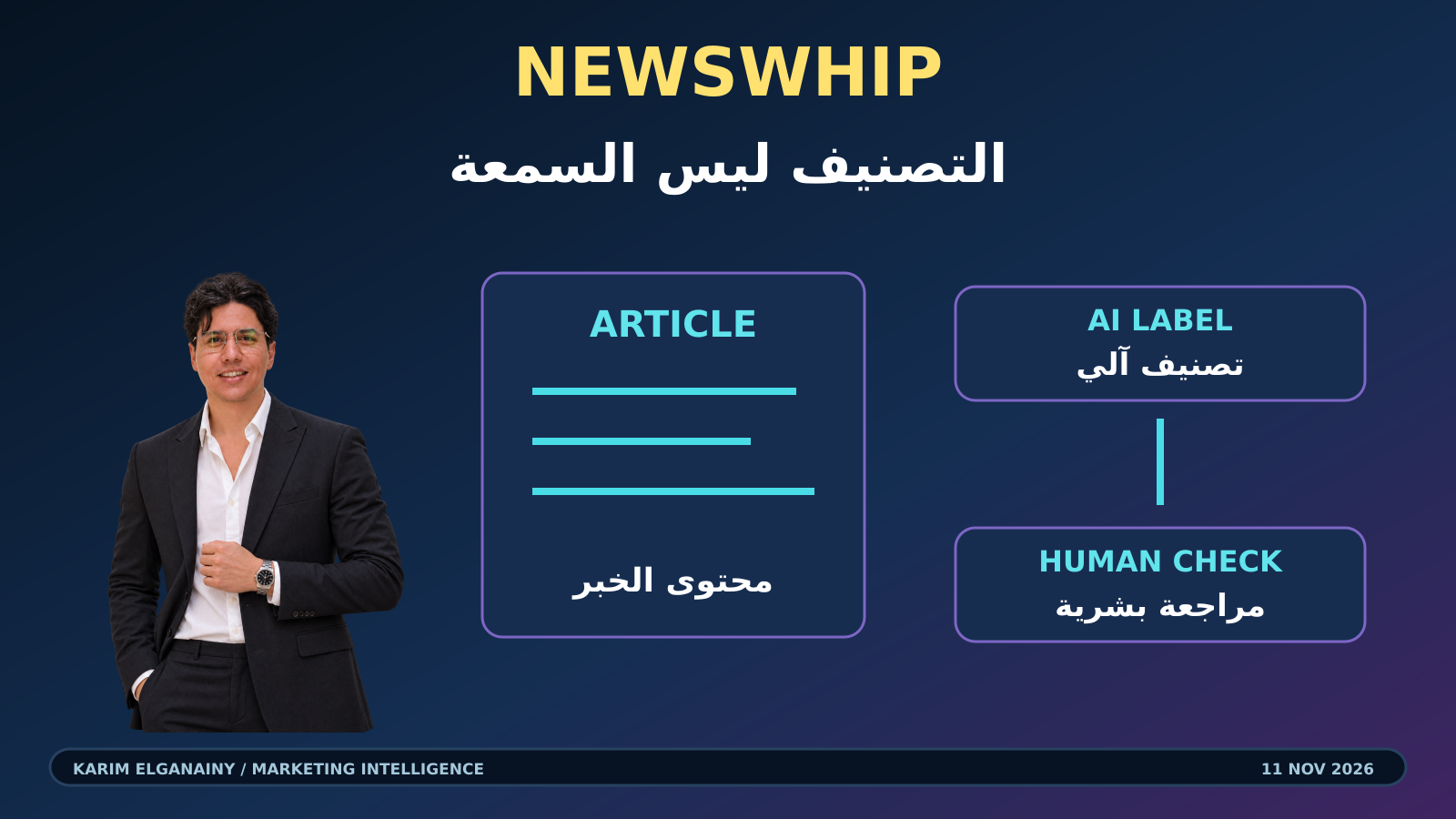
NewsWhip’s new AI sentiment feature raises a practical question for communications teams: when a dashboard calls coverage negative, what decision should follow? A useful answer begins with the article, its target and its context. It then asks whether the issue warrants investigation, a response or continued observation. The label can help organize that work, but it cannot complete the judgment by itself.
The announcement is a reason to improve the evidence behind a reputation dashboard. It is not sufficient evidence that a brand’s reputation has changed. This article first summarizes the verified launch, then develops an independent evaluation method. The proposed tests, calculations and operating practices below are original editorial analysis, not descriptions of NewsWhip’s internal model or guarantees of its performance.
What was announced on November 10
Sprout Social announced AI Sentiment Analysis within NewsWhip on November 10, 2026. The company says it evaluates full-article context and classifies coverage as positive, negative or neutral for a brand. Teams can create custom Analyzers with criteria for brand-message tracking. Metrics connect to underlying articles and driver summaries, and the announcement says the feature is available within NewsWhip dashboards for brand customers. Source: Sprout Social announcement.
The release supplies no independent accuracy benchmark, error rate, language-specific validation or causal study of reputation change. Arabic support, pricing and precise plan eligibility were not verified. Those gaps matter when deciding which workflows to trust and which require additional testing. Availability in a dashboard should not be read as verified suitability for every language, market or sensitive use case.
Separate four different kinds of evidence
Start with a four-stage map: published content, audience exposure, audience interpretation and later trust or behavior. An article-level sentiment label addresses the first stage. Even a completely correct label does not establish how many relevant people encountered the article, whether they understood it as the brand intended or whether it influenced a later decision. Each later claim requires evidence appropriate to that claim.
For example, an article could criticize an industry practice while describing one company’s corrective action favorably. A reader might remember the criticism, the corrective action or neither. A monitoring team should identify what the article actually says about the named brand before drawing conclusions about its likely effect. The distinction is especially important when several companies appear in the same report or a quotation is attributed to an opposing party.
Use separate fields in reporting rather than one blended reputation number. Record the content assessment, available distribution evidence, any audience research and the observed business signals. Mark unknowns explicitly. A blank exposure field is more honest and useful than silently treating potential reach as confirmed readership. This separation lets leaders see which conclusions are supported and which remain hypotheses that the team should investigate.
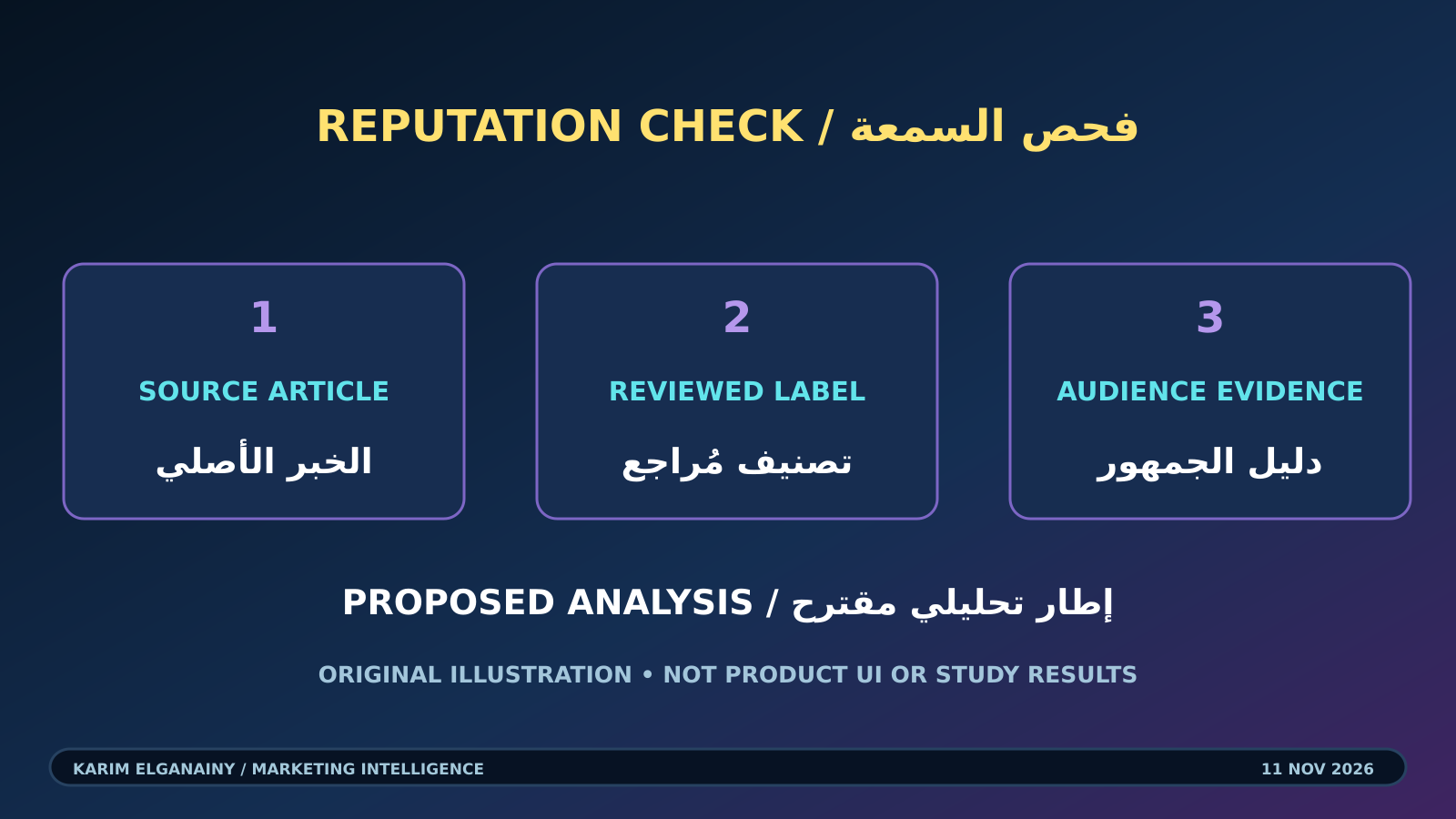
Original illustration by Karim Elganainy. Original conceptual illustration for this analysis: Source Article, Reviewed Label and Audience Evidence are three distinct panels. They show that coverage assessment is one input to a wider reputation investigation. The artwork has Arabic and English labels, explained in the surrounding localized text. This is not a NewsWhip interface, its technical architecture or proof of audience impact. Source context: announcement.
Define the unit before calculating a trend
Agree what counts as one item in the dashboard. An original report, a syndicated copy, a later update and a social post linking to the report can describe the same underlying event while reaching different readers. Counting all of them as independent editorial judgments can exaggerate the apparent breadth of an issue. Removing all copies can also erase useful distribution information. Keep original-story counts and distribution counts distinct.
Define the time window and treatment of revisions. An early article may contain an allegation that is corrected later. The team needs a clear rule for retaining the original assessment, storing the updated version and explaining any change in the trend. Otherwise, yesterday’s report may change invisibly, making it difficult to reconstruct why a decision was taken at the time. This is a reporting design recommendation, not a claimed product feature.
Keep the denominator visible. A hypothetical move from 10 negative articles out of 100 to 20 out of 400 doubles the negative count while reducing the negative share from 10% to 5%. Neither view alone describes reputation. Report the counts, the shares and the change in total coverage together, then inspect whether the mix of topics, outlets or markets changed. The example is arithmetic, not a NewsWhip customer result.
Build a review sample that includes difficult cases
Create a reference set from coverage that resembles the organization’s real monitoring workload. Include routine neutral reporting, mixed assessments, criticism of competitors, quotations, irony, brand-name ambiguity and articles where the headline differs from the body. Sample important languages and markets separately. A collection containing only clear praise and obvious criticism will make almost any evaluation look easier than operational use actually is.
Write a short labeling guide before reviewers see the automated result. It should state the target brand, the relevant passage, the meaning of each category and how to handle insufficient context. Ask two reviewers to assess the same sample independently. Reconcile disagreements by discussing the evidence, while retaining the original assessments. Human disagreement can expose a vague definition rather than a model defect, so do not disguise it as certainty.
Reserve a separate set for the final check after refining the criteria. Repeatedly adjusting rules against the same examples can make a process look reliable without showing that it generalizes. Document how examples were selected and which difficult cases remain unresolved. If multilingual review is needed, use people who understand the language and context; translating everything into one language can remove precisely the ambiguity the team needs to test.
Look at consequential mistakes, not only average agreement
A single overall agreement rate treats every mismatch as equally important. Operationally, missing a serious allegation and flagging a harmless industry update can have different consequences. Review these error types separately. Ask whether urgent flags are usually relevant and whether important cases are being missed. Set acceptable performance according to the decision being supported, rather than choosing a favorable average after seeing the results.
Consider a clearly hypothetical review set with 20 genuinely urgent items. If the system flags 15 of those and also flags 15 non-urgent items, it produces 30 alerts. Half of the alerts are relevant, and it identifies 75% of the urgent items. Five urgent items remain missed. These figures describe different questions: how much review effort is wasted and how much important coverage escapes the alert queue.
That example evaluates urgency, which is a separate editorial classification from positive, negative or neutral sentiment. Do not present it as a built-in NewsWhip measure. A negative restaurant review and a substantiated safety allegation could both carry negative sentiment while demanding very different responses. Maintain the distinction between what the article says, the seriousness of the issue and the action the organization is prepared to take.
Give every escalation an evidence trail
An escalation should include the relevant article, the brand-specific passage, the reason it matters, the unresolved questions and the person responsible for deciding the next step. Avoid sending only a colored badge or a percentage change. The recipient should be able to understand the issue without reconstructing the monitoring team’s work. Source links are useful because they make this inspection possible, provided reviewers actually read the underlying material.
Choose actions that fit the evidence. Some items require a factual check with an internal owner. Others warrant monitoring for new information or correcting an inaccurate statement through an approved process. Public response is a separate communications decision, not an automatic consequence of a negative label. The review should consider whether a response would clarify the situation, create unnecessary attention or make a claim the organization cannot yet support.
Record the decision and its reason, including the choice to take no public action. Later review can then distinguish a missed signal from a deliberate, informed decision. Keep access to internal assessments proportionate to their sensitivity, and avoid collecting unrelated personal information about authors or readers. A useful audit trail documents the issue and the decision; it need not become an unrestricted file on everyone involved.
Make multilingual validation a local task
For a team monitoring Arabic and English, the first question is whether the intended language and coverage sources are supported in the actual product configuration. That was not established by the reviewed announcement. Ask the supplier for current documentation and test the relevant workflow before relying on it. A translated interface, a translated article and a model evaluated on original-language reporting are different forms of support.
Prepare examples that reflect how local coverage expresses criticism, praise, uncertainty and attribution. The same phrase can carry different force depending on the publication, dialect, quotation marks or surrounding argument. Reviewers should explain their interpretation in plain language and point to the passage that supports it. Do not assume that a category distribution matching the English dashboard proves equivalent performance in another language.
Report quality by language and case type when the sample supports it. If there are too few reviewed items to draw a useful conclusion, say so. A small pilot may reveal failure modes without estimating a stable error rate. Keep those two findings separate. This is especially important when leaders want one global score: a combined average can conceal a weak process in a market that deserves its own attention.
Add audience evidence before claiming reputation change
Coverage analysis can help select questions for audience research. It can identify which claims deserve testing and which groups might be relevant, but the research design must still establish what people encountered and what they believe. Use consistent questions and comparable samples when tracking change. Explain any differences in timing, recruitment or market composition that could affect the comparison, rather than attributing every movement to the monitored coverage.
Verified customer feedback can add useful context, particularly when people explicitly refer to the issue. Keep the distinction between a few informative comments and a representative estimate. Service complaints, purchase changes and brand surveys can each illuminate a different part of the problem. They should not be merged into one causal story merely because they moved during the same week. Other events may explain part or all of the change.
A defensible executive summary can therefore be modest and actionable: coverage on a particular issue increased; reviewed articles support a specific concern; audience impact remains uncertain; the team is checking a defined question. That statement gives leaders a basis for action without overstating knowledge. If later research supports a stronger conclusion, update the assessment and preserve the earlier uncertainty rather than rewriting the history of the decision.
Run a bounded pilot and decide what to trust
Begin with a defined set of brands, markets, sources and decisions. Establish the current manual workload, select a review sample, agree escalation owners and specify what would cause the pilot to pause. Measure time spent reaching a justified decision, not just time saved assigning a category. Faster classification has limited value if reviewers must spend more time correcting misleading alerts or searching for the relevant passage.
At the end, separate the decisions the evidence supports. The workflow may be suitable for sorting a daily reading list while remaining unsuitable for automatic crisis escalation. It may work adequately in one language but need additional review elsewhere. Document those boundaries and revisit them when the source mix, labeling criteria or product changes. Trust should attach to a tested use case, not to a broad claim that AI understands reputation.
The practical value of NewsWhip’s announcement is the opportunity to make coverage assessment more inspectable and useful. Teams should judge that opportunity through their own reviewed examples and operational outcomes. Keep the article label close to its evidence, keep responsibility for action explicit and reserve reputation claims for the audience evidence that can support them.
Comments
No published comments yet.