
Analysis date: November 11, 2026. A new healthcare-services award offers a useful question for hospital suppliers: what should a commercial milestone allow you to say, and what still needs operating evidence? The distinction matters when promoting a business whose work supports care without itself providing treatment.
The verified announcement
Argaam’s November 10 report records SMEH’s November 9 award notification: SAR 39,403,068.50 including VAT for maintenance, cleaning and non-medical operation at King Salman Center for Kidney Diseases, Riyadh Second Health Cluster.
The issuer’s statement sets 60 months from site handover after signing, with financial impact upon execution. Signing updates remain pending. These are contract milestones, not recognized revenue or profit; the award establishes no added treatment capacity.
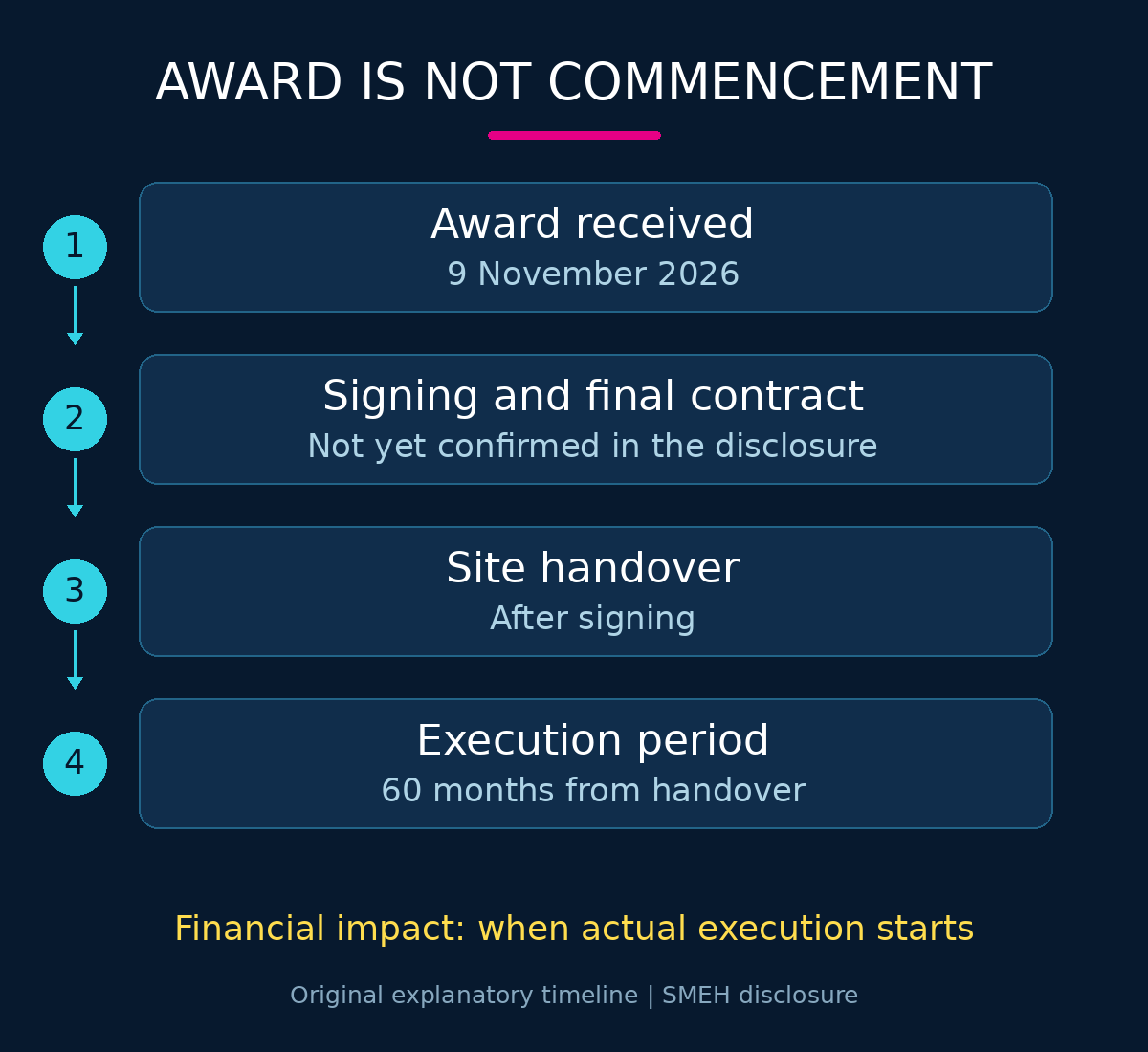
Original explanatory diagram, not a photograph or a forecast. Confirmed and future stages are distinguished; the sequence follows the issuer statement. The cover is a conceptual illustration, not an image of the actual center.
Independent analysis: make readiness visible before promoting performance
The remaining sections propose a practical framework for comparable suppliers. They do not describe SMEH’s internal procedures, contract targets or achieved results. A procurement announcement is useful evidence of a commercial development. An operating claim requires a different evidence file: agreed responsibilities, a defined service area, a reporting period and a record that can be checked.
Before communications teams publish a service promise, operations should identify who owns each handover decision. A readiness register might include the approved scope, site access arrangements, staffing responsibilities, maintenance planning and escalation contacts. The purpose is to expose unanswered questions early. It is not a substitute for technical inspection, contractual review or the decisions of the responsible healthcare organization.
For example, a supplier could describe its proposed approach to reporting an equipment issue without promising that every problem will be resolved immediately. Precise descriptions help buyers evaluate capability. Superlatives such as “uninterrupted care” would require much broader evidence and could imply control over clinical services outside the supplier’s remit.
Build a service dashboard with definitions, not attractive percentages
A useful dashboard begins with a small number of questions. Were scheduled tasks completed within the agreed window? Which faults remained open? How often did the same problem return? Did the responsible team acknowledge an escalation? These are suggested measurement questions, not disclosed performance indicators for this award.
Each measure needs an owner, a denominator and rules for exceptions. “Tasks completed” is ambiguous if canceled tasks disappear from the record. “Fast response” is ambiguous if the clock starts only after someone assigns the ticket. Keep receipt, acknowledgement, attendance and closure as separate timestamps, and distinguish an administrative closure from verified resolution.
An illustrative review might reveal that most tickets receive quick acknowledgement but repeated faults take much longer to resolve. That pattern would support examining diagnosis, spare-parts availability and handoffs before advertising faster response. The example is hypothetical; no such result is reported here. Reporting the count of unresolved cases alongside a percentage also prevents a small sample from appearing more decisive than it is.
Translate operating evidence into responsible marketing
For business buyers, a clear service page can explain scope, governance and how enquiries are routed. Organize it around the buyer’s questions rather than a long list of generic capabilities. Separate facility support from medical services, and make the boundary clear in both Arabic and English materials. Additional language versions should preserve the same limits rather than introducing stronger promises.
A marketing evidence register can connect every public claim to its source, approval owner and review date. A team could then publish a substantiated case example when permission and operating evidence exist. A contract award alone does not provide permission to use a customer’s logo, share confidential service details or make claims about patient outcomes. Keep those approvals separate from editorial enthusiasm about winning work.
For more context on distinguishing commercial growth from delivery economics, see the earlier SMEH contract-quality analysis. It concerns a different development and should not be combined with this award as if both were new revenue.
Keep commercial measurement connected to delivery
Suggested marketing measures include qualified enquiries, completed responses, agreed next steps and progression to a suitable procurement discussion. Define “qualified” before comparing campaigns. A large increase in form submissions has limited commercial meaning if the requests are outside the supplier’s scope or nobody follows them up.
Review those measures with operations and finance. Track delivery evidence, invoicing and collection separately rather than using one headline contract amount as a proxy for all three. Do not divide a total value into equal annual revenue unless the accounting and delivery basis supports that treatment. This article offers no margin estimate, revenue schedule or investment recommendation.
The strategic priority is a repeatable connection between what a supplier promises, what its teams can document and what a buyer needs to decide. That makes a modest, specific claim more useful than a broad performance claim that cannot yet be checked.
Sources and verification limits
The dated news was checked against Argaam and the complete issuer statement. The issuer links to Saudi Exchange announcement 99183, but direct retrieval returned HTTP 403; independent access to that page is not claimed. No patient records, internal service data or undisclosed contract terms were available. The operational and marketing framework above is independent analysis, not a statement that the company has adopted it.
Comments
No published comments yet.