A familiar tagline can carry a new brand idea, but keeping recognizable words does not settle whether people still identify the advertiser or understand the intended change. Maybelline’s new platform offers a useful occasion to examine those questions separately. For a marketing team reviewing its own positioning, the practical answer is to protect the cues that identify the brand, test what the new message means to different audiences, and connect that meaning to something a customer can actually explore or choose.
This article first summarizes the verified announcement. Everything after that digest is original practical analysis: a proposed way to evaluate a verbal brand asset, not a report of Maybelline’s internal research or evidence that the campaign has succeeded. The distinction matters because an attractive creative rationale, a favorable audience response and a commercial contribution require different evidence. A team can have a convincing explanation of its idea while still needing to learn whether the market receives it as intended.
What Maybelline announced
On November 10, 2026, Maybelline New York announced a permanent evolution of the tagline introduced in 1991. The new English wording is “MAYBE. WE’RE BORN WITH IT. MAYBE. IT’S MAYBELLINE.” Its platform, The Beauty of Infinite Possibility, launches with global brand ambassador Miley Cyrus. The company describes the pronoun change as a move toward collective meaning and reframes “Maybe.” around possibility. Its official announcement says the global rollout takes place during November, without documenting individual market dates or official localized slogans.
The official campaign page connects the idea to product exploration, including mascara, lip color and concealer. The release supplies no recognition, brand-lift or sales results for the new platform. Its intended meaning should therefore be treated as the company’s intention, not demonstrated audience interpretation. No audience-reaction study was reviewed for this analysis, and no supporting consumer-survey percentages are repeated here.
Map what changes before judging the creative
Begin an internal review with an inventory of the existing execution. Record the words, spoken rhythm, brand name, visual presentation and context in which each appears. Then mark what the proposed version retains, changes or removes. This simple inventory makes the decision more concrete than asking whether a new line feels modern. A change to a pronoun, a pause or punctuation may look small on a slide but alter how the full sentence is heard. Treat that possible effect as a question to investigate, not an established outcome.
Give every changed element a reason and an associated question. If the creative brief seeks a broader sense of belonging, ask participants whom they think the message includes. If the rhythm changes, ask whether the advertiser is still recognized when the logo is absent. If the brand name remains, examine its prominence rather than merely checking that it appears. Preserve copies of the actual test executions so the eventual findings refer to specific materials. Otherwise a meeting about one cut can quietly become approval of several untested versions.
Separate recognition, meaning and relevance
The first research question is identification: who does the audience think is speaking? Present a suitable execution without an explicit brand reveal and ask an open question before offering choices. Record wrong-brand answers, uncertainty and correct identification separately. Recognition among existing customers should also be reported separately from recognition among less familiar potential buyers. An aggregate result can hide a strong response from people who already know the brand and a much weaker connection among people the new positioning is intended to reach.
The second question is interpretation: what does the audience think the message is saying? Ask people to explain it in their own words before showing the creative brief. Code responses against a short, documented set of themes, while retaining unexpected meanings and disagreement. Avoid treating repetition of a prompted phrase as spontaneous comprehension. A participant who selects an attractive statement from a list may be agreeing with the researcher’s explanation rather than describing the idea they actually took from the advertisement.
The third question is relevance: what makes that interpretation useful in the product category? Ask what the idea invites someone to do, explore or consider, and why that would matter to them. A broad emotional statement may attract agreement without providing a reason to investigate a product. This is not a demand that every brand advertisement become an immediate-response promotion. It is a request for a credible connection between the promise, the audience’s situation and the next experience the brand is able to provide.
Design a comparison that can answer the question
For a proposed rollout test, compare old and new executions under reasonably comparable conditions. Randomly assign suitable participants where the research design allows it, and keep format, length, product context and exposure instructions aligned. If the new version has a different celebrity, soundtrack and production style, a difference in response cannot be attributed confidently to the wording alone. Either isolate the verbal change or state clearly that the experiment compares complete creative packages. Both questions can be useful, but they support different decisions.
Recruit for the actual decision rather than a convenient audience alone. Define which customer groups, familiarity levels and markets matter, then plan how to inspect their results. Keep the initial questionnaire short enough that the recognition and interpretation measures occur before extensive prompting. Determine the sample and analysis with appropriate research support instead of borrowing an arbitrary universal minimum. Record uncertainty and small subgroup limits. A handful of eloquent interviews can reveal useful hypotheses, but should not be presented as a reliable population percentage.
Consider the imbalance between a long-established execution and a newly introduced one. Equal exposure in a test does not create equal historical familiarity. A team can examine an immediate comparison and then a later learning check, while keeping those findings distinct. Define what each stage is meant to reveal before results arrive. Do not keep adding exposure until the preferred creative wins, and do not assume that a first-exposure disadvantage will automatically disappear. Both persistence and improvement need evidence from the design actually used.
Read the trade-offs instead of choosing one winning number
Consider a purely hypothetical pilot, unrelated to Maybelline’s results. Suppose correct brand identification is 70% for the existing execution and 64% for the new one, while unaided articulation of a desired meaning is 35% and 48%, respectively. Those differences are a six-percentage-point decrease and a thirteen-percentage-point increase. The example deliberately supplies no sample size or uncertainty estimate, so it cannot establish a meaningful statistical difference or justify a rollout. It illustrates why a single overall score would obscure the decision.
The team would need to ask whether the desired interpretation occurs among the people who recognize the advertiser, whether mistaken identification favors a competitor, and whether a practical revision could address the weakness. Examine responses within the same research design rather than merging unrelated survey percentages. Keep recognition, interpretation and relevant consideration visible as separate measures. Weighting them into a composite can be useful for an internal decision, but the chosen weights express the organization’s priorities; they are not independent proof that the creative is better.
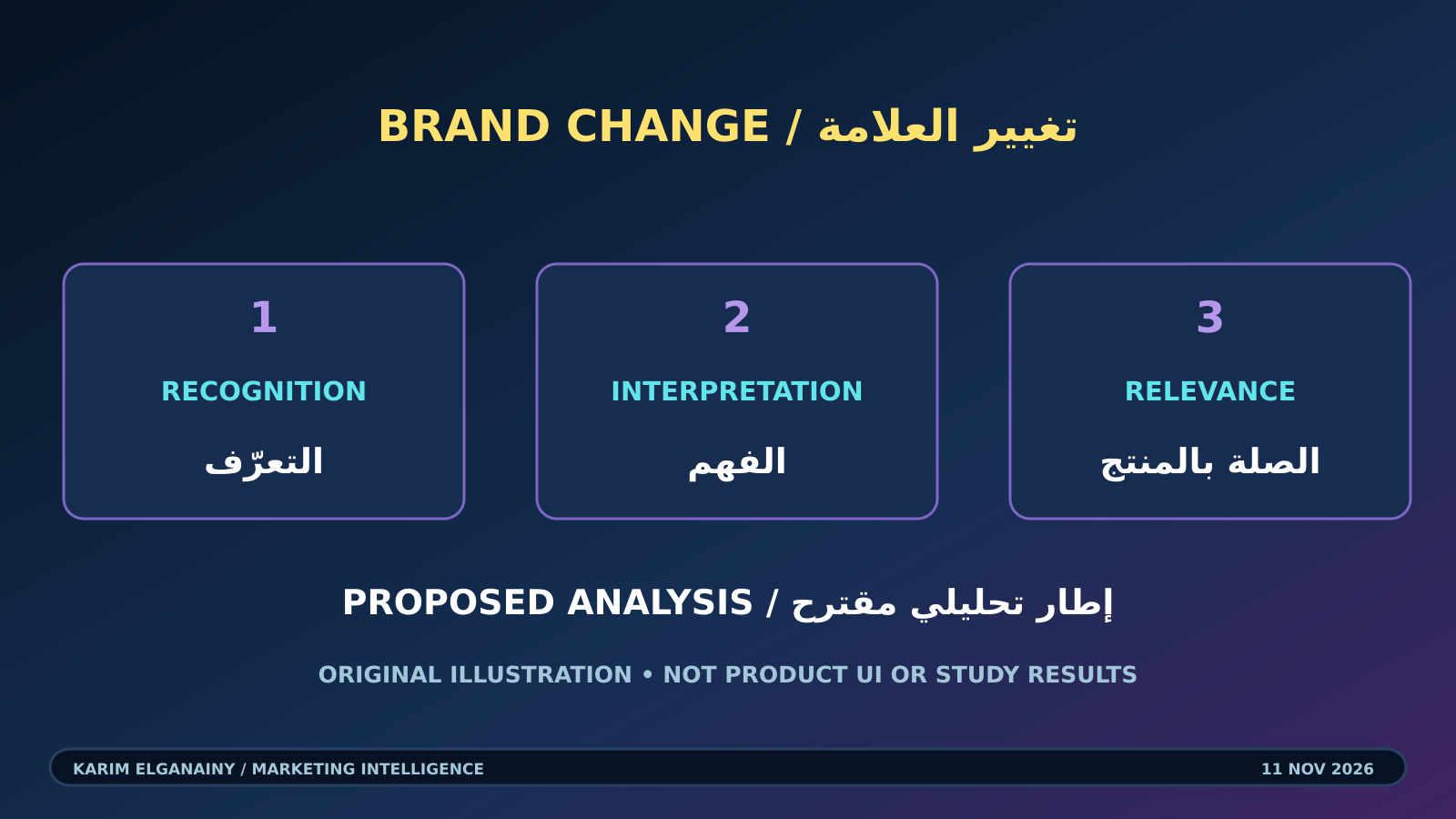
Original illustration by Karim Elganainy. Original conceptual illustration: three panels with Arabic and English labels for Recognition, Interpretation and Relevance connect a verbal brand asset to a rollout decision. They show editorial evaluation categories, not campaign results, a source interface or Maybelline’s research process. News context: Maybelline’s primary announcement. This artwork does not reproduce source imagery or depict reported results.
Make the brand promise testable in the next experience
After someone responds to the message, inspect what happens next. For a hypothetical cosmetics brand, a promise about creative possibility might lead to useful product comparisons, application examples or guidance that helps people choose an approach. The exact experience should follow what the brand can credibly deliver. Do not turn an emotional promise into an unsupported product-performance claim. A creative review and a claims review answer different questions, and both can be necessary before an execution is approved for use.
Trace one complete route from advertisement to landing page to a relevant next action. Check whether the same idea remains understandable, whether the advertised product is easy to find, and whether the information helps a person make a choice. Record broken or confusing steps as experience problems rather than blaming the tagline by default. Similarly, an increase in page visits is not enough to conclude that positioning improved. Visitors may arrive for many reasons, and the research should distinguish useful exploration from exposure that produces little understanding or interest.
Translate the intended meaning and the recognition cues
A multilingual brief should specify two things separately: the meaning the brand wants to communicate and the recognizable elements it hopes to preserve. Ask local language specialists to explain the options, including where a natural expression requires a different rhythm or grammatical structure. A literal translation may keep the words while changing the tone. A freer adaptation may communicate the idea clearly while weakening the connection to the existing asset. Neither trade-off can be resolved through a universal instruction to translate more closely or more creatively.
Test localized executions with people who use the language in the intended context. Ask for an unprompted explanation, the perceived speaker and any unintended implication. Back-translation can help reveal a divergence in wording, but it cannot by itself demonstrate emotional equivalence or audience acceptance. Keep the original English slogan identified as English when discussing it, and label any explanatory rendering as an editorial translation rather than official campaign copy. Document the approved local version and its reviewer so an untested draft does not become a market asset by accident.
Give the rollout a decision record
Create a concise record containing the creative objective, the retained assets, the exact tested versions, the audience definition, the evidence and the release decision. Name an owner for unresolved questions. If a local team needs a different expression, record why and which parts remain shared. This is particularly useful when website, paid media, retail materials and social content are prepared by different people. A common idea should not require identical execution everywhere, but departures should be deliberate enough that the team can explain and evaluate them.
Plan checkpoints around actual exposure and learning rather than an arbitrary desire for constant updates. Early checks can reveal execution errors, confusing translations or a broken landing-page route. Later research may examine recognition and meaning after sustained exposure. Commercial analysis requires its own timing and comparison, with changes in price, distribution, promotion and availability considered. Keep these evidence streams separate in the decision record. A creative milestone, a media-delivery milestone and a change in sales do not become the same observation merely because they appear on one slide.
Decide what to preserve, revise or pause
Before reviewing results, agree what would justify moving forward and what would trigger revision. An organization might require satisfactory identification among a priority audience, a clearer association with the intended meaning and no unresolved claims problem. The actual thresholds should reflect the decision and research design, not numbers copied from an unrelated case. Specify what happens when evidence is mixed. A modest change to delivery, branding prominence or the next-page explanation may be more appropriate than choosing between total replacement and complete rejection.
Make stopping a legitimate outcome. If the new language repeatedly conveys an unintended promise, loses the advertiser or creates a mismatch with the product experience, preserve the useful findings and revise the proposal. If the evidence supports expansion, retain the tested core while tracking material changes in later executions. Budget for this learning work as part of the rollout, rather than treating evaluation as an optional post-launch decoration. Its purpose is to reduce uncertainty about a consequential brand decision, not to produce a flattering presentation.
The useful lesson for brand teams
The practical lesson is to evaluate a tagline as part of a working brand experience. Familiar words, a changed emotional idea and a clear product route can coexist, but their contribution needs to be examined rather than assumed. Start with identification, move to interpretation and then ask why the message matters in a real choice. Make the questions sufficiently specific that an unfavorable result can change the work. Research that can only confirm the original brief does little to improve the decision.
For a team considering its own repositioning, the next step can be small: select one representative execution, document the cues it changes, and write three unprompted questions about recognition, meaning and relevance. Use the answers to refine a properly designed comparison. This provides a more disciplined starting point than copying another brand’s pronoun change or judging a platform through novelty alone. It also allows the team to learn from a news announcement without inventing results, claiming universal audience agreement or confusing a stated ambition with an established outcome.
Comments
No published comments yet.