Two campaigns can reach the same audience and offer the same service at the same price, yet produce different results because each assumes a different question is on the customer's mind. The first says “buy now” to someone who does not yet know what they need. The second helps that person define the problem, explains the criteria for choosing, and removes a practical obstacle to completing the decision. The difference is not simply that the second message is friendlier. It performs a function closer to the customer's actual situation, and that hypothesis can be tested rather than turned into a blanket promise of higher sales.
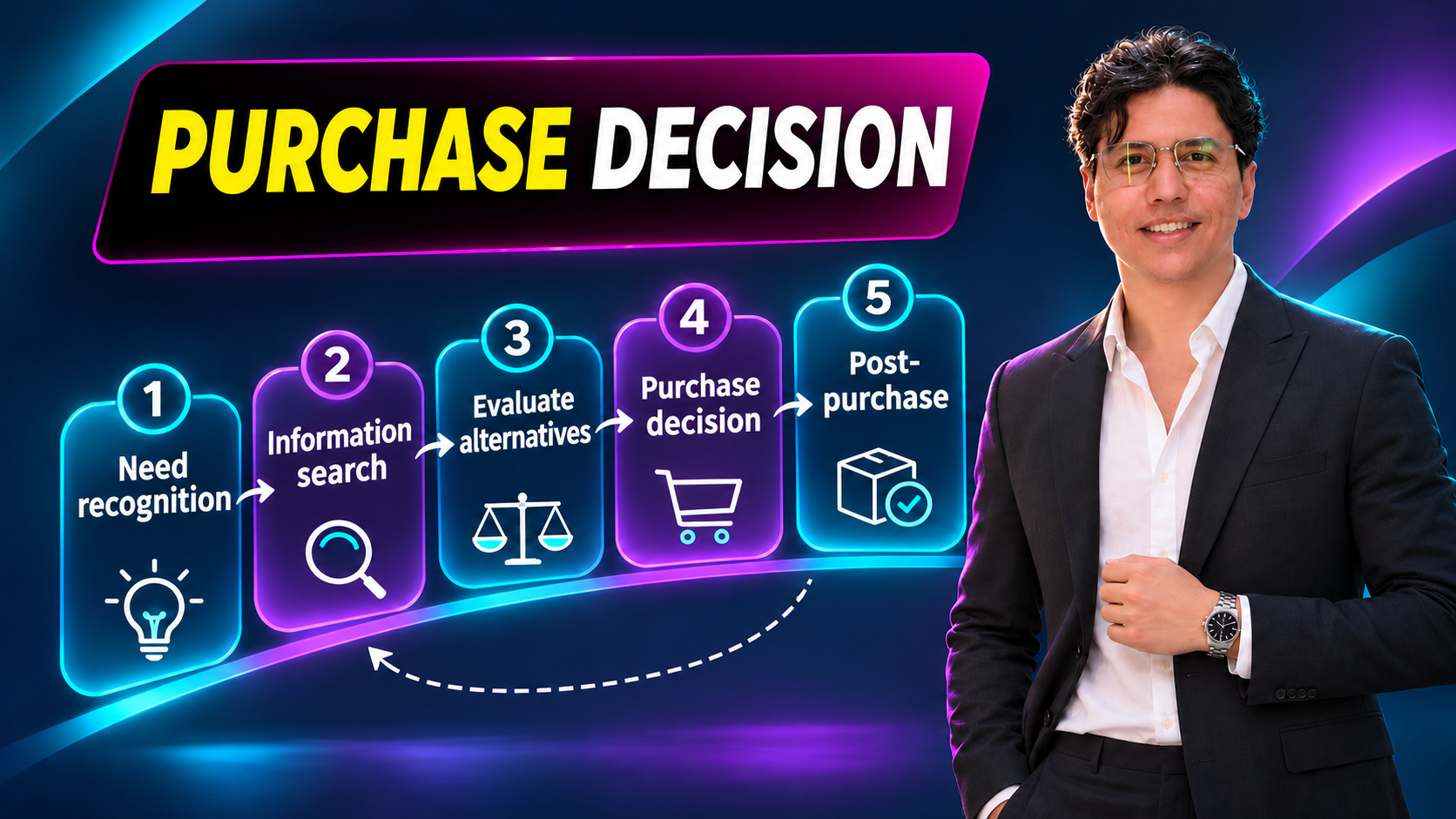
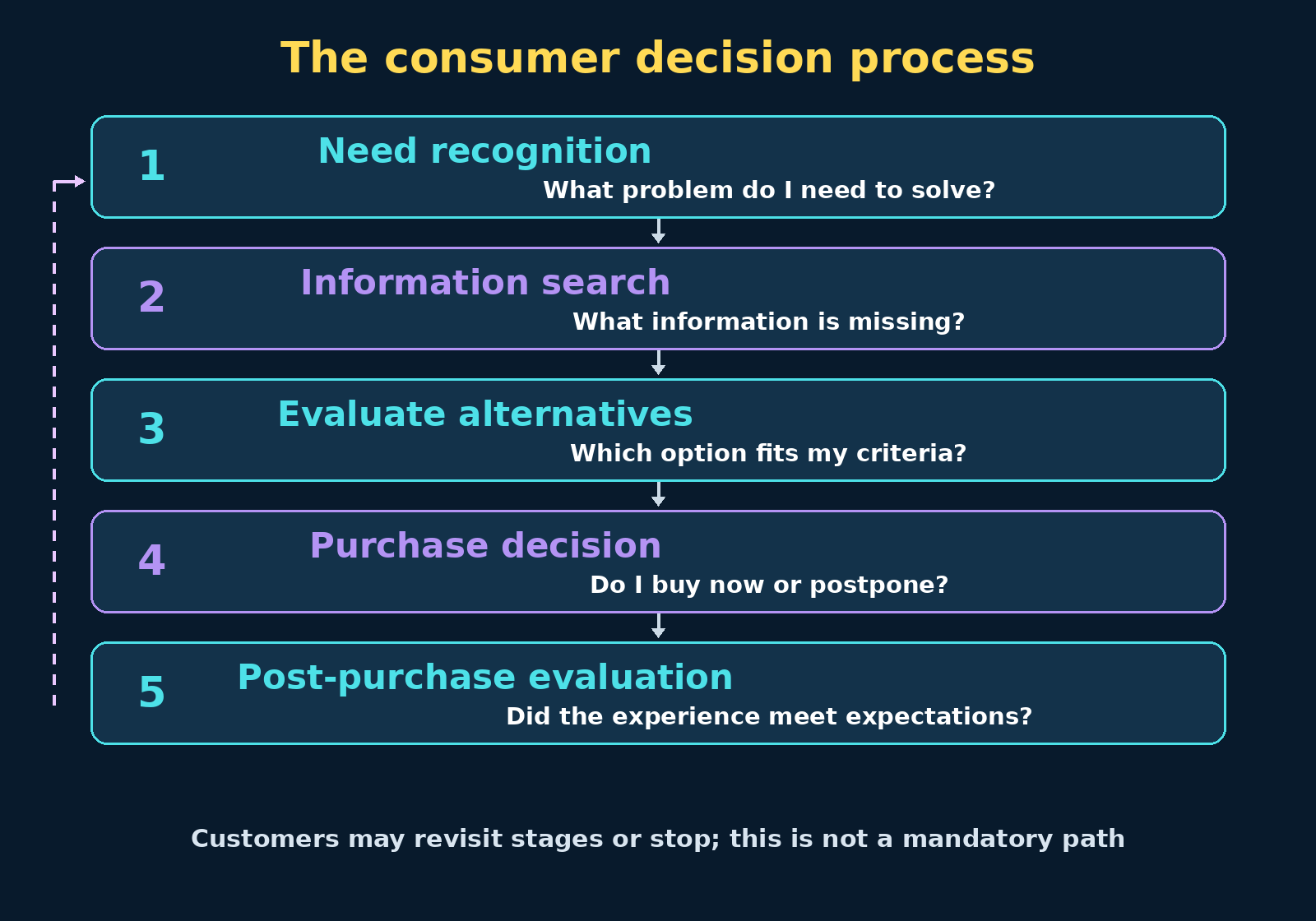
The consumer decision process organizes these questions into five stages: need or want recognition, information search, evaluation of alternatives, purchase decision, and post-purchase evaluation. This lesson aims to turn the stages into a tool for diagnosis, design, and measurement, rather than five boxes in a presentation. We will connect each stage to suitable content, required evidence, a possible obstacle, and a clear metric. We will then test the map against a retail example and a healthcare service example, separating hypothetical results from published facts.
The lesson's foundation and the model's limits
This explanation draws on the uploaded course materials “Introduction to Digital Marketing,” physical pages 162–176, and “Digital Customer Experience,” pages 39–53. Both present the five stages and apply them particularly to email and connections between channels. Some slides use the terms Bidding/Decision and Post-bid Evaluation. In this lesson's context, they mean purchase decision and post-purchase evaluation, not auction bidding. We therefore use those clearer terms here.
The slides attribute the model to John Dewey in 1910. We explain what the material says, but do not present that attribution as a settled history of the invention of the modern marketing model. Establishing how ideas about thinking and problem-solving developed into this particular marketing formulation would require a primary historical source that this lesson has not verified. For a teaching comparison, OpenStax presents the same five stages and notes that some routine purchases do not require a lengthy search. That link is an additional reference for defining the stages, not the source of the original examples and calculations below.
The sequence is a tool for understanding, not a law describing every person. A customer may already know which alternative they want before visiting your website, return from checkout to comparison after seeing an unexpected cost, or buy routinely without reading educational content. Nor can a marketer know someone's internal thinking from a single click. Viewing a comparison page is a possible behavioral clue, not proof that the visitor has defined their need, consented to tracking, or genuinely needs the product.
Before the stages: are we speaking to a new or an existing customer?
The original material begins with an important question: is this person new, or do they have previous experience with us? Someone who bought a device a week ago needs setup instructions and support, while a new visitor may need an explanation of differences between product categories. Sending both the same sales message can confuse the first without helping the second. But a purchase record does not give us complete knowledge of a person. They may have bought a gift, their circumstances may have changed, or they may not want any further promotional contact.
Write down the starting point clearly: what do we know directly, what are we inferring, and what do we not know? We know that an order was completed and when it was delivered, but interest in replacing the product is only an assumption. We can optionally ask about the customer's intended use instead of guessing from unnecessary data. Give each message an understandable reason, and make communication preferences easy to change. In this way, personalization serves the customer rather than surrounding them with more messages.
Stage one: need or want recognition
The central question is: “What do I want to change, and why now?” The need may be obvious, such as a device that has stopped working, or less clearly defined, such as a feeling that work is taking longer than it should. Do not start with a long list of specifications before explaining the problem they address. At the same time, do not invent a problem to sell a solution. A gap between the current and desired situation does not mean that your product is the only solution, or that buying is the best decision.
Content can help readers name their need: a guide built around questions, an explanation of different use cases, or a simple requirements tool. For a home-office equipment retailer, for example, the useful question is not “Do you want the latest monitor?” but “Do you need more space to display several documents, or higher resolution for visual work?” The answer might point to a monitor, or to rearranging existing equipment. Recommending against a purchase when it offers no real benefit protects the credibility of the content.
The sign of success is not advertising impressions alone. Observe whether interested people move to appropriate content, whether they can define their requirement without lengthy assistance, and which questions the service team repeatedly hears. Do not label every view as awareness of a need. Form a specific hypothesis, such as whether explaining use cases will reduce unsuitable enquiries. Then compare the nature of those enquiries before and after the change, while accounting for differences in traffic sources and periods.
Stage two: information search
Once someone has identified their need, the next question is: “What options are available, and what should I know?” A useful answer now matters more than rushing to a purchase prompt. Provide the information that prevents misunderstanding: what the service does and does not do, whom it suits, the main conditions, and the time or effort expected of the customer. Educational content does not mean hiding the price. The missing price may itself be the biggest information gap.
The original material suggests welcome email journeys rather than applying immediate pressure to a new subscriber. This idea can be implemented as a short sequence based on explicitly expressed interests: one message explaining use, another answering common questions, and a third offering a comparison to those who request it. Not everyone needs every message. Give each message one understandable next step, and let people jump to detailed information or human assistance without completing a compulsory sequence.
It is important to distinguish how easy information is to find from whether that information is correct. An attractive page with an incomplete description does not succeed merely because reading time rises. Test understanding: ask an appropriate number of participants to identify what an offer includes and excludes, and record points of confusion without steering their answers. These are diagnostic interviews, not an automatic representation of the market. Their findings can inform a broader test, provided the sample size, recruitment method, and limitations are recorded.
Stage three: evaluation of alternatives
At this stage, the customer asks: “Which option best meets my criteria?” Comparison is not the same as declaring that you are the best at everything. Identify the dimensions the customer needs to weigh: total price, compatibility, delivery time, ease of use, support, and return or cancellation policy. If some dimensions are unknown, say so. Do not fill a table with green check marks whose meaning lacks clear evidence.
A fair comparison starts with a consistent basis. Do not compare a monthly subscription with an annual contract without explaining the difference, or the price of a device alone with a bundle that includes installation. Date the information when prices or specifications can change, and check competitors' information before publication. In comparisons between your own packages, explain who the lower-priced package suits. Do not turn it into a deliberately unattractive option designed only to push everyone toward the higher tier.
Reviews and customer testimonials can help, but must not become fabricated evidence. Do not select a quotation that changes the meaning of an experience, use a person's image without a clear right to do so, or present one customer's opinion as an outcome everyone should expect. It is better to identify the type of use and the example's limits, separating opinion from a verifiable specification. If you lack reliable evidence for a claim, remove it rather than dressing it up as “leading” or “best.”
Observe whether the comparison reduces compatibility questions, not merely whether it increases clicks on the most expensive package. A useful metric is the share of returns associated with an unsuitable choice after purchase. Honest comparison may reduce immediate sales of some products, but prevent unsuitable transactions. Its evaluation therefore needs a decision metric alongside a later quality metric, rather than the buy button alone.
Stage four: purchase decision
The focus now moves from “Which option?” to “Can I complete this confidently now?” Intent may be strong while execution is difficult: an unavailable appointment, fees revealed late, a long form, a phone field that rejects the local format, or unclear cancellation terms. Before increasing the retargeting budget, inspect the process itself on a phone and in the customer's language. Record the actual error instead of attributing every departure to weak interest.
Show the full commitment before confirmation: price and mandatory charges, fulfillment method, delivery or service timing, and important policies. Do not use a false countdown or artificial scarcity. If a decision requires human review, do not label a submitted request a “confirmed booking.” A clear distinction between request and confirmation prevents mistaken expectations that lead to later complaints. The best message at this point may be a brief explanation of what happens after the button is pressed.
The course material warns against continuing to advertise the same product to someone who has already bought it. In practice, this means clear suppression rules based on reliable events, while monitoring delays in data updates. It does not mean retargeting is appropriate for every field or every piece of information. Health details or sensitive inferences must not be used to construct advertising audiences. Follow applicable consent and rules, and separate necessary service messages from promotional campaigns that require a different basis for contact.
Stage five: post-purchase evaluation
The purchase is not the end of marketing responsibility. The question now is: “Did I receive what I expected, and do I know how to use it?” This stage begins with a clear confirmation, organized delivery or fulfillment, useful instructions, and accessible support. Requesting a review before the customer has had a chance to use the product may measure their impression of ordering speed rather than quality in use. Time the question to suit the service, and explain precisely what you are asking them to evaluate.
When a problem appears, do not turn the support message into an upsell. Address the cause of the difficulty first, and give the customer a clear picture of the available steps. Feedback can be grouped into problems with the promise, selection, fulfillment, use, or support. These are not final diagnoses, but a way to bring teams together around causes they can investigate. The solution may require changing the product description rather than training the complaints team to deliver a more polished apology.
Retention does not mean repeat purchases at any cost. Some products last a long time, and some services are not needed again. Success may therefore mean correct use or a fully resolved problem rather than another invoice. In healthcare in particular, the absence of an additional visit is not a failure when it is not medically needed. Tie reminders to a legitimate need and appropriate consent, and leave clinical decisions to the professional.
Turning the model into one working map
Instead of creating five independent campaigns, build one worksheet for each use-case segment. For every stage, record the customer's question, missing information, available evidence, proposed content, next step, implementation owner, and quality metric. Add a column for confidence in the assumption. This map forces the team to acknowledge that some problems are known from interviews, some are inferred from data, and others are only ideas that need testing.
For example, you may see a high exit rate from a packages page and assume that the price is too high. But visitors may not understand the differences between packages, the page may have attracted an unsuitable audience, or the measurement system may not record a move to another channel. Do not start discounting before examining these alternatives. Combine technical error records, summaries of questions you are permitted to use, and short interviews. Then propose one change that tests the most plausible explanation.
Earlier models help distribute the roles: RACE organizes the management of marketing activity, while AAARRR helps diagnose growth and metrics. Decision stages focus on the kind of question a person is trying to resolve. There is no mandatory one-to-one mapping between boxes in different models. A single comparison page can serve more than one stage and activity.
A complete hypothetical example: a home-office monitor retailer
Every number in this example is educational, not a real store's results. The retailer hypothesizes that customers confuse screen size with usable workspace, leading to unsuitable choices. For need recognition, it publishes a guide asking about software, intended use, and available desk space. During search, it explains connections, resolution, and computer requirements without assuming every reader needs the latest category. During comparison, it presents three options by use case and explains each option's limitations.
At the decision stage, it clearly adds the full price, delivery timing, and return policy, and checks that the form works on mobile. After delivery, it provides a setup guide and support for compatibility problems. These changes represent a proposed journey design, not a single causal test: introducing them all simultaneously would not reveal which element made the difference. The team therefore begins by testing comparison clarity while keeping other elements as stable as possible.
Suppose there are two randomized groups, each containing 1,000 eligible visitors over equal observation windows. The original version records 120 checkout starts and 72 completed orders. The new comparison version records 150 starts and 90 completed orders. Checkout-start rates are therefore 12% and 15%, while orders per visitor are 7.2% and 9%. Checkout completion among those who started is 60% in both groups. The observed change is therefore before checkout, not an improvement in the checkout page's performance itself.
But these numbers alone do not justify declaring the new version a winner. Check whether randomization was implemented correctly, whether visitor identities appeared in both groups, and whether delayed orders were included under a consistent window. Then allow an appropriate period to review cancellations and returns using a definition agreed in advance. If unsuitable orders increase, the comparison may have persuaded people more than it helped them. The figures shown also do not, by themselves, establish statistical significance or support generalizing the result.
A hypothetical healthcare example: easier access, not pressure to seek treatment
Suppose a center offers clinical nutrition consultations. This is a service-design example, not medical advice or a real offer. At need recognition, it publishes general information about the clinic's role without diagnosing the reader, frightening them, or promising a result. During information search, it explains the team's qualifications, the nature of the consultation, and how a visitor should prepare, with clinical content approved by a qualified professional. Do not make a marketing model a substitute for triage or for directing urgent cases through the approved clinical pathway.
When evaluating alternatives, a person needs practical information: branch location, accessibility, appointments, communication language, confirmed cost and inclusions, and how insurance coverage is handled if available. Do not reduce the decision to the lowest price, use patient stories without appropriate permission, or imply that one service suits everyone. Booking staff can explain procedures, but treatment suitability and the interpretation of symptoms remain the medical team's responsibility.
At the decision stage, an initial form need only collect what is necessary to arrange contact, clearly stating that a request becomes a confirmed appointment only after confirmation. Do not collect health details in general advertising tools simply because they make segmentation easier. After the visit, separate service follow-up from clinical follow-up, and ask for feedback on organization as an optional choice, without pressuring the person to publish their health experience. Any medical follow-up or additional examination must reflect clinical need, not a sales target set by marketing.
For training purposes only, suppose 200 eligible enquiries produce 100 confirmed appointments and 80 completed visits. Confirmations per enquiry are 50%, attendance per confirmed appointment is 80%, and visits per enquiry are 40%. These answer three different questions. Do not label all three “conversion rate” without naming the denominator. If the team improves appointment information and the confirmation process, attendance might change. But that does not justify concluding that the content improved a clinical outcome, because the data do not measure one.
Measurement without pretending to read the customer's mind
Start by defining the event, unit of counting, and observation window. Are you measuring people, sessions, or orders? Are canceled orders excluded from completed orders? Is attendance measured against appointments due that week or appointments booked that week? Differences in these details can manufacture an apparent improvement. Keep a written definition for every metric, and do not compare a group whose opportunity to purchase has matured with a new group that has not had the same time.
Separate behavioral indicators from their interpretation. Reading FAQs may indicate interest, or it may indicate ambiguity on the page. More calls may signal a successful advertisement, or missing basic information. Use data to generate a better question, then test it. Avoid collecting extra information merely because the tool allows it. Collect what is needed to deliver the service and measure a specific improvement, with access and retention restricted according to applicable requirements.
Place guardrail metrics alongside the primary goal: complaints, cancellations, unsuitable requests, service-team time, and communication opt-outs. If orders rise but the effort required to correct expectations doubles, the conversion dashboard has hidden a cost. You do not have to compress everything into a single number. What matters is that the decision-maker sees the benefit and the cost together, and knows which effects have not yet been measured.
Three mistakes in operating the journey
The first mistake is building a fixed schedule and calling it a customer journey. Sending five messages over five days does not establish that the recipient has moved through five stages. They may buy on day one, return a month later, or not be suitable for the service at all. Tie continuation to an understandable condition, allow messages to stop when the purpose is fulfilled or consent is withdrawn, and give the customer a direct route to the information they want. Time is an organizing element, not independent evidence of intent.
The second mistake is treating every channel as a copy of the same message. Someone arriving from a very specific search may need an immediate answer, while someone else sees a general post for the first time. A consistent promise does not require repeating the text word for word. Design the entry point for its context, then keep price, terms, and key details consistent wherever the customer encounters them. They should not discover after calling that the advertisement referred to another branch or an expired period.
The third mistake is improving one stage at the expense of what follows. A heavily exaggerated advertisement may increase visits to a service page, and an ambiguous offer may increase form completion, but the team pays the price in rejected requests and corrected expectations. Review a sample of completed and incomplete journeys while respecting privacy, and ask where the customer's understanding of the offer changed. If the problem lies in the first promise, improving the final confirmation text is not enough. Quality passes through the stages just as financial effects do.
To prevent these mistakes, give each journey an owner responsible for consistency across the whole experience, not just a single channel's metric. That owner can bring marketing, operations, and support together to review real cases stripped of personal details, identify inconsistent information, and assign corrections to the relevant people. The meeting does not need dozens of charts. It needs a specific question, limited but reliable evidence, and a decision with a deadline and a metric. Repeated use turns the map from a training document into a working method that can be reviewed.
A practical two-week team exercise
During the first two days, choose one service and a defined use-case segment. Collect common questions from permitted sources and remove unnecessary personal details. Classify the questions under the five stages, allowing a question to appear more than once when it serves multiple stages. Discuss the classification with the service team. What looks like a price objection may be a question about scope, and what looks like postponement may be a lack of suitable appointment availability.
Over the following days, select one gap with a clear effect that can be addressed. Write a hypothesis in this form: “If we clarify this information for this audience, we expect this behavior to change without harming this guardrail metric.” Identify the implementation owner, measurement method, time needed for the outcome to mature, and the decision you will make in the event of success, failure, or ambiguous data. Do not invent a success threshold after seeing the results.
Implement the limited change, and check data quality early without rushing to stop the test as soon as an attractive number appears. At the end of the period, write down what you learned and what you did not. A lack of improvement does not mean the model is wrong. The obstacle hypothesis may have been incorrect, implementation may have been weak, or the sample may have been insufficient. Document the next decision instead of repeating the same experiment under a different title.
Lesson takeaway
The best use of decision stages is to move from “How do we push the customer to buy?” to “What do they need to make a suitable, clear decision?” The answer may be better content, a more honest comparison, visible total pricing, a simpler form, or support after fulfillment. Not every difficulty is an advertising problem, not every departure is a loss, and not every purchase proves a successful experience. Make the stages a shared language across marketing, service, and operations, and connect every improvement to evidence, a test, and stated limits.
Lesson sources
- Uploaded course material: “Introduction to Digital Marketing,” physical pages 162–176, and “Digital Customer Experience,” pages 39–53. These were used to explain the model's structure and cross-channel application; their slides and images were not copied.
- OpenStax: The Consumer Purchasing Decision Process: an additional reference for the stage names and the limits of linear progression, not the source of the numerical examples.
- All retail and healthcare-center examples, calculations, and the test plan in this lesson are original hypothetical teaching examples, not claims about results achieved by Karim or any organization.
Comments
No published comments yet.