A new visibility feature can improve a conversation about advertising waste without solving every problem in a lead funnel. That is the useful starting point for Google Ads' latest invalid-traffic announcement. A finance team wants to understand charges and credits; a marketing team wants qualified demand; an operations team wants inquiries it can serve. Those questions overlap, but they are not interchangeable. Treating them as one problem can lead to incorrect calculations and unhelpful arguments about whether a campaign is working.
The practical opportunity is to reconcile the platform's traffic-quality information with billing and business outcomes. This article proposes an independent review process. It does not report a hands-on test of the new card, promise that a particular account already has it, or claim that a reported protection metric proves additional revenue. The examples below are deliberately hypothetical and should not be read as results from Karim's clients.
What Google announced
On 12 November 2026, Google announced the rollout of the Invalid Traffic Overview Card. Google says advertisers can see amounts saved and automatic credits relating to invalid activity. It reports an average 30% reduction in advertiser exposure to invalid leads so far in 2026 through system upgrades. That is Google's own aggregate claim, not a forecast for an individual account or an independently verified result in this article. The short announcement does not provide enough methodology to translate that percentage into expected savings for a new advertiser.
Separate three operational questions
Start with three questions on separate lines: was advertising activity classified as invalid, was a charge or credit applied correctly, and did a genuine inquiry meet the business's qualification standard? A real person can submit an inquiry that the business cannot serve. A duplicate submission can have several causes. A failed callback can reflect an operational problem. None of those observations alone establishes the platform's classification of invalid activity.
Agree on terminology before reviewing a performance report. Use precise labels such as unreachable, duplicate, outside service area, ineligible service request and invalid traffic reported by the platform. These are proposed operating labels, not new Google product fields. Keep uncertainty visible and avoid labeling people fraudulent simply because they did not buy or could not be reached within a short window.
Verify availability without inventing interface details
When the feature appears in an authorized account, record what it actually shows and the period it covers. Do not build an internal procedure around a guessed menu location or assume that every campaign has identical coverage. The announcement establishes a rollout, not a live inspection of your account. Capture the displayed definitions and any relevant explanations so future comparisons use the same meaning rather than a remembered screenshot.
If the card is absent, continue ordinary billing and lead-quality review while checking the official product guidance available to the account. Absence is not proof that protections are absent, and the presence of a card is not proof that every issue has been resolved. Keep feature availability, reported protection and independently reconciled outcomes as separate statuses in the review notes.
Preserve the distinction between prevention and later credit
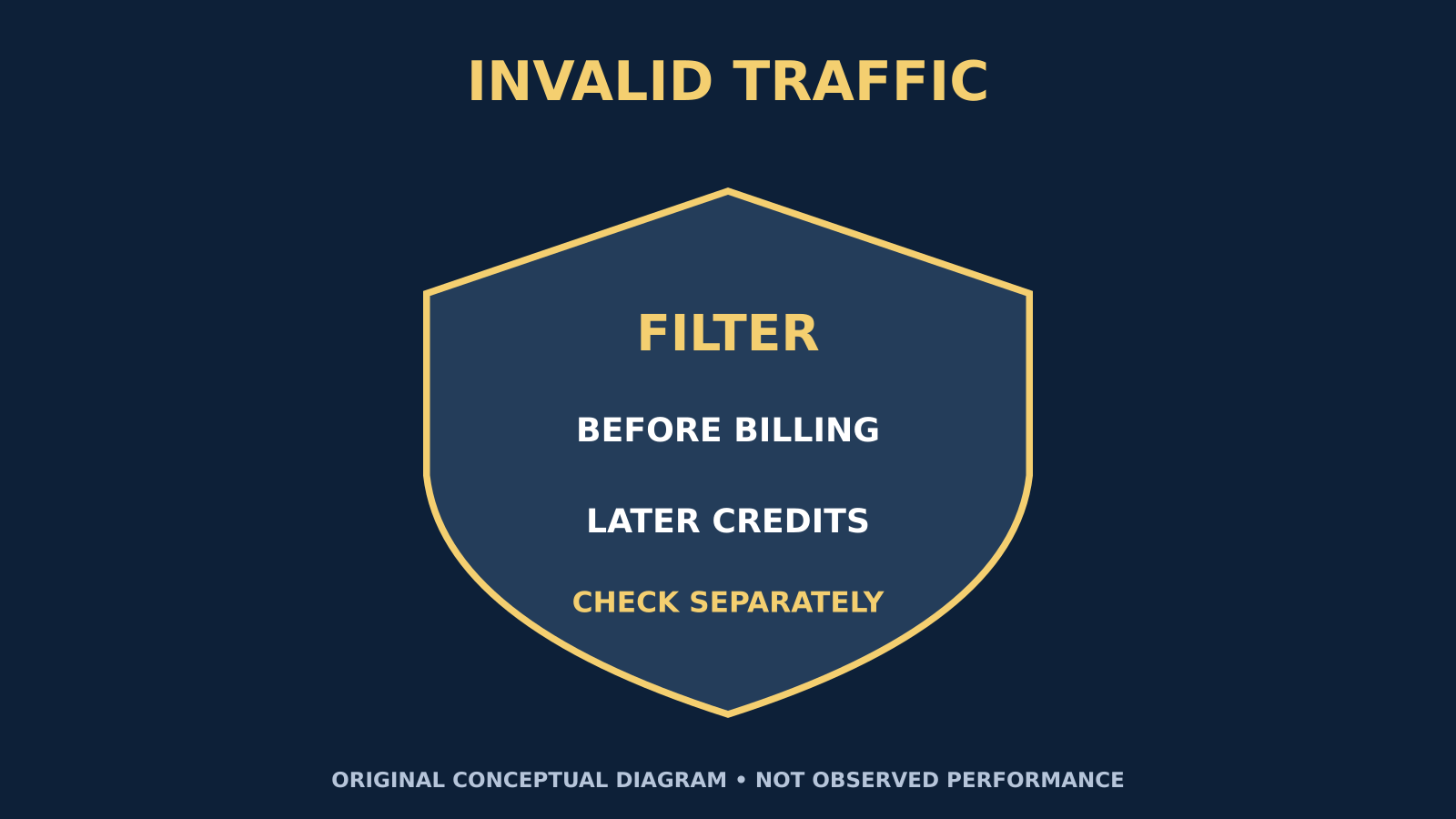
Original explanatory illustration, not a Google Ads screenshot or a measured performance chart. The English labels distinguish “Filter Before Billing” from “Later Credits Check Separately”; each requires its own accounting interpretation. Source context: Google's announcement.
A prevented charge and a later billing adjustment are different accounting events. Treat them separately even if a dashboard presents both as evidence of protection. A value that was never charged should not automatically be subtracted from an invoice again. A credit should be matched to the relevant billing record and period. The purpose is not to dispute every number, but to prevent a well-intended savings report from understating actual spend or counting the same benefit twice.
Build a reconciliation worksheet with clear ownership
Create a worksheet that records the reporting period, currency, account, source of each amount and whether the figure is a charge, an adjustment or a reported avoided amount. Keep explanatory platform metrics separate from financial postings. Give finance responsibility for the payable interpretation and marketing responsibility for campaign context. A shared worksheet is useful only if its columns have definitions that both teams accept.
Retain the original exports and note when they were obtained. If a figure changes later, record the difference rather than silently replacing the previous value. Use access controls appropriate to the information involved. The review should not require sharing account credentials or customer details in a spreadsheet that a wider group can access. Preserve an audit trail proportionate to the decision, not an uncontrolled copy of every underlying record.
A hypothetical calculation that avoids double counting
Suppose an illustrative statement shows SAR 10,000 in advertising charges before a separately recorded SAR 500 invalid-activity credit. Ignoring taxes and all other adjustments solely for this example, the resulting amount is SAR 9,500. If a separate dashboard reports SAR 1,000 of activity prevented from being billed, do not subtract that SAR 1,000 again and report SAR 8,500 as payable. The avoided amount was not part of the assumed SAR 10,000 charge.
These numbers are invented to explain the logic, not the exact layout or terminology of Google's card. Actual invoices may present adjustments differently. Reconcile the real statement before calculating net spend, and do not infer a refund date or cash payment from a dashboard value. A credit, an avoided charge and money returned to a bank account must not be described as the same event without evidence.
Do not turn the 30% statement into a budget promise
The reported average reduction concerns Google's stated exposure measure, not a guaranteed reduction in your cost per qualified lead. It cannot be multiplied by a campaign budget to forecast a saving. It also does not establish that the same fraction of previous leads was invalid. Keep the date, scope and source attached whenever the statistic appears, and do not combine it with an unrelated historical percentage to create a trend.
For context, Google's earlier invalid-traffic article was published on 12 August 2025 and discussed a different protection result. We are not treating that older announcement as new or comparing its percentage with the 2026 claim. Different populations, periods or definitions can make two impressive-looking numbers unsuitable for direct comparison even when they come from the same company.
Investigate lead quality downstream
After reconciling spend, review a permitted sample of inquiries using a predefined qualification rubric. The goal is to understand where the business journey breaks, not to force every disappointing outcome into the invalid-traffic category. Record whether the inquiry matched the service, whether contact was attempted, whether the person responded and whether the requested appointment or product was actually available. Keep the assessment consistent across campaign groups.
In healthcare, operational qualification must not turn into informal medical triage by a marketing analyst. Use approved booking criteria and appropriate staff for clinical questions. Report aggregate patterns where possible and avoid sending patient histories to advertising tools merely to improve a dashboard. A marketing team can learn that a booking route is confusing without exposing private clinical details or making a judgment about a person's treatment needs.
Check the handoff before changing acquisition
A lead can deteriorate between submission and follow-up. Review whether the form explains the next step, whether contact details are validated appropriately and whether the receiving team sees the inquiry promptly. These are suggested checks, not claims about the cause of any particular campaign's performance. A traffic-protection improvement will not automatically correct an unavailable service, an unclear price or a missed callback.
Choose a small sample across both good and poor outcomes, rather than examining only complaints. Document sampling rules so the review is not shaped entirely by the most memorable cases. If the organization changes its definition of a qualified lead, mark the change date. Otherwise, a better-looking qualification rate may reflect a new definition rather than a better campaign or better traffic.
Use comparisons that preserve the denominator
Report spend, recorded inquiries, qualified inquiries and completed business outcomes separately. State whether a cost metric uses gross charges or reconciled net spend. Keep currencies, time windows and event definitions aligned. If late credits arrive, explain whether a historical cost metric is restated or whether the adjustment is shown in the current period. Either policy needs consistency and a visible note so readers do not mistake accounting timing for performance.
A falling cost per inquiry can coexist with a rising cost per qualified inquiry. That is not automatically a contradiction; the denominators describe different stages. Equally, an improvement in a platform protection metric does not prove better downstream conversion. Compare the stages without assuming they must move together, and investigate material changes before attaching a causal explanation or reallocating substantial budget.
Set an escalation path for discrepancies
Define what evidence a discrepancy report should contain: the account reference, dates, relevant billing items, the observed mismatch and the question that needs answering. Share only information appropriate to the authorized support channel. A concise, reproducible issue is more useful than a broad allegation that all low-quality leads are fraudulent. Keep confirmed facts separate from suspicions and avoid including unnecessary personal information in a support attachment.
Assign an owner and a follow-up date. Record the response, any adjustment and whether the issue is resolved. Do not repeatedly submit the same uncertain request or assume that a response confirms a refund until the relevant record shows it. Escalation is part of the review process, not a substitute for basic reconciliation or permission to change account settings without authorization.
Run a limited review before scaling automation
For an initial review cycle, select one account and a stable set of campaigns. Freeze the definitions, collect the available card information, reconcile billing and inspect the downstream qualification sample. Measure how much of the discrepancy can be explained and how much remains unknown. This is an original workflow proposal, not a claim that Google requires these exact steps or guarantees their outcome.
Automate only the stable parts after checking access and data quality. A dashboard alert can flag an unusual change, but it should not automatically accuse a source of fraud, exclude an audience or move budget. Start with a human-reviewed threshold appropriate to the account's volume. If data coverage changes or a definition shifts, pause the comparison and repair the measurement before interpreting the trend.
Choose the next action by the diagnosed problem
If the issue is a billing mismatch, reconcile it with finance and the relevant support process. If it is a service mismatch, improve the offer explanation and routing. If it is a follow-up delay, repair the operational handoff. If evidence remains insufficient, run a bounded investigation instead of pretending to know the cause. The same symptom, such as a disappointing lead-to-booking rate, can justify different actions depending on the evidence.
Evaluate the chosen action against a business outcome and an operational safeguard. For example, a form change should not be called successful merely because it reduces submissions; assess whether it improves appropriate completed bookings without blocking people who need assistance. Keep the test reversible and define the review date before making the change. This preserves a learning process rather than a sequence of reactive account edits.
Karim's strategic takeaway
Use the new visibility to improve the quality of the conversation, not to replace judgment. Keep prevented charges separate from credits, reconcile both with actual billing, and diagnose genuine lead quality through the business journey. A platform's aggregate protection claim is context, not your forecast. The useful result is a review that tells the team what to fix next, what remains uncertain and which number can safely support the decision.
Comments
No published comments yet.