
A purchase can be visible while the reason for choosing remains hidden. That distinction matters when a marketing report turns a recorded transaction into an explanation of which channel deserved the budget. An AI answer may precede a later website visit, yet the team may observe only the last visit. The sensible response is neither to award AI every unexplained sale nor to ignore it. It is to separate what happened, what is claimed and what can actually be supported.
This article uses a new industry announcement as the starting point for an original operating proposal. The procedures, examples and decision rules below are editorial analysis, not an implementation endorsed by IAB. They are intended to help a marketing team ask better questions without pretending that a new vocabulary has solved missing evidence or established the incremental value of an individual platform.
What was announced on 12 November
IAB announced its AI-Era Attribution Blueprint on 12 November 2026. It distinguishes Human-Owned, AI-Assisted and AI-Executed conversion pathways, and separates eligibility to make a claim from receiving attribution credit. The public resource page describes an evidence framework but requires an account to continue reading. We reviewed those public pages, not the complete gated document. This is therefore an independent analysis of the announcement, not a comprehensive review or certification of the blueprint.
Start with the commercial decision
Before adding a dashboard field, write the decision that better measurement should improve. A useful question might be whether to fund a small content experiment, maintain a search campaign or investigate an unexplained increase in direct visits. These are different decisions with different evidence needs. A team can justify an investigation with weaker evidence than it would need to justify moving a large share of its budget. Documenting that difference prevents an exploratory signal from quietly becoming a financial instruction.
Name the decision owner and review date. Describe the present allocation and the consequence of doing nothing. If the organization cannot state what it might change, more granular reporting may create attractive charts without reducing uncertainty. Keep the proposed action reversible while the measurement approach is young, and do not attach an automatic budget rule to a classification that has not survived a manual review.
Separate the outcome from the explanation
Use the transaction or operational system to establish the outcome first. Decide whether the relevant event is an order, a paid subscription, a qualified appointment or an attended visit. Record cancellations and reversals consistently. The attribution question comes afterward: what evidence connects an interaction to that outcome? Mixing these steps makes it easy to treat a platform's reported conversion as both proof that something happened and proof that the platform caused it.
For healthcare marketing, an inquiry is not an attended appointment, and attendance is not a clinical outcome. An operational report can examine aggregate acquisition and booking patterns without implying that a channel improves treatment. Keep patient details out of marketing evidence exports unless an authorized, appropriate process specifically requires them. Better attribution does not require collecting every available detail about a person.
Build an evidence ledger, not another score
Create a small review ledger with a transaction reference, event time, claimed role, claimant, evidence type, evidence timestamp and review status. Keep the underlying personal record in its authorized system; use a restricted reference when reviewers do not need its contents. Add an explicit unknown category. A blank is otherwise liable to be interpreted differently by every analyst, and the result becomes impossible to compare across periods.
The ledger should preserve contradictory evidence rather than overwrite it. A customer may remember an AI recommendation while an analytics event records a paid-search visit. Both observations can be retained without assigning each the full sale. The analyst's task is to explain what each observation supports and what it does not. Store the review rationale so that another person can reproduce the classification later.
Keep claims and awarded credit apart
A claim is an assertion to evaluate. A verified observation is evidence about a particular event. Credit is the result of an attribution rule. Incrementality is a different question: what would have happened without an activity? Keeping these concepts in separate columns is more useful than combining them into a single confidence percentage whose calculation no one can explain. A precise-looking score can hide a weak causal story.
For example, a referral may support the observation that someone reached the site from a particular source. It does not, by itself, establish that no purchase would have occurred otherwise. Likewise, a favorable answer in a test prompt says something about that answer, not about actual purchases. Label each statement at the level the evidence supports and resist converting a visibility measure into revenue simply because both appear on the same slide.
Use a review pathway that makes uncertainty visible
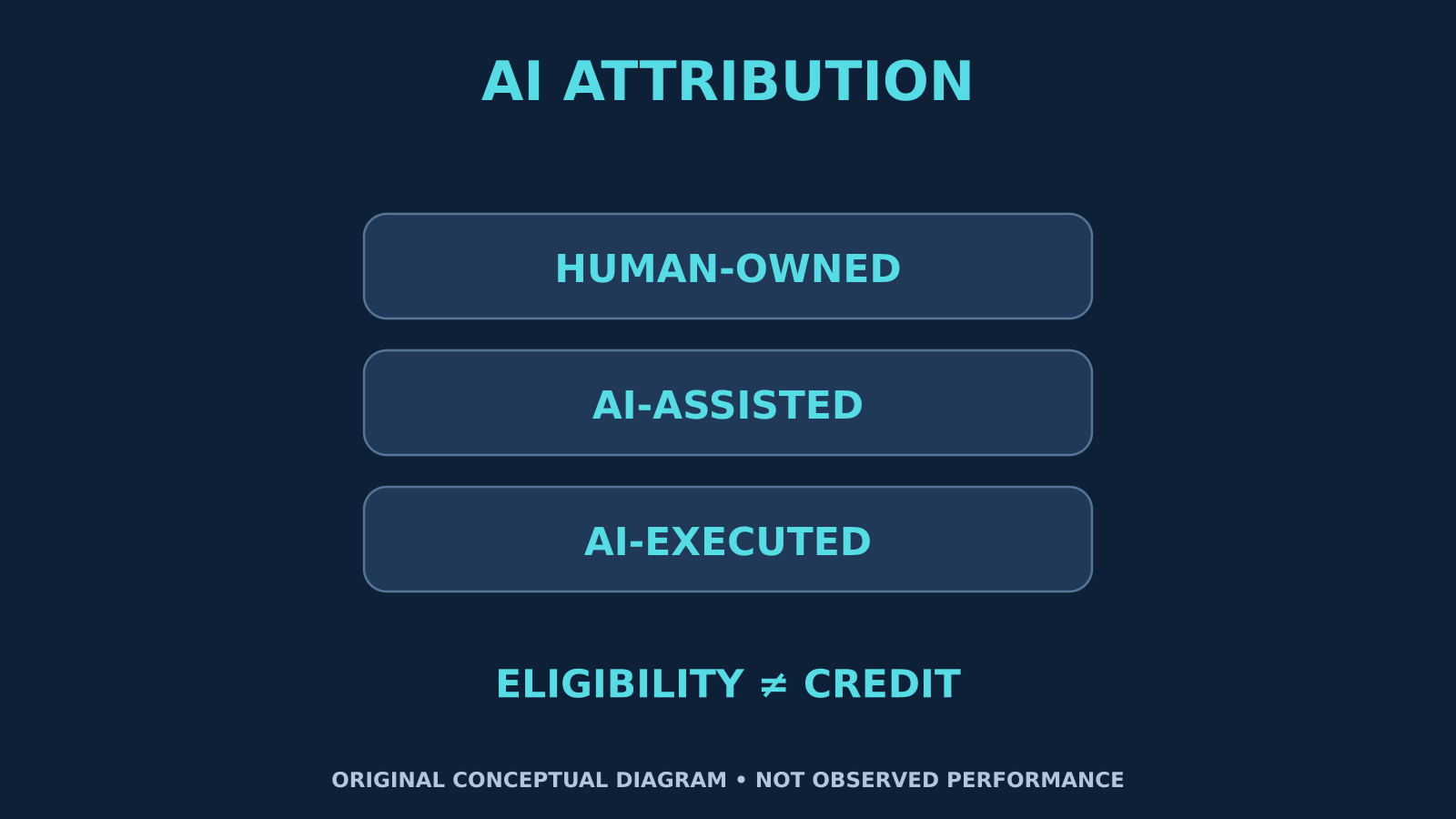
Original explanatory illustration, not an IAB graphic or software screenshot. The labels show Human-Owned, AI-Assisted and AI-Executed pathways. “Eligibility ≠ Credit” means eligibility to make a claim does not itself award attribution credit. Context: IAB's announcement.
A useful manual process starts with the observed outcome, records the claim and checks the available evidence before assigning a status. It should allow verified, unsupported, conflicting and not-yet-reviewed states. These labels describe the review result, not the customer's honesty or the platform's motives. A disagreement can reflect incomplete instrumentation, a difference in definitions or a genuine data-quality problem. Preserve enough information to distinguish those possibilities without asserting more than the investigation found.
Do not turn direct traffic into an AI estimate
An unexplained change in direct or branded activity can be a reason to investigate, but it is not a ready-made estimate of AI contribution. Write down alternative explanations before examining the desired answer. Campaign timing, offline exposure, returning customers and tracking changes are examples of hypotheses a team might test; they are not claims about what happened in a particular account. The point is to make competing interpretations visible.
If a customer survey is used, ask a neutral question with a genuine unknown or cannot-remember option. Preserve the question wording and collection window. Report the response rate and avoid generalizing respondents' answers to every buyer without examining who responded. A self-report can enrich the ledger, but a memorable channel is not automatically the only influence or the cause of the transaction.
Agree on deduplication before adding numbers
Ask every reporting partner what one conversion means, which time window is used and how repeat events are handled. Create a shared event definition before comparing totals. If two platforms both claim one sale, the organization still has one sale. Adding their claims together measures claims, not unique business outcomes. This simple distinction is often more valuable than choosing a more elaborate allocation formula.
Keep reconciliation exceptions visible. A late cancellation, a timezone mismatch or an imported event can create a difference without implying fraud or superior performance. Assign an owner to resolve each material exception and preserve the correction date. Do not silently revise historical charts in a way that makes last month's decision impossible to reconstruct. An honest series explains changes in its definitions as well as changes in its values.
Run a bounded pilot with explicit stop rules
Choose one business unit, one outcome and a short, predefined observation period. This is a suggested pilot design, not an IAB requirement. First test whether reviewers can apply the same definitions to the same records. If they disagree frequently, improve the instructions before expanding coverage. Measure review effort as well as coverage; a process that consumes excessive time may be unsuitable even if its taxonomy is elegant.
Set stop rules around data access, missing fields and unresolved contradictions. If the proposed workflow depends on information the organization is not authorized to use, stop that part rather than improvise a collection method. If too many records remain unknown, report the limitation and adjust the business decision. Unknown is a finding about the available evidence, not a reason to invent an allocation.
A hypothetical example without false certainty
Suppose a retailer records 100 completed orders in a pilot. Reviewers identify 20 orders with a documented AI-related claim, but only 12 have evidence meeting the team's prewritten review standard. The remaining eight stay unresolved. These invented numbers illustrate a reporting distinction: 20 claimed orders and 12 supported claims are not 20 or 12 incremental orders. The business still needs a separate design to estimate what would have happened without the activity.
The same report might show that six of the 12 supported claims also include a paid-search interaction. Do not add six to 12 and call the result 18 unique orders. Instead, show overlap and explain the allocation rule, if one is used. A reviewer should be able to move from the headline back to the underlying event definitions without discovering that denominators changed between charts.
Ask vendors for evidence, not persuasive labels
During a vendor discussion, request a worked example showing how an observed event becomes a claim and how a claim is accepted or rejected. Ask what remains invisible, what is estimated and whether the organization can export a review trail. Compare the treatment of missing information across providers. A vendor that exposes uncertainty may be more useful than one that provides a complete-looking answer without explaining its assumptions.
Also ask how the process changes when an event is reversed, when a source cannot be observed or when a customer declines optional data collection. These are operational tests, not accusations. Avoid agreeing to persistent collection or new access merely to complete a sales demonstration. The organization should understand the data requirement and its purpose before deciding whether the proposed integration belongs in its environment.
Connect measurement to a testable next action
Once the ledger is stable, choose a small action that can be evaluated independently of the vendor's own success measure. A content correction, an improved product explanation or a clearly scoped acquisition experiment may be easier to assess than an immediate channel-wide budget shift. Define the outcome, comparison and review date in advance. Where a causal experiment is feasible, distinguish its result from the descriptive attribution report.
A practical scorecard can track reconciliation completeness, share of unresolved claims, reviewer agreement and the selected business outcome. No universal target is implied here. Set thresholds appropriate to the decision's cost and reversibility. If evidence quality improves while sales remain unchanged, that is better measurement, not automatically marketing growth. Reporting the two separately protects the credibility of both the analytics team and the investment proposal.
Karim's strategic takeaway
The useful opportunity is to make attribution claims auditable before making them influential. Start with a narrow decision, preserve the original outcome count, expose overlap and unknowns, and insist on a reviewable path from claim to evidence. Do not wait for perfect observability to improve the process, but do not pretend a new framework has removed uncertainty. The strongest recommendation is the one whose limits are as clear as its proposed next step.
Comments
No published comments yet.