
An AI shopping assistant can answer quickly and still leave a customer unsure whether its recommendation serves the customer or the seller. That uncertainty is not solved by adding a warmer greeting or another conversion button. It calls for a more disciplined question: what can the person understand, check and control before taking the next step? A newly published consumer study provides a useful starting point for asking that question, without supplying a ready-made answer for every market.
This article separates a brief account of the research from an independent practical framework. The proposed tests, examples and operating rules below are editorial analysis, not interventions evaluated by the researchers. Their purpose is to help a marketing team investigate its own customer journey before treating a higher engagement number as evidence that trust has improved.
What the new research actually establishes
Li Ma and Shanshan Zheng's Scientific Reports article, published on 10 November 2026, examines AI-assisted shopping through an extended stimulus–organism–response framework. The indexed publisher abstract reports 979 valid online responses, associations involving transparency, usability, online word of mouth and trust propensity, and a mediating role for trust in purchase intention. Privacy concern weakens the reported transparency–trust relationship; information collection strengthens the online-word-of-mouth relationship with trust.
The indexed accepted-manuscript record identifies a Chinese Gen Z sample and data collection from 11 November to 11 December 2024. This is newly published research, not a November 2026 market survey. The publisher labels it an early, peer-reviewed accepted article subject to further edits. Direct page and PDF access redirected to publisher authentication; this reading uses indexed primary-source material, not a complete independent review of coefficients, questionnaire items or raw data.
Separate a useful idea from a causal promise
For an operating team, the useful idea is that a recommendation's presentation and a customer's interpretation deserve separate measurement. A person may find an interface easy to use but still doubt the recommendation. Another may trust the company yet leave because the suggested item is unavailable. Treating both situations as a generic conversion problem makes the intervention harder to select and its result harder to explain.
Do not turn survey associations into a forecast that one interface change will increase sales. A useful causal question is narrower: among comparable eligible visitors, does a particular explanation help people choose appropriately without increasing confusion or unwanted disclosure? That question specifies an intervention and a population. It can guide a local test even when the research does not provide an effect size transferable to that test.
Start with the decision the customer faces
Choose one journey rather than redesigning the entire assistant. A hypothetical office-equipment retailer might focus on visitors comparing two printers. Before writing copy, list the facts they need: intended use, compatibility, running costs, availability and support. Then identify what the assistant actually knows and which answer requires a person or an authoritative product source. A convincing tone should not conceal a missing fact.
Define the acceptable next step as an informed comparison, a suitable product selection or a requested human consultation. A purchase is not the only legitimate outcome. If the assistant helps someone discover that neither printer meets their requirements, leaving can be an appropriate result. Record that possibility before the test so the team does not later classify every refusal as a failure to persuade.
Build an evidence and control map
Map each consequential recommendation to the information supporting it. Distinguish customer-provided preferences, verified product specifications and assumptions introduced by the assistant. Give each factual source an owner and a review date. If a specification changes, the team should know which response needs review instead of relying on customers to discover that the explanation has become outdated.
Next, map what the customer can control. Can they change the preference that produced the recommendation, compare alternatives, decline optional personalization and ask for a person? Keep those controls understandable. A control buried behind an unfamiliar label offers little practical reassurance. This is a proposed design audit, not a claim that every additional control increases trust or improves commercial performance.
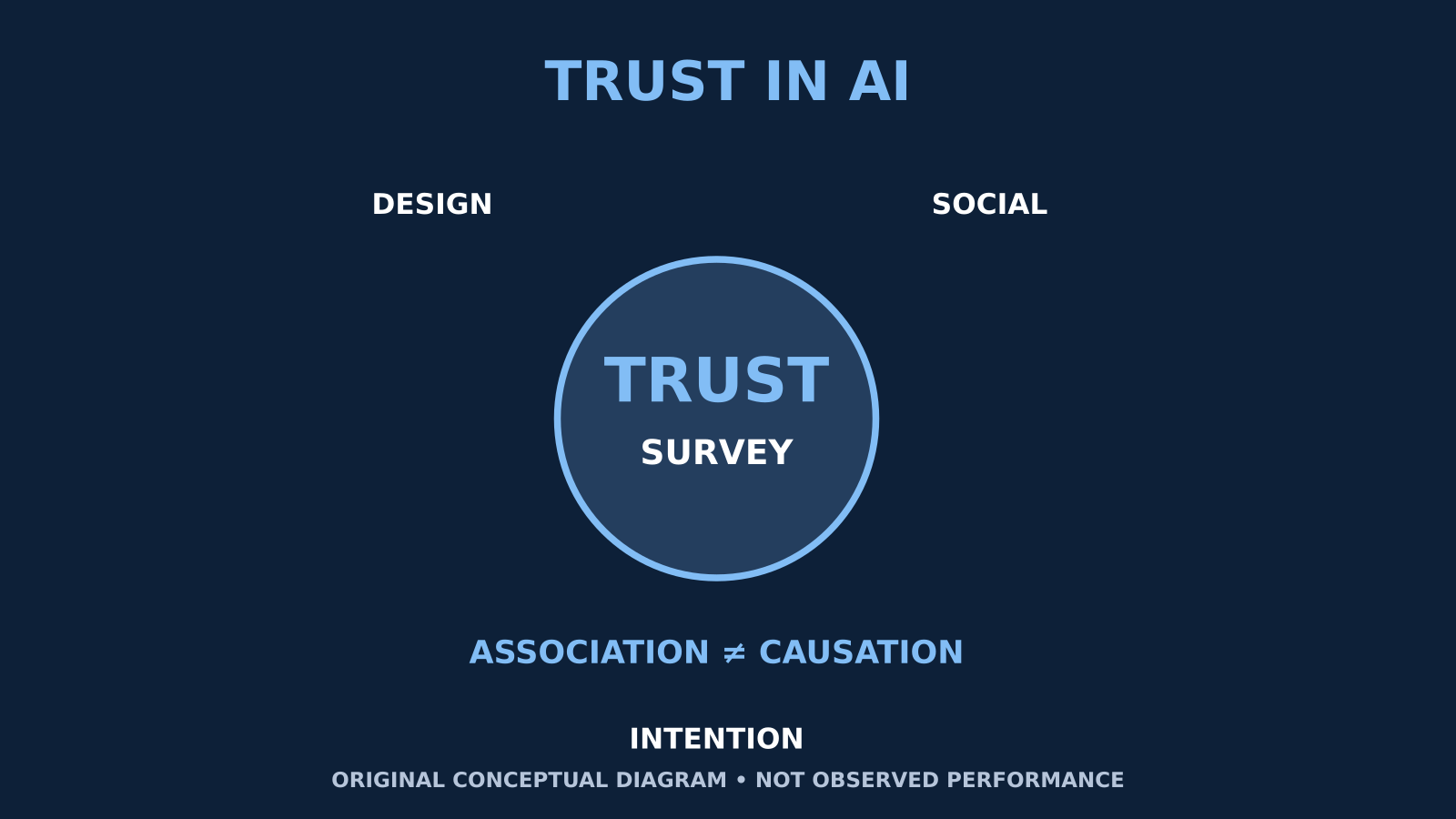
Original editorial illustration: design, social context and intention in a trust survey, not the study's model, measured effects or a screenshot. English labels read TRUST SURVEY, DESIGN, SOCIAL and INTENTION; the warning distinguishes association from causation. Research context: Ma and Zheng, Scientific Reports.
Make explanations specific enough to challenge
Compare a vague statement such as “recommended for you” with a concrete explanation such as “shown because you selected occasional home printing and wireless connection.” The second version gives the customer something to correct. It does not need to reveal private technical details or imply a degree of personalization the system cannot support. The wording must describe the real reason used, not a plausible story generated afterward.
Test comprehension by asking participants to explain the recommendation in their own words. Avoid a leading question such as “Was our explanation clear?” A person may agree out of politeness or believe they understood while drawing the wrong conclusion. Record the misunderstanding itself, including whether the visitor confused a paid placement, a stock constraint or a preference match with an objective quality ranking.
Treat privacy as an operational promise
Before requesting any information, write down why it is needed for the current task, where it goes and how long it must remain available. Remove optional questions that do not change the service. A product comparison may not require an email address. If contact details are needed for a requested callback, separate that request from permission to receive unrelated marketing.
Then check that the interface and the underlying workflow tell the same story. Do not promise that information stays within a conversation if it enters other systems. Give the responsible privacy and security teams the actual data flow to review. This article is not a legal compliance checklist; the practical point is that reassurance unsupported by operations is a weak foundation for customer confidence.
Keep social proof distinguishable from evidence
An assistant can present customer reviews as experiences, but should not transform them into verified product facts. Preserve dates and relevant context where available. A glowing comment about delivery does not establish technical suitability, and a high average score does not answer every buyer's question. Make the source visible enough that a visitor can judge what the feedback does and does not support.
For the hypothetical printer journey, keep a small review panel separate from the specification comparison. Ask participants what influenced their choice. If they think a review establishes compatibility when it does not, the design needs correction. Do not fabricate testimonials or selectively remove genuine criticism merely to make the interface feel reassuring. The objective is a defensible choice, not manufactured certainty.
Design one bounded experiment
Specify the hypothesis before launch. For example: a short, accurate recommendation explanation will improve visitors' ability to identify why an item was suggested, without increasing mistaken beliefs about suitability. Keep the underlying product set, commercial terms and support route comparable across versions. If those change at the same time, a better outcome cannot confidently be attributed to the explanation alone.
Where feasible and appropriate, assign eligible visitors randomly and keep each person's experience consistent. Agree the sample plan and analysis with someone competent in experimentation before looking at results. Do not keep checking until a favorable difference appears, and do not stop simply because a short early window looks promising. If traffic is insufficient, use a structured usability study and state its narrower evidential value.
Measure understanding, then business consequences
Use distinct measures for distinct questions. Comprehension checks assess whether customers can identify the recommendation's basis. A confidence question captures a reported feeling, not verified behavior. Completed orders, cancellations and support contacts describe different operational outcomes. Keep their denominators explicit, and compare the same eligible population and observation window rather than mixing all site visits with only assistant users.
Add guardrails before starting: misleading-answer incidents, unnecessary requests for information, accessibility failures and unresolved handoffs. Decide who reviews them and when the test pauses. A small apparent conversion improvement is not a reason to tolerate a known misleading claim. Conversely, a lower click rate may be acceptable if people understand the offer better and avoid unsuitable actions. The interpretation should follow the declared decision rule.
Work through a hypothetical result carefully
Imagine each version receives 1,000 eligible sessions. In the original version, 80 orders are completed; in the explanatory version, 90 are completed. The observed rates are 8% and 9%, a difference of one percentage point and a relative increase of 12.5%. These invented figures illustrate arithmetic only. They do not establish statistical significance, a durable effect or the value of a particular product.
Suppose the explanatory version also generates more cancellations and more questions about why personal information was requested. The responsible next step is to inspect those signals and the experiment's uncertainty, not announce a success from the order count alone. Check whether order definitions, tracking and follow-up windows match. Discuss financial value only after accounting for relevant returns, service effort and implementation costs.
Adapt the question before moving into healthcare
For a healthcare marketing team, the safe analogue is clarity about booking and service information, not automated clinical persuasion. Test whether someone can understand the branch, service inclusions, appointment process and how to reach a qualified person. Do not borrow a retail example to imply that an assistant can decide which treatment a patient should receive or guarantee a health outcome.
Use fictional scenarios or appropriately governed research rather than placing real patient details into marketing test tools by default. Keep clinical questions on the approved professional route, and explain uncertainty when the assistant lacks confirmed information. A booking that is later canceled because the service was misunderstood is not evidence of a successful patient journey. Operational suitability and respectful communication should remain visible alongside acquisition metrics.
Turn findings into a maintainable decision
Before rollout, name the owner of the recommendation logic, the factual knowledge, the customer-facing explanation and the escalation process. Agree how updates will be checked across languages. A clear English explanation and a vague Arabic translation are different experiences; matching screen layouts alone will not make them equivalent. Review actual meaning, especially exclusions, optional choices and statements about data use.
Keep a short decision record: what was tested, what changed, what remains uncertain and what would trigger review. If the evidence is inconclusive, say so and choose a smaller next investigation rather than presenting indecision as a technical failure. The strategic takeaway is to make trust inspectable through accurate information, meaningful control and honest measurement. More interaction is useful only when the customer can make a better-informed next move.
Sources and scope
Primary research context: publisher article and abstract and indexed accepted manuscript. The analysis above does not reproduce the paper's figures or provide a substitute for reading the full study. The experiment, printer example, healthcare adaptation and numerical illustration are original editorial proposals, not reported research results.
Comments
No published comments yet.