
Editorial review: November 2, 2026. TikTok published the underlying product preview on October 30, 2026; these are not November 2 announcements.
The verified product context
TikTok describes GMV Max Pro as extending optimization to coupons, affiliate costs, and platform commissions. Growth Autopilot combines advertising and coupon budgets around a seven-day ROI target. The preview also introduces search impression-share diagnostics and creative-selection options. The announcement does not establish access for every merchant, market, or account. TikTok's October 30 product preview.
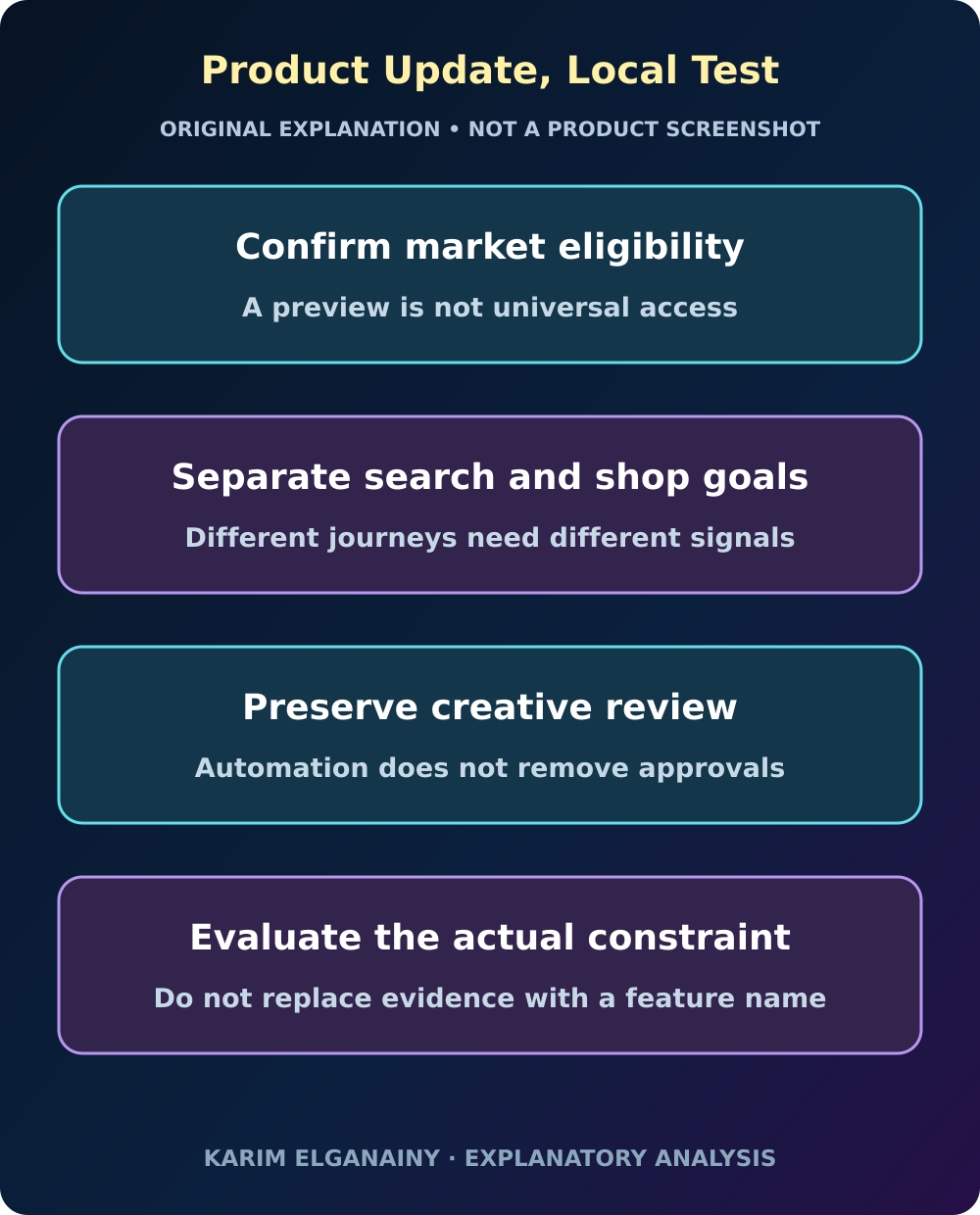
Original editorial framework; not a product screenshot or proof of campaign results.
Original analysis: a merchant needs an economic model
The practical question is not whether more variables can be optimized together. It is whether the merchant can explain how an order contributes to the business after those variables interact. The framework below is original editorial analysis, not a description of additional product functionality or a forecast of results. It uses hypothetical examples to show where commercial decisions can become clearer, and where an attractive platform metric can conceal an unresolved cost.
Imagine a small homewares merchant selling a storage bundle. Its advertising team sees a transaction value, its finance team sees a settlement, and its warehouse sees a parcel that might later return. All three views are useful, but none alone describes the economics. Before changing a campaign objective, reconcile those views for one product cohort. The exercise should identify which amounts are already netted out and which costs remain elsewhere, so the same discount or commission is not subtracted twice.
1. Build an order contribution bridge
Start with the amount the customer actually pays for merchandise after the merchant-funded discount. State whether shipping receipts are included. Then subtract product cost, fulfillment expense, applicable payment or marketplace charges, affiliate compensation, and the economic effect of returns. Keep advertising expense visible as a separate line. This is an illustrative management framework, not an accounting standard; use definitions consistent with the merchant's own records and confirm uncertain treatments with the responsible finance team.
A useful bridge has two properties. First, every line has an identifiable origin, such as a settlement export, product-cost table, or campaign report. Second, every line uses a compatible population and time basis. Do not divide the advertising cost of all promoted products by the successful orders of one attractive product. Similarly, do not compare yesterday's settled receipts with today's placed orders without explaining the lag. A precise-looking margin is not meaningful when its components describe different activity.
2. Use a numerical example that exposes the trade-off
Consider a purely hypothetical order with merchandise receipts of 100 currency units after discounts. Product and fulfillment costs total 50, other transaction charges total 10, affiliate compensation is 8, and an expected returns allowance is 7. Contribution before advertising is therefore 25. If the allocated advertising cost is 18, the illustrative contribution after advertising is 7. These numbers are invented for explanation and are not TikTok benchmarks, merchant results, or suggested operating targets.
Now suppose an additional merchant-funded coupon reduces receipts by 5, while advertising cost falls by 3 and all other example amounts remain unchanged. The contribution becomes 5, not 10: 95 minus 50 minus 10 minus 8 minus 7 minus 15. A better advertising-cost figure did not produce better unit economics in this simplified scenario. In a real calculation, some fees may also change with price, and incremental orders could change total contribution. Recalculate those relationships rather than carrying the example's fixed assumptions into a budget decision.
3. Decide whether the question concerns an order or a portfolio
A merchant can accept lower contribution per order while increasing total contribution, but the two statements must not be confused. Ask whether the current decision concerns one product, a bundle, a customer cohort, or the entire shop. A promotion may shift orders away from another item rather than create new demand. If the comparison ignores the displaced item, the promoted product can look successful while the portfolio barely changes.
For the homewares merchant, a storage bundle may replace purchases of individual containers. Compare the bundle's contribution with the contribution those orders might otherwise have generated, while acknowledging that the counterfactual is uncertain. Do not automatically credit repeat purchases that have not happened. If future customer value matters to the decision, show it as a separate assumption with a range and a review date. This keeps today's observed economics distinct from tomorrow's hoped-for value.
4. Match the evaluation window to the question
A short optimization window and a complete profitability review serve different purposes. The former can support an operational decision before all commercial outcomes mature; the latter may need cancellations, returns, delivery exceptions, and final charges. Build two views rather than forcing one number to do both jobs. Label an early cohort as provisional and show which costs are estimated, observed, or still unavailable.
For example, a merchant reviewing a recently launched bundle might know placed orders and initial spending but not the eventual return rate. It can still monitor whether the launch stays within an authorized exposure limit. It cannot responsibly call the resulting contribution final. Compare cohorts at similar ages when assessing progress, and revise estimates when actual outcomes arrive. Otherwise, a young cohort with few recorded returns may appear stronger than an older cohort simply because its liabilities have not yet become visible.
5. Distinguish a constrained launch from unlimited learning
A new product can require exploration, but “the system needs data” is not a complete spending rationale. Define what the merchant needs to learn: whether the offer is understood, whether the destination converts suitable visitors, whether fulfillment can handle demand, or whether the product produces acceptable contribution. These questions require different observations. A sales count alone may not reveal which part of the launch is functioning well or failing.
Create a small launch ledger linking each question to an observable signal and a permitted response. If shoppers misunderstand bundle contents, revise the explanation rather than assuming a larger coupon is the solution. If stock is unreliable, address availability before expanding acquisition. If orders arrive but contribution remains uncertain, investigate the cost bridge. The editorial recommendation is to preserve the distinction between a product problem, an offer problem, and a media problem, rather than treating every weak result as a reason to alter advertising expenditure.
6. Diagnose search opportunity without inventing demand
An auction-share metric is useful only with its eligibility definition and denominator. A share can change because participation changed, because the competitive environment changed, or because the advertiser won a different portion of relevant opportunities. Before interpreting a movement, inspect the keyword set, dates, targeting, and eligibility conditions. Do not relabel a diagnostic percentage as the proportion of all customer demand captured; the two concepts need not cover the same population.
Separate branded queries, category exploration, and specific product-intent phrases in the analysis. A merchant may already receive some branded demand through other routes, while a category phrase may attract shoppers whose needs the offer does not meet. Low share is therefore a question, not a command to raise spending. First examine destination relevance, stock, contribution, and the desired customer action. Winning more eligible appearances does not itself establish that the business generated additional orders rather than shifted where existing demand was recorded.
7. Make creative eligibility a commercial filter
A creative asset can be technically available and still be unsuitable for a particular offer. Build a small eligibility record linking each asset to the product shown, price or promotion depicted, language, destination, and valid usage permissions. For creator material, verify the scope and duration of permission through the relevant agreement or authorized process. Do not infer permission from the ability to view or download a video. This is a practical review principle, not legal advice about a particular contract.
The homewares merchant should distinguish an evergreen demonstration from a video mentioning last month's bundle price. A persuasive old asset may introduce a mismatch even if the product itself remains available. If an automated selection process is being considered, decide which assets may enter its candidate pool before evaluating its recommendations. A smaller, accurate pool can be more useful operationally than a larger pool containing expired offers. Selection quality cannot compensate for an incorrect commercial statement embedded in the asset.
8. Review promotion consistency across the entire purchase path
A customer encounters the promotion as a sequence: creative, action button, destination, cart, and confirmation. Check whether the same qualification survives each step. A discount may apply only to selected products, require a minimum basket, or exclude certain delivery charges. The review should ask what the customer is likely to understand before clicking and whether the purchase path preserves that understanding. Do not rely on one clear page to repair an earlier misleading impression.
For bilingual commerce, compare the arithmetic and conditions as well as the language. A percentage discount and a fixed-value saving can produce different impressions even when both descriptions are technically possible. Test sample baskets that qualify and do not qualify, using an approved non-purchasing review process where possible. Capture which product and offer version were checked. This makes it easier to identify whether a later complaint comes from a changed condition, an old creative, or a destination that no longer matches the campaign.
9. Prepare a decision sheet with separate conclusions
At the end of the review, report three conclusions separately: whether the product economics are acceptable under stated assumptions, whether the campaign and creative are eligible for the intended execution, and whether evidence supports expanding acquisition. A “yes” to one does not answer the others. A well-described offer can still lose money; a profitable historical product may lack current stock; an available campaign option may not suit the merchant's measurement situation.
Keep the sheet short enough to update when conditions change. Include the product cohort, provisional contribution calculation, uncertain costs, asset references, actual account availability check, and the next decision date. Where an assumption dominates the result, show how the decision changes if that assumption moves. For example, a higher return allowance may remove the room for additional acquisition spending. This is more informative than a single headline ratio presented without the commercial conditions that make it meaningful.
The practical implication
The October preview offers a timely reason to revisit the merchant's commercial model, but a product announcement cannot supply that model. Start with a reconciled order bridge, maintain separate early and mature cohort views, and treat search diagnostics as questions about eligible opportunity rather than proof of incremental demand. Evaluate creative candidates against both permissions and current offer accuracy. Confirm actual access before building an execution plan around any named capability.
The desired result is a decision that remains understandable when finance, media, and operations examine it together. The merchant should be able to explain what it spent, what the customer paid, what costs remain unresolved, and why another unit of acquisition is or is not justified. That clarity does not guarantee profitable growth. It does prevent a favorable advertising metric from silently substituting for the harder question of whether the business is creating worthwhile contribution.
Comments
No published comments yet.