The result is a supplier signal, not a campaign verdict
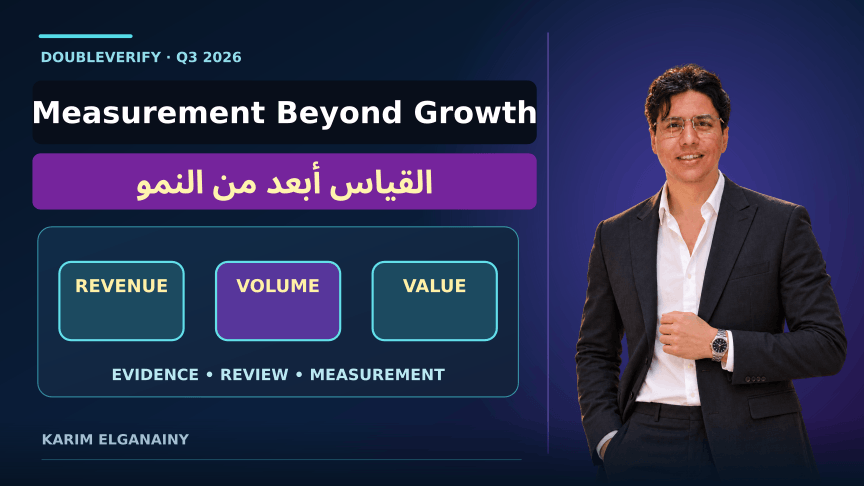
DoubleVerify published its third-quarter results on October 30, 2026. This editorial review is dated November 2. The filing reports revenue of $205.6 million, up 9% year over year; social measurement revenue rose 20%, while connected-TV media transactions measured increased 22%. That last measure is transaction volume, not CTV revenue. Shareholders approved the proposed merger agreement on October 29; completion remained conditional and was expected by the first quarter of 2027. These are company-reported facts, not independently measured advertiser outcomes. Official source.
The practical question for a marketing leader is narrower than whether the supplier had a good quarter: what should the team require from its measurement spending before renewing, expanding, or changing the relationship? The analysis below is an original procurement and operating framework. It does not claim that any particular advertiser has experienced the problems described, and it does not infer campaign performance from the financial announcement.
A measurement provider can become commercially more successful while an individual advertiser still struggles to connect a report to a decision. The reverse is also possible: a useful service can deliver substantial operational value without producing an exciting supplier growth headline. Keeping those propositions separate prevents a familiar budgeting mistake, in which a prominent market signal becomes a shortcut for assessing the work inside the account.
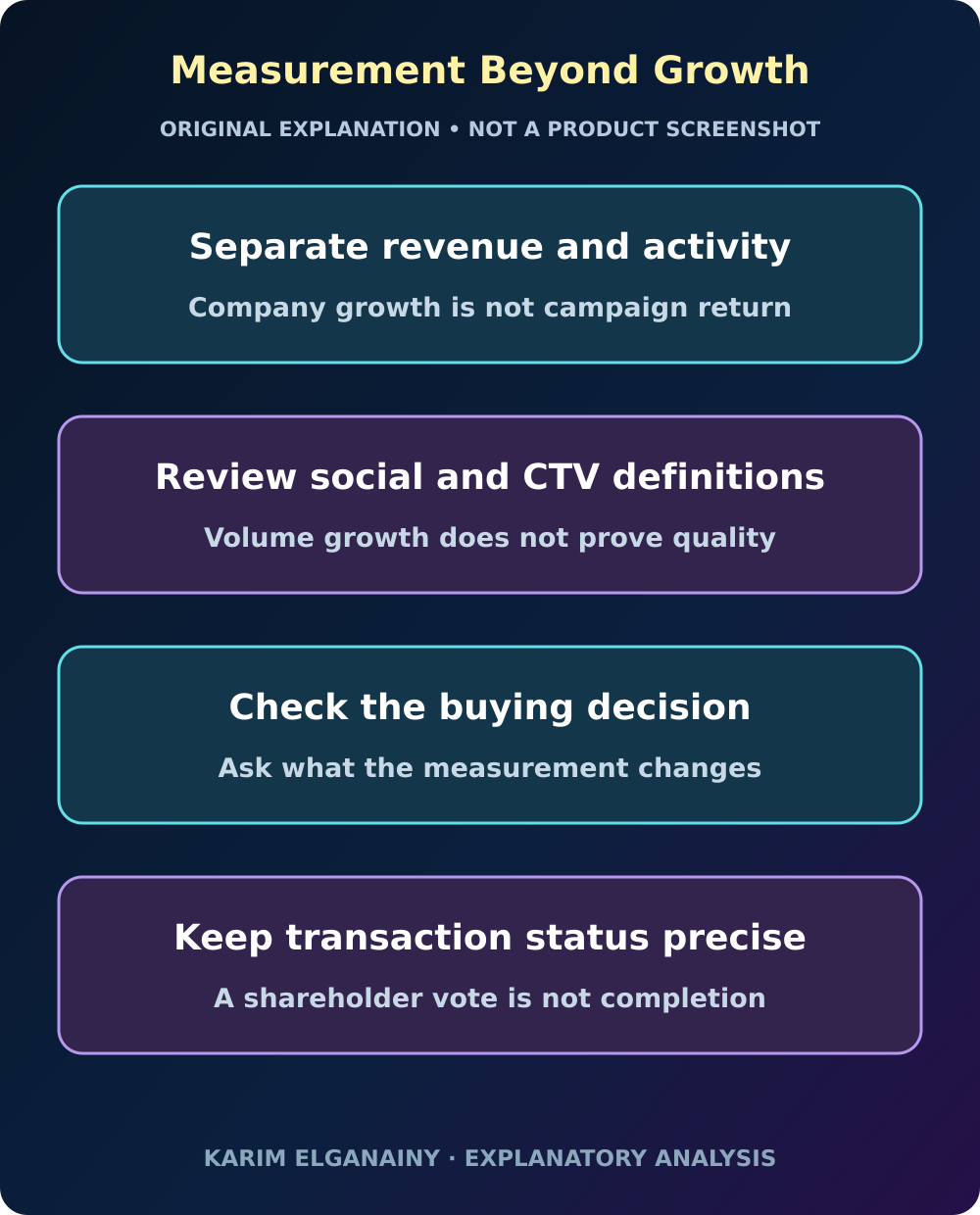
Original editorial framework; not a product screenshot or proof of campaign results.
Put the invoice beside the decision log
Start the renewal conversation with a record of decisions rather than a gallery of dashboards. For each material intervention during the reporting period, write down what the team saw, what it changed, who approved the change, and what happened next. A decision might involve excluding an unsuitable placement, investigating an unexplained discrepancy, changing a buying rule, or keeping a placement after an initial concern proved unfounded. All four can be useful outcomes.
The record should distinguish an observation from an action. A flagged impression is an observation. A documented adjustment to a buying instruction is an action. A subsequent improvement in an agreed business measure is an outcome that still needs an appropriate comparison. Combining these into one success count makes the service appear more decisive than the evidence supports. Separating them helps the team see whether its bottleneck is detection, interpretation, authority, or execution.
This exercise also exposes a quieter source of waste: findings that nobody owns. If an alert reaches an agency inbox but no one has permission to alter the campaign, buying additional detection may not solve the problem. The next budget increment might be better spent on a named escalation owner, a clearer response window, or a smaller number of rules that the team can actually maintain.
Define the denominator before comparing channels
A measurement conversation becomes unreliable when different populations share the same label. Before comparing channels, ask what entered the measurement process, what could be assessed, what remained unavailable, and what was excluded from the displayed rate. A percentage without those boundaries is not a sufficient basis for reallocating spend. The team needs a population map before it needs another chart.
Build that map around the actual media plan. List each buying route, format, geography, and device environment separately where the available evidence differs. Then show which questions can be answered for each combination. This is not an invitation to demand identical technical capabilities everywhere. It is a way to stop a broad coverage statement from being mistaken for a specific answer about a specific placement.
For example, imagine two hypothetical video packages with similar reported quality scores. One has a clearly documented assessed population; the other leaves a material portion of delivery unexplained. The identical scores do not make the packages equivalent. A sensible review would investigate the unknown portion before celebrating a tie or choosing the cheaper package. Unknown is a status to manage, not a synonym for either safe or unsafe.
Buy the question, not the longest feature list
A procurement brief should describe the decision the advertiser needs to make. One team may need help determining whether a supply path meets its content requirements. Another may need timely evidence for a dispute. A third may need consistent reporting across agency partners. These are related needs, but they should not be collapsed into a single promise of better measurement.
Once the question is explicit, specify the smallest useful deliverable. That might be an export with stable identifiers, a documented exception workflow, or a report that reaches the buyer before the next allocation decision. A sophisticated interface can be welcome, but it is secondary if the underlying evidence arrives too late or cannot be reconciled with the advertiser's own records.
This approach creates a fairer comparison between suppliers. Instead of scoring the number of features mentioned in a presentation, give each candidate the same realistic task and the same constraints. Ask how it would identify a discrepancy, communicate uncertainty, and support a decision. Evaluate the completeness of the explanation as well as the attractiveness of the answer. A vendor that clearly marks an unresolved area may be more useful than one that hides it inside a polished summary.
Separate protection from growth claims
Some measurement spending is designed to reduce exposure to an unwanted condition. Other spending is intended to improve how the advertiser allocates resources. These functions can overlap, but their evidence should remain distinct. A protective control does not need to be described as a sales engine to justify its existence. Conversely, calling a service protective should not exempt it from operational scrutiny.
For protective work, define the acceptable condition, the escalation route, and the evidence needed to close an incident. For allocation work, define the comparison that would support a change in spend. If a team wants to claim that a measurement intervention improved acquisition efficiency, it should explain how it separated that intervention from changes in creative, offers, audience composition, or seasonality. A favorable before-and-after chart alone leaves those alternatives unresolved.
The distinction is particularly helpful in executive reporting. Present the control's status and the commercial experiment's result as separate lines. This avoids forcing every measurement expense into an unsupported return-on-ad-spend story. It also prevents the team from hiding a weak commercial test behind the importance of brand protection. Each activity can then be judged against the job it was actually purchased to perform.
Make ownership changes a contract question
The proposed ownership transaction is relevant to buyers as a reason to review continuity provisions, not as proof that service will improve or deteriorate. A pending transaction does not establish either outcome. The practical response is to ask which commitments already exist in writing and which depend on future decisions that have not been made.
A renewal checklist can cover access to historical records, notification of material service changes, support responsibilities, export formats, and the handling of unresolved disputes. The advertiser should know who can answer these questions today. If an answer depends on a future integration plan, record that dependency rather than converting a sales conversation into an assumed guarantee.
Avoid designing the media operation around a hoped-for combination of products. It may be sensible to explore future possibilities, but the current contract should stand on its own. A service that only becomes worthwhile after an unspecified integration introduces a different risk from a service that meets today's requirements and might later become more convenient. Procurement should make that distinction visible to the budget owner.
Test portability before it becomes urgent
Continuity is easier to assess when the advertiser can reproduce a modest piece of its reporting outside the main interface. Choose one completed campaign, export the relevant records, and ask an analyst who did not build the original dashboard to explain the result. The point is not to rebuild the supplier's technology. It is to discover whether the evidence remains intelligible after it leaves the familiar screen.
Document the definitions, time zones, identifiers, and filters required to perform that exercise. If the exported result differs from the interface, investigate the reason while the campaign team is still available. A discrepancy may have an ordinary explanation, but an explanation discovered months later is less useful to a buyer facing a dispute or an agency transition.
Portability also means preserving institutional memory. A file without its interpretation can become little more than a costly archive. Keep a short note explaining why a rule was introduced, who approved it, and when it should be reconsidered. That note can protect a new team from repeating an old investigation or retaining an exclusion whose original rationale no longer applies.
Plan a limited renewal experiment
Before committing to a broad expansion, choose one decision problem that the existing setup handles poorly. Define a bounded trial around that problem, with a clear owner and a stopping rule. The trial should be large enough to expose the relevant workflow, but it should not silently become a permanent addition to every campaign merely because setup work has already been done.
Decide in advance what would count as success. Useful criteria might include whether the evidence arrived before a buying decision, whether the buyer could trace an alert to the affected delivery, or whether an escalation was resolved with a documented explanation. These are examples for planning, not reported DoubleVerify results. The appropriate criteria depend on the advertiser's purpose and available data.
At the end, compare the value of the decision support with its full operating cost. Include analysis time, agency coordination, exception handling, and the effort required to maintain the configuration. A low unit price does not necessarily mean a low operating burden. Equally, a higher fee may be reasonable when it replaces work the team would otherwise need to perform itself. The comparison should be explicit rather than implied by the invoice alone.
The useful response to a growth headline
The strongest response to this announcement is neither automatic expansion nor reflexive skepticism. It is a more precise account review. Ask which decisions the measurement relationship makes possible, which populations remain uncertain, and which contractual protections preserve access to the evidence. Then decide whether the current service, a revised scope, or a competitive review best addresses the actual gap.
That is a different conversation from the earlier discussion of AI adoption research. Here the focus is a supplier's financial disclosure and the advertiser's buying discipline. The commercial result can prompt questions, but it cannot answer them on the advertiser's behalf. A good measurement budget earns its place through traceable decisions, understood limitations, and an operating arrangement the team can sustain.
Comments
No published comments yet.