
The news — 2 November 2026
Argaam reports Mouwasat’s Q3 revenue of SAR 856.4 million versus 777.3 million and net profit attributable to shareholders of 188.0 million versus 199.7 million. Nine-month revenue was 2,566.6 million versus 2,338.0 million; attributable net profit was 600.4 million versus 583.7 million. Comparisons are 2026 against 2025; amounts are rounded to one decimal place. Financial figures: Argaam.
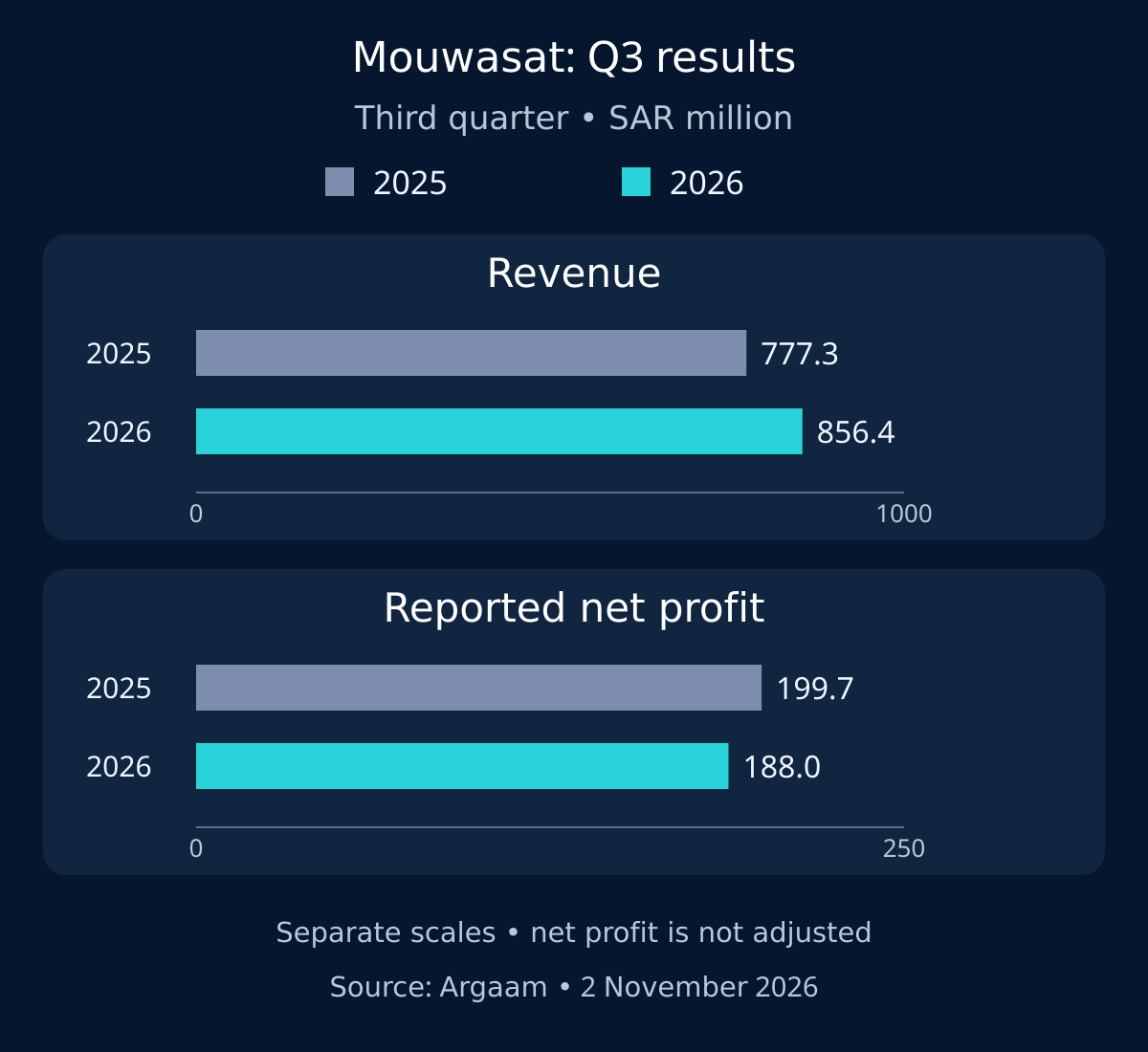
Original Q3-only comparison. Data: Argaam. Cumulative figures are in the text.
The comparison needs context
Al Yaum reports the company’s explanation that the prior-year quarter benefited from collection of doubtful receivables. It reports company-stated profit growth of 4.3% when that effect is excluded. This adjusted comparison is not the reported result and is not independently recalculated here. Al Yaum’s results coverage. Ajel’s coverage, dated 2 November 2026, also reports the explanation.
There is separately verified expansion context. Mouwasat’s own announcement, dated 22 January 2026, says its Yanbu Industrial City hospital received its final operating license and would begin receiving patients on 1 February 2026. That establishes the opening timetable, not the hospital’s individual financial contribution. Primary company announcement.
The numerical results above are sourced to Argaam. The identified Saudi Exchange announcement was inaccessible because of a CDN restriction; this article does not claim to have read the original filing. Company context and secondary reporting are kept distinct from primary financial confirmation.
Analysis: a profit headline is not a demand diagnosis
The remaining sections are independent practical analysis, not findings about Mouwasat’s internal marketing, staffing or payment processes. A lower reported profit does not, by itself, establish weaker patient demand. Nor does an adjusted comparison prove that every service line is performing well. The disciplined response is to identify which question each measure can answer before changing commercial activity.
A healthcare team should distinguish demand generation, access to appointments, service delivery and financial realization. These stages run on different timelines. An inquiry can arrive today, a visit can occur later, and payment can arrive later still. A collection relating to older activity belongs to a different analytical story from the campaign that happens to be running when cash arrives.
Build the review around those separate timelines. Ask what changed in eligible inquiries, what changed in accessible appointments, and what finance recognizes and collects. Do not combine these into a single narrative simply because their reporting dates match. A coherent explanation needs reconciled evidence, not synchronized dashboard colors.
Treat availability as an input to acquisition
Before promoting a service, create a practical availability record for each relevant location. Include the service offered, booking route, operating schedule, responsible owner and last verification date. Add any administrative prerequisites that the authorized team can accurately explain. The purpose is not to build a public clinical eligibility algorithm; clinical suitability remains with qualified professionals.
Use this record to decide what a campaign can responsibly promise. A service may be ready for general information, ready for bookings, or temporarily constrained. Those states call for different messages. A location-awareness campaign can explain where a hospital is without implying that every specialty has immediate appointments. A booking campaign needs a maintained route to genuinely available care.
Assign responsibility for changing the message when availability changes. Otherwise, marketing can continue purchasing attention for an experience operations cannot deliver. This is a proposed control for another healthcare organization, not a claim that Mouwasat has such a mismatch. The practical objective is to prevent avoidable disappointment rather than maximize inquiries irrespective of fit.
Separate new-location learning from network growth
For a hypothetical hospital network, a new facility raises a measurement question: how much activity is new to the network, and how much has shifted between locations? These outcomes are not equivalent, although a more convenient location may still improve access for existing patients. Do not label every first visit to a new branch as a newly acquired patient.
Agree on definitions before producing a launch report. Distinguish first contact with the network, first attendance at a location, repeat attendance and referrals between sites. Compare similar observation windows and explain data gaps. Aggregate reporting is usually sufficient for the marketing decision; identifiable medical details do not belong in ordinary acquisition dashboards.
Evaluate the location on its own operating context rather than forcing it to resemble an established site immediately. Ask whether people can find accurate information, reach the right booking channel and attend an available service. Keep those access questions separate from a forecast of financial maturity. Without the relevant evidence, neither a launch announcement nor group results can establish the new facility’s contribution.
Keep payer clarity and collections on different tracks
An acquisition team can help people understand the administrative next step without promising individual coverage. General participation with a payer does not mean every member’s intended service is covered. Route case-specific questions to the authorized team, and keep public explanations current. Do not ask campaign platforms to collect medical information merely to make attribution easier.
Collections require a different review. Finance should distinguish payments for current activity, settlement of older balances and the relevant accounting treatment. Marketing should not count an old balance collected this month as newly acquired business. Equally, a payment delay does not automatically prove that the original inquiry was poor quality; the explanation requires evidence from the appropriate process owner.
A useful shared meeting therefore has separate outputs: an access issue to fix, an administrative-information issue to clarify, or a finance question to investigate. Not every issue should become a campaign change. This prevents a team from cutting useful communication to compensate for a problem that arose elsewhere in the service or payment journey.
A hypothetical capacity-aware acquisition test
Imagine a hospital network with accurate appointment information that is difficult to find on its location pages. A focused test could make the location, service description and next booking step clearer while leaving clinical claims, pricing and appointment supply unchanged. This is an illustrative information-design experiment, not a report of a Mouwasat campaign.
Define the intended outcome as appropriately completed appointments, not clicks alone. Measure intermediate steps so the team can identify where the journey changes. Include safeguards such as incorrect-location bookings, avoidable transfers, cancellations and unresolved administrative questions. Staff should have a route to flag misleading wording even when the headline conversion metric improves.
Use an appropriate comparison, ideally randomized where feasible. Record changes in schedules, staffing, availability and channel mix that could affect interpretation. Choose the evaluation window from the available data and decision requirements, not an arbitrary universal duration. A technically successful page update may still yield inconclusive business evidence.
At review, decide whether to keep, revise or withdraw the change. An increase in inquiries with no improvement in suitable completed appointments is not sufficient evidence for scaling spend. Conversely, fewer but more appropriate inquiries may be useful if service safeguards hold. The decision should reflect the whole access journey, without encouraging unnecessary treatment or promising clinical outcomes.
The practical lesson
Read the reported result, understand the stated comparison adjustment and then ask for the operating evidence needed for the next decision. For healthcare marketing, the useful discipline is to match acquisition to real availability while preserving separate views of patient access, revenue and collections. This is business analysis, not investment advice, a valuation or a claim of personal experience inside the company.
Sources and scope
- Argaam: financial figures, rounded consistently.
- Al Yaum and Ajel: secondary reporting of the company’s comparator explanation; Ajel carries the news date.
- Mouwasat’s Yanbu announcement: primary source for the opening timetable.
- Saudi Exchange announcement: identified original link; contents were not readable.
Comments
No published comments yet.