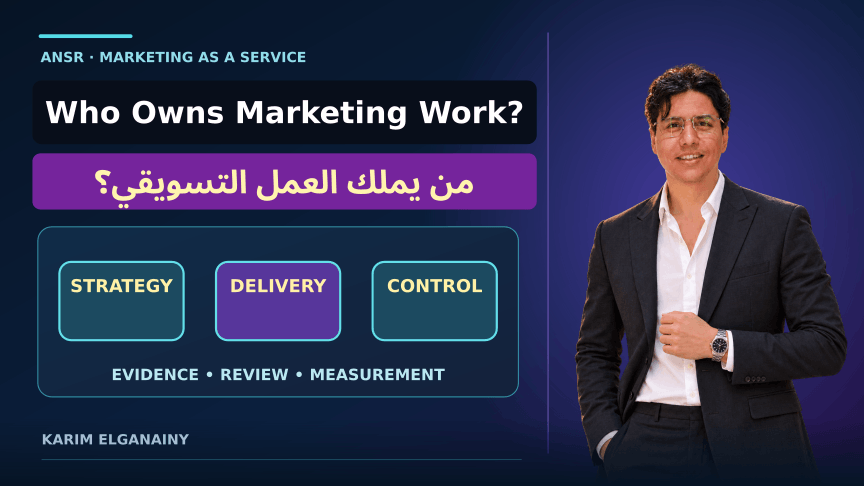
Editorial review: November 2, 2026. ANSR issued a launch announcement on October 27 and a subsequent description of the service on October 30. October 30 is not the first launch-announcement date.
The verified announcement
ANSR announced Marketing as a Service for clients operating a Global Capability Centre with the company. Dedicated execution teams sit within that model while clients retain marketing strategy and brand direction. Here, GCC means Global Capability Centre, not the Gulf Cooperation Council. October 27 launch announcement; October 30 subsequent statement.
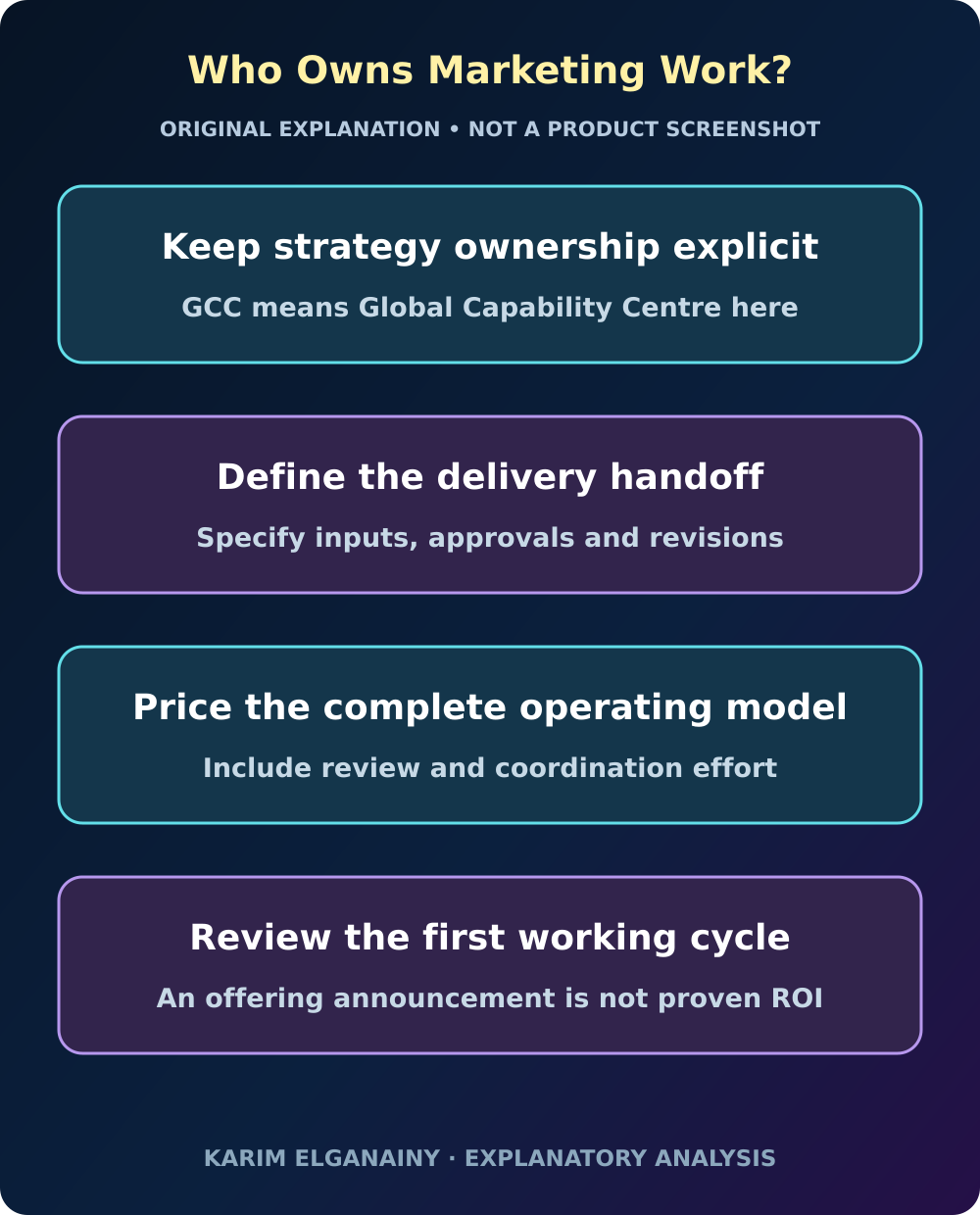
Original editorial framework; not a product screenshot or proof of campaign results.
Original analysis: a team boundary is a design decision
The remainder is an independent operating-model analysis, not a description of additional ANSR commitments, contract terms or customer results. A business considering an embedded execution team needs to decide which work should cross the organisational boundary and what must accompany it. Adding people does not resolve unclear priorities. Nor does retaining strategy internally ensure that strategy arrives in a form an external delivery team can execute.
Consider a fictional business software company with a central marketing team and several regional sales groups. Its problem is not a shortage of ideas: it has too many competing requests, inconsistent launch information and a backlog of revisions. Extra production capacity could help, but only after the company distinguishes genuinely ready work from unresolved decisions. Otherwise, it hires more capacity to wait for answers. This example frames the practical questions below without claiming to represent an ANSR client.
Begin with a service catalogue, not a headcount request
List the recurring outputs the organisation actually needs. A landing-page adaptation, a campaign report, an email build and a new positioning narrative are different services, even if all appear under marketing. For each, describe the input, output, expected reviewer and acceptance condition. Avoid an entry such as “support growth,” which can absorb almost any request without defining what successful delivery looks like.
Separate repeatable production from exploratory work. A repeatable task might adapt approved content to a known format. An exploratory task might investigate which audience problem deserves a new campaign. Both can be valuable, but their planning needs differ. A team should not be judged on the same turnaround expectation for a well-specified adaptation and an unresolved strategic question.
Start the catalogue with a small number of services that recur often enough to observe. Add examples of acceptable and unacceptable requests. A request is not ready simply because somebody assigned a deadline. It needs the information necessary to begin, or an explicit agreement that discovering that information is part of the service. This distinction helps identify whether the bottleneck is execution capacity, decision ownership or incomplete upstream work.
Decide what the client must supply
For the fictional software company, a launch request might require the product description, supported markets, approved claims, destination, commercial terms and intended audience. The marketing team should not transfer a collection of unresolved assumptions and then label the resulting delay a supplier problem. Create a minimum input package for each service rather than one enormous brief used indiscriminately for everything.
Assign an internal owner who can resolve each type of uncertainty. Product compatibility may belong to product management; pricing to a commercial owner; terminology to brand or content leadership. The delivery team needs a route to an answer, not a directory of people it must persuade individually. Where several owners disagree, identify who has the authority to settle the conflict.
Track the time spent waiting for inputs separately from active production. This is not an invitation to argue over blame. It makes the operating constraint visible. If a task spends most of its life awaiting a commercial decision, increasing the number of designers may do little to improve delivery. The appropriate intervention may be a clearer decision meeting or a smaller scope, not another production seat.
Turn prioritisation into an explicit queue
Multiple stakeholders can each describe their request as urgent. A shared queue needs a rule that resolves those conflicts. Choose a small set of factors that reflect business priorities, such as a verified launch dependency, customer impact and the cost of delay. Do not pretend that a mathematical score removes judgement; the score is useful only if people understand and accept how it is used.
Keep emergency work visible rather than allowing it to enter through private messages. Record what it displaces and who authorised the change. A team that repeatedly meets urgent requests by delaying planned work may appear responsive while becoming impossible to forecast. The client should see the trade-off before it becomes a missed commitment elsewhere.
For the software example, an urgent correction to an inaccurate live claim may properly outrank a planned creative variation. A late preference for a different background colour may not. The point is to distinguish business urgency from stakeholder impatience. Give the delivery team a consistent escalation route so that it does not need to make political choices disguised as scheduling decisions.
Define acceptance at the level of the deliverable
Approval is often treated as a single event, but reviewers may be checking different things. A product specialist checks accuracy; a brand reviewer checks expression; an operator checks whether the asset can be implemented. Specify the checks needed for each service and the order in which they should occur. Avoid collecting many signatures that all assume someone else verified the important condition.
For a landing-page adaptation, acceptance might require approved meaning, functioning links, appropriate language presentation and a handover package that another operator can maintain. These are proposed internal criteria, not promised ANSR service specifications. The precise checklist should follow the real task. A research memo needs different acceptance conditions from a finished email or a reporting extract.
Separate an error correction from a change of preference or scope. If the approved request asked for one audience and the stakeholder later chooses another, the revision is not automatically evidence of poor delivery. Record the change so that performance discussions distinguish avoidable defects from legitimate business evolution. A fair distinction helps both sides improve the work without rewarding defensive documentation over useful collaboration.
Make knowledge transfer part of production
An embedded team can accumulate substantial knowledge about products, audiences and internal expectations. Decide where that knowledge will live. It should not exist only in one person’s chat history or memory. Maintain concise working references for recurring terminology, claim evidence, approved examples and known constraints, with a named owner for updates.
Ask the team to capture the reason behind a significant decision, not every message exchanged along the way. “Use this expression” is less transferable than a short explanation of the misunderstanding the expression avoids. The aim is a practical knowledge base that helps the next person work correctly, rather than an archive so large that searching it becomes another production task.
Test transfer through a small handover exercise. Can a second operator complete a routine request using the available materials without extensive private explanation? If not, determine which missing information matters. This exercise can reveal fragile dependencies before staff leave or responsibilities change. It also gives the client a clearer view of whether it is gaining organisational capability or merely receiving outputs from an inaccessible process.
Protect access without obstructing delivery
Map the systems needed for each service: design files, publishing tools, analytics, asset libraries or approved customer-information environments. Grant access according to the actual task and existing organisational policies. A production team does not automatically need broad administrative rights simply because it works across several marketing functions.
Use named accounts where the authorised workflow supports them, and define who approves changes to access. Keep credentials out of briefs and general project discussions. Establish how draft work, approved assets and live changes are distinguished. A useful operating model makes it difficult to confuse permission to prepare a campaign with permission to publish it or spend money.
Before an engagement changes or ends, review how access will be removed and how necessary materials will be retained by the client. These are operational questions for appropriate internal specialists, not legal conclusions about a particular arrangement. Resolving them early avoids the situation in which the business can retrieve a final file but cannot maintain the system that produced or delivered it.
Measure the service without confusing it with the market
A delivery team can influence turnaround, correctness, completeness and maintainability. It may also contribute to commercial results, but those results depend on product, offer, market conditions and decisions outside the team’s control. Use a measurement structure that distinguishes service performance from campaign performance rather than combining everything into a single flattering or punitive score.
For recurring tasks, inspect accepted throughput, time in queue, rework reasons and downstream usability. Pair speed with quality: completing more assets is not an improvement if the client spends more time repairing them. Pair quality with relevance: immaculate work that addresses an obsolete priority is not useful simply because it meets a checklist.
Review a sample of completed and blocked requests together. Discuss the mechanism behind a pattern, not just its average. If revisions cluster around incomplete pricing information, fix the input. If the same implementation defect recurs despite clear instructions, revise training or the delivery method. A good service review identifies an action and an owner instead of becoming a recurring presentation of numbers that neither party can explain.
Compare operating options on their real boundaries
An embedded service, an agency project, a freelancer and an internal hire can each make sense under different conditions. Compare the work each option actually includes. One proposal may cover production only while another includes management, onboarding or maintenance. Apparent cost differences are difficult to interpret until those boundaries are aligned.
Include the client’s retained workload in the comparison. Briefing, reviewing and resolving priorities still consume time even when execution is delegated. Do not assume those activities disappear because they are absent from a supplier invoice. Equally, do not assume an internal team is costless to coordinate. Use a complete but practical view of the work rather than an ideological preference for outsourcing or insourcing.
The decision should name the problem being solved. A temporary backlog, a persistent specialist need and a desire to build durable internal capability may justify different arrangements. If the objective changes, revisit the model rather than treating the original choice as permanent. A service relationship is useful when its boundaries fit the business problem, not because the label sounds contemporary.
Plan the next operating state before expansion
Define what would justify expanding, narrowing, continuing or ending the arrangement. The evidence should include the quality of outputs, the client effort required and the resilience of the process. Keep a no-expansion option available when the unresolved bottleneck lies outside execution. More staff cannot reliably compensate for an organisation that will not make a decision.
For the fictional software company, success might mean that a defined class of launch adaptations moves through a predictable queue with fewer clarification loops and maintainable handovers. That is a specific operational result worth documenting. It is not a guarantee of sales growth. The practical significance of the ANSR announcement is the operating-model question it raises: what should an organisation retain, what can it delegate, and what must remain understandable when the work crosses that boundary?
Comments
No published comments yet.