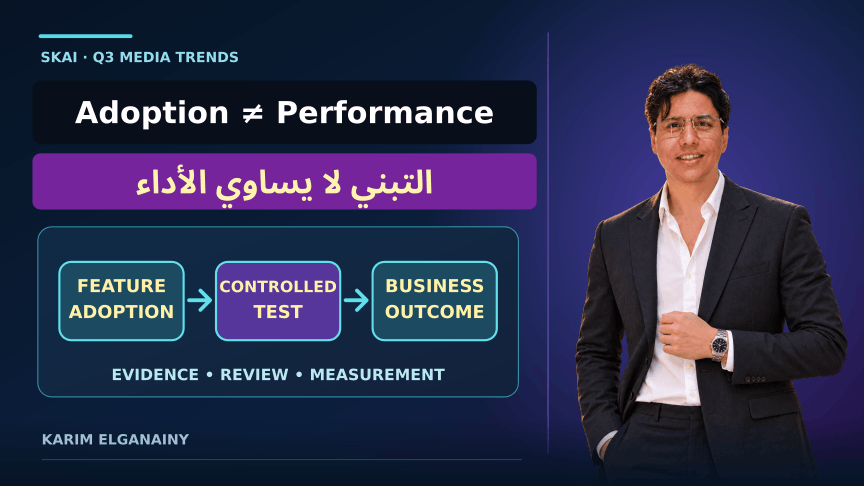
Skai published its Q3 2026 Digital Marketing Quarterly Trends Report on 27 October. For advertisers planning holiday activity, the useful question is not simply which channel grew fastest. It is whether changes in campaign automation, event calendars and measurement definitions are being separated before a budget decision is made. This analysis, published on 28 October, uses the release as a starting point for that practical review, while keeping a visible limitation in the public methodology in view. Skai’s announcement.
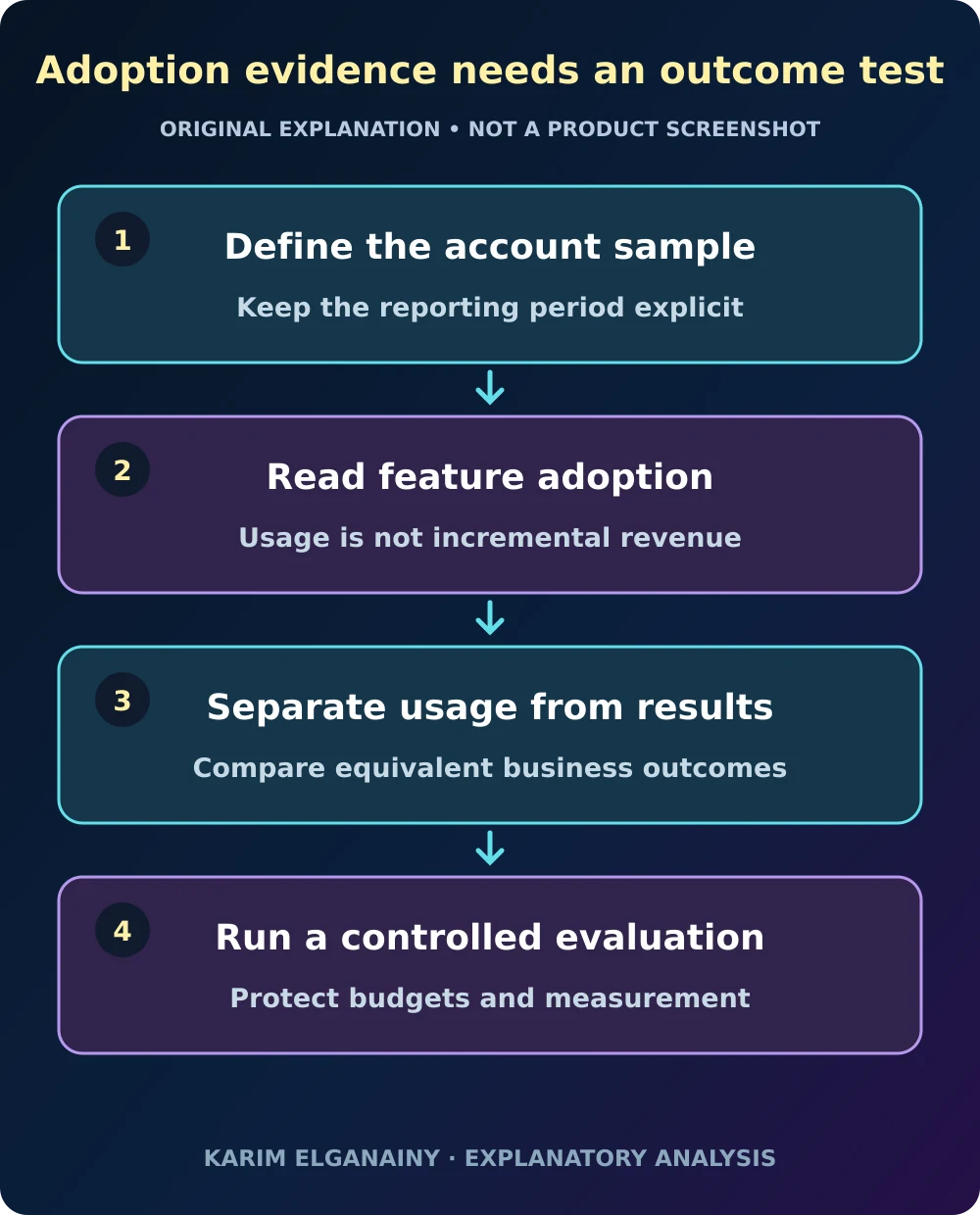
Original explanatory illustration by Karim Elganainy. This is an editorial planning framework, not a reproduction of Skai’s report artwork. Source context: Skai’s Q3 report announcement.
Read the methodological limitation first
Skai describes aggregated, anonymized platform activity and says only advertisers active throughout both comparison periods were included. However, the release’s methodology references Q2 2025 as the year-earlier comparison for its Q3 2026 analysis. That inconsistency is unresolved in the material reviewed here. This article therefore does not repeat the release’s year-over-year channel growth figures or silently substitute a different comparison period. Published methodology.
That editorial boundary also provides a useful operational lesson. A report can contain relevant information without every comparison being ready for a spending decision. Keep the observation, the uncertainty and the proposed next action in separate fields. Teams should be able to use a dated adoption observation while withholding judgement on a period comparison whose basis needs clarification. Treating the whole document as either unquestionable or unusable would discard that distinction.
Adoption is an observation, not an effectiveness verdict
The companion report page states that AI Max adoption reached 66% of Google accounts in September, compared with 38% in January. These figures describe Skai’s observed platform population, not all Google advertisers. They establish a change in participation across two stated months; they do not establish the effect of adoption on profit. Skai’s report page.
For an individual business, the next question is what changed inside its own accounts. Record whether a feature was deliberately enabled, inherited through a migration or introduced alongside other changes. Then compare the intended objective with the actual settings. A team may discover that it has been discussing an automation strategy while the operational change was narrower, broader or simply different from the strategy described in the brief.
Build a campaign-change register
A campaign-change register should connect each meaningful setting change to a date, an owner and an expected effect. Include targeting, creative eligibility, bidding objectives, measurement configuration and budget constraints. Keep the entries specific enough that another analyst can reconstruct what happened without relying on the memory of the person who managed the account.
This register is especially useful when several teams work on the same business. A media specialist might change a campaign setting while a commerce team changes the offer and an analytics team updates conversion tracking. If those changes occur together, a simple before-and-after result cannot isolate their effects. The register does not solve that identification problem, but it makes the problem visible early enough to choose a more appropriate test or qualify the eventual conclusion.
Match the calendar to the commercial question
A quarterly comparison is convenient for reporting but may be an awkward way to evaluate a seasonal business. Before interpreting an apparent change, create a calendar of promotional periods, product launches, stock constraints and major campaign transitions. Ask whether the two periods contain comparable commercial opportunities rather than assuming that matching quarter labels creates a fair comparison.
For holiday planning, it can be useful to keep both a calendar view and an event-relative view. The calendar view answers what happened during the accounting period. The event-relative view asks what happened before, during and after a comparable promotional moment. Neither should replace the other without explanation. If the business needs a financial-period answer, an event-only analysis can omit meaningful costs. If it needs an event-planning answer, a quarterly average can conceal the timing that matters most.
Give audience building and demand capture distinct jobs
A media plan should state whether each activity is intended to introduce the brand, deepen consideration or capture existing demand. These are planning roles, not permanent labels attached to particular platforms. One environment may support more than one role, depending on the audience, message and execution.
Assigning a role creates a better conversation about evidence. An introduction campaign might require a credible reach and awareness assessment, while a demand-capture campaign might need a much closer view of conversion quality and margin. The two can be evaluated together without forcing them into an identical short-term metric. What matters is documenting how the business expects one stage to support another and what observation would challenge that expectation. Otherwise, a full-funnel narrative can become a way to avoid testing any part of the plan.
Review economics beyond the click
A cheaper click is helpful only in relation to what the business receives afterward. Build a simple chain from media cost to qualified visits, purchases, returns and contribution. The point is not to demand perfect knowledge at every stage. It is to make clear where the available evidence ends and where an assumption begins.
For example, an account might receive more traffic while selling a different product mix or attracting customers with a different repeat-purchase pattern. That is a hypothetical diagnostic possibility, not a finding about Skai’s advertisers. A review that stops at click cost would miss it. Where reliable downstream data are unavailable, state the limitation and identify a practical improvement. Do not fill the gap with a general industry benchmark that uses a different audience, attribution window or definition of revenue.
Separate attributed revenue from incremental value
Attribution assigns credit under a chosen set of rules. A budget decision about incremental value asks what would have happened without the activity. The two questions can inform one another, but they should not share a label. A campaign can receive conversion credit from customers whose behaviour might not have changed because of the advertising.
When preparing an experiment, define the decision first. Are you evaluating an additional budget, a different audience or replacement of another channel? Work with a qualified measurement partner to determine a feasible comparison and whether the sample can support the desired conclusion. Where a controlled test is impractical, make the assumptions of the alternative explicit. Reporting a range of uncertainty is more useful than presenting a precise number whose causal meaning has not been established.
Make creative and landing pages part of the same test
Automation can change who sees a message, but the message and its destination still need to support the intended task. Review the promise in the ad alongside product availability, price, shipping information and the action requested on the landing page. A mismatch can complicate interpretation even when the campaign’s technical delivery looks healthy.
For a bounded test, decide which elements will remain stable and which will change. Preserve a record of creative versions and destination changes, with approval dates. If everything changes at once, the team may learn whether the overall package worked but not which component deserves credit. That can still be a useful experiment if it is the actual question. Problems arise when the analysis later claims to isolate a feature that was never isolated in the design.
Plan learning before the peak period
A pre-peak period can serve as a deliberate learning window rather than a smaller version of the main sales event. Define which uncertainties can realistically be reduced before the highest-pressure days. These might include whether the offer is understood, whether the destination functions correctly or whether a particular audience produces sufficiently qualified activity to justify further investigation.
Do not assume that every early result will transfer to peak conditions. Competition, customer urgency and product availability may differ. Instead, document which findings are likely to be operationally reusable and which require another check. A broken tracking event is a problem worth fixing before any period; a promising response rate might depend heavily on the circumstances under which it was observed. This distinction lets the team learn without converting a rehearsal into a forecast it cannot defend.
Give automated decisions clear boundaries
Before expanding automated execution, specify what the system may change and what requires human approval. A useful boundary is tied to the consequence of the action: budget exposure, creative claims, audience exclusions or changes that alter the interpretation of measurement. Avoid treating a product’s default settings as a substitute for the organization’s own operating policy.
The review should also name the person who can pause activity and the evidence that would trigger a review. Where the system can provide logs, preserve them in a form the team can examine later. This is an original governance recommendation, not a statement about a particular Skai product feature. The purpose is to retain a clear account of decisions as execution becomes faster, so that operational speed does not make it harder to identify or reverse an unsuitable change.
Design a dashboard that exposes disagreement
A useful dashboard should make differences between sources visible. Show platform-reported results, business-system results and any experimental evidence as distinct layers, with their definitions and refresh schedules. A disagreement may reveal timing, attribution or data-quality differences rather than a simple error that one team can fix by choosing its preferred number.
Give each layer a decision purpose. Platform data may help manage delivery; order data may support financial reconciliation; an experiment may help evaluate incremental value. Combining them requires care rather than a cosmetic total. The dashboard should also identify which comparisons are not yet approved for interpretation. That is where the unresolved period reference in a public report becomes a practical example: a visible qualification is better than allowing an ambiguous number to circulate without its original context.
Set expansion criteria before reviewing results
Before a test begins, agree what evidence would justify expansion, revision or stopping. The criteria should reflect the commercial objective and the quality of measurement available. They should also allow an inconclusive outcome. If the only acceptable result is a recommendation to spend more, the review process is not functioning as a genuine test.
Include implementation costs and organizational capacity in the decision. A promising media result may require work the business cannot yet sustain, such as more frequent creative review or better product-data maintenance. Conversely, a modest improvement might be attractive if it is dependable and easy to operate. The aim is not to create a universal pass mark. It is to make the business’s own trade-offs explicit before enthusiasm for a new capability or a prominent industry statistic shapes the conclusion.
What to take into the next planning meeting
Bring three items: a dated record of campaign changes, a calendar that explains the comparison and a measurement map connecting delivery to business outcomes. Ask which question each chart answers, which assumption supports it and what evidence would change the current recommendation. That discussion is more valuable than importing a market-level growth figure directly into next month’s budget.
Skai’s October release provides a timely reason to examine how automation and seasonal planning interact. The appropriate response is a more disciplined local evaluation, not an automatic allocation shift. Keep platform-sample observations within their scope, avoid repairing ambiguous methodology by intuition and require a clear reason for every proposed expansion. This allows useful industry reporting to inform judgement without replacing the evidence that the advertiser needs from its own business.
Sources and publication note
The report announcement is dated 27 October 2026; this analysis is dated 28 October. Sources are Skai’s official release and its Q3 report landing page. The public methodology’s inconsistent comparison-period reference remains unresolved here. All operating frameworks, examples and recommendations above are original analysis, not additional findings from Skai’s dataset.
Comments
No published comments yet.