Published October 28, 2026. Stagwell announced its acquisition of publisher advertising-services company Freestar on October 26. The issuer positions the transaction within its Owned Media offering and broader Media and Commerce business. That corporate announcement does not independently establish better campaign performance or publisher outcomes. Read Stagwell's announcement.
For a marketing leader, the important question is what should change in the evaluation of a media route when organizational ownership changes. A shorter organizational distance between advertiser services and publisher services can create useful coordination, but buyers still need evidence about the inventory, costs, incentives, and outcomes relevant to their own campaigns. This article offers an original due-diligence framework rather than a financial valuation or a claim that the transaction has already produced specific benefits. The examples are hypothetical. The framework applies to evaluating a proposed arrangement; it does not allege undisclosed practices by either company.
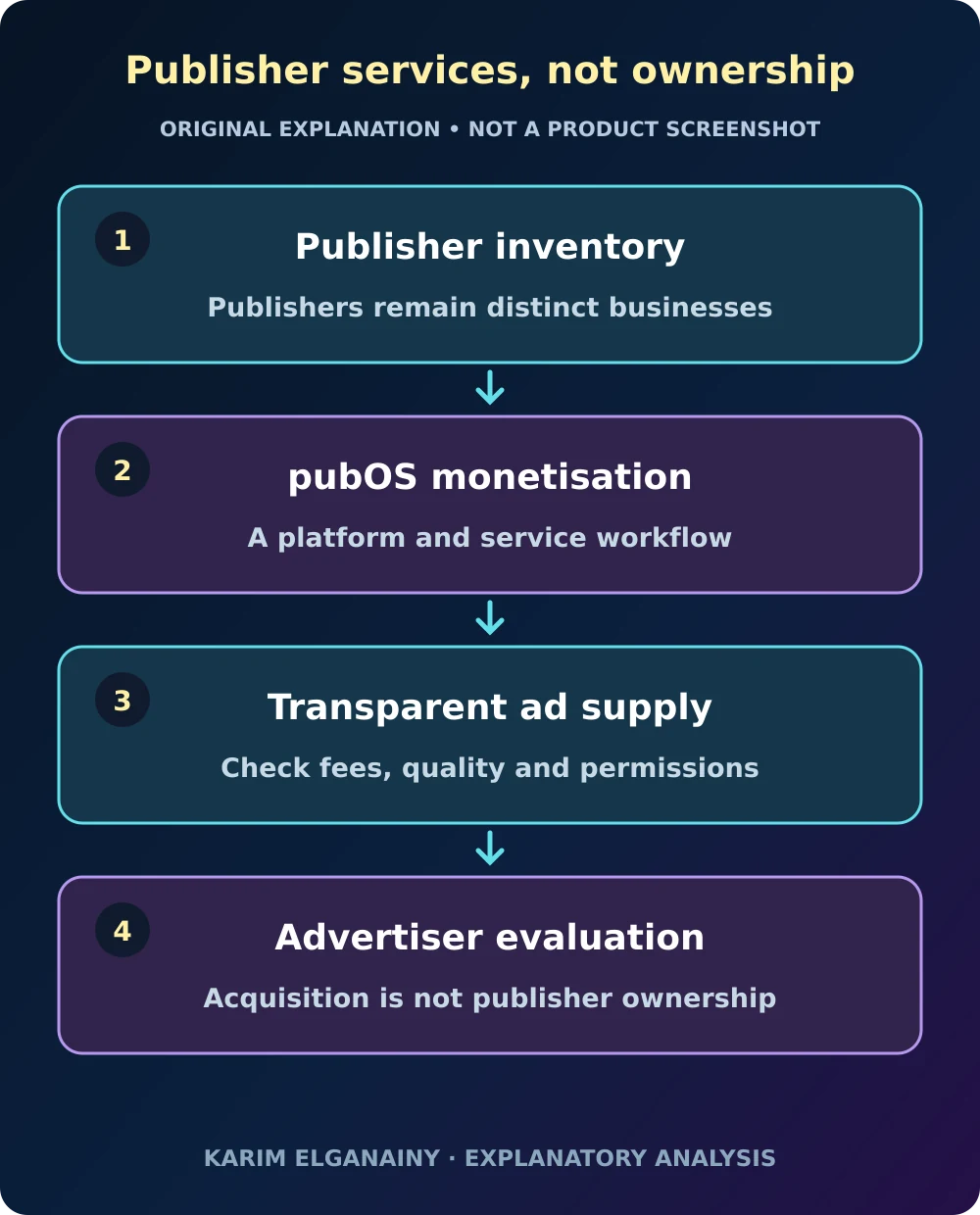
Original explanatory illustration by Karim Elganainy, showing an editorial media-evaluation framework rather than a transaction diagram supplied by the companies. Source: Stagwell acquisition announcement.
Translate the corporate story into a buyer question
An acquisition headline describes a change in corporate ownership. A buyer's decision concerns a particular campaign, audience, market, and contract. Start by asking whether the proposed arrangement changes access, service responsibilities, reporting, or commercial terms for the work under review. If none of those changes, the news may warrant monitoring rather than an immediate alteration to the media plan.
Ask the account team to distinguish what is operational today from what is intended for a later phase. A roadmap can be relevant to a relationship, but it should not be counted as a benefit already delivered. Write down the specific claim the team will evaluate and the evidence needed to assess it. This makes the acquisition useful context without allowing a broad integration narrative to substitute for campaign-level due diligence.
Map the route without assuming ownership simplifies it
Request a plain-language explanation of how the proposed placement reaches the advertiser. Identify the parties involved, their responsibilities, and the reporting available at each stage. Keep the explanation tied to the actual buying arrangement rather than a generic diagram of the advertising ecosystem. A corporate relationship between two participants does not, on its own, show which operational steps disappear or which remain.
The map should clarify who can answer a discrepancy, remove an unsuitable placement, or explain a charge. Avoid assuming that fewer visible company names necessarily means a better outcome. The useful test is whether the route becomes easier to inspect and manage for the campaign in question. Where details are unavailable, record the gap and decide whether the remaining uncertainty is acceptable for the scale and purpose of the proposed test.
Compare total commercial terms, not a headline rate
A seemingly attractive media rate can be difficult to interpret without understanding what is included. Ask for a consistent description of media cost, service charges, technology costs, and any other relevant commercial components in the proposed arrangement. Compare like with like across alternatives and identify where one offer includes work that another charges separately. These are procurement questions, not claims about the pricing practices of the companies involved.
Keep the comparison tied to the intended outcome and required service level. The cheapest line item may not represent the lowest total cost of a useful campaign, while a bundled offer does not automatically justify a premium. Document assumptions and unresolved questions before approval. If the buyer cannot explain the commercial comparison to another stakeholder, the arrangement may need clarification before it becomes a recurring commitment.
Ask how recommendations are governed
When an organization participates in more than one part of a media relationship, buyers should understand how recommendations are selected and reviewed. Ask whether proposed inventory is evaluated against the advertiser's objective, what alternatives were considered, and what disclosures apply to the arrangement. The aim is not to presume improper behavior; it is to establish a process that remains credible when commercial relationships are complex.
A useful review record explains why a route was chosen, who approved it, and what would trigger reconsideration. Keep performance review distinct from relationship management so a disappointing result can be discussed without becoming a referendum on the entire partnership. Transparency is most useful when it supports ordinary decisions, including the decision to reduce a test, request a different option, or stop using an arrangement that does not fit the campaign.
Evaluate inventory at the level that matters
A publisher name is helpful context, but a campaign runs in particular environments and formats. Ask what information can be supplied about the placements actually proposed, including the content context, device experience, format, and relevant audience characteristics available through approved reporting. Do not treat a broad reputation label as a substitute for understanding where and how the creative will be encountered.
For a hypothetical educational campaign, the team might value a clear reading environment and enough space for a qualified message. A different campaign might prioritize another format. Define those requirements before comparing offers. That makes suitability an explicit planning decision rather than an argument invented after results arrive. Where placement detail is limited, use a smaller test and a proportionate review process instead of assuming that a recognizable umbrella brand settles every question.
Keep editorial relevance separate from endorsement
Advertising alongside editorial content should not imply that the publisher endorses the advertiser's claims. Review the creative and format for clear boundaries, and confirm how any sponsored or branded material is identified in the specific arrangement. The buyer should understand what readers are being shown and whether the presentation matches the approved brief. This is an editorial and procurement check, not a declaration about particular legal requirements.
Avoid borrowing the authority of a news environment to strengthen unsupported product or healthcare claims. The same claim needs appropriate support wherever it appears. For a brand seeking contextual relevance, describe the fit in terms of the audience's information task rather than suggesting that a publication's reputation transfers automatically to the advertiser. Credibility is easier to preserve when the relationship is clear and the message can stand on its own evidence.
Define quality before the campaign runs
Agree on a small set of quality criteria that can be assessed through the reporting and verification available for the arrangement. These might concern placement transparency, delivery consistency, or the visitor experience after a click. Specify how exceptions will be handled and who is responsible for resolving them. A criterion that cannot be observed or acted upon may be too vague to support a useful decision.
Keep quality measures distinct from business outcomes. A campaign can meet its placement requirements and still fail to generate the intended response, just as a short-term response does not excuse a placement that breaches the approved brief. Review both dimensions. This prevents the team from using a single attractive result to ignore a problem elsewhere in the campaign and helps identify whether the next correction belongs in media selection, creative, or the destination experience.
Test the audience hypothesis without overstating precision
Write down why the proposed inventory is expected to reach people relevant to the campaign. Identify which parts of that expectation come from available evidence and which are assumptions. Avoid treating a general readership description as proof that every delivered impression reaches the intended decision-maker. A useful plan acknowledges the difference between a plausible audience fit and an individually verified audience identity.
Select a measurement approach that can evaluate the hypothesis at an appropriate level. If the campaign is designed to support awareness, do not judge it only by immediate inquiries. If it is intended to generate qualified administrative interest, define that outcome rather than relying on raw traffic. The comparison should be coherent with the objective and the available evidence, with uncertainty stated clearly instead of hidden behind increasingly elaborate audience labels.
Preserve choice in the experiment
Use a bounded allocation rather than replacing an established plan solely because an acquisition creates a compelling story. Define what will remain unchanged, what will be tested, and how the alternative will be compared. Keep creative and destination differences documented so the review can distinguish media-route changes from other interventions. A small test can be commercially meaningful if it is designed to answer a specific question.
Set a review point and a decision rule before the campaign starts. The outcome may be to expand, revise, pause, or request more evidence. Do not interpret the absence of a clear result as automatic permission to increase spend. Sometimes the appropriate conclusion is that the test was too noisy or the reporting too limited to support a confident choice. That is information for planning the next step, not a failure to be concealed.
Make GCC relevance a local evidence question
For a GCC campaign, verify the markets, languages, formats, and placement options actually available in the proposed arrangement. A global corporate announcement does not establish local coverage or an appropriate audience mix. Ask for evidence relevant to the specific market and objective, and keep regional reach claims separate from the practical availability of inventory for a particular campaign.
Review the Arabic creative and landing experience as a complete path. An apparently suitable placement can still send visitors to information that is incomplete, poorly localized, or inconsistent with the offer. Use qualified language review and test the administrative next step. The recommendation here is to validate a local fit, not to infer that the acquisition creates a new Gulf offering or that the same media approach should be used across all countries in the region.
Apply healthcare safeguards to the message and data
A healthcare advertiser should keep the campaign objective within its approved marketing scope. Administrative information, service availability, and clear contact instructions can be reviewed without turning the campaign into individualized clinical advice. Avoid implying that placement near health-related content establishes a viewer's condition or authorizes sensitive inference. A contextual relationship is not a diagnosis and should not be presented as one.
Have the appropriate internal specialists review claims, measurement, and data handling before launch. A corporate acquisition does not establish that a particular setup meets the organization's requirements. Nor should a marketing team assume that more detailed tracking is always the better option. Use the information necessary for the approved question, preserve access boundaries, and make the destination's practical next step accurate. This framework offers no clinical recommendation or assurance of legal compliance.
Ask publishers a parallel set of questions
Publisher-side teams evaluating a service relationship can also turn the news into a specific operating review. Ask what changes in support, reporting, decision rights, and the handling of advertiser requests. Clarify who can approve changes affecting the reader experience and how commercial recommendations are evaluated against the publication's own priorities. These questions matter even when a relationship remains stable after an ownership change.
Measure success in a way that includes the publisher's responsibilities, not revenue alone. A hypothetical review could examine reporting clarity, issue resolution, and whether approved presentation standards are maintained. Do not assume that buyer convenience and publisher value are always identical, or always in conflict. The useful work is to make the relevant objectives explicit and identify how disagreements will be resolved before they become urgent operational problems during a campaign.
The strategic takeaway: require inspectable value
The acquisition is a reason to update questions, not a reason to waive them. For advertisers, the strongest next step is a concrete comparison of the proposed route, its terms, the placements it can document, and the outcomes it can support. For publishers, it is a clear understanding of service responsibilities and retained decision rights. Both sides benefit from claims that can be examined at the level where work is actually done.
Start with a limited test whose result can change the plan. Preserve the ability to choose another route, keep the commercial explanation understandable, and review quality separately from response. The most useful integration is one a team can describe through verified operational improvements. Until those improvements are established for the actual relationship, treat them as propositions to evaluate rather than completed results implied by the acquisition headline.
Comments
No published comments yet.