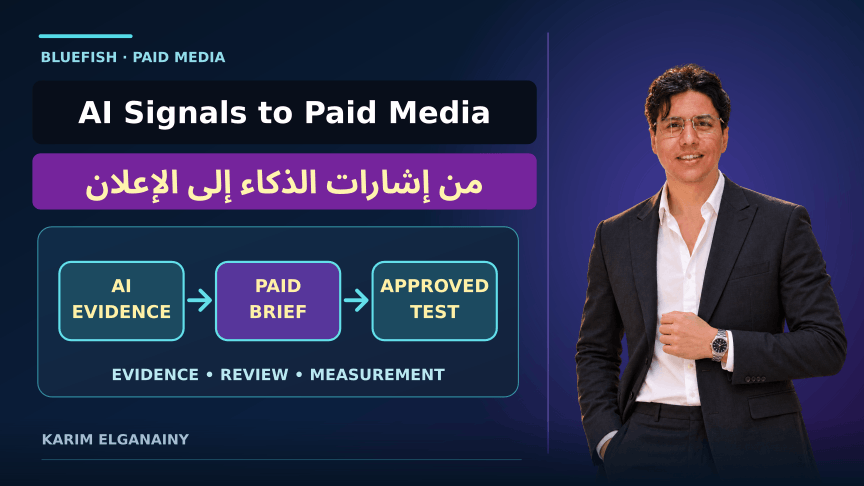
Published October 28, 2026. Bluefish has announced an expansion into paid media, including Paid Media Briefs with targeting, creative, and landing-page recommendations. Its source page displays October 26 in the header but October 27 in the announcement dateline. We preserve that discrepancy rather than presenting October 28 as the launch date. Primary announcement.
The strategic question is how an observation about an AI answer becomes a justified advertising decision. A brand's absence from one answer can suggest a research question; it cannot, by itself, establish that buying more exposure is the right response. This article develops an original evaluation framework for that decision. It is not a product test, a buying recommendation, or evidence of improved campaign results. All examples below are hypothetical, and suggested controls describe what a marketing team should assess rather than capabilities verified inside Bluefish.
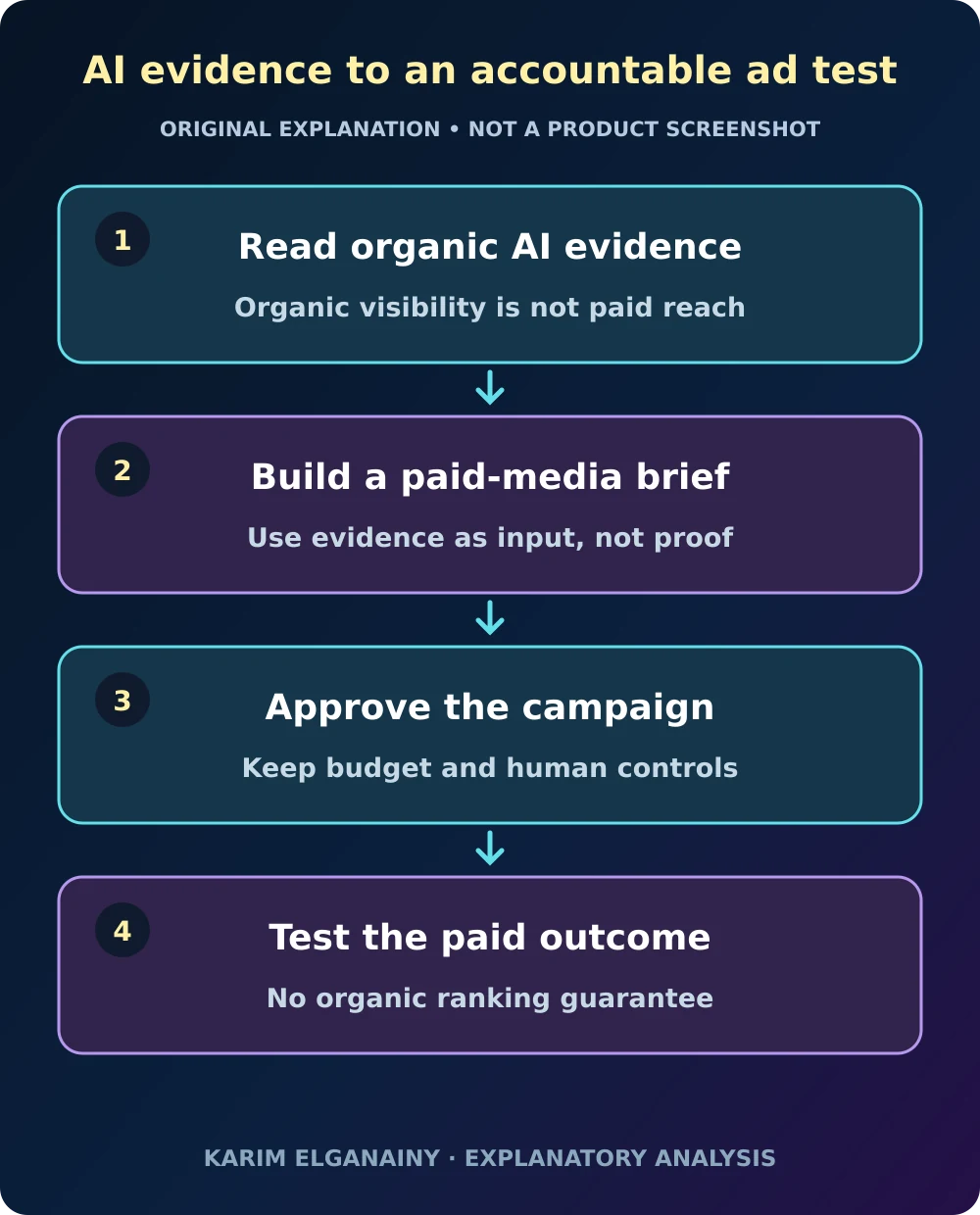
Original explanatory illustration by Karim Elganainy, showing an editorial evaluation framework rather than a product screen. Source: Bluefish announcement.
Define the business question before collecting answers
Begin with a decision that could change depending on the evidence. A team might ask whether a product's delivery conditions are poorly understood, whether a service category needs clearer explanation, or whether a campaign destination answers the questions its audience actually has. These are narrower and more useful than asking how often the brand appears in a large collection of generated responses.
Write down the proposed consequence of each possible finding. If inaccurate information would trigger a content correction, distinguish that from an advertising experiment. If the information is already accurate but the campaign does not reach the intended audience, a distribution test may be appropriate. Making these branches explicit prevents the research process from becoming a justification for an advertising budget that was already decided before the evidence was reviewed.
Record the observation conditions
Create an evidence record for every answer used in a planning discussion. Include the exact question, language, date, relevant settings available to the researcher, and the part of the response that supports the observation. Preserve permitted context without collecting unnecessary personal information. A screenshot or extracted sentence without its question can be easy to misinterpret when it reaches someone who did not conduct the review.
Avoid describing a limited collection as a complete picture of consumer experience. The observation shows what appeared under the recorded conditions, not everything a platform might say to every person. Ask reviewers to identify ambiguity and missing context before turning examples into categories. The point of documentation is not to make the exercise cumbersome; it is to keep a memorable answer from carrying more weight than the evidence can support.
Separate visibility, accuracy, and relevance
Use distinct labels for different problems. Visibility asks whether a brand appears in the observed response. Accuracy asks whether the information presented is supported by current facts. Relevance asks whether that information helps answer the particular question. A brand can appear frequently while the answer is unhelpful, or appear rarely in questions that were never commercially important to the organization.
This separation changes the next action. An inaccurate service detail needs verification and correction wherever the organization controls it. A weak campaign message may need a creative test. An irrelevant question may deserve removal from the monitoring set rather than a higher bid. Keep these possibilities visible in the planning brief. Otherwise a single visibility score can encourage spending on an issue whose actual cause lies in information quality or question selection.
Build a question portfolio with commercial boundaries
Select questions that correspond to real decisions the organization can serve. Group them by task, such as learning about an offer, comparing practical options, or checking availability. Document why each group matters and which team owns the underlying information. Include exclusion rules so the portfolio does not expand into topics that are interesting but unrelated to an actionable business objective.
A hypothetical home-services business could separate questions about geographic coverage from questions about service inclusions. Its team should not combine both into a single absence rate and then prescribe the same campaign response. Review the portfolio periodically with sales or service staff who understand common administrative misunderstandings. This consultation supplies context; it does not authorize importing private customer conversations into external tools or treating anecdotal questions as a statistically representative demand estimate.
Keep an observation distinct from a targeting instruction
An answer-analysis finding is an input to judgment, not an automatic instruction to target a person. Ask what audience definition is actually available, appropriate, and approved in the advertising system being considered. A topic that appears useful in research may not translate into a valid targeting option. Avoid promising precise access to people who asked a particular question unless that capability has been established through authoritative product information.
Require the media planner to explain the connection between the research finding and the proposed campaign settings. That explanation should remain understandable without relying on a vendor's confidence score. If the bridge is weak, use the finding for content planning or further research instead. A recommendation becomes operationally useful when it specifies a feasible test, its assumptions, and the decision that will follow, rather than merely naming an attractive audience.
Make the landing page the information checkpoint
Before changing campaign spend, inspect the destination page against the question that motivated the test. Does it explain the relevant offer, its limits, and the practical next step? Are important conditions visible without requiring the visitor to search several unrelated pages? Have the responsible teams confirmed that the details are current? These checks are within the advertiser's control and provide a concrete starting point.
Use a change log to distinguish page corrections from paid-media changes. If both happen together, interpretation becomes harder: a better outcome could reflect clearer information, different distribution, or both. That does not make the combined intervention useless, but the report should describe it honestly. An evidence-led team can choose a bundled improvement while acknowledging that it has not isolated the contribution of each component and cannot claim a platform-specific causal effect.
Translate the insight into a creative hypothesis
A useful creative brief names the misunderstanding it intends to resolve. For example, the hypothesis might be that explaining what a package includes will help appropriate visitors decide whether to inquire. The creative then needs a clear message, a supported claim, and a destination that continues the explanation. Avoid language suggesting that the brand can control or guarantee the answer an AI system provides.
Prepare alternatives that differ in a meaningful way rather than changing several variables without a reason. One version might foreground a verified practical detail while another leads with a broader category explanation. Specify what would make either version unsuitable before looking at results. That discipline keeps attractive engagement numbers from rescuing copy that misstates the offer, creates an unrealistic expectation, or draws inquiries the organization is not equipped to serve.
Design measurement around the decision
Choose a primary outcome that fits the test and can be measured responsibly. A campaign intended to clarify an offer might be assessed through appropriate inquiries and reduced administrative confusion, rather than clicks alone. Define the numerator, denominator, observation period, and treatment of duplicate or irrelevant contacts. Keep the measurement plan small enough that the team can implement it consistently and explain its limits.
Where possible, separate the effect of the intervention from other changes. If a controlled comparison is unavailable, describe a before-and-after review as directional evidence and record major confounders. Do not equate a change in answer visibility with a change in revenue. Those observations concern different stages of the decision process. A good report can conclude that message quality improved while the commercial effect remains uncertain and requires further observation.
Bound spend and execution authority
Set a budget ceiling, an approval owner, and stop conditions before a paid test begins. Recommendations should not quietly become permission to publish, raise budgets, or change targeting. Keep research access, drafting authority, and spending authority distinct. A person who can inspect an intelligence report does not automatically need the ability to launch every action suggested in that report.
Include practical stopping conditions beyond poor performance. Pause the test if the destination contains an unverified claim, the measurement configuration differs from the approved plan, or the operating team cannot handle the inquiries appropriately. These are proposed governance controls, not assertions about a vendor's default settings. The objective is to make the experiment reversible and understandable, with a clear record of what was authorized and what the team actually changed.
Evaluate Arabic and English independently
For a GCC pilot, use locally relevant question sets and review the meaning in each language. Do not treat an English question translated word for word as complete coverage of an Arabic information need. Ask qualified reviewers whether the phrasing reflects the intended task and whether the response has preserved important qualifications. Keep market and language differences visible rather than pooling everything into a regional average.
Apply the same scrutiny to the advertising destination. An Arabic ad leading to an incomplete English form may introduce friction that has nothing to do with AI-answer visibility. Record the experience across the whole path, including acknowledgment messages and administrative follow-up. This is a recommended evaluation approach, not a verified claim about Bluefish's Arabic capabilities or current advertising availability in any particular Gulf country. Confirm actual product and market support before planning deployment.
Apply a narrower boundary in healthcare
A healthcare organization can use this framework to examine administrative information such as locations, contact routes, or service descriptions approved by its responsible specialists. Keep marketing analysis separate from diagnosis, treatment selection, and individualized clinical guidance. An observed question about health does not justify inferring a person's condition or building a campaign around sensitive assumptions about that person.
Have the appropriate internal reviewers assess data handling, claims, and proposed measurement before testing. Do not assume that a vendor's positioning or an integration makes every use appropriate. The practical marketing task may simply be to correct an inaccurate administrative page and improve its bilingual explanation. That can be a legitimate outcome without creating a new audience, sending sensitive details to an advertising platform, or presenting the work as a clinical benefit.
Ask procurement questions the pilot can answer
Request a demonstration using an approved example and ask which parts are currently available, which require configuration, and which remain on a roadmap. Clarify the sources behind a recommendation, the ability to inspect supporting observations, and the process for correcting an error. Ask how the proposed workflow fits the team's existing approvals rather than assuming a new interface replaces them.
Evaluate total effort, including review and implementation, rather than the speed of generating a brief. Compare the proposed method with a simple existing workflow using the same evidence and question. A procurement decision becomes more defensible when the team can identify a repeatable benefit and a known limitation. It need not rest on a sweeping promise that all organic and paid activity will become one seamless process after a subscription is purchased.
The strategic takeaway: buy learning before scale
The opportunity is to shorten the distance between a documented information problem and a well-designed marketing test. Start with one question portfolio, one approved destination, and one accountable decision. Make it possible to stop with a content correction, a rejected hypothesis, or a decision not to spend. Those outcomes can be as useful as a campaign that proceeds.
For marketing leaders, the standard should be inspectable reasoning: what was observed, why it mattered, what was changed, and what the evidence now supports. The announcement provides a timely prompt to develop that discipline, but it does not replace it. Expand only when the team can distinguish better information from greater exposure and can explain how its next investment follows from the results rather than from the appeal of a new category label.
Comments
No published comments yet.