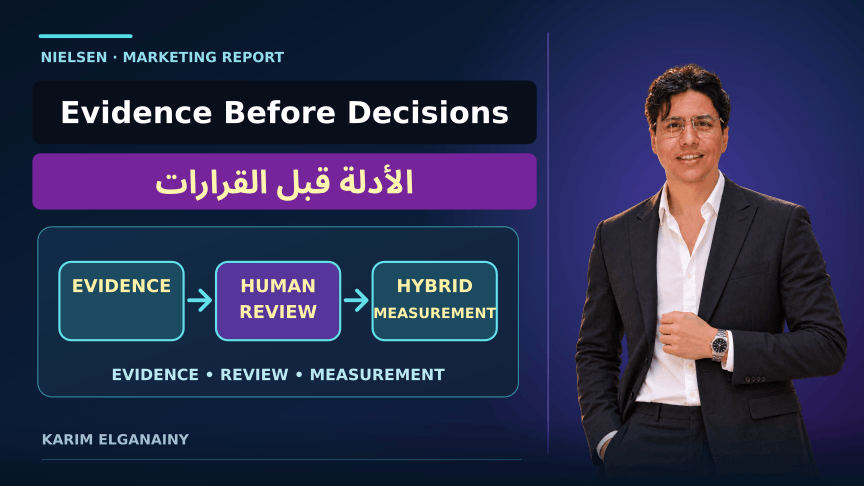
Nielsen’s 2026 Annual Marketing Report offers a useful starting point for a harder conversation: how should a marketing team connect AI-assisted decisions, brand investment and commercial accountability? Nielsen’s official insights archive dates the report to October 26, 2026. This analysis is published on October 28 and focuses on the management decisions the findings can inform, rather than treating a survey as a prescription for every business.
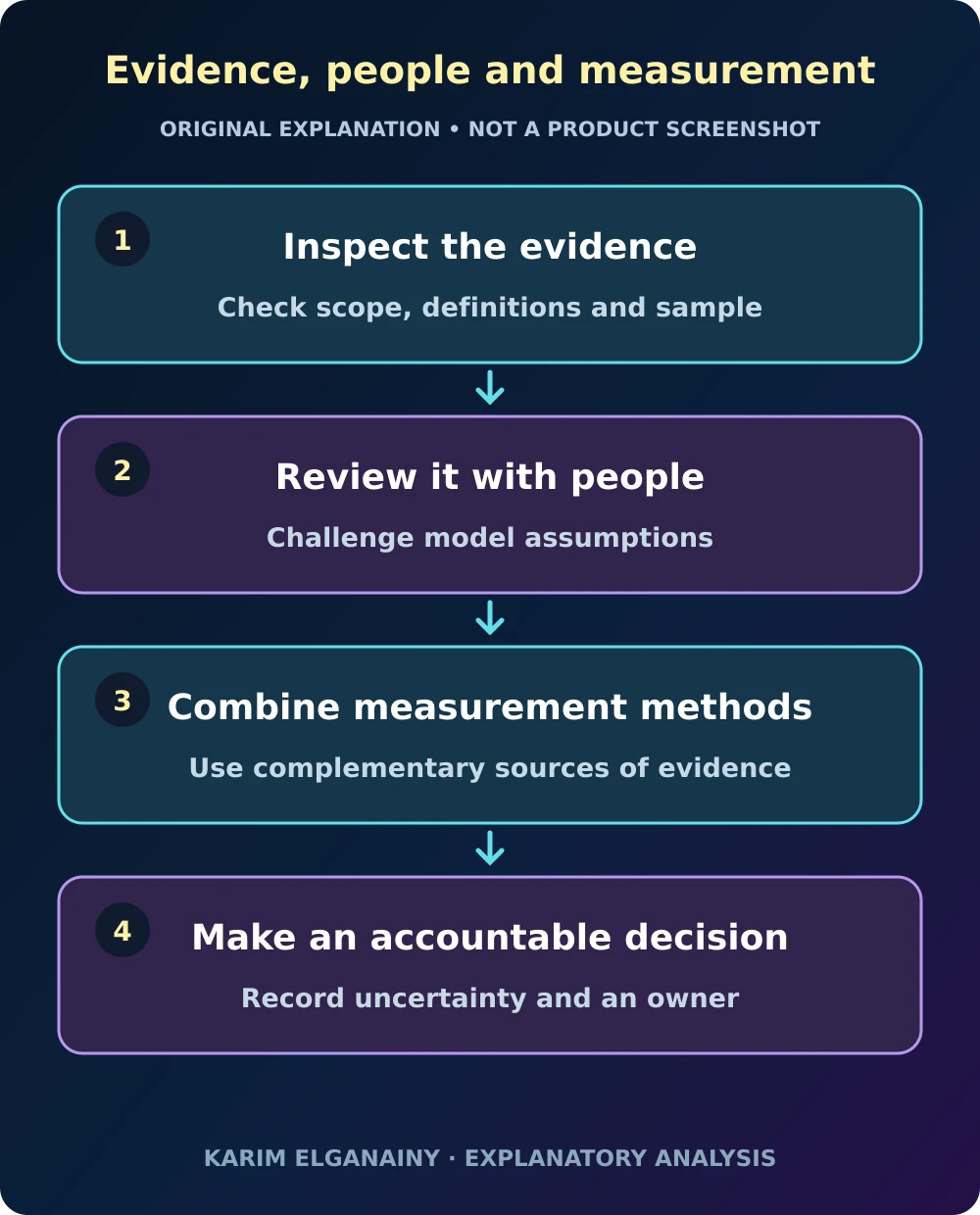
Original explanatory illustration by Karim Elganainy. Editorial interpretation informed by Nielsen’s report, not a reproduction of its charts.
Three signals, with their limits intact
The report page says 55% of surveyed marketers trust AI recommendations but require human review; 49% use hybrid or full-funnel metrics to assess combined impact; and 58% have dedicated, growing creator-partnership budgets. Its quick-read description refers to 1,200 marketers across six markets. These figures describe reported practices and attitudes, not demonstrated improvements in sales or profitability.
The public summary inspected here does not provide the complete sampling frame, fieldwork dates, question wording, weighting or subgroup bases. Without those details, readers should not calculate a margin of error, assume national representativeness or extrapolate a percentage into a universal market size. The analysis below is an independent planning framework. Its proposed actions are not additional findings from the survey, and no implementation results are claimed.
Define what a decision needs before adding AI
Before evaluating an AI recommendation, write down the decision it is meant to support. A request to improve campaign performance is too broad to review consistently. A decision about whether to revise a particular audience, creative message or landing page can be connected to evidence, constraints and a responsible owner.
A useful decision brief contains the objective, the available options, the evidence required and the consequences of being wrong. It also specifies what the system may not decide. For example, a tool might propose a budget reallocation while the account owner retains approval over spend. This makes the review meaningful because the reviewer knows what must be checked. Otherwise, a polished recommendation can enter a meeting without anyone being clear about which business assumption it relies on or what action it authorizes.
Give human review an operational meaning
Requiring a person to approve an output is only the beginning of governance. A team should define which errors that person is expected to catch and what information they need to catch them. Reviewing a headline for unsupported claims is different from reviewing a proposed targeting change or a forecast used in a quarterly plan.
Assign review responsibilities by expertise and consequence. A subject-matter expert can check product accuracy; an analyst can inspect the calculation; a budget owner can assess commercial trade-offs. One approval button should not be assumed to cover all three. Record material changes and rejected recommendations so the organisation can learn where assistance is reliable and where it creates avoidable rework. A review process earns its place by improving decisions, not by adding an undocumented pause before an automated suggestion is accepted.
Distinguish data quality from presentation quality
A clear dashboard can make inconsistent inputs look coherent. Before using any generated summary, check whether the underlying figures refer to the same period, geography, currency and audience. Ask whether conversions are counted once or several times, and whether the definition changed between the periods being compared.
Build a short data dictionary that names each measure, its owner, its source and its refresh schedule. Include known exclusions and unresolved discrepancies rather than hiding them in an analyst’s private notes. If two systems disagree, describe the disagreement before averaging or combining their values. The goal is not to delay every decision until the data becomes perfect. It is to prevent a presentation layer from implying a level of precision that the inputs cannot support, especially when a recommendation will influence money or public claims.
Make full-funnel measurement a decision system
A collection of awareness, engagement and sales figures does not automatically explain how marketing works. Start by asking which decisions each measure supports. Reach may help evaluate delivery, a research measure may help assess a brand response, and a business outcome may help assess commercial contribution. Those roles should remain visible even when the measures appear together.
Avoid forcing all signals into one score unless the weighting has a clear rationale. A composite can conceal a weak result behind a strong but less relevant one. A more useful review explains what moved, which explanation is plausible and what evidence would challenge it. If awareness rises while qualified demand falls, the team needs a diagnosis, not an average that labels the campaign acceptable. Measurement should expose trade-offs that managers can discuss rather than smooth them away.
Write the causal claim before choosing the method
A marketing report should distinguish association from contribution. If sales rise during a campaign, several explanations may remain possible, including price changes, distribution, seasonality and competitor activity. State the proposed causal claim plainly before selecting a measurement approach: which change is expected to produce which outcome, for whom and over what period?
Then assess what comparison is feasible. Depending on the circumstances, a team might consider a controlled test, a structured regional comparison or a documented before-and-after analysis with explicit limitations. These approaches are not interchangeable, and weaker evidence should produce more cautious wording. Where the available data cannot isolate the campaign’s effect, report the observed movement and uncertainty. Avoid presenting a precise return figure simply because a dashboard can divide attributed revenue by spend.
Separate learning budgets from scaling budgets
A useful planning distinction is between money spent to learn and money spent to expand an established approach. A test budget should answer a specific uncertainty. A scaling budget should depend on evidence that the approach can deliver an acceptable result under the proposed conditions. Mixing those purposes can make a disappointing test look like a failed rollout or let an unproven tactic expand without scrutiny.
For each experiment, define the question, the exposure needed to learn, the evaluation window and the decision that follows. Agree in advance what would justify continuing, changing or stopping it. Do not demand a commercial conclusion before sufficient evidence exists, but do not allow “learning” to become a permanent explanation for inconclusive spending. A review should be able to name what became clearer and what uncertainty remains.
Treat creator partnerships as a portfolio of jobs
A creator can contribute an explanation, a trusted introduction, a distinctive piece of creative work or access to a relevant community. Those are different jobs and should lead to different briefs. Choosing partners mainly because their audiences are large can obscure whether they are suited to the customer question the brand needs to answer.
Build a partnership brief around the audience, the message, the intended response and the evidence of fit. Specify what creative freedom is useful and which product claims require verification. Evaluate the resulting work against the agreed role rather than retrofitting a success story around whichever number looks strongest afterward. A tutorial designed to reduce confusion should not be judged only by raw views, while a broad awareness execution should not be presented as a direct-response test without an appropriate measurement design.
Clarify rights before extending creator content
A piece of creator content may be suitable for one channel without being cleared for every later use. Before producing or repurposing it, confirm the agreed scope of usage, duration, territories, editing rights and paid distribution. This is a planning checklist, not legal advice; specific contractual questions should go to qualified counsel or the responsible legal team.
Operational clarity also matters after the agreement is signed. Maintain an asset register that records what can run, where, until when and under whose approval. Include the versions actually delivered, because an edited clip may change the meaning of a statement or remove a necessary qualification. Rights and review information should travel with the asset rather than remain buried in email. That reduces the chance that a convenient creative file becomes an avoidable approval problem during campaign expansion.
Evaluate audience overlap before celebrating scale
When a campaign uses several partners or platforms, summed audience totals can exaggerate the number of distinct people reached. Even where perfect deduplication is unavailable, the team should recognize the limitation and avoid describing a combined total as unique reach. Ask what additional audience each placement is intended to contribute.
The same discipline applies to frequency. Repeated exposure can serve a purpose, but an average may hide very different experiences across audience groups. Request the most relevant distribution information available and explain what remains unknown. A portfolio review should examine whether the investment adds useful coverage or mainly repeats the same message to people already reached. This turns the conversation from buying more inventory to deciding where an additional unit of spend is likely to answer an actual communication need.
Protect regional and language differences
A multinational survey can prompt useful questions without resolving a local market decision. A company operating in Arabic and English should investigate how customer vocabulary, purchase conditions and service expectations differ. A translated headline can be linguistically correct while missing the concern that drives a decision in one market.
Use local reviewers when developing messages and interpreting feedback. Separate results by market when definitions and sample sizes permit, and label small or incomplete observations accordingly. Do not convert a pooled survey percentage into a target for every regional team. Instead, ask whether the underlying management issue exists locally and what evidence would confirm it. This preserves the value of external research while preventing it from displacing the customer knowledge and operational constraints that should shape a specific plan.
Build a review meeting around exceptions
A recurring performance meeting should focus on decisions that need attention, not on reading every dashboard aloud. Before the meeting, circulate the key movements, data-quality warnings and proposed actions. For each action, identify the owner and the evidence that would justify approving it.
During the review, separate an operational issue from a strategic question. A broken tracking event needs a different response from a weak proposition or an unclear audience. Keep a decision log that records what was agreed, what was deferred and why. Revisit earlier decisions when new evidence arrives. This creates accountability without pretending that every choice was certain at the time. It also gives future reviewers a basis for understanding the reasoning instead of judging the team solely by an outcome that became visible later.
Turn the report into a bounded internal audit
The practical next step is an audit of one decision pathway: one AI-assisted recommendation, one measurement question and one creator brief. Check whether each has a clear purpose, reliable inputs, an accountable reviewer and an agreed way to judge the result. This limited exercise can reveal gaps without requiring an immediate technology purchase or a complete reorganisation.
Nielsen’s findings are useful as prompts for that conversation, not as proof that a particular investment will work. Our assessment is that better marketing accountability comes from making assumptions and responsibilities inspectable. Improve the process where the audit finds a specific weakness, then test whether the change helps. A report becomes valuable when it leads to a clearer decision and a more honest explanation of its limits, rather than another set of percentages copied into a strategy deck.
Sources
Nielsen’s 2026 Annual Marketing Report supplies the attributed survey figures. Nielsen’s official insights archive supplies the October 26 publication date. This October 28 article’s planning framework and recommendations are original editorial analysis, not additional survey findings.
Comments
No published comments yet.