
News update — 1 November 2026
Argaam reports Saudi Chemical’s consolidated Q3 2026 revenue of SAR 1,697.54 million versus 1,788.07 million and net profit of 64.59 million versus 87.24 million. Nine-month revenue was 5,266.59 million versus 5,197.41 million; net profit was 232.37 million versus 238.48 million. Comparisons are with the corresponding 2025 periods. Financial figures: Argaam.
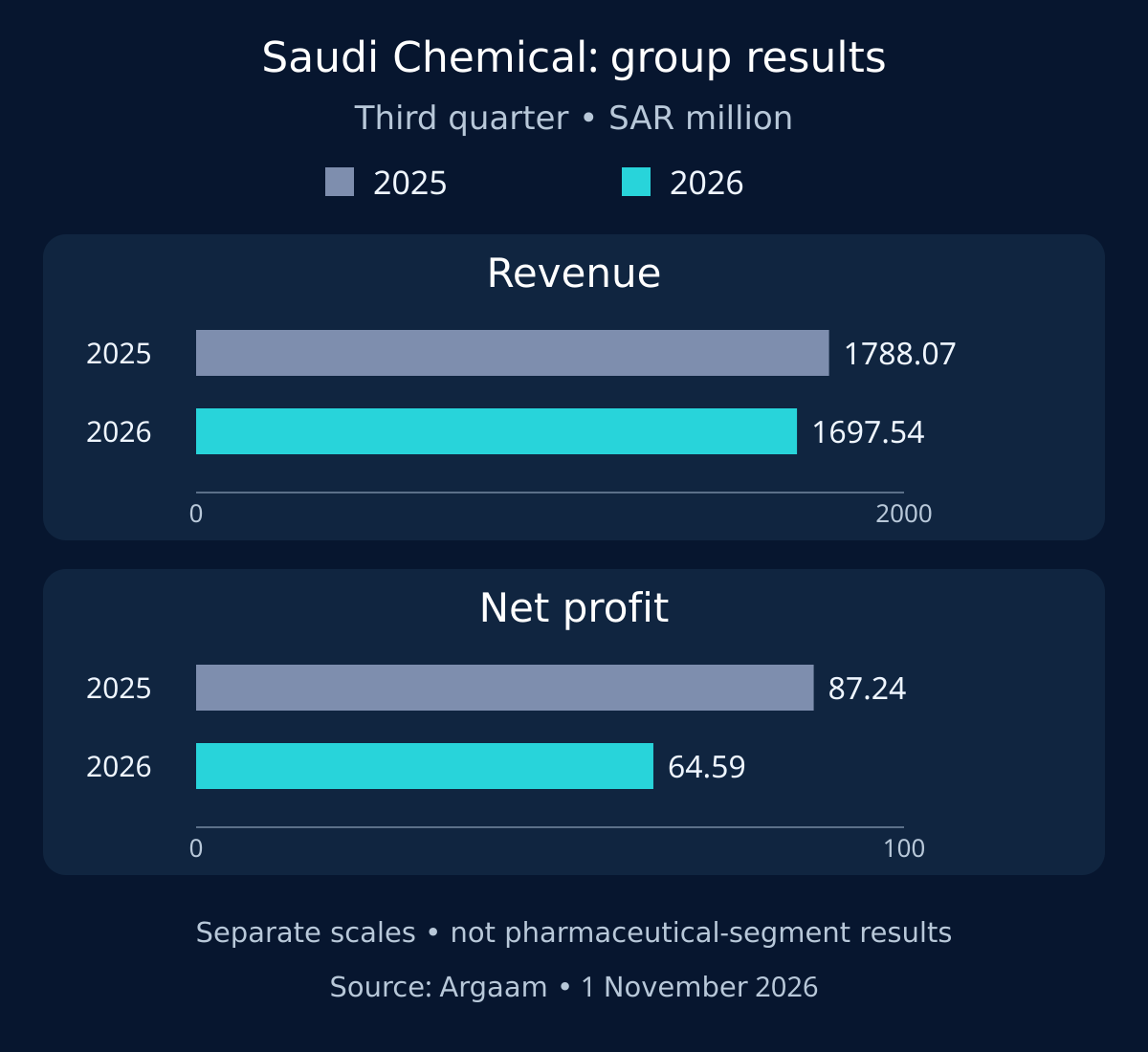
Original chart. Source: Argaam. Q3 consolidated group figures, not pharma; nine-month results appear in the text.
What is verified, and what is not
Saudi Chemical’s own company directory identifies SITCO Pharma with pharmaceutical distribution, AJA Pharma with pharmaceutical manufacturing and marketing, and CCCI with trade in medicines, medical materials and equipment. The group also includes non-healthcare businesses. Primary company source.
The financial figures above come from Argaam, a secondary source. The linked Tadawul filing was blocked by a CDN access restriction, and no Q3 segment breakdown was verified. The primary company website was checked for business scope, not used to independently confirm these results. Jaras’s announcement page is dated 1 November 2026 at 08:00 Saudi time. This verifies the date shown by that secondary source, not primary-filing confirmation.
The following sections are independent analysis for healthcare B2B and pharmaceutical marketing teams. They do not explain the causes of Saudi Chemical’s results, assess its subsidiaries’ performance, or describe practices known to be in use at the company.
Begin with the right commercial question
A diversified group’s headline result is an invitation to ask better questions, not a substitute for a business-unit scorecard. For a healthcare supplier, the useful question might be whether suitable institutional accounts can move from an identified need to a correctly fulfilled order. That is different from asking whether a campaign generated attention.
Start by choosing the decision the evidence should support. Are you deciding which accounts deserve sales attention, which product-information gaps to address, or whether an acquisition channel merits additional resources? Each decision needs different evidence.
Do not infer a pharmaceutical trend by assigning group totals to the healthcare portfolio. Request the relevant segment and operational information instead. If it is unavailable, preserve that uncertainty in the report. An honest unanswered question is more useful than a precise-looking estimate built on the wrong reporting boundary.
Map the account journey, not just the lead funnel
An illustrative institutional-sales journey could run from a qualified account inquiry through requirements clarification, technical review, an eligible quotation, a purchase order and fulfillment. Define the stages with sales and operations for the actual product and buyer.
For every stage, record the entry condition, the responsible team and the evidence needed to move forward. A downloaded brochure is not the same as a qualified buying requirement. Distinguish quotations, orders, completed deliveries and collected payments when reporting campaign contribution.
Measure account progression alongside contact activity. Several employees from the same institution may download material without representing separate opportunities. Agree how the CRM links contacts to accounts, avoids duplicate opportunities and records reopened discussions.
Make the proposition operationally credible
For a hypothetical distributor, useful marketing content could clarify the supported product range, the ordering process and the route for availability questions. For a hypothetical manufacturer, it could explain relevant capabilities and the documentation a prospective partner should request. These propositions need different sales content.
Tie every operational promise to an owner who can keep it accurate. If availability changes, a static campaign should not imply guaranteed stock. If delivery depends on a confirmed order or specific handling arrangements, communicate the appropriate qualification rather than turning an aspiration into an unconditional promise. Commercial clarity should reduce avoidable misunderstandings, not conceal them until the quotation stage.
Separate scientific or product claims from service information. Product-related material needs review by the appropriate internal specialists before use. This is not a regulatory checklist or authorization of promotional claims. The practical principle is to connect content approval with version control, accountable ownership and a clear retirement process for outdated material.
Build a scorecard that can survive reconciliation
A practical B2B scorecard can show qualified accounts, opportunities accepted by sales, quotation progression and order outcomes. Define each measure and its reporting window and denominator. Record lost or stalled opportunity reasons without forcing uncertain cases into convenient explanations.
Keep financial and operational measures distinct. Finance should define recognized revenue and the relevant contribution calculation; sales should validate opportunity status; operations should confirm fulfillment. Marketing can connect campaign and account identifiers without claiming that every subsequent transaction was caused by the campaign. Customer acquisition, repeat purchasing and account expansion may require different evaluation methods.
Review missing data as a management issue. If reasons for lost quotations are often absent, improve that recording process before concluding that price is the main obstacle. If order status arrives late, show the reporting lag. Keep unknown outcomes visible rather than silently classifying them as failures or successes.
Test one information problem before scaling
Consider an entirely hypothetical supplier receiving qualified institutional inquiries that repeatedly require clarification before a useful quotation can be prepared. A focused experiment could compare the existing inquiry journey with a clearer requirements page and structured handoff to sales. The intervention is information quality, not a price reduction or an attempt to increase medicine use.
Define the primary outcome in advance: for example, eligible inquiries reaching a correctly prepared quotation. Track safeguards such as incomplete submissions, unnecessary data collection, sales rework and unresolved buyer questions. Do not judge the change only by form completion; a longer form may produce fewer submissions but better-qualified requests, or simply create needless friction.
Use an appropriate comparison where feasible, and document differences in account mix, product availability and sales capacity. Use the evidence to expand, revise or stop. If the sample is too limited or conditions change materially, call the result inconclusive rather than presenting a before-and-after movement as a proven causal effect.
The practical takeaway
The useful response to corporate financial news is not to manufacture a marketing explanation. Separate reported facts, unknowns and testable proposals. For healthcare B2B teams, that means connecting credible information, qualified account demand, sales execution and fulfillment while respecting the boundaries between them.
This is independent business and marketing analysis, not an investment recommendation, a valuation or a forecast. It makes no claim of personal operating experience inside Saudi Chemical or its subsidiaries.
Sources and verification scope
- Argaam: Saudi Chemical financial results — secondary source for the figures presented above.
- Saudi Chemical Holding: Our Companies — primary source for the group’s business scope, not a confirmation of the quarterly financial figures.
- Jaras: announcement page — secondary-source publication date.
- Saudi Exchange: linked issuer announcement — identified link; contents unavailable because of the access restriction.
Comments
No published comments yet.