The US Federal Trade Commission’s October 29, 2026 announcement says staff sent warning letters to 25 healthcare-plan marketers and lead generators. The concerns include descriptions of coverage, costs and incentives. The agency explicitly says the letters do not allege wrongdoing by recipients. Read the primary announcement.
The remainder is original operational analysis: a proposed way for marketing teams to examine how a promise survives the journey from advertisement to conversation. It does not describe findings about any company, establish a new rule, or provide legal advice. For Saudi organizations, the value lies in the questions and controls, not in treating a US announcement as a statement of Saudi requirements. Any jurisdiction-specific decision needs separate qualified review.
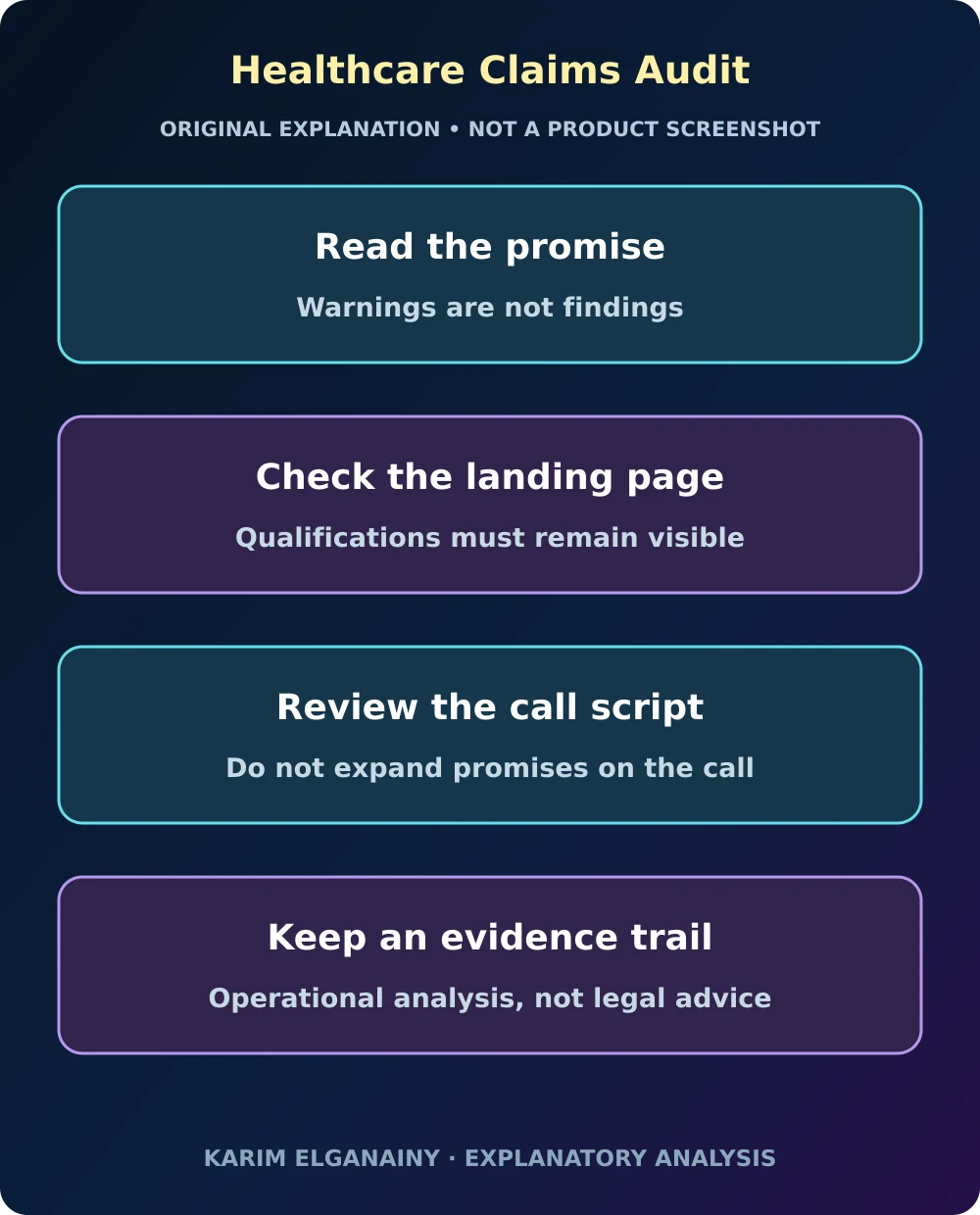
Original editorial framework; not a product screenshot or proof of campaign results.
Start with the promise a person actually receives
An advertisement can pass a narrow wording check while leaving a visitor with an inaccurate impression. A team might describe a monthly payment correctly but place it beside a headline that suggests a much broader service. The useful review question is therefore not only whether each sentence is defensible. Ask what a reasonable visitor would expect to happen next after seeing the headline, image, price treatment and call to action together. Record that expected outcome in plain language before comparing it with the service that the operational team can actually deliver.
One practical exercise is to give the creative to a colleague who has not worked on the campaign. Ask them to explain what is being offered, who provides it, what they expect to pay and what remains uncertain. Do not coach the answer. A misunderstanding is not automatically a legal conclusion, but it is useful design evidence. If several reviewers independently infer an unavailable benefit, the team has a concrete communication problem to investigate. Repeating the test after revision is more informative than collecting additional approvals on the same ambiguous design.
Build a promise ledger rather than a folder of approvals
A promise ledger is a small working table connecting each meaningful claim with its support, owner, limits and next review date. Include statements in images, comparison cards, form headings and scripts, not just advertising copy. A row might capture the phrase “appointments available,” the location and period to which it applies, the booking system used to verify it and the person responsible for updating it. This is a suggested management instrument, not a regulatory form. Its purpose is to make maintenance possible when several teams touch the same message.
The ledger should distinguish a stable description from a changeable operational fact. A service category may remain consistent while availability, price or eligibility changes rapidly. Assign the shorter review cycle to the more volatile claim. Do not solve uncertainty by adding an unreadable collection of qualifications below the form. First decide whether the headline can be made more accurate. Then place essential conditions where people encounter the relevant choice. The best outcome may be a less dramatic offer that needs fewer explanations and produces fewer avoidable misunderstandings.
Examine the handoff, not just the advertisement
Map the route from an impression through the landing page, submitted form, follow-up message and first conversation. At each stage, write down what new information appears and whether it changes the original impression. A campaign that attracts people with one proposition and introduces a materially different proposition during the call deserves attention even if every individual asset has an approval record. Reviewing the sequence makes it easier to see where a useful clarification arrives too late to guide the initial decision.
For an illustrative example, imagine a service-navigation campaign that uses the language of direct care. The visitor submits a request expecting an appointment, while the operator believes the form merely requests an introduction. No real organization is being described here. The correction could involve clearer identity, a different button label and a confirmation message explaining the next step. Training callers to repair the misunderstanding is weaker than preventing it. Track whether the revised route reduces confused conversations, not merely whether it increases the percentage of completed forms.
Give lead quality a definition people can audit
A low cost per lead can disguise a high cost of explanation. Define a useful inquiry by the task the organization is equipped to handle, rather than by the presence of a telephone number. Separate valid contact information, fit for the offered service, understanding of the next step and readiness to proceed. These are different observations. A person may be genuinely interested but not eligible, or eligible but surprised by the nature of the offer. Combining every outcome into a single “bad lead” category destroys information the campaign team needs.
Create a modest reason-code system that staff can use consistently without collecting unnecessary detail. Examples could include wrong service expected, unclear price expectation, duplicate request and unable to reach. These are proposed internal categories, not official labels. Review a sample of notes to check whether different staff apply them similarly. Report the distribution alongside spend and volume. If a cheaper creative produces far more misunderstandings, the apparent efficiency may disappear once staff time and unresolved requests enter the comparison. The organization should choose the evaluation window before declaring a winner.
Put partners inside the review boundary
Where a partner creates advertisements or collects inquiries, ask how the actual version seen by the visitor will be identified. An approved template is not evidence that every variation stayed within the intended message. Establish a way to retain the relevant creative version, destination and launch period while respecting applicable data-handling requirements. The operational objective is traceability: when a complaint references a promise, the team should be able to determine which promise appeared rather than debate what the standard template was supposed to say.
Commercial arrangements should be examined for incentives that undermine message quality. A volume-only target can reward the easiest form submission rather than an informed inquiry. This is an analytical risk, not an allegation about a particular partner. Consider a balanced scorecard combining usable demand, clarity signals and timely handling of corrections. Agree who can pause an inaccurate asset, how replacements will be checked and who informs downstream teams. A process that requires many approvals to stop a misleading variation but almost none to launch it has an avoidable operational asymmetry.
Treat translation as a fresh comprehension test
For bilingual Saudi campaigns, translation is not simply the final production step. The same design can create different expectations when terms are shortened, borrowed or given different visual emphasis. Review the Arabic and English versions against the same underlying offer record, then test each independently for understanding. Do not assume that a fluent translation preserves the practical meaning of a pricing phrase or a service category. A translator can accurately reproduce an ambiguity that the original author should have resolved before translation began.
Keep a shared terminology record for recurring service descriptions, identities and limitations. Include context and examples, not just equivalent words. If the Arabic call to action implies booking while the English version implies requesting information, decide which action the system actually supports and correct both accordingly. Avoid presenting this as a claim about any mandatory Saudi wording; local obligations require their own assessment. The operational principle is narrower and broadly useful: visitors using either language should receive a consistent explanation of what their action will initiate.
Review evidence without expanding data collection
Teams do not need to reconstruct a person’s private circumstances to diagnose a confusing offer. Begin with the creative, publicly displayed terms, form structure and aggregate outcome categories. Where a more detailed review is necessary, specify the question first, then decide what information is genuinely needed and who may access it. A broad collection of call recordings or sensitive details should not become the default simply because it could make a dashboard more complete. Keep the review proportionate to the decision it is meant to support.
Separate quality review from targeting decisions. A note explaining why someone misunderstood an offer should not automatically become a new audience attribute. Establish an explicit boundary around the permitted purpose of review material and consult appropriate specialists before changing that purpose. These are suggested governance questions, not an interpretation of privacy law. They help a campaign owner avoid solving one communication problem by creating a second, less visible data-management problem. Useful evidence is evidence that can be interpreted and handled responsibly, not merely evidence that is easy to capture.
Use a short, reversible improvement cycle
Choose a single journey with a known source of confusion, establish a baseline and change the minimum necessary elements. For example, align the headline, form label and confirmation message around the actual next step. Keep other major changes stable where feasible so the resulting pattern is easier to interpret. Set a stopping condition for obvious new confusion and define who will review it. A limited test is a way to learn about the communication design; it is not permission to experiment with a claim the organization cannot support.
The review should allow more than one legitimate result. A clearer message may reduce raw inquiry volume while improving the share of conversations that can be usefully resolved. It may also reveal that the underlying offer is poorly matched to the audience, in which case rewriting the button is not enough. Compare outcomes with their operational consequences, including staff workload and visitor experience. Document uncertainty when the sample is small or when service availability changed during the test. Precision in the conclusion matters as much as precision in the advertisement.
Decide what needs attention on Monday
A marketing lead can begin with three bounded actions: inventory the active promises, inspect one complete visitor journey and agree a shared definition of a useful inquiry. Assign an owner to every issue discovered and distinguish an immediate correction from a longer design improvement. Share the resulting decision log with the people answering calls so that the campaign and the conversation do not drift apart. The log should record what changed, why it changed and which evidence would justify another revision, without becoming a warehouse of unnecessary personal information.
The broader lesson is to manage the expectation, not merely the asset. An approved image can become inaccurate when availability changes; an accurate page can be undermined by a vague partner introduction; an effective translation can be weakened by a contradictory confirmation message. A durable review system follows the promise through those changes. It does not need to treat every negative outcome as misconduct. It needs to identify when the organization’s own communication creates avoidable uncertainty and provide a practical route to correct it before more people encounter the same problem.
Comments
No published comments yet.