
The news: a better quarter, a different cumulative picture
Care Medical's release dated 29 October 2026 reports Q3 revenue of SAR 472 million versus 412 million and net profit of 87 million versus 82 million. Nine-month revenue was 1,316 million versus 1,196 million; net profit was 233 million versus 248 million. These are rounded figures, compared with the equivalent 2025 periods. Primary company release.
This article was published on 31 October, not the announcement date. Argaam's results coverage provides an additional financial reference. The chart separates the quarterly and cumulative windows; it is an original visualization, not a reproduced company graphic.
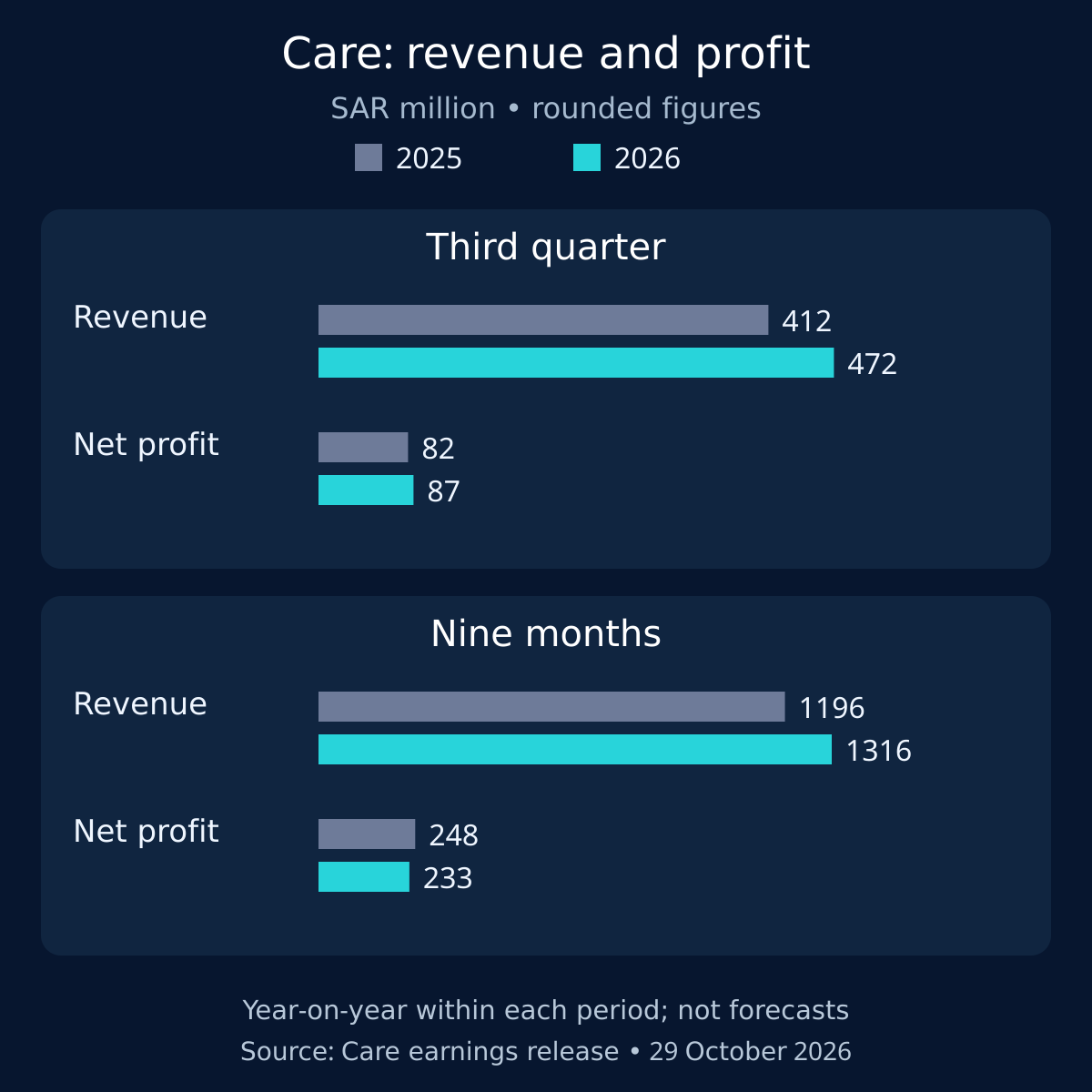
Original explanatory chart. Data: Care Medical earnings release. Rounded amounts; separate periods, not a forecast.
Analysis: ask what the growth engine actually delivers
The remaining sections are independent practical analysis, not statements that Care has implemented the suggested methods. They do not identify a cause for the reported financial movements. That distinction matters: a consolidated result can motivate a management question without answering it.
For a healthcare marketing team, the useful question is not simply whether demand grew. It is whether an appropriate service reached a person who needed it, whether the provider could deliver that service reliably, and whether the resulting activity made commercial sense after the relevant costs. A campaign dashboard rarely contains all those answers. Finance, scheduling, clinical operations and customer service each hold part of the evidence.
A useful management review therefore connects three different systems: the acquisition funnel, the service-delivery process and the financial record. Keep them connected without pretending they measure the same thing. An inquiry is not an appointment; an appointment is not attendance; attendance is not automatically a new patient; recognized revenue is not cash collected. A rising count at one stage can coexist with friction at the next.
Start with a measurement contract, not a larger campaign
Before expanding a campaign, write a short definition sheet. Specify what counts as a qualified inquiry, a booked appointment, a completed visit and a cancellation. Record whether repeat encounters are counted separately. Give every conversion rate a named denominator and a defined reporting window. This prevents an attractive percentage from concealing a change in counting rules.
For example, a hypothetical clinic might see more bookings after simplifying its contact form. That observation alone does not establish success. If duplicate bookings also increase, appointment capacity may appear fuller without more completed care. If the mix of services changes, average revenue per visit may move even when prices remain unchanged. These are possible explanations to test, not findings about Care.
Assign an owner to each measure and agree when its data becomes mature enough for decisions. The marketing team can own campaign identifiers and acquisition costs; operations can validate appointment outcomes; finance can reconcile recognized revenue and collections. Resolve discrepancies before building a combined scorecard. Otherwise, a polished report can merely make inconsistent definitions look authoritative.
Capacity should shape the proposition
A service campaign should describe an experience the operating team can actually support. Start with the appointment types, locations, available slots and service information that can be maintained accurately. Avoid scaling demand solely because a channel produces inexpensive inquiries. A low acquisition cost is not useful if the next step repeatedly disappoints people.
Consider a hypothetical service line with spare capacity at one branch but long waits at another. A practical response could be clearer location information and a better routing process, rather than a blanket discount. The test should ask whether suitable people reach the appropriate available service with less confusion. It should not encourage unnecessary treatment or promise a clinical result.
Use service-quality guardrails alongside the commercial objective: abandoned booking attempts, avoidable transfers, unresolved coverage questions, cancellations and complaints. Choose measures relevant to the actual problem. If the intervention increases completed appointments while worsening essential service safeguards, treat that as a mixed result requiring investigation, not an uncomplicated win.
Link payer information to clarity, not promises
For providers serving different payment arrangements, unclear eligibility information can create avoidable friction. A practical review can examine where people encounter uncertainty about covered services, documentation or the next administrative step. Marketing should help explain the process while leaving individual eligibility decisions to the authorized teams and applicable agreements.
Do not turn general insurer participation into a promise that every service is covered for every member. Keep public information current and provide an appropriate route for case-specific confirmation. This is a proposed communication discipline, not a claim about Care's current processes or a summary of a particular insurance contract.
The financial review should also distinguish billed activity, recognized revenue, outstanding receivables and collections. Marketing cannot resolve all of these, but a shared discussion can prevent acquisition decisions from ignoring downstream friction. Use aggregate operational reporting for this purpose; do not expose individual medical details in ordinary campaign dashboards.
A focused experiment for another healthcare business
An illustrative experiment could test a clearer booking-information page for one service and one location. State the problem first: people may be abandoning the process because the next step is unclear. Establish the baseline, choose a primary outcome such as appropriately completed bookings, and define guardrails before launching. Do not simultaneously change price, channel targeting, eligibility wording and appointment availability if the aim is to understand the page's contribution.
Where feasible, use a properly designed randomized comparison. If only an observational comparison is practical, document that limitation and examine changes in demand, staffing, availability and service mix. Set the evaluation period from traffic, variability and the decision at stake rather than a universal number of days. Inconclusive evidence is a valid outcome.
At review, distinguish implementation success from business success. A page can load correctly yet fail to improve the user journey. A booking improvement can still fail to translate into attendance. Decide whether to expand, revise or stop based on the complete evidence, and preserve the assumptions for the next review.
The takeaway: growth needs a shared operating language
The strategic lesson is to make marketing accountable to a defined service journey, not to equate every upward metric with durable value. Maintain separate views of the latest quarter and the cumulative period, then ask what additional operating evidence would change the next decision. Do not infer a campaign's causal contribution from consolidated financial statements.
This is business and marketing analysis, not a recommendation to buy, sell or hold securities. It makes no forecast of Care's results or valuation and does not claim personal operating experience at the company.
Sources
- Care Medical: Q3 2026 earnings release, dated 29 October 2026; primary financial reference.
- Care Medical investor relations, company publication archive.
- Argaam: Care Medical financial results, secondary cross-check.
Comments
No published comments yet.