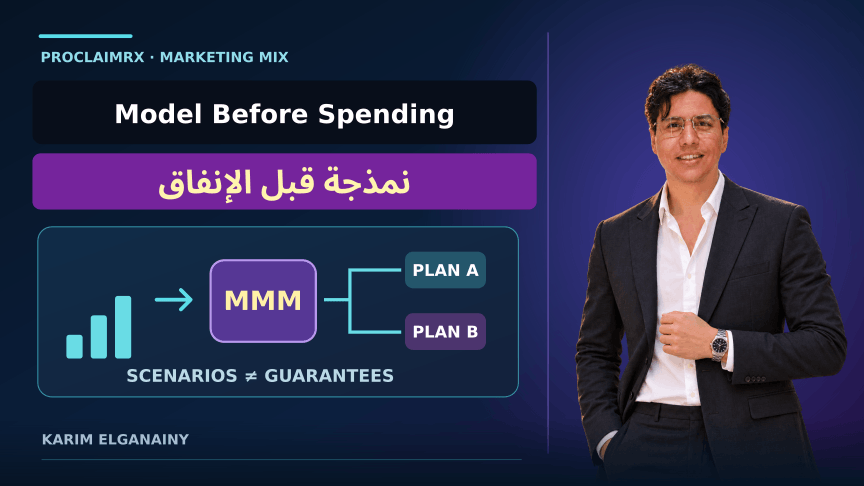
ProclaimRx announced a marketing mix modeling product for commercial-stage biopharma on October 26, 2026. The company says its PLAiTO engine supports on-demand modeling and budget scenarios, with recommendations traceable to data and assumptions. These are supplier statements, not independently verified performance results. This October 27 article examines how a buyer could evaluate the proposition. Company announcement, distributed through PR Newswire.
The important marketing question is not whether a model can produce another answer quickly. It is whether the answer changes a real decision in a defensible way. The following framework is original editorial analysis: a proposed buying and validation process, not a description of additional ProclaimRx features, a report of customer experience, or a guarantee of return.
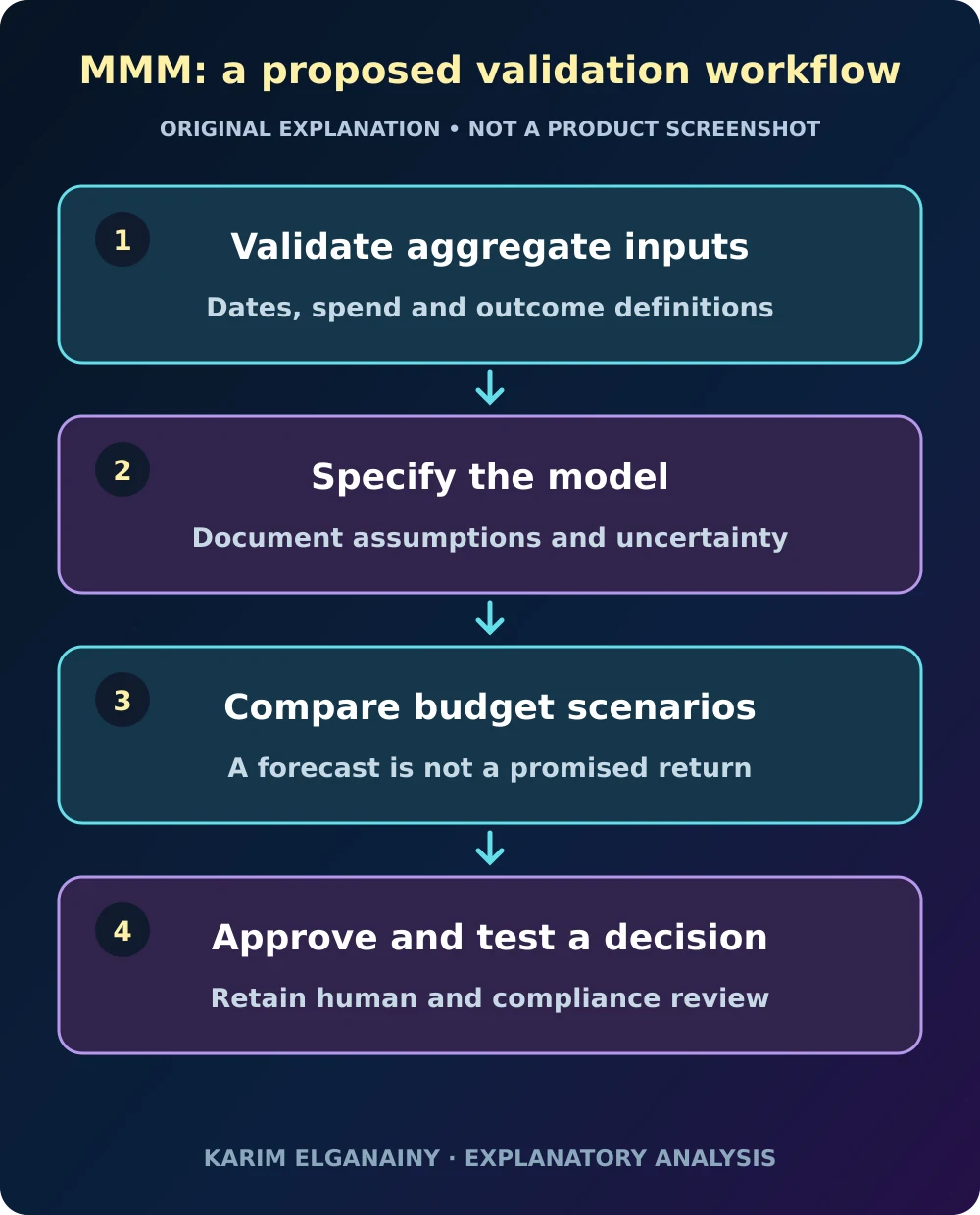
Original explanatory illustration by Karim Elganainy: a proposed evaluation workflow, not the product interface or evidence of performance. News context: ProclaimRx announcement.
Start with a decision that somebody owns
Before arranging a demonstration, write a one-page decision brief. Specify which budget is under review, who can change it, when the decision must be made and what alternatives are genuinely available. An analysis of all commercial activity can become impressive but unusable when the buyer has authority over only one small component.
A useful starting question might be whether to preserve the current channel allocation or test a modest change in one eligible geography. That is different from asking the system to find the optimal marketing strategy. The narrower question makes it possible to identify necessary evidence, operational constraints and an accountable decision maker. Keep a list of questions outside scope so that a promising demonstration does not quietly become an unlimited implementation project.
Define the outcome before collecting the data
Choose an outcome with an agreed meaning and a reliable reporting process. A commercial team might consider net sales, qualified professional engagement or another approved business measure, but those variables answer different questions. Do not permit the most convenient available measure to become the objective without discussion.
Write the definition beside its limitations. If the outcome is revenue, establish the treatment of returns, discounts, timing and currency. If it is engagement, define which actions count and why they are relevant. If the buyer ultimately cares about a downstream business result, preserve the distinction between that result and an intermediate signal. This prevents a presentation from moving between unlike metrics while appearing to tell one coherent performance story.
Build a data contract, not a spreadsheet collection
For a first evaluation, ask every contributing team to describe its dataset in the same format: owner, time period, geography, frequency, units, revision policy and known gaps. Include the meaning of a missing value. A blank caused by a delayed feed should not automatically become zero activity.
Create a reconciliation step before modeling. Finance, media operations and commercial analytics should be able to explain why their totals agree or differ. Keep the original extracts and record subsequent transformations. This does not require giving every employee access to sensitive information; it requires enough documentation for authorised reviewers to reconstruct the relevant process. The proposed standard is simple: a surprising recommendation should prompt an investigation, not a hunt for the file that happened to be uploaded.
Separate controllable activity from market context
List candidate explanations for changes in the outcome before inspecting a vendor recommendation. Promotional activity is one category; distribution, availability, commercial agreements and changes in the underlying market may belong on a separate contextual list. The point is not to assume every factor can be measured perfectly, but to expose omissions that could matter.
Ask the analyst to explain which variables the model includes, which it excludes and why. When two activities tend to move together, request a discussion of how confidently their contributions can be separated. Avoid treating a precisely displayed number as a precise understanding of the business. A responsible evaluation should make room for uncertain attribution and for decisions that cannot be supported by the available variation in the data.
Turn transparency into a demonstration requirement
The practical test of explainability is a review task. Select one recommendation and ask the team to trace it from the proposed action back through the scenario, inputs and assumptions. Then change a documented assumption and observe how the answer changes. Record whether the explanation remains understandable to both the technical reviewer and the budget owner.
Request an exportable decision record rather than relying only on a polished screen. It should identify the model version, dataset cut, scenario settings, constraints and reviewer comments. These are proposed procurement requirements, not capabilities confirmed in the announcement. If an important component is unavailable, document the gap and its consequence instead of implying that an attractive presentation has satisfied the entire requirement.
Validate before allocating money
Agree on a validation plan before seeing the preferred recommendation. Ask how the model will be evaluated on information not used in fitting, how unstable results will be identified and what comparison will provide a meaningful baseline. The exact method should be chosen by qualified analysts for the dataset, not copied mechanically from an example article.
Add business plausibility checks alongside statistical review. Would the recommended action exceed eligible audience size, available inventory or the organisation's ability to execute? Would the projected effect require a sudden change unsupported by operational knowledge? A result can deserve further investigation without being ready for deployment. Define who can reject a scenario and require a written explanation when a material concern is overridden.
Use scenarios to expose choices, not hide them
Present a small set of interpretable options. For example, compare maintaining the current plan, making a constrained reallocation and conducting a limited test. Use the same accounting basis and time horizon for each. Clearly distinguish a model estimate from an approved spending commitment.
Include a downside case and a no-change option. A scenario exercise becomes less useful when every route assumes growth and the only decision is how enthusiastically to proceed. Ask which assumptions would have to hold for each option to be attractive. If the recommendation reverses under a reasonable alternative assumption, that sensitivity is part of the decision, not an inconvenient detail to remove from the executive summary.
Add operational constraints before optimisation
Marketing budgets exist inside contracts, creative production schedules and approval processes. Build a constraint register with named owners. Separate genuinely fixed restrictions from preferences that could be reconsidered. A contractual commitment should not be treated like a negotiable planning habit, and a negotiable habit should not quietly become a mathematical law.
For regulated products, require the relevant internal reviewers to confirm that proposed activities are eligible before treating them as executable options. This article does not establish a jurisdiction-specific advertising rule or permission. The working principle is narrower: an analytical recommendation should never substitute for the organisation's actual medical, legal, privacy and commercial approval processes. A technically attractive option that cannot be implemented is not a usable allocation plan.
Design a bounded learning exercise
If evaluation supports further work, choose a pilot that can produce a decision rather than merely generate another dashboard. Specify its duration, eligible scope, budget ceiling and stopping conditions. Document how performance will be interpreted if market conditions change or a feed becomes incomplete.
Where feasible and appropriate, ask the measurement team to design a comparison that tests the proposed action. Do not label every before-and-after movement as an effect caused by marketing. The final report should describe what changed, what was measured and which alternative explanations remain. A pilot can succeed by revealing that a proposed allocation is not justified; saving the organisation from a weak decision is a legitimate learning outcome.
Keep healthcare interpretation within its boundaries
Commercial analytics should not be presented as evidence that a treatment improves health outcomes. Likewise, a model of promotional activity should not be used to invent claims about patient need or individual clinical suitability. Keep the article's business analysis separate from clinical communication and from decisions reserved for qualified professionals.
For a Gulf-based team considering a similar analytical approach, start with local relevance rather than importing another market's assumptions. Review product availability, audience eligibility, data permissions, currency and reporting conventions with the responsible local teams. Do not assume the announced product is available, compliant or appropriate in every jurisdiction. Request direct confirmation of service scope and contractual terms before planning an implementation around it.
Give faster analysis a slower approval checkpoint
If a team can create scenarios frequently, establish rules for which changes require review. Not every refreshed estimate should trigger a new budget instruction. Define a cadence for routine monitoring and a separate escalation process for material deviations, so the organisation does not confuse analytical activity with strategic progress.
Maintain a decision log that records accepted, rejected and deferred recommendations. Include the reason, accountable owner and next review point. This produces a learning asset even when a particular model is replaced. The goal is continuity of judgment: future reviewers should understand why a decision made sense with the evidence available at the time, rather than judge it only by a result that became visible later.
Evaluate the economics of the evaluation itself
Ask for a cost picture covering implementation, data preparation, analysis, training, ongoing support and internal review time. Distinguish a one-time setup cost from a recurring operating expense. Compare that total with the importance and frequency of the decisions the organisation expects to improve.
Do not manufacture a return figure simply because the proposal concerns return on investment. Begin with a business case expressed as testable assumptions: which decisions might improve, what evidence would support that improvement and what it costs to learn. Include an exit route, data portability expectations and responsibilities after termination. A product can be technically interesting yet poorly matched to the buyer's current decision volume or organisational readiness.
The strategic takeaway: buy a better decision process
My strategic reading of this development is that the purchasing conversation should move from model speed to decision quality. An impressive demonstration is a starting point. The stronger commercial case connects a specific question, documented inputs, credible validation, executable options and an accountable approval process.
A marketing leader can act now without committing to any vendor: choose one allocation decision and assemble the evidence packet described above. That work clarifies whether a specialised tool would solve a real bottleneck or simply automate an unresolved argument. The disciplined next step is a bounded evaluation with explicit acceptance criteria, not an assumption that a new analytical product will automatically produce better growth.
Source
- ProclaimRx issuer announcement, October 26, 2026, 12:10 ET, distributed through PR Newswire. Product statements are attributed to the supplier; the evaluation framework above is original analysis.
Comments
No published comments yet.