Generative Pulse opened early access to a standalone brand-monitoring platform on October 26, 2026, according to Muck Rack. A Muck Rack subscription is not required; the company plans a fuller launch in early 2027. Its SEEN framework examines inclusion in AI answers, evaluation, factual accuracy and narrative alignment. This is an early-access announcement, not evidence of improved sales or guaranteed recommendations. Issuer announcement.
Published October 27, this analysis asks a different question from the launch release: how should a marketing team turn observations about AI answers into a defensible operating process? The useful opportunity is not another score on the executive dashboard. It is a clearer path from an observed problem to a verified correction, with someone accountable for the outcome.
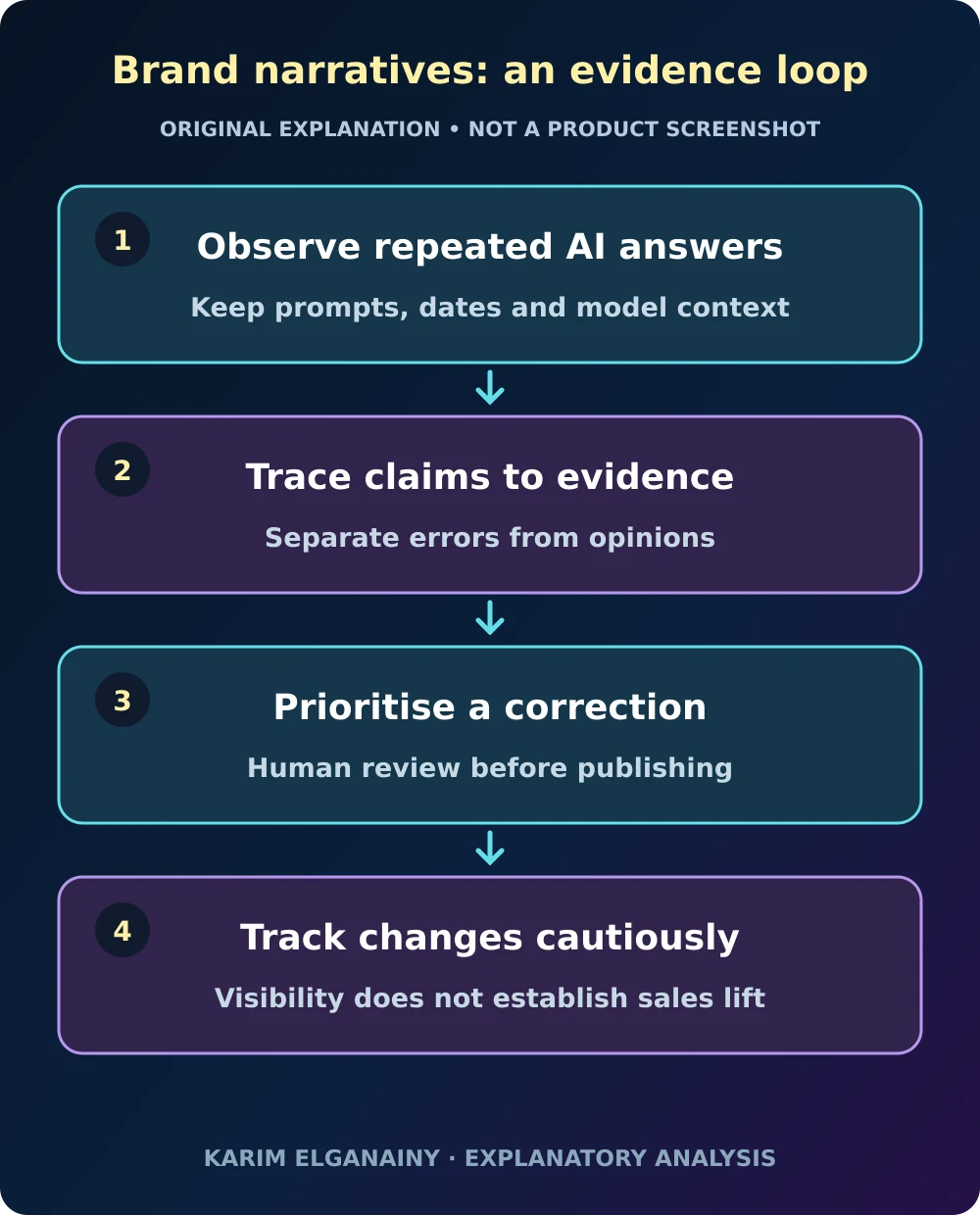
Original explanatory illustration: an independent proposed review workflow, not a Generative Pulse screenshot or a report of customer results. News context: Muck Rack announcement.
Analysis: begin with the decision, not the score
A marketing department should first decide what it would do differently after reading a monitoring report. If the answer is only “show the number to management,” the implementation brief is incomplete. A useful question might be whether prospective customers receive the correct explanation of a service, whether an obsolete offer persists, or whether the organisation is confused with another business of a similar name.
Write each question as a decision statement. For example: if repeated answers cite an outdated eligibility page, the content owner will check and replace that page, then review the same question set after the update becomes accessible. This does not assume the change will alter any model’s answer. It establishes what the team controls and what evidence would count as progress.
Separate reputation, discovery and conversion decisions. A misleading description can be important even when traffic is small. Equally, frequent mentions may be commercially unhelpful when they appear for irrelevant questions. One combined score cannot resolve these different priorities without an explicit weighting policy.
Construct a question set that resembles real demand
Build the initial monitoring panel from approved public customer questions, sales objections and service enquiries. Remove personal details and avoid copying sensitive conversations into a third-party service. Group questions by intent: discovering options, comparing providers, checking a specific fact, and deciding whether the next step is appropriate.
Do not let branded questions dominate the sample. Asking directly about a company is different from asking for options in a category where the company might reasonably appear. Keep both groups, label them, and report their results separately. Otherwise, an increase in easy branded queries could produce a reassuring chart while category discovery remains unchanged.
Record wording, language, location assumptions and collection date. Keep a stable core panel for comparisons and a separate exploratory panel for emerging issues. If every question changes each week, the team loses its baseline. If no question ever changes, the panel can miss genuine shifts in customer demand. A two-panel design makes that trade-off visible rather than hiding it inside a single trend line.
Distinguish a factual error from an unwelcome opinion
A monitoring process needs an evidence register before it needs an escalation channel. For every claim under review, capture the exact statement, the answer date, any cited page, the relevant public fact and the person qualified to verify it. A communications preference is not automatically a factual correction.
Suppose an answer gives an incorrect branch address. That can be compared with an approved location record. Suppose instead it describes a company as expensive. The team should examine the comparison context and available evidence rather than simply mark the statement wrong because it dislikes the wording. These situations require different responses.
Introduce practical labels such as confirmed factual error, unsupported claim, ambiguous wording, outdated information and unresolved disagreement. Assign severity separately. A minor spelling mistake and a false claim about service availability should not receive identical urgency merely because both are technically inaccurate. The aim is a queue that helps people act responsibly, not a larger count of detected problems.
Keep the original answer beside the interpretation
Preserve the observed answer and the analyst’s assessment as separate records. An automated summary may omit a qualification, merge two competitors or miss that a cited page discusses an older product. Reviewers need enough context to challenge the interpretation without repeating the entire collection process.
Muck Rack’s AI terms say customers should verify generated outputs and that accuracy and completeness are not warranted. That is a relevant caution for using analysis produced by an AI-enabled tool; it is not a verdict on this particular launch’s performance. Muck Rack AI terms.
For high-impact issues, require a second reviewer before escalating externally. Record why a classification changed, not just its final status. A small disagreement log can improve future reviews by revealing ambiguous definitions. It also protects the team from mistaking consistency of automated labelling for correctness of judgement.
Route each issue to someone who can resolve it
The most useful output is often an assigned task rather than a presentation. A broken page belongs with the web team; a contradictory service description may require product or operational approval; an inaccurate third-party article needs a factual, proportionate correction request. These routes should be agreed before the monitoring volume grows.
Create a simple handoff containing the observation, evidence, proposed action, owner, due date and verification method. Do not ask a content writer to promise a service that operations has not confirmed. Do not ask public relations to manufacture favourable coverage simply because a dashboard ranks the brand poorly.
Allow “no change” as a legitimate decision. Sometimes the answer is fair, the source is credible, or the proposed intervention would consume more resources than the issue warrants. Closing a task with a documented explanation is better than producing unnecessary content to make the workflow look active.
Design a correction experiment without claiming causality
Choose one narrow, material issue for the first experiment. Establish a baseline using a defined set of questions and collection conditions. Make the correction in the source the organisation actually controls, then maintain a dated change log. Record other events that could affect the answer during the observation period.
Repeat the same question panel after the change and compare outcomes cautiously. A corrected answer is encouraging, but it does not prove that the website edit alone caused the improvement. Different model versions, retrieval behaviour, news coverage or query wording may also matter. Avoid presenting a before-and-after screenshot as a controlled experiment.
An appropriate report states what changed, what was observed and what remains uncertain. If the error persists, investigate whether the original page is still accessible, whether conflicting pages remain, and whether the monitored answer cites a different source. The process should support a new diagnosis rather than trigger repeated rewriting of already accurate copy.
Protect bilingual accuracy instead of averaging it away
For organisations serving Arabic and English audiences, build separate question panels and review criteria for each language. A correct English description does not establish that Arabic answers use the right service name, location or eligibility language. Transliteration can create ambiguity even when both versions refer to the same organisation.
Ask a fluent reviewer to assess meaning rather than matching words mechanically. Keep an approved bilingual terminology sheet for recurring names and service descriptions. When a term has several legitimate translations, document the preferred public wording without classifying every alternative as an error.
Report language-level results before producing any combined view. A headline average can conceal a material problem affecting one audience. The same principle applies to locations or service lines: segmentation is valuable when it supports an actual decision, not when it creates dozens of charts with no accountable owner.
Use a stricter boundary for healthcare applications
A healthcare organisation could apply this workflow to public operational facts such as branch details, appointment routes and published service descriptions. That does not mean a marketing team should use monitoring software to decide clinical questions or rewrite medical advice without appropriate professional review.
Keep patient information outside the illustrative workflow. Use synthetic or fully generic questions when testing sensitive scenarios, and obtain internal privacy and clinical review where relevant. An answer about a hospital’s opening hours and an answer about treatment suitability carry different risks and require different reviewers.
Prioritise potentially harmful misinformation separately from commercial visibility. A brand may appear frequently while the answer contains an unsafe implication; a visibility score would not resolve that concern. For GCC teams, verify local language quality, contractual availability and internal data-handling requirements before assuming that a global announcement establishes local readiness.
Buy an operating capability, not a promise of influence
An early-access evaluation should ask practical questions about exports, reproducibility, access controls, support, collection coverage and the ability to inspect underlying evidence. Request a demonstration using a small agreed set of questions rather than only the provider’s strongest prepared examples.
Clarify what is included in the proposed commercial arrangement and what remains experimental. Separate the cost of the software from the staff time needed to investigate and resolve findings. A low subscription price can still create an expensive process if every alert requires prolonged manual reconciliation.
Avoid setting a success target that the tool cannot independently establish. Better AI visibility is not the same as additional qualified demand, and additional demand is not the same as profitable conversion. Where business outcomes are measurable, track them as a separate evidence stream with clear attribution limitations. Where they are not, be honest about the operational value being assessed.
Karim’s strategic takeaway
The strongest first deliverable is a short, repeatable review cycle: define the customer question, inspect the answer, validate the claim, assign the appropriate action and test again. Keep uncertainty visible at every stage. That discipline makes monitoring useful even when no dramatic improvement appears in the first reporting period.
At the end of a pilot, assess the quality of decisions as well as the volume of observations. Did the team correct a material public fact? Did it discover contradictory information? Did it reduce the time needed to route an issue? Did reviewers agree more consistently because the evidence standard improved? These are more defensible early outcomes than an unsupported promise to control what AI recommends.
The launch is a reason to evaluate a new workflow, not a reason to abandon established content quality, customer research or communications judgement. A brand earns the most from monitoring when it uses the findings to become clearer and more accurate for people, rather than merely more flattering to itself in a machine-generated answer.
Comments
No published comments yet.