
Walmart's October 26, 2026 announcement offers a timely case for thinking about the architecture of a seasonal campaign. The company sets out three shopping windows: November 12–15, November 23–29, and November 30–December 2. Its creative platform is “A Who Knew Carol,” featuring the Muppets; selected online deals give Walmart+ members a 24-hour head start while supplies last. Those are announced plans, not campaign results. Primary announcement.
Published October 27, this article examines a practical question: how can a marketing team connect a recognizable creative idea with several distinct commercial moments without turning every message into another countdown? The framework below is independent analysis. It does not describe Walmart's internal planning, attribution methods, budget allocation or expected return.
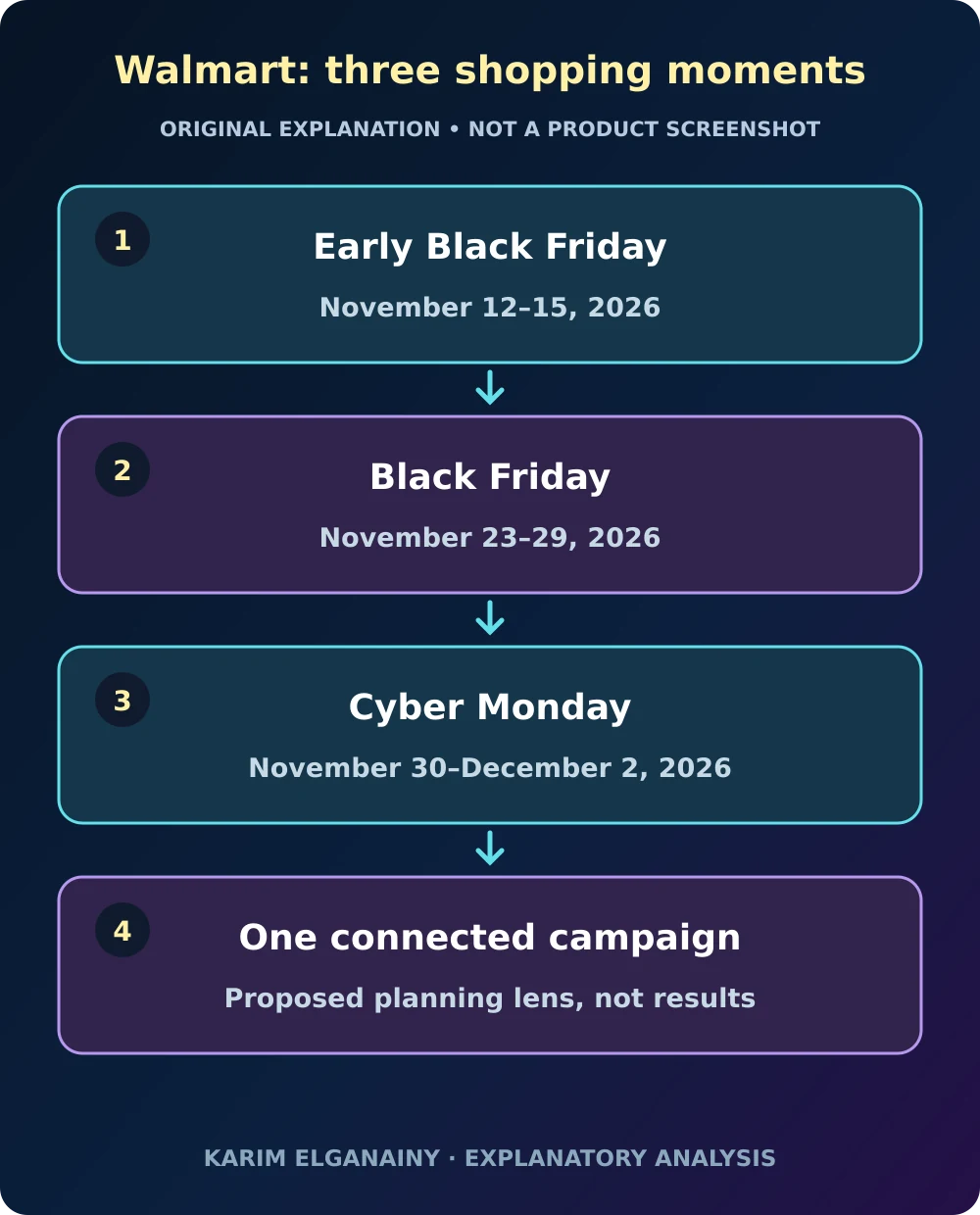
Original explanatory illustration by Karim Elganainy: an independent campaign-planning framework, not Walmart creative or a company dashboard. News context: Walmart's announcement.
Start with a customer task, not a calendar grid
A campaign calendar can look comprehensive while leaving the customer confused. The planning team sees launch dates, channel slots and asset deadlines. The customer sees a sequence of unrelated messages competing with many other demands. A useful starting point is therefore the task that the campaign helps someone complete: choose a suitable gift, compare alternatives confidently, or finish a purchase without an avoidable surprise.
Translate that task into a short proposition before dividing the season into phases. State who needs help, what decision is difficult, and what evidence the business can provide. This is more operational than an abstract instruction to increase engagement. It gives the creative team a job and gives the landing-page team a way to judge whether its content supports the same promise.
For a hypothetical household retailer, the task might be finding a practical present within a chosen budget. The campaign does not need to promise the lowest price everywhere. It could instead make product selection clearer, show relevant restrictions early and help shoppers compare a manageable set of options. That is a proposed example, not an account of the announced campaign.
Give each phase a different purpose
Multiple promotional windows should not automatically mean repeated copies of the same sales message. A team can assign a distinct decision to each phase: prepare a shortlist, act on a relevant offer, then complete an unresolved purchase. The sequence should follow customer needs and business readiness rather than forcing everyone through the same rigid funnel.
Write a one-page phase brief containing the audience, the desired action, the evidence needed, the destination and the condition for stopping a message. Someone who has already purchased should not keep receiving an urgent prompt for the identical item unless there is a clear, respectful reason. Someone who only explored a category may need practical information rather than greater pressure.
This approach also clarifies creative production. A campaign can keep its central visual language while changing the question that an asset answers. One execution can help discovery, another can explain offer eligibility, and another can resolve delivery uncertainty. Consistency comes from the underlying promise, not from repeating an identical headline until it loses meaning.
Build a promise-to-destination checklist
The most expensive campaign mistake may occur after the click. An advertisement can create a precise expectation that the destination fails to satisfy. Before approving media, compare the promise in the creative with the page that receives the customer. Check product availability, offer conditions, dates, price presentation, device usability and the next action.
Give every important claim an owner. Merchandising should verify the assortment and price; operations should verify fulfillment constraints; the marketing owner should verify that creative and page language agree. A small responsibility table is often more useful than a large presentation that leaves accountability implicit.
Use a practical rehearsal. Ask someone outside the campaign team to begin with the advertisement and attempt the intended task on a phone. Record where they hesitate, what they misunderstand and which question remains unanswered. Fix the journey before buying more traffic. This is a quality-control proposal, not a promise that usability improvements alone will create profitable growth.
Treat membership access as a separate proposition
Where an offer has eligibility conditions, the campaign must make the distinction understandable before the customer feels misled. Separate the value of the product from the value of any membership. A person should be able to understand what they are buying, whether access depends on a subscription, and what terms require further reading.
For planning purposes, assess membership acquisition and product sales separately. Combining them into a single success metric can hide an important trade-off: a campaign might increase sign-ups without producing durable member value, or increase sales while offering little reason to remain a member. The appropriate evaluation depends on the business objective and the data legitimately available.
A proposed scorecard could track qualified sign-ups, successful first use, support contacts and later cancellation alongside campaign costs. These are suggested measures, not reported Walmart outcomes. Define the observation period in advance and avoid declaring retention success from a short launch-window result.
Keep one creative idea, but modularize the work
A recognizable creative platform can reduce fragmentation, but only if teams know what must stay consistent and what may change. Create a simple asset system: stable elements express the campaign promise, while flexible modules carry the relevant product, date, audience need and action. This gives local teams room to adapt without rebuilding the brand expression from scratch.
The creative brief should include exclusions as well as instructions. Identify claims that require evidence, imagery that requires permission, language that could imply an unavailable benefit, and combinations of messages that would confuse eligibility. These guardrails help production move faster because fewer decisions have to be reopened at the last moment.
For an Arabic and English campaign, review meaning rather than merely matching words. A short English phrase may need a different Arabic construction to sound natural. Check the actual mobile layout, especially dates, currency, offer qualifications and right-to-left reading order. Approve each version as a complete customer experience rather than treating translation as a final administrative step.
Design measurement around the decision to be made
A campaign needs a primary business question before it needs a dashboard. Is the team trying to acquire new customers efficiently, improve conversion among existing visitors, or shift demand toward products that can be fulfilled reliably? Each question calls for different evidence. A single blended return figure may conceal the very issue the team needs to understand.
Separate delivery, behavior and economics. Impressions and reach describe exposure. Visits and completed actions describe observed behavior. Contribution after relevant costs speaks to a different commercial question. None should be relabeled as another. A larger audience is not automatically incremental demand, and attributed revenue is not automatically additional profit.
Where feasible, plan a suitable comparison before launch. A controlled holdout or carefully designed geographic test may help answer an incremental-impact question, but its usefulness depends on scale, contamination, comparable conditions and implementation quality. If those conditions cannot be met, describe the result as observational and narrow the conclusion accordingly.
Plan for the demand that moves between windows
When several offers run across a season, a strong result in one window may reflect demand borrowed from another. Evaluate the full period as well as each individual event. Otherwise a team may celebrate a spike while missing a weaker total result or a deterioration in margin.
Keep a change log covering prices, assortment, stock interruptions, media changes and major site problems. Analysts need this context when interpreting movement in results. A chart without operational annotations can encourage a neat but unsupported story about why customers acted.
Set rules for budget changes before emotions rise during the campaign. For example, a team could require acceptable fulfillment capacity and a stable measurement window before expanding spend. The exact threshold should come from its economics and risk tolerance; there is no universal percentage that can responsibly be borrowed from another retailer's announcement.
Make customer service part of the campaign
Promotional clarity is not only a legal or copywriting issue. It is also a service issue. Give support teams the same dated offer reference used by the campaign team, including eligibility, exclusions and escalation contacts. When conditions change, update the reference and identify which live messages may now be inaccurate.
Review incoming questions as diagnostic evidence. Repeated confusion about dates may indicate unclear creative. Questions about availability may reveal a mismatch between targeting and inventory. These signals do not replace sales analysis, but they can expose a problem early enough to repair the experience.
Agree on a response plan for failure. Decide who can pause an advertisement, correct a page or notify affected customers when the promise cannot be fulfilled. A campaign should not depend on finding the right person during an incident. Operational readiness is part of the marketing plan, not work that begins after the creative launch.
Adapt the mechanism, not the cultural wrapper
For a Gulf business, the transferable lesson is coordination between a central idea, phased customer tasks and operational readiness. It is not an instruction to import another market's festive imagery, shopping assumptions or membership structure. Local relevance needs its own customer evidence and editorial judgment.
A healthcare organization should be especially careful about transferring retail urgency to decisions about care. A useful adaptation might improve service information, appointment availability and preparation instructions, rather than pressure people to buy services they do not need. Clinical appropriateness, privacy and clear service conditions should shape the brief from the beginning, with relevant professional review.
The same distinction applies to measurement. A completed form is not a completed appointment, and an appointment is not proof of appropriate care or a satisfied patient. Use the campaign's legitimate objective, protect sensitive information and keep commercial reporting separate from unsupported health-outcome claims.
A practical brief for the next planning meeting
Bring five decisions to the meeting: the customer task, the role of each phase, the promise each destination must fulfill, the primary evaluation question and the owner of operational exceptions. Leave with named responsibilities and a short list of unresolved evidence requirements. Avoid approving a media calendar while the offer itself remains ambiguous.
Then run a modest rehearsal using real creative drafts, real destination pages and representative devices. Test the workflow for updating a condition as well as the happy path to purchase. A campaign that is easy to launch but difficult to correct carries an avoidable operational risk.
The strategic takeaway is that a seasonal campaign is a coordinated service system as much as a communications idea. Its quality depends on whether the customer understands the promise, can act on it, and receives what was reasonably expected. The announcement provides a current prompt for that discussion; actual effectiveness remains a question for evidence after execution.
Comments
No published comments yet.