Magnite’s newly listed South Korea streaming research deserves attention for a planning question, not a universal spending rule: how should a brand divide the jobs performed by different screens? Reviewed on 27 October 2026, the company’s summary describes a Q3 2026 survey of 905 adults who watch advertising-supported streaming video. It reports that 69% use connected television or IPTV for streaming. These are findings from a defined survey population, not a forecast of advertising revenue or proof of sales impact. Read Magnite’s primary research summary.
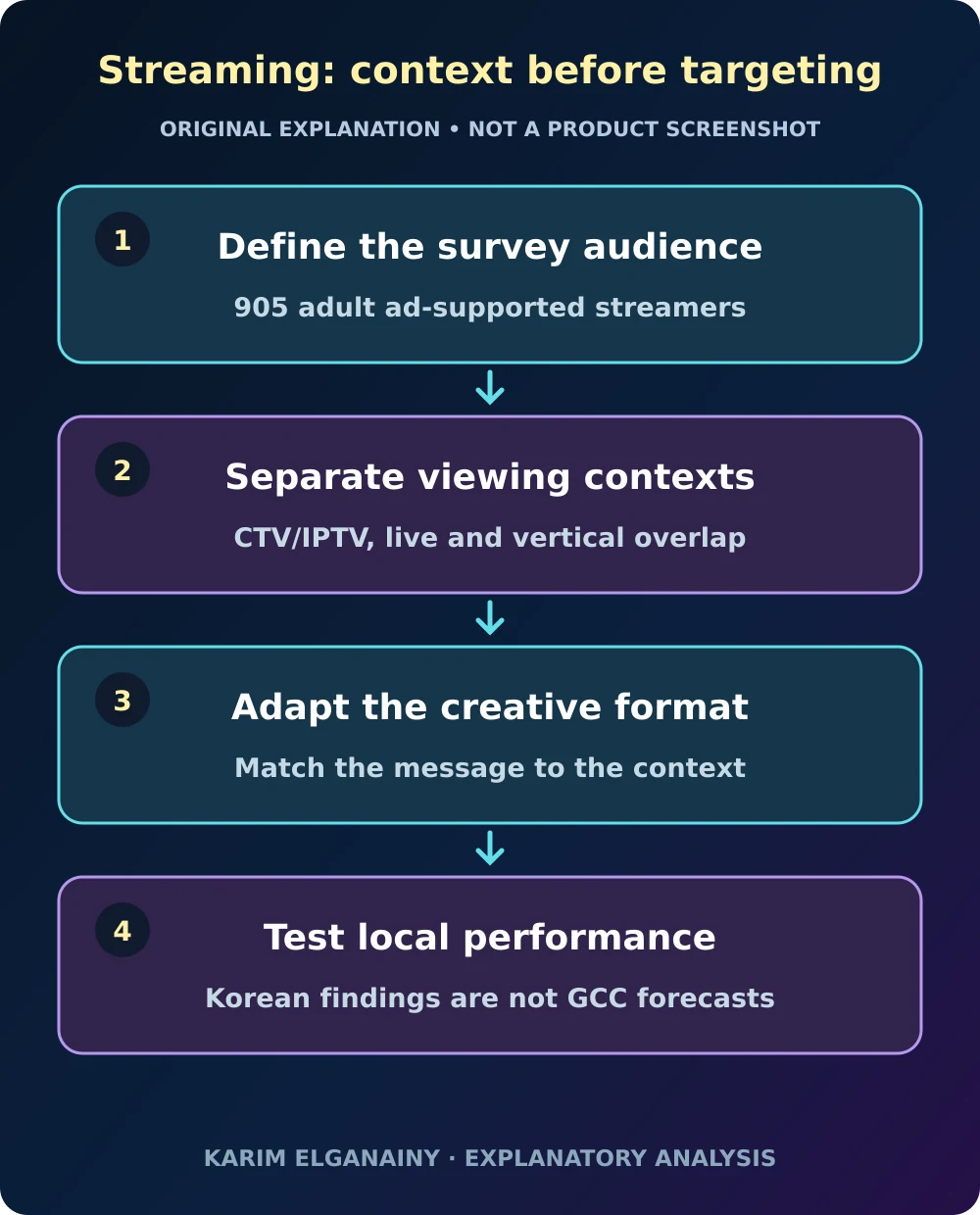
Original explanatory illustration by Karim Elganainy: a proposed planning workflow, not a Magnite chart or product interface. Research context: Magnite’s South Korea study. The recommendations below are independent analysis, not additional survey findings.
Why a screen is not a complete strategy
A screen describes where a message appears. It does not, by itself, explain what the audience needs, what the advertiser should communicate or what happens after exposure. Planning becomes weak when a team starts with a fashionable format and works backwards to invent a business objective. A better starting point is the decision the campaign needs to influence.
Imagine a retailer introducing a complicated new appliance. One execution might establish the problem the product solves; another might explain installation requirements; a third might help a shopper compare sizes. These are different communication jobs. Assigning every job to the same video, merely resized for different placements, can create a consistent appearance without a coherent customer journey.
The useful response to cross-screen research is therefore a job map. Write the customer question, the information required to answer it, the suitable creative treatment and the next reasonable action. Only then ask which available environments can support that treatment. The resulting plan may still use several screens, but the variety has a purpose rather than becoming an end in itself.
Read the sample before reading the opportunity
The sample definition matters because it determines which people the findings describe. A study of a selected viewing population cannot automatically establish the habits of every resident, every age group or every category buyer. Nor does a percentage establish how often an advertiser can reach those people through a particular buying platform.
Before using a research number in a budget presentation, request the questionnaire, recruitment approach, weighting, fieldwork dates and subgroup sizes. Ask whether reported device use allows multiple answers and whether a response concerns any use or a defined frequency. These details affect interpretation even when the headline number is accurately quoted.
If the methodology is incomplete, reduce the strength of the conclusion instead of filling the gaps with assumptions. A directional hypothesis can still be useful. What should change is the decision it supports: a modest discovery test rather than a large allocation presented as mathematically inevitable. The public summary does not supply enough detail here to independently assess representativeness or calculate a defensible sampling error.
Build a creative system around information needs
Start with one clear proposition that can survive different contexts. The proposition should explain why the product matters without depending on a particular device or an elaborate sequence. Then create executions that each do one job well. Consistency should come from the idea, visual identity and factual promise, not from forcing identical timing and layouts everywhere.
For a larger-screen execution, a team could test a simple demonstration with an easily remembered destination. For a personal-screen execution, it could test a concise comparison or a practical next step. These are creative hypotheses, not claims that one format always performs better. Test legibility, comprehension and the ability to act before spending heavily on distribution.
Keep a shared claim sheet beside the creative brief. If one version promises availability, price or service coverage, every related landing page should support that promise. A cross-screen campaign can fail because the underlying information contradicts itself, even when each individual asset looks polished. Give someone explicit responsibility for that consistency.
Buy a defined audience opportunity, not a device label
A buying conversation should specify the inventory that will actually run. Ask for eligible applications or publishers, geography, placement type, creative requirements, reporting fields and the process for exclusions. The broad label connected television may conceal materially different experiences; the label mobile may be even less informative.
Make the supply description understandable to the business owner. A useful proposal says where the campaign can appear, who controls placement selection, how delivery is verified and what happens when an agreed environment becomes unavailable. If important details remain unresolved, record them as conditions before approval rather than burying them inside a confident reach forecast.
Also separate access from scale. A technical buying route does not establish that a particular market has enough suitable inventory at the proposed price. Ask for a dated availability statement and an estimate with assumptions. A small, well-defined opportunity may be more valuable than a large theoretical one that cannot be checked after delivery.
Design the measurement question before the media split
Choose a question that the team can realistically answer. For example: does adding a second screen improve qualified demand compared with the existing plan at a comparable total budget? That is different from asking whether people remember the advertisement, whether impressions were delivered or whether a platform attributed purchases to exposure.
Where feasible, create comparable test and comparison groups and agree on the allocation method before launch. Keep the main offer, availability and measurement window consistent. If random allocation is not practical, discuss alternative designs with the analyst and document their weaknesses. The goal is not to make an ordinary campaign look like a laboratory; it is to make the limits of the conclusion explicit.
Set a primary outcome and a small number of diagnostic measures. Completed eligible orders could be the outcome for a retailer, while delivery quality and landing-page engagement explain implementation. Avoid selecting whichever metric improves after seeing the results. A campaign that raises engagement but not the agreed outcome may still teach something, but it has not passed the original commercial test.
Avoid adding overlapping reach into an imaginary audience
A report from one channel and a report from another may each count the same person. Adding those numbers can produce a total that looks impressive but does not describe distinct people. The risk is especially important when a plan intentionally reaches customers in more than one environment.
Ask how each system defines a user, device, household and impression. If a cross-channel deduplication method is available, request its coverage and limitations. If it is unavailable, show channel-level figures separately and clearly label the overlap as unknown. Honest uncertainty is more useful than an exact-looking total built from incompatible units.
Frequency needs similar care. A low average within each channel can coexist with repeated exposure among a smaller audience. Review distributions where the reporting supports them, not just averages. When it does not, use practical guardrails and acknowledge the blind spot. Do not describe those guardrails as a verified person-level cap across every screen.
Make the next action fit the viewing situation
A campaign should not assume that every viewer is ready or able to respond immediately. Some placements may work better with a memorable benefit and a destination that can be found later. Others may permit a direct interaction. The appropriate action follows the context and the complexity of the decision.
For a considered purchase, a useful next step may be checking product compatibility rather than buying immediately. For a local service, it may be verifying location and availability. A weak landing experience can turn media interest into unnecessary friction: unclear eligibility, hidden conditions or a form that asks for information before explaining the offer.
Before launch, walk through the journey as a first-time visitor. Check that the destination loads, the promise is visible, the language is appropriate and the action can be completed. Assign responsibility for fixing failures during the campaign. This operational work is part of marketing effectiveness, not a separate technical detail to examine only after disappointing results.
Transfer the method to the Gulf, not the Korean percentages
For a Saudi or wider Gulf team, the study can prompt useful questions without supplying local answers. Audience composition, language, viewing services, device access and buying availability may differ. Copying an overseas percentage into a local business case would hide those differences rather than resolve them.
Use the research as a question generator. Which viewing situations matter for the intended audience? Which services offer suitable inventory locally? What Arabic and English creative variants are actually needed? Which measurement approach can operate within the organisation’s data and consent requirements? Answer these questions with local evidence before proposing a scaled plan.
Healthcare marketers should be especially cautious about converting broad entertainment research into assumptions about patient behaviour. An original, hypothetical hospital campaign could test whether clearer service information improves appropriate enquiries, but it should not infer diagnosis, medical need or treatment suitability from viewing activity. Keep clinical information accurate and send claims, data practices and campaign eligibility for the organisation’s appropriate review.
Treat the budget as a learning commitment
A pilot needs enough investment to answer its question, but it does not need an invented promise of return. Estimate media, creative adaptation, measurement and operational costs separately. Explain which costs would recur at scale and which pay for learning. That distinction helps the team avoid rejecting a useful experiment for the wrong economic reason or scaling an expensive process without noticing.
Agree in advance on what would justify expansion, revision or stopping. Expansion should require evidence relevant to the objective and acceptable delivery quality. Revision should identify a specific, repairable problem. Stopping is appropriate when the proposition does not work or the evidence cannot support a responsible next step.
Do not conceal an inconclusive result behind an optimistic narrative. If the test was too small, reporting was incomplete or the comparison was compromised, say so. A good decision memo can recommend a different design rather than another larger campaign. Learning has value only when it changes what the organisation does next.
The strategic takeaway
The strongest practical lesson is not that one screen deserves a predetermined share of every budget. It is that planning should connect a customer question, a communication job, a verified placement and a measurable decision. Research can sharpen the hypothesis; it cannot replace the test.
For the next planning meeting, bring four documents rather than one headline statistic: a screen-role map, an inventory definition, a creative claim sheet and a measurement brief. These make disagreement productive. The brand team can debate the message, the media team can verify delivery conditions and the analyst can identify what the result would actually mean.
That is the disciplined response to a new streaming study: use it to improve the questions, retain its population and period, and keep the recommendation proportional to the available evidence. A smaller plan with a clear learning objective can produce a more useful business decision than a sweeping cross-screen promise that nobody can verify.
Sources and date note
- Magnite: Streams & Screens, South Korea, primary public summary; survey period Q3 2026, reviewed 27 October 2026.
- Magnite insights index. The indexed listing dates the research 26 October 2026; retrieved index versions were not synchronised, so no exact release time is asserted. This article’s publication date is separate from the study period.
Comments
No published comments yet.