Why classify the transaction rather than the channel?
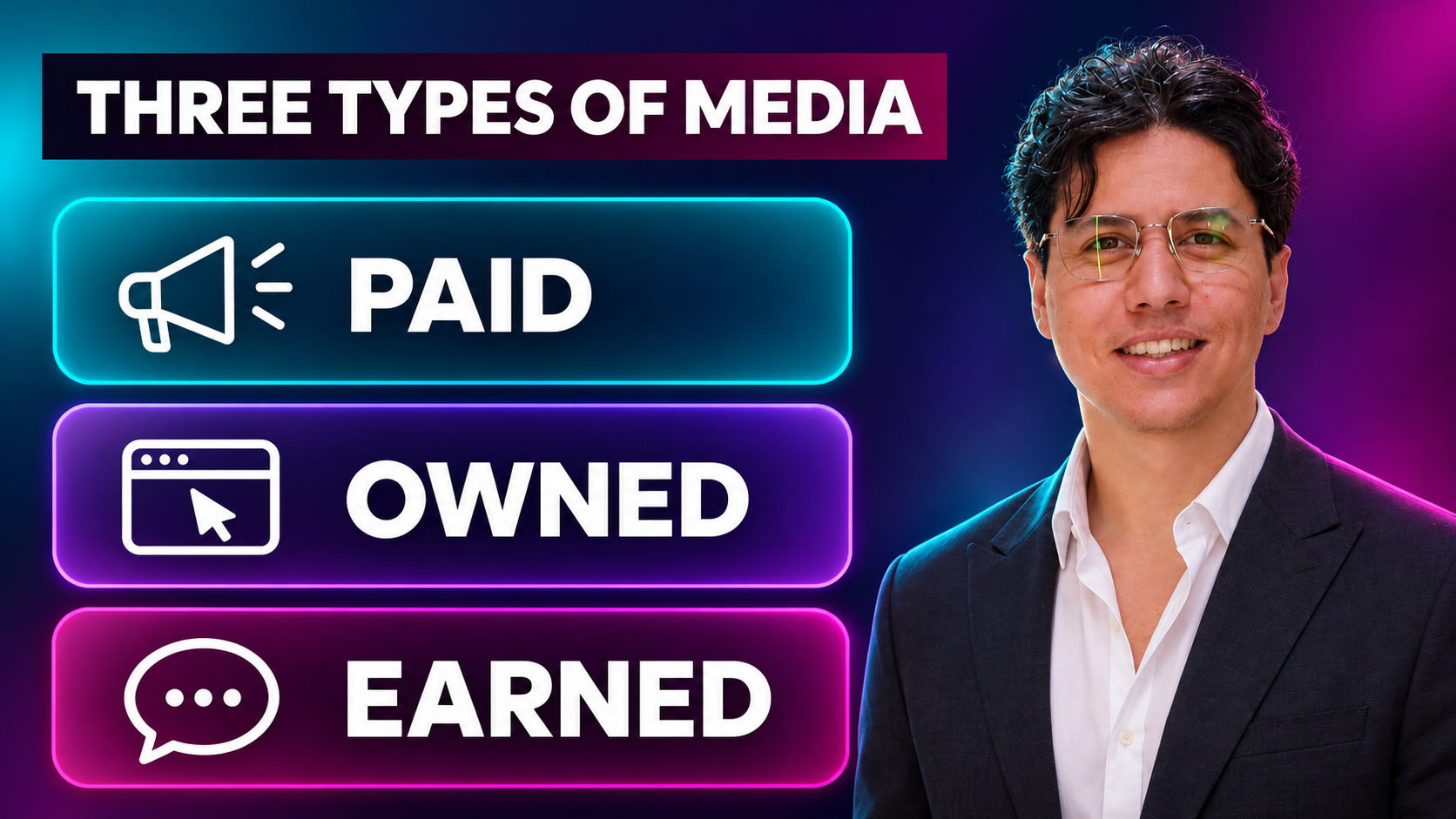
Paid, owned and earned media are a practical way to decide how a brand reaches customers and which parts of that journey it can change. Paid media buys distribution. Owned media is an asset or publication the organization controls. Earned media is attention or coverage that a third party gives without a payment or contractual obligation to say something favorable. The categories describe specific activities, not permanent labels for every platform. A social network might host an advertisement, a brand-written demonstration and an independent customer recommendation at the same time. The budget, responsibility and evidence behind those activities are different, even when they appear in the same feed.
The course introduction distinguishes the categories and asks learners to classify their organization’s channels; the customer experience notes apply those categories to Reach, Act, Convert and Engage. We will use that foundation to investigate handoffs, not just count how many campaigns belong in each column. No universal spending split follows from the model. Nor does it say that a campaign with all three kinds of media will succeed. The question is whether you can buy the right exposure, provide a useful answer after it, and respect what independent people decide to say about the experience. The examples and numbers below are hypothetical teaching illustrations, not business performance claims.
Paid media: buy a specific chance to reach someone
A search advertisement, a sponsored placement and a commission-based partner message are paid when the arrangement compensates someone for distribution or a defined commercial result. Compare what the purchase actually includes: a placement, a click, delivery to an intended audience or a measurable outcome. The billing unit is not automatically the commercial outcome. In a search campaign, the click buys an opportunity to answer a question; it does not buy a customer. In a creator campaign, the sponsorship buys the agreed work or access to the audience, not control over how viewers react. Keep the scope, geography, budget and disclosure obligations visible in the media brief.
Use paid distribution when there is a clear audience problem, a limited testable budget and an owned destination ready to fulfill what the advertisement says. For instance, a shop might pay to reach people looking for a lamp that fits a shallow desk. If the page omits the base depth and the store cannot answer questions, a larger budget buys more chances to disappoint the same audience. Treat the promised information and the ability to deliver it as prerequisites. If capacity is uncertain, start with one product and a bounded location; agree who can pause delivery if availability or service conditions change.
Owned media: control the answer, not every route to it
A product page, store locator, app guide and permissioned customer email are owned in the practical sense that the brand can decide what to publish and update. Control has degrees. The company may edit a post on its account without owning the social network, the ranking system or access to its followers on demand. It may manage its customer list without having permission to use every address for any purpose. Keep an editable master for important descriptions and give one responsible team the ability to correct price, availability and restrictions. A platform change should not be able to erase the only current copy of a customer promise.
Organic search makes the distinction concrete. The instructions and product facts on a page are owned content; a search engine’s unpaid decision to display it, and the visit that may result, are not owned placement. Optimization does not buy a guaranteed ranking. Separate the work you control, such as making the page answer a question accurately and loading it correctly on a phone, from the discovery you hope to earn. Do not promise an exact number of organic visits just because the material has been published. Keep analytics definitions clear enough to distinguish an indexing or visibility problem from a problem understanding the page itself.
Earned media: invite independent attention without buying the verdict
An unprompted recommendation, an editor’s independent mention and a customer’s unsolicited review can be earned. A public relations team may invest working time in making an accurate briefing available, but that does not turn the independent decision to cover it into a purchased placement. The reverse also matters: compensating someone for a post, even with a valuable free product or a commission, changes the relationship with that publisher. A transparent sponsored collaboration can be valuable; it does not need to be described as an unsolicited endorsement. A seller who republishes an independent review creates an owned presentation of an earned statement, subject to permission and accurate representation.
Earned attention is not guaranteed, necessarily positive or free to support. A customer discussing a difficult return is independent commentary too. Track topics, recurring problems and whether the person received help, rather than aiming for a count of positive statements regardless of context. If questions arise about a recurring defect, improve the product or explanations before requesting more coverage. Do not filter requests for reviews only to people who are expected to praise the brand. In this model trust is a result of an independent voice and a credible experience, not a score that can be purchased by labeling a post differently.
Read the map across the customer journey
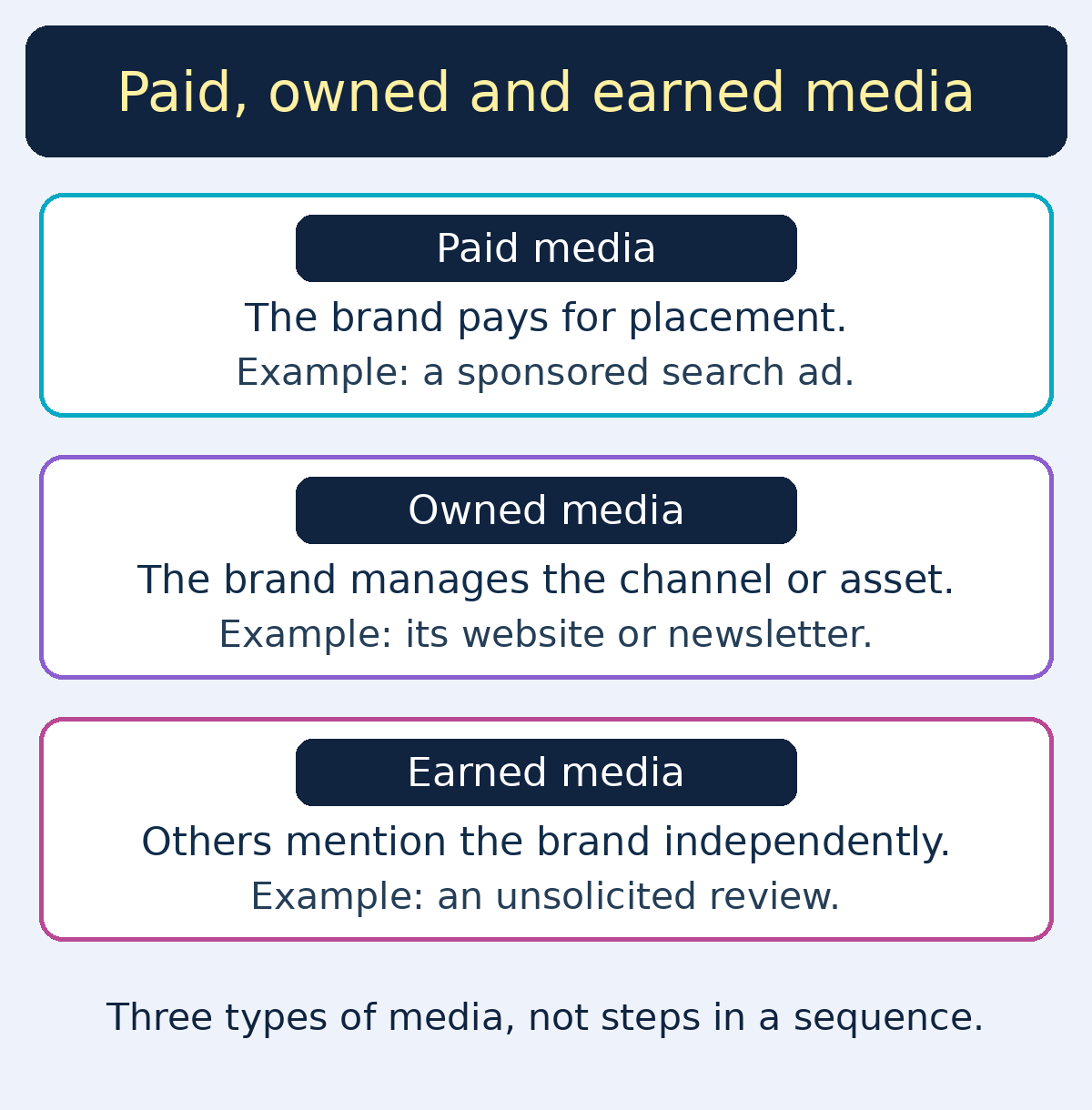
The diagram is an original teaching aid based on the distinction in the course materials. Experience runs across the trip: it can be checked when someone first sees a promise, tries to find an answer, pays or asks for help. It is not a fourth class of media. This lesson is not the PESO framework and does not add Shared as a fourth category. A customer's sense of confidence, confusion or relief tells you something about what the organization made easy or hard; it is not a purchase of distribution, a brand asset or independent coverage by itself.
Reach asks how the right people discover the offer. Act asks what useful next action they can undertake, such as checking whether a product fits. Convert asks whether the order or commitment can be completed without a surprise. Engage asks whether the customer can start using the product, get support and buy again if it fits. A paid search placement can support Reach, a brand guide can support Act, independently written reviews can reduce uncertainty at Convert, and a permissioned service guide can support Engage. None of these pairings is exclusive. A paid reminder after purchase might serve a valid replenishment need, but it is still paid and should not run just because an audience can be targeted.
Use the map to locate the handoff most likely to fail. If a buyer learns a price in an ad and sees a different total at checkout, that is a cross-media continuity problem, not a reason to classify the checkout as earned. If a helpful setup guide exists but customers never receive it, the issue may be access rather than asset quality. Write down what must stay consistent between stages: eligible product, destination, deadlines, service area and who will answer exceptions. Compare the planned experience with the actual one using a test path under the same conditions a customer faces.
Classify one activity by the value exchanged and the control retained
Start with a row for each activity rather than each account. Record who writes the message, who can edit it, who decides on placement, whether a payment or consideration is exchanged, and what the customer is meant to do next. A brand demonstration posted to its account is owned content on rented infrastructure. Paying to boost the demonstration buys paid distribution. Someone voluntarily sharing their independent experience in response creates a separate earned event. Store the links and versions next to each row. This makes it possible to verify the claim later without turning all exposure from the same social network into a single bucket.
When a tactic mixes roles, separate the pieces that depend on different teams or agreements. A journalist might link to a brand-built guide; the article can be earned while the guide is owned. A sponsored partner may return some visitors after a paid mention; do not call those visits earned merely because the link opens the store organically on a phone. There will also be outcomes whose source cannot be classified. Leave them unknown rather than giving credit to whichever reporting system captures them first. This is a teaching classification designed to improve operating choices, not an instruction to rewrite every analytics platform’s channel definitions.
Plan an experiment around a point of friction
Choose one customer decision that the team can observe, such as checking size, reserving a product or booking a qualified demonstration. Confirm that the promise can be kept today. Map the minimum assets: the reach mechanism, an accurate answer, a way to complete the next action and support if something fails. Check which of those pieces already exists and who can edit each of them. A business without a working mobile landing page may need to invest first in its owned path; a business with a clear offer and no access to the relevant buyers may benefit from a small paid test. Do not interpret balance as a mandatory equal allocation.
Before spending, agree on the test population, the window and the business decision that the result will inform. Separate media cost, content production cost and the cost of delivering the promised experience. Record the denominator and the exclusion rule for each KPI, and write a stopping condition that staff can use without debating the dashboard. For example, a store can pause a promotion when the stock shown on the destination is no longer available. This is different from stopping because an early day looks weaker than expected. Preserve the affected period in the record so poor operations do not disappear from review simply because the team restarted delivery later.
First worked example: a retailer selling a desk lamp
Imagine an independent retailer introducing a lamp for narrow desks. For Reach, it buys a small set of search placements against questions about depth and reading comfort. For Act, its own product page includes a base measurement, a photo with a ruler, and a clear comparison with the next model. For Convert, buyers can read independent reviews but still see the total price and collection options on the store’s page. For Engage, the confirmation message leads to a brand-maintained setup guide and a support route. Each step serves a customer decision. A genuine review is welcome, but does not substitute for a photo that shows whether the lamp will fit.
In one hypothetical reporting window the shop spends 3600 units of local currency on paid placement and reports 900 campaign-tagged visits. It associates 54 placed orders with those visits under the same tracking convention. The descriptive conversion rate is 54 divided by 900, or 6%. There are 6 returns, leaving 48 kept orders. The acquisition cost per kept order using media spend alone is 3600 divided by 48, or 75. If each kept order contributes 95 after relevant variable costs and before media, the contribution remaining from the attributed kept orders after media spend is 48 times 95 minus 3600, or 960. That is a conditional accounting illustration, not profit, because it omits other fixed and campaign costs.
Do not read 48 attributed orders as 48 added orders. Some buyers might have purchased anyway, including people who first learned about the product from a colleague. Separately, imagine comparable groups of stores with similar seasonal sales, inventory and staffing. The group with a media intervention records 60 kept orders while a credible comparison records 42. The difference is 18 kept orders; treat it as evidence of an incremental effect only under a design that supports that comparison, with adequate observation and uncertainty. This comparison is a separate hypothetical, not a calculation that reconciles to the earlier tagged visits. If inventory goes out of stock in the comparison group, investigate rather than calling the full difference the effect of advertising.
Now trace the strongest intervention backwards. If many visitors check the dimensions but then ask the same question in store, the immediate task may be to show the base depth and wiring clearance more clearly, not to expand targeting. If the product page answers the question but customers cannot select the correct collection point, the owned purchase path needs repair. If independent reviews repeatedly report a loose fitting, a better sponsored video does not solve the product issue. Give the search budget, product page, checkout and fulfillment checks to the people who can fix them. Then repeat the smallest test that can tell whether the relevant problem has changed.
Second worked example: a business selling inventory software
Imagine a software provider trying to earn qualified demonstrations with small distribution businesses. For Reach, it sponsors visibility in a relevant trade newsletter. Its own readiness checklist supports Act, helping a buyer decide whether the team can supply the necessary data. For Convert, the provider offers a scoped demonstration, explains what the buyer will need to prepare, and quotes implementation separately. It may also link to an independent community discussion, clearly distinguishing any authorized excerpt from the original opinion. For Engage, a buyer who starts a pilot receives a guide to the first inventory reconciliation and a named point of support. The promised task is specific; the ad does not guarantee that adopting the tool will solve every stock problem.
In a hypothetical comparison, each group contains 40 eligible accounts. Using a predeclared definition of a qualified demonstration, the test and comparison groups record 10 and 6, respectively. That is 25% versus 15%, or 4 more qualified demonstrations in the test group. They record 5 and 3 pilots, or 12.5% versus 7.5% of eligible accounts, and 2 versus 1 signed contracts. Report all those counts, with the same observation window and denominators. The contracts are too few to support a confident conclusion on commercial lift. The evidence may justify checking the readiness process and running a follow-up test, not an automatic rollout. Report sales staff time, preparation burden and support work alongside appointment counts.
Avoid leaking distinctions between teams. If the newsletter link leads directly to a booking page with no useful description, a demonstration might be booked by someone who cannot qualify. If a salesperson answers a question differently from the readiness checklist, the owned path is contradicting itself. If one group receives faster follow-up because the staff know it is the test, the contrast now includes another intervention. Assign accounts at an appropriate level, track parallel outreach and keep the definition of qualification stable. Consider how interdependent accounts are before interpreting uncertainty. A team that cannot maintain a fair comparison can still document feasibility, but should label the result accordingly.
Give each measure a job and a denominator
For paid reach, start with relevant delivery and cost using the platform’s documented counting rules, then link to a business event the organization can verify. Compare only periods with comparable audience and availability. For owned assets, measure useful actions rather than raw traffic alone: eligible visits that finish a fit check, completed orders as a share of started checkouts, or successful first use among accounts that received onboarding. For earned attention, record independent mentions or authenticated feedback by source and theme, not a made-up number of people supposedly convinced. An attribution label indicates a rule has associated an event to a touch. It does not establish that the touch caused the event.
Track experience alongside the channels. A useful operational view combines customer questions, promised time to resolution and the share of a defined group that actually reaches the intended endpoint. Where information is missing, distinguish unknown from failure. A buyer who moves from web to phone without a matching record may not be lost; a user who opens a setup email may not yet be onboarded. Make the dashboard explain what cannot be observed, avoid unnecessary transfer of customer data to advertising systems, and let the relevant team know where to fix the underlying process rather than assigning blame based on a single rate.
Avoid common category and measurement mistakes
Do not relabel a paid creator post as earned because discussion around it is organic. Record the paid publication separately from independent replies. Do not call every brand-controlled post an owned infrastructure asset; save the source outside the platform and keep a correct destination the team can operate. Do not confuse a review request with purchased praise, and do not suppress legitimate criticism from analysis. It is acceptable for a campaign to have limited earned attention. It is less acceptable to compensate for the gap by claiming independence that is not there or importing other people’s remarks without permission.
Avoid using the model where it adds categories but no decision. If the business cannot reliably distinguish who supplied the message or whether incentives were involved, describe the uncertainty instead of inventing labels. For a service failure or a change in eligibility, fixing the affected handoff may be more urgent than drawing a map of media spend. The framework does not establish rights to contact people, to reuse content or to alter accounts. It also cannot determine whether a specific audience can be reached cost-effectively in a new market. That takes a separate check of context, audience needs, constraints and evidence.
Exercise: run a channel and handoff audit
Choose an offer your organization can actually fulfill. Write down the customer’s current question and the next useful action, then create one row for every distribution or content activity involved. Mark it paid, owned, earned or unknown, and add the reason for that choice. Map the rows across Reach, Act, Convert and Engage. Next, note what people should understand or be able to do at each stage. Use a walkthrough on a phone to check the path and ask another person to repeat it without help. Do not fill an empty category by inventing traffic or making paid activity sound independent.
For the weakest handoff, describe the problem in observable terms: what happened, how many eligible visits or accounts were involved and what comparable group or period you will check. Propose one limited improvement with a named owner, an observation window and an explicit stop condition. Present a simple memo: decision, expected effect, cost, source of truth, uncertainty and what would change the next decision. Ask a colleague to identify a competing explanation. If the test cannot distinguish the explanation from your preferred one, improve the comparison or describe the exercise as a process check. A transparent result that does not support expansion is still valuable.
Takeaway: purchase only what the journey can support
An effective media mix does not make every team buy, own and earn the same amount. It makes the promise clear, makes the next step work and lets independent feedback remain independent. Buy distribution only when the route to a useful decision is ready. Maintain the owned facts needed to fulfill the promise. Learn from earned feedback, including the criticism you did not expect. When the result is not clear, use the smaller reversible change that improves the experience and produces evidence you can explain. The worth of the model is not the elegance of the three labels; it is the decision you can make and defend after applying them.
Sources and course context
This lesson draws on the course’s digital marketing introduction, physical PDF pages 187–189, and digital customer experience notes, physical pages 38 and 56. The introduction attributes the overlapping categories to Chaffey and Ellis-Chadwick. The experience notes credit Smart Insights for the RACE view and use Experience as a journey overlay; they also include a channel-mix exercise. The decision checks, example numbers, teaching diagram and audit exercise in this article are original applications. For public background on the journey stages, see Smart Insights: RACE planning framework. For a practical application on this site, see the RACE course lesson.
Comments
No published comments yet.