
Pinewood.AI said on 2026-11-18 that its Boost automotive advertising tool now manages ChatGPT Sponsored Cards alongside other paid channels. Company announcement.
The announcement establishes a new buying option, not its commercial benefit for a particular dealer. The rest is a proposed independent test, not a description of Boost features, an OpenAI specification or a forecast of results.
Choose the budget decision before choosing the metric
Start with a concrete question: if a store moves part of its existing budget into this placement, will it generate more completed test drives for vehicles the store can actually sell? That is a substitution test. If a group instead wants to know whether spending extra money produces extra sales, that is a different test with a different comparison. Do not switch questions after seeing the data. Agree on the eligible stores, stock categories, spending envelope and observation window first. Record which decision maker can expand the test or stop it.
Follow unique buyers instead of counting submissions
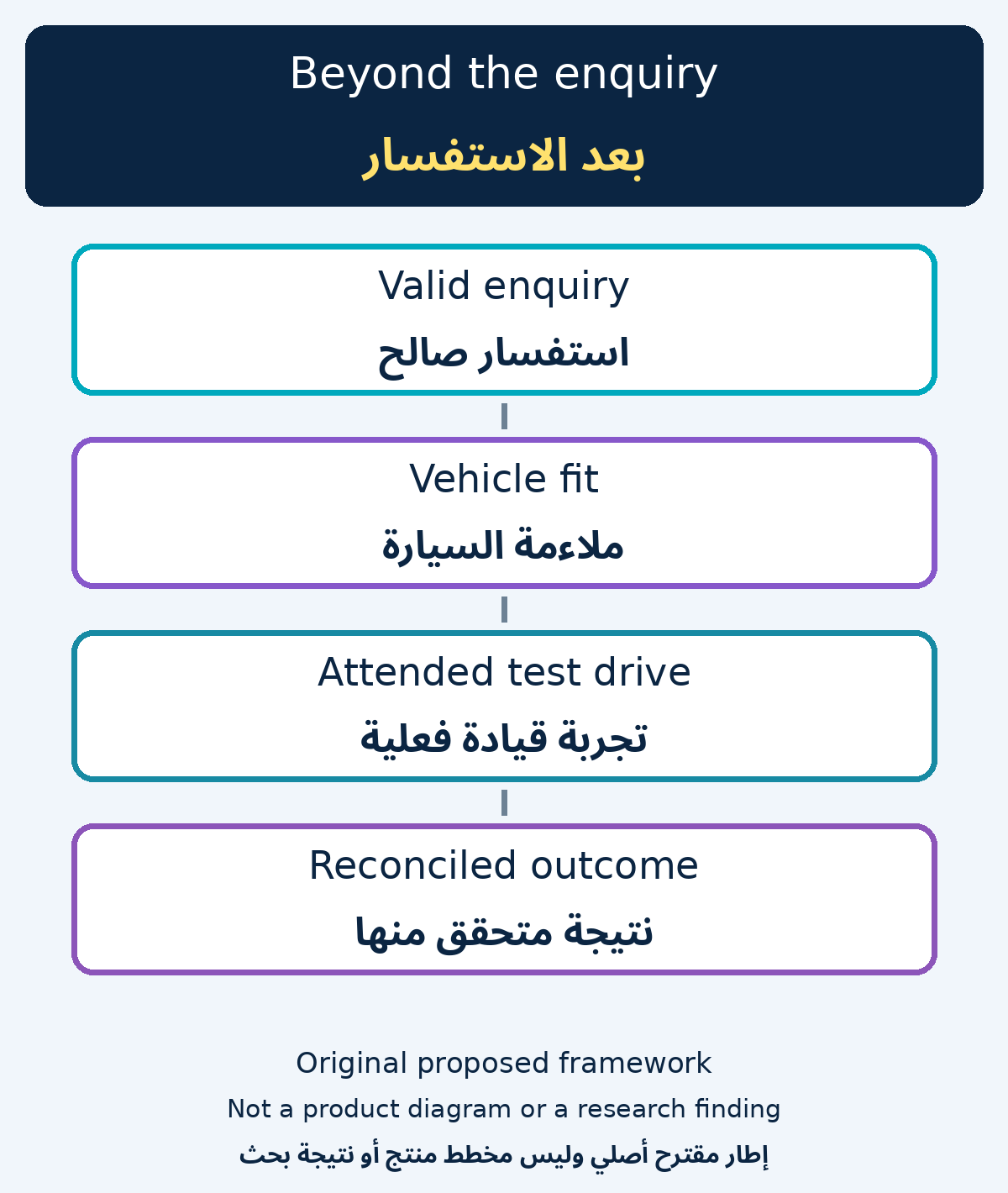
Ask the contact center to distinguish reachable buyers from duplicates, spam and people outside the service area. Tag an appointment as booked only when the buyer agrees to a specific slot, and mark a completed test drive only when store staff confirm attendance. Use a consistent attribution and deduplication rule across channels. Keep people whose source is unknown in a separate bucket; excluding them silently can make the easiest channel to track look more productive. Report both the volume and the percentage whose source could be classified.
Protect the comparison from inventory and staffing changes
Compare groups with similar sales histories, relevant inventory and lead-handling capacity. If enough locations are available and assignments can be separated, randomly assign them to existing versus reallocated spending. Keep pricing, response standards and offers comparable. Track local promotions, stockouts and delays even if they are inconvenient to explain. A group with ready-to-drive inventory and a fully staffed desk can outperform another group regardless of its advertising. If exposure overlaps or there are too few independent stores, call the result a feasibility exercise and avoid claiming a lift.
Read the whole funnel in a hypothetical example
Suppose two comparable groups each spend 10000 units of the same currency. Group A records 100 unique enquiries, 40 qualified appointments, 24 completed drives and 6 sales. Group B records 130 enquiries, 39 qualified appointments, 18 completed drives and 5 sales. A costs roughly 417 per drive and B roughly 556. B has more enquiries and a lower cost per enquiry, but sends fewer people to the showroom. These numbers illustrate the calculation, not expected performance. The single-sale difference is especially fragile; without uncertainty estimates, the example cannot establish which allocation is better.
Wait for sales outcomes and keep a stop condition
Create cohorts by enquiry date and compare them after equal follow-up. Define the lag using the store’s own sales history rather than an arbitrary number of days; retain open cases so slow conversions are not treated as failures too early. Review completed-drive cost alongside contribution after variable acquisition costs. Before widening the test, ask whether the comparison held, whether the effect could be noise and whether the stores can handle extra arrivals. Set a separate operational stop condition, such as verified customer-facing offers diverging from inventory. In that situation, pause and correct the mismatch before discussing a budget increase.
Connect the media test to the work of the dealership
The daily jobs behind the experiment matter as much as the choice of ad placement. Give one person responsibility for the approved stock list and another for the queue of incoming enquiries. Put a small checklist in front of whoever accepts a shift: confirm the store and vehicle category, log whether an enquiry is a repeat, and set a follow-up date for open cases. If the system cannot identify a vehicle, ask the buyer what they are considering instead of guessing from a campaign label. Record the answer without sending personal data back to an ad platform merely to make a dashboard look more complete.
When a customer moves from chat or a form to a phone call, the records may reflect both events. Keep a primary customer record and retain the individual events as supporting information. That lets the marketing team answer two different questions: how many people asked about a vehicle and how many interactions were needed to help them. This distinction also helps uncover operational problems. For instance, if many people ask twice about availability, the store may have left the first request unanswered, or its advertised stock may be stale. In that case investigate response delays and offer quality before ranking the ads.
Check how the customer experiences the handoff. The destination should state where the vehicle is, what can be booked and when staff can respond. If a promoted car sells, do not silently switch to a more expensive listing and continue as if the ad were still accurate. Remove or amend the offer; where appropriate, show a clearly identified alternative. A weekly measurement report cannot substitute for this same-day operational check. Use only necessary data in the reconciliation file, restrict its access and make sure the people reviewing results can work with counts rather than a list of phone numbers.
Before the pilot starts, select several sample enquiries and trace them from the first receipt through follow-up and showroom confirmation. Ask the marketing and showroom leads to reconcile discrepancies together. An incorrectly assigned call or an appointment logged before the buyer agrees should be corrected at source; reclassifying only the dashboard will hide the process problem. After launch, look at the same sample flow in both groups. If only the test group receives coaching or faster follow-up, the comparison will reflect those operational differences as well as the media change. Either hold the process constant or state precisely what combined change the test is measuring.
A useful project note separates failures in the media journey from failures in the dealership journey. List the issue, the owner, the evidence and what action is permitted. A destination page that fails on mobile, a full weekend appointment calendar and a broken source tag each require different fixes. Pause a broken flow promptly rather than wait for a clean comparison; record the interruption and the affected dates so the team does not silently aggregate a damaged period with normal weeks.
Write a decision memo the finance and sales teams can challenge
Start the review with a table that distinguishes contacts, bookings, completed drives and finalized sales. Include spend, the period, the number of participating locations and the number of cases with an unknown or disputed source. Next to each funnel stage, show a denominator the sales team recognizes. For example, report drives completed per booked appointment as an operations measure and completed drives per eligible store-week as an experiment outcome. Those ratios can move in opposite directions if stores see more requests than they can handle. Keeping both visible is more informative than choosing the better-looking figure.
Market comparisons should reflect how locations actually operate. A group might contain small stores that normally sell few vehicles and larger stores that account for most of the volume. An average that treats every store equally answers a different question from a total dominated by large stores. Show both when feasible and state which one will guide the decision. If an analyst models the result, uncertainty should respect the level at which stores were assigned rather than treating hundreds of enquiries as independent advertisements or independent stores. Document any exclusion before looking at which group it benefits.
Do not mix every cost into one ratio. Show the incremental media budget, any tooling or management charges attributable to the test, and the dealership work needed for each outcome. Keep separate the value of the final sale and the value of a lead that remains open. Finance can then test whether the conclusion changes under different but defensible assumptions about margin and the follow-up period. This is particularly important if the new placement appears to attract interest in one type of vehicle while the comparison group sells a different mix. A drive in a highly discounted model does not necessarily have the same business value as another drive.
A suggested decision meeting has three questions. First, did staff deliver the experience promised in the advertisement, with no material increase in customer friction? Second, was the comparison sufficiently intact to say something useful about the budget decision? Third, is the plausible benefit large enough to justify the additional cost or the opportunity cost of shifting money away from an existing channel? A yes on the last question is not a substitute for the first two. If the answer is uncertain, choose the smallest follow-up step that can resolve the uncertainty rather than doubling spend to make a weak design look decisive.
Finally, distinguish a replication from a rollout. A replication in another location keeps essential parts of the design while checking a different mix of inventory and buyers. A rollout exposes far more of the budget and requires a separately documented decision. Both can be reasonable next steps, but not every encouraging pilot earns a rollout. If results disappear after a change of location, ask what changed in the offer, audience and service before generalizing. Leave the memo and tracking definitions available to the next operator so experimentation becomes cumulative instead of restarting with each dashboard.
Make the next decision explicit
The useful outcome is not simply a new line in the media report. It is a reasoned choice among holding the allocation, extending collection, correcting the design, or reallocating spend. Keep a compact record of the budget change, the funnel counts, data gaps and assumptions. That record helps a manager at a different store judge whether the result applies locally, without mistaking an ad placement or a vendor integration for a repeatable gain.
There is one last useful safeguard: decide how to handle the time between a test drive and a signed sale. Customers sometimes visit a second location, change their vehicle choice, or come back after the reporting period. The group should document a single policy for these cases and report a separate count of late or disputed records. Apply it in the same way across both groups. If the result changes when a small disputed group is assigned differently, explain that sensitivity rather than presenting an exact channel ranking. A policy that everyone understands is more valuable than a polished report whose answers change when a manager asks to see the underlying cases. Preserve only the records needed to review the decision. The memo should say who may correct a record and when the change takes effect in reporting.
Comments
No published comments yet.