What the company announced
On 16 November 2026, Immedica reported that the Saudi Food and Drug Authority authorized Loargys (pegzilarginase) for hyperargininemia in people aged two or older with arginase 1 deficiency (ARG1-D), alongside dietary protein restriction. The Saudi decision was not independently verified for this article. The announcement does not establish dispensing availability, coverage or local pricing.
Separate authorization from access
The following is independent operational analysis, not a description of an existing service. Regulatory authorization, first confirmed supply and payment arrangements are distinct events. A specialty pharmacy could ask which local distributor is responsible and when an order can actually be placed, then request written confirmation before sharing a date. A coverage team could verify whether a payer has published a decision, for whom it applies, and whether an approval process is in place. An unanswered question should stay marked as unknown. It does not mean a product is unavailable or excluded, and should not be turned into a reassuring promise either.
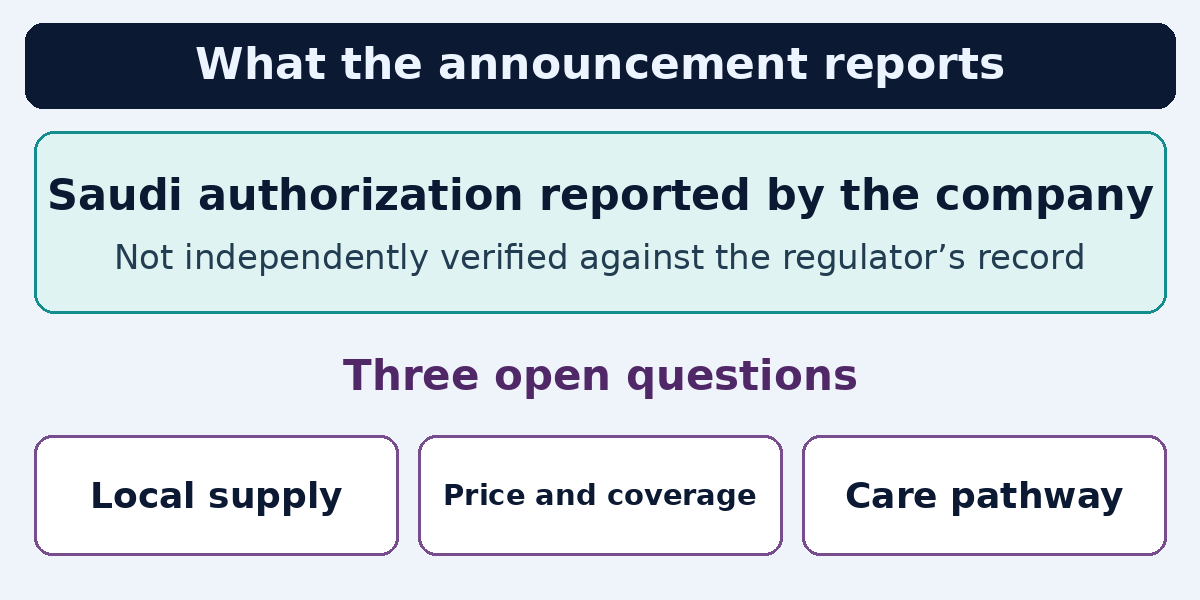
Original explanatory diagram by Karim Elganainy, based on Immedica’s announcement. The open access questions are independent analysis, not documented service outcomes.
Use European material for context, not as a Saudi pathway
The European Medicines Agency describes specialist supervision and allergic reaction risks in its EU assessment. It notes limited evidence and authorization under exceptional circumstances. This is European context only, not a confirmation of Saudi labeling or implementation. Clinical teams should refer to applicable local documentation rather than importing another jurisdiction’s wording into a Saudi referral form.
Prepare a referral handoff without assuming a launch
A genetics or metabolic-service coordinator could identify the receiving team, confirm how a referral is accepted, and document a contact for unresolved referrals. Separately, a pharmacy lead could verify ordering readiness and identify who will answer supply questions. These are suggestions, not statements about what Saudi institutions are currently doing. Keep the checks in a simple list with a responsible person, an evidence date and a follow-up action. Avoid requesting patient records just to confirm a generic process. A referral being accepted is not proof that a medicine can be dispensed or funded.
Communicate only the verified milestone
A public notice can attribute the authorization report to Immedica and explain which access details have not been confirmed. Update only the relevant item when new written evidence arrives. If a hospital confirms its own process, identify that institution and the scope rather than implying nationwide access. This is a regulatory news and operations note, not advice on treatment. Its practical value is a clearer handoff between teams and fewer promises they cannot yet support.
Comments
No published comments yet.