
A useful finding, with a precise boundary
Nepa, 12 November 2026: Google AI product-answer use among people who never used AI chat: Sweden 36%, Finland 29%, Denmark 25%. July survey: 3,137 respondents, ages 16–74, age/gender representative. The report page is dated 2 November. We did not review the full report.
This commercial, self-reported evidence is not a causal experiment, a Saudi estimate or the proportion of purchases completed through AI. The following framework is original practical analysis, not a summary of an unseen report or a claim that our team ran the proposed experiments. Its central question is simple: how should a marketing team investigate discovery when a customer's label for a tool differs from the experience that tool provides?
Stop using one label for several behaviors
A questionnaire that asks only whether someone uses AI makes the respondent solve a classification problem before answering the commercial question. One person may interpret AI as a dedicated chatbot. Another may include a summary inside a search engine, a shopping assistant or a recommendation feature. Their answers can differ even when they encountered similar information. The practical response is not to correct the customer's vocabulary, but to ask about recognizable activities.
Create separate questions for actively opening a chat, reading a generated search answer, following a source link and checking another source. Add a genuine unsure option. Do not make respondents select a technical label they do not understand. If examples or screenshots are used, show neutral, current examples and test whether they improve recognition without suggesting a preferred answer. Keep the wording and order consistent when comparing periods; otherwise a measurement change can masquerade as changing behavior.
Build a discovery map before a channel dashboard
Start with the decision customers are trying to make. For an unfamiliar service, they may want to understand suitability, compare alternatives, establish trust or find a practical next step. Map the information needed at each moment and the destination where it can be verified. This creates a useful content brief even when precise attribution is unavailable. It also prevents a team from producing dozens of generic articles simply because a new distribution surface attracts attention.
Record three distinct layers: the information a customer encountered, the action they remember taking and the action the business can independently observe. A remembered answer is not a tracked referral. A referral is not necessarily a new customer. A booking is not proof that a particular answer caused it. Keeping these layers separate makes uncertainty manageable. Combining them into a single AI conversion number creates false precision and obscures what the team actually knows.
Read the chart as a denominator lesson
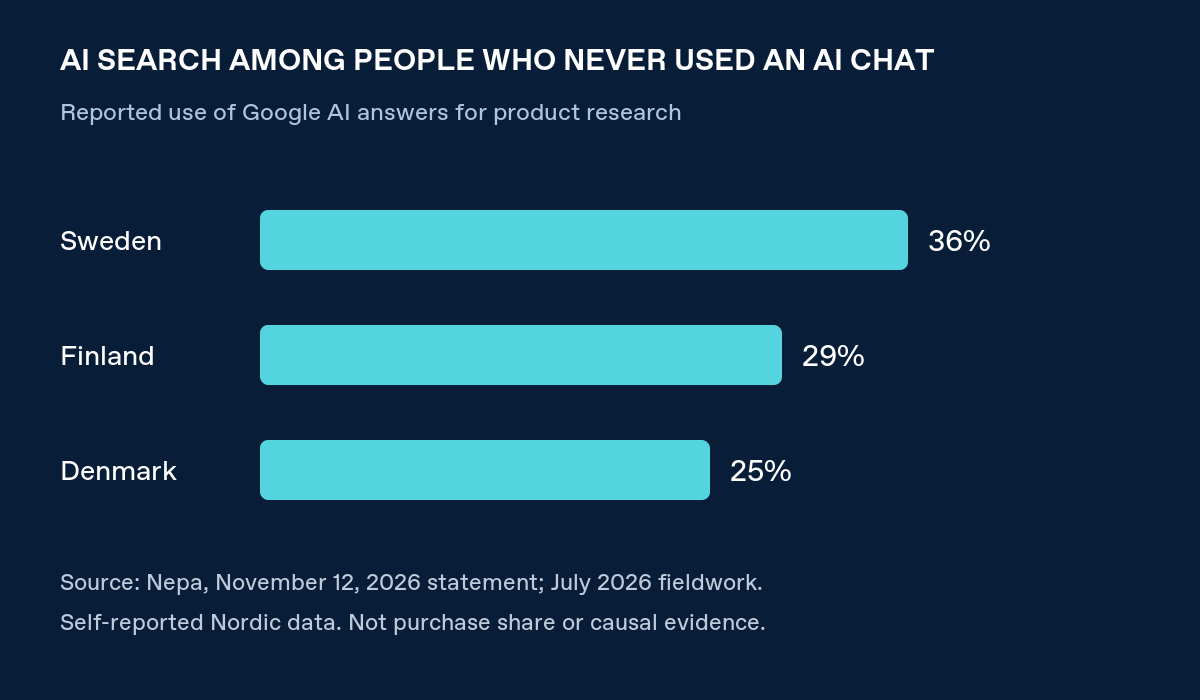
Original explanatory chart, not a reproduction of Nepa’s artwork; data attribution. Use the population defined above. Do not read sales, market size or campaign effectiveness into a chart that does not measure those outcomes.
Before showing any research chart to a commercial team, write its denominator in ordinary language beside the title. Ask a colleague to explain the number without reading the surrounding article. If the answer changes the population, the graphic needs repair. A chart can be numerically correct but commercially misleading when its labels let readers substitute the audience they wish it described. Do not combine country percentages into an overall figure without the appropriate underlying subgroup counts and method.
Design a small local study that answers your question
For a Saudi or Gulf business, use the Nordic finding to formulate a question, not import a percentage. Start with a defined category, language and decision period. Interview recent customers about one real journey, then test a short questionnaire on a separate group. Ask what they needed to know, where they looked and what they verified. Avoid collecting unnecessary sensitive details. The goal is a clearer discovery model, not an intrusive record of every online action.
Recruit beyond the easiest audience. A survey of social followers may overrepresent people already familiar with the brand. A survey after successful purchase excludes people who abandoned the journey. Document recruitment, exclusions, response timing and the number of usable responses. Report the resulting sample as it is. If the study is exploratory, call it exploratory. A modest but transparent customer study is more useful than a large-looking claim with an invisible selection process.
Audit answerable facts before chasing mentions
Make a list of the questions a customer reasonably needs answered before contacting the business. Check that each answer has a clear, current source page, a responsible owner and a review date. Align service names, locations, eligibility descriptions and contact routes across the pages the business controls. Where information varies by location or circumstance, state the distinction rather than compressing it into a promise that is easy to repeat but inaccurate.
This is a proposed quality-control practice, not a guaranteed method for entering an AI answer. Prioritize facts whose errors would cause wasted enquiries or poor decisions. A clear page that prevents an unsuitable enquiry can be valuable even if it produces fewer clicks. In healthcare, distinguish general service information from individualized advice. Explain how someone can seek an appropriate professional assessment, without implying that an online summary can decide their diagnosis or treatment.
Test comprehension, not only appearance
Choose a small set of customer questions and define the factual requirements of a useful answer before inspecting any result. Include essential qualifications, not just the brand name. Then evaluate whether a reader can understand the offer, identify the source and find a suitable next step. Record the question, date, language and observed context. Keep an unchanged comparison set so that the team can distinguish its own content revisions from changes in the surfaces being observed.
Treat repeated checks as observations, not a ranking guarantee or a representative census of every user's experience. Different questions, locations and sessions may produce different results. Do not turn a favorable screenshot into evidence of stable visibility. A useful internal report shows what was tested, which facts were correct, what was missing and what the team can repair on its own pages. It also records unresolved findings without inventing an explanation for them.
Use a hypothetical example without inventing attribution
Imagine a fictional clinic reviewing 200 recent enquiry responses. Forty people remember reading a generated search answer, while 20 of those remember visiting the clinic website afterward. Those counts would mean 20% of the respondents recall the answer and half of that subgroup recall the later visit. They would not prove 40 incremental enquiries, identify every journey or establish that the answer caused the visit. These are invented numbers for teaching measurement, not Nepa results.
Suppose the website analytics separately show 30 visits from a labeled referral source. Do not reconcile the difference by assigning anonymous sessions to interviewees. The datasets may use different periods, units and definitions. Keep the observed referral count and remembered exposure count on separate lines. Investigate matching conditions only with appropriate data and permissions. An honest discrepancy is an invitation to improve measurement, not a reason to manufacture a perfectly connected funnel.
Give the experiment an operating owner
Assign one person to maintain the question set and another to verify service facts with the relevant team. Agree how corrections reach the website, how long review should take and who can approve a change. Keep a simple revision log containing the issue, evidence, decision and check after publication. Without ownership, a discovery audit can become a recurring slide deck while the same incorrect information remains available to customers.
Set a short pilot window and avoid changing every element at once. For example, improve the clarity of one service cluster while keeping a comparable cluster unchanged where operationally appropriate. Track whether customers find answers more easily and whether enquiries contain fewer avoidable misunderstandings. Such a comparison still needs careful interpretation: demand, staffing and other campaigns may change. Treat the pilot as a learning exercise unless its design supports a stronger causal claim.
Choose metrics that can change a decision
Use a compact scorecard with explicit units. It could include the proportion of audited facts that are current, the share of test readers who understand the next step, unresolved information errors, qualified enquiries and time spent correcting content. Define qualification before reading results. Include workload as well as demand, because an apparently successful visibility exercise can create avoidable follow-up work when the underlying offer remains unclear.
Decide in advance what would justify expansion, revision or stopping. Better comprehension with no change in volume may still justify continuing a content improvement. More enquiries with worse fit may justify revising the page rather than increasing promotion. Keep commercial outcomes separate from diagnostic measures, and avoid presenting a composite score whose attractive trend hides deterioration in one important component. The purpose is a decision the team can defend, not a new vanity metric.
The strategic takeaway
The useful response to this research is neither to declare traditional search finished nor to assume every customer has become an AI shopper. It is to improve the questions used to understand discovery and the facts customers can verify once they become interested. Investigate observable behaviors, retain denominators and distinguish remembered exposure from measured action. Those habits remain useful even as the names and interfaces of discovery tools change.
For healthcare marketing in particular, relevance and accuracy should come before visibility claims. A prospective patient needs a trustworthy explanation and an appropriate route to help, not a confident but unsupported promise. Begin with one service, one language-specific question set and one accountable review process. Expand only when the evidence shows that the work makes decisions clearer and the resulting enquiries more useful. This is a practical recommendation, not a prediction of search placement or revenue.
For a related example of translating research into a careful pilot, see AI shopping and Gen Z trust. It is a separate study and should not be merged with these Nordic percentages.
Comments
No published comments yet.