
A shopping assistant earns its place when it helps a customer make a better choice, not when it produces a longer conversation. For merchandising and growth teams, the useful question is whether guided discovery removes uncertainty without introducing new mistakes. Evaluate the advice, the available merchandise and the completed customer experience together. A polished answer is only one part of that chain.
The verified development and the boundary of this analysis
Anthropic’s November 12, 2026 announcement describes J.Crew’s US Style Advisor: conversational outfit suggestions using the retailer’s catalog photography. This article is published November 16. Read the primary announcement.
The sections below are original practical analysis, not reported product specifications, measured J.Crew results or a claim of firsthand access. The announcement is evidence of a development, not a controlled evaluation of commercial effect. Treat the following workflow as a proposed way to assess a guided-shopping service. Its checks, responsibilities and experiments are recommendations for a hypothetical retailer, not features attributed to this particular implementation.
Start with the uncertainty the customer brings
“Help me choose” can conceal several different problems. A customer might not understand a dress code, might need a garment compatible with something already owned, or might want fewer options rather than more. These are different jobs. An assistant that treats every request as a search for additional products can increase cognitive work while appearing responsive.
Before selecting a success metric, write a small set of customer decision tasks in ordinary language. For each task, identify what a satisfactory answer must clarify and what remains unknowable. A request about appearance is not permission to infer sensitive characteristics. Allow people to state relevant preferences voluntarily, and make a short answer possible. The proposed goal is decision quality: useful guidance with proportionate effort, not maximizing turns or extracting the most detailed possible profile.
Separate editorial taste from merchandise truth
Styling involves judgment, while stock, price and product attributes require dependable records. Keep these responsibilities distinct in the operating plan. A coherent outfit can still be commercially unusable when its essential item cannot be purchased in the required size. Conversely, a perfectly available set of products can be an unhelpful answer to the occasion.
Ask reviewers to score relevance and factual correctness separately. Record the product state associated with the recommendation, rather than comparing an old answer against a catalog that has since changed. Define what happens when information is missing: a qualification, an alternative or a handoff can be preferable to confident improvisation. This is a proposed quality-control approach, not a claim about the architecture behind the announced service. The distinction helps teams locate the actual defect instead of blaming every weak answer on the model.
Treat the visual as evidence that needs context
An image can make combinations easier to understand, but it does not establish fit, comfort or suitability for an individual. Review the relationship between the advice and the displayed merchandise. Does the visual help explain the recommendation, or merely make it more attractive? Can customers identify which items are included and which are illustrative?
For a hypothetical retailer, an editorial review might compare a written recommendation with its visual and linked product records. If a photograph includes an accessory that is not part of the proposed purchase, the presentation should not silently imply otherwise. Avoid substituting beautiful composition for explanation. A useful visual supports a decision the customer can understand and revise; it should not create a stronger impression of certainty than the underlying information justifies.
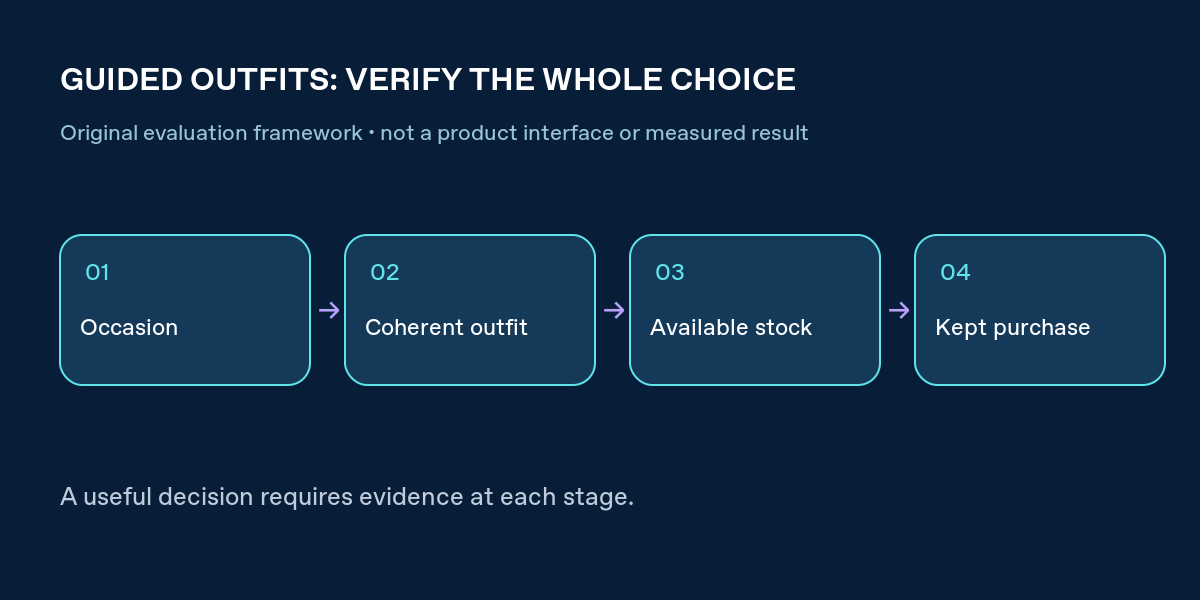
Original explanatory diagram, not a product screenshot or measured funnel. Occasion → Coherent outfit → Available stock → Kept purchase describes a proposed review sequence: understand the purpose, assess the combination, check availability and examine the post-purchase outcome. Arrows do not guarantee behavior or causation. News context: the primary announcement.
Design a handoff that preserves the reason for the choice
A recommendation can be helpful inside a conversation and confusing on a product page. The transition should preserve the information needed to continue: which item serves which purpose, what assumptions shaped the suggestion, and which details the customer still needs to verify. This is especially important when a person changes size, color or one component of a combination.
Inspect the journey rather than only the answer. In a proposed test, a reviewer follows the recommendation through selection and cart editing, then checks whether the original rationale still holds. A replacement may change the look or the cost. The customer should not need to reconstruct the entire discussion to understand that change. Seamless navigation is useful, but preserving meaning matters more than reducing a click that was helping someone check an important detail.
Measure useful choices before celebrating engagement
Conversation length, message volume and return visits can describe use; they cannot independently establish better decisions. A long session may indicate curiosity, enjoyment or repeated failure. Choose a primary question before looking at activity charts. For example: does the service help eligible visitors find an appropriate, available selection with less unresolved uncertainty?
Measure intermediate events with explicit units. Distinguish a recommendation shown, a product opened, a cart addition and a completed order. Do not silently treat sessions as people or count every suggested item as a separate successful journey. Add a small, voluntary feedback question about usefulness where appropriate, while acknowledging that respondents may differ from nonrespondents. Keep quality review alongside behavioral data so that an attractive conversion rate does not hide misleading advice, confusing substitutions or repeated customer effort.
Use a comparison that can answer the business question
A hypothetical pilot could compare guided discovery with the existing experience among eligible visitors, provided assignment and tracking are suitable for the question. Define eligibility, the evaluation period and the main outcome in advance. Preserve meaningful operational differences in the record, including stock changes, promotions and service interruptions.
If random assignment is not feasible, do not relabel a before-and-after comparison as causal proof. Customers who choose an assistant may already differ from those who avoid it. Describe the limitation and use the evidence for a narrower decision, such as identifying recurring comprehension problems. An imperfect but honest comparison can guide improvement. A confident attribution claim built from incomparable groups can instead steer budget toward a story that the data never established. No universal sample size or winning threshold is implied here.
Include returns, support and operating cost
A purchase is an important milestone, but it is not the end of the experience. A service might encourage larger baskets while also generating mismatched expectations. Review available post-purchase signals on a consistent basis, including cancellations, returns and relevant support reasons. Avoid assuming that every return is caused by the assistant or that every retained order proves excellent advice.
Include the work needed to maintain the service: merchandising review, exception handling, catalog corrections and customer support. Compare contribution using an agreed cost definition, not revenue alone. Some effects take longer to observe than an initial test window. Mark immature outcomes as pending rather than treating missing returns as zero returns. This proposed discipline prevents an early dashboard from becoming a permanent success claim before customers have had time to experience what they bought.
Give failure categories an accountable owner
A generic “bad recommendation” bucket makes improvement difficult. Separate an incorrect product fact from an unsuitable combination, an unavailable option, a broken destination and an unexplained substitution. These categories suggest different remedies and different owners. A content correction will not fix a stale stock connection, and a navigation repair will not resolve poor editorial judgment.
For each meaningful incident, preserve only the information needed to understand and reproduce the problem within authorized access. Record the relevant version and product state, the customer-facing consequence and the correction. Review recurring patterns rather than only dramatic examples. A modest, consistent error taxonomy can be more actionable than an impressive overall satisfaction score. The purpose is not to eliminate every subjective disagreement about taste, but to distinguish legitimate preference differences from avoidable failures of information or service.
Localize the decision context, not just the wording
For a GCC retailer considering a comparable concept, language translation would be only one part of preparation. Customer questions may depend on climate, occasion, delivery expectations and locally relevant product information. These are hypotheses to investigate with the intended audience, not assumptions about every shopper in a region.
Test Arabic explanations with real decision tasks and check that product names, sizes and checkout information remain understandable across languages. Do not infer local availability from an overseas announcement. Confirm the commercial and technical scope independently before making a launch promise. Healthcare marketers should be especially careful about transferring a retail styling analogy: a persuasive shopping recommendation is not a clinical recommendation. Educational service navigation must not present uncertain suitability judgments as medical advice or collect health information merely to imitate a retail personalization experience.
Set a stop rule as well as a growth rule
Before expanding a pilot, specify which problems require a pause, which can be corrected during operation and which need a narrower scope. A repeated material factual error deserves a different response from a harmless wording preference. Give someone clear authority to stop a faulty path and explain what evidence is needed to reopen it.
Karim’s strategic takeaway: evaluate guided shopping as a decision-support operation, not a chatbot campaign. Strong taste, dependable merchandise information and honest measurement must work together. Expansion is justified when the team can explain the customer benefit, the remaining uncertainty and the cost of maintaining quality. If the evidence only shows more conversations, the next step is better diagnosis, not a larger promise. The most useful assistant may be the one that helps a person finish confidently and leave sooner.
Comments
No published comments yet.