
A deadline reaching its date, not a new launch
LinkedIn’s published schedule places the sunset of Marketing API version `202511` on November 16, 2026. This is a previously announced deadline reaching its date, not a new product announcement today. The documentation also specifies `surface` values `LAN` or `CTV` for publisher-list creation from version `202611`, and a separate December 15 placement-matching deadline. Existing attached lists are described as continuing to work. Sources: migration schedule, change notice.
The practical issue is not whether a team has heard about the date. It is whether somebody can show which requests the business actually sends, which workflow depends on each request, and what would reveal a failure. The audit framework below is original operational analysis, not a LinkedIn-prescribed procedure or evidence that any particular company, including this website’s owner, has an affected integration. Establish exposure before declaring an incident.
Separate version choice from placement meaning
Treat the two workstreams as different questions. One asks whether the integration is using a supported contract. The other asks whether a publisher list expresses the intended placement and is used consistently. Changing a version value cannot, by itself, prove that the campaign’s meaning is correct. Conversely, a well-organized list inventory does not establish that every scheduled reporting job uses the intended version.
Use two named owners and one shared acceptance document if different teams maintain these functions. Record the version review, the placement review and the evidence for each separately. The team can then finish a reporting repair without incorrectly closing a campaign-creation issue. A green aggregate project status should never hide an untested critical path. Ask the business owner to approve what successful operation means before engineers choose a convenient technical proxy for success.
Start with a map of actual requests
Inventory production services, scheduled exports, internal scripts and vendor-managed connections. For each, record its purpose, owner, endpoint family, configured version, last observed successful execution and the business output it supports. Inspect deployed configuration rather than trusting the version in an old repository sample. LinkedIn documents version selection through a request header; the relevant reference is its versioning guide.
Do not collect credentials into the inventory. Store a reference to the approved secret location, not the secret itself. Record uncertainties explicitly: a vendor-managed connector may require written confirmation or a supported diagnostic screen. “Unknown” is a useful queue item, not evidence that a service is broken. Prioritize unknowns by the decisions they feed and the consequences of delay. An executive report that silently stops refreshing can deserve more attention than a visible failure in a rarely used convenience script.
Make the reporting test business-readable
For reporting workflows, define a small baseline with known account scope, dates, timezone, currency and metric definitions. Compare both the request outcome and the resulting records. A successful HTTP response with an empty result may be correct, or it may indicate a changed filter, date boundary or account selection. The test should tell a reviewer which explanation was checked rather than labeling every empty table a platform outage.
Preserve the original raw evidence in approved restricted storage and keep the managerial summary free of unnecessary personal data. Compare row counts, date coverage and selected totals without assuming that every metric must remain numerically identical. Attribution updates or late-arriving data may complicate comparisons. Document the tolerance and its reason before examining the result. Otherwise a team can keep moving the acceptance threshold until an inconvenient difference disappears, which is not a reliable migration test.
Test creation separately, without accidental spend
A reporting check does not exercise the same path as preparing a campaign or assigning a publisher list. Build a second acceptance set for the operations the integration is actually authorized to perform. Prefer dry-run validation or an approved test environment when available. If real writes are necessary, agree the objects, limits and cleanup beforehand. An engineering investigation is not permission to activate advertising or change a customer’s budget.
Include negative cases deliberately: missing input, an unknown internal placement label, and a combination the application should reject. These are proposed local test cases, not assertions about every platform response. The useful result is that the application stops an unsafe or incoherent action before a user thinks it succeeded. Give error messages enough context to be actionable without exposing tokens, private audience data or unnecessary account details. Record which boundary was tested and which still requires review.
Turn placement labels into a controlled vocabulary
Keep a clear internal mapping between the business-facing placement choice and the value submitted by the integration. Do not infer this mapping from a list’s display name. A name such as “Premium inventory” does not prove where that list belongs. Inspect the actual object and its intended use, then document the interpretation. Flag ambiguous legacy records for review rather than guessing from the most common campaign in the account.
Separate identification from cleanup. An audit can locate inconsistent records without immediately deleting, recreating or reassigning them. Those actions may affect live operations and need an appropriate change plan. Preserve object identifiers, existing relationships and the reason for each proposed alteration. This makes review possible and avoids a cosmetic migration that changes business meaning while appearing to simplify the database. The goal is coherent use, not a tidy spreadsheet at any cost.
Use two gates, not one deadline checkbox
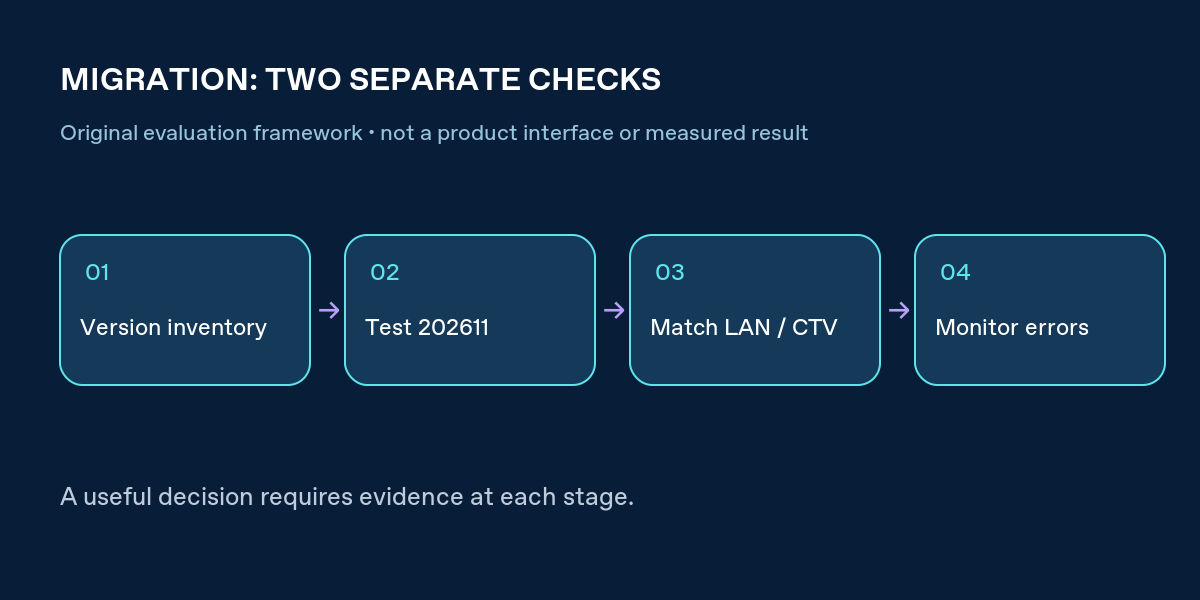
Original explanatory diagram: Version inventory → Test 202611 → Match LAN / CTV → Monitor errors. The sequence supports two separate checks: request-contract validity and placement consistency. It is a proposed operating model, not a LinkedIn interface or evidence of a completed migration. Sources for dates and requirements appear in the opening section.
The diagram’s value is organizational. A task can move through the first gate while remaining open at the second. Keep that distinction in the issue tracker and in the message sent to marketing. “Reporting verified; campaign-list assignment still under review” is more useful than “API update done.” Attach a small evidence package to each gate: the tested scope, timestamp, reviewer and observed result. A screenshot of a green dashboard alone cannot establish that the underlying data is fresh or that the next write will work.
A hypothetical reconciliation exercise
Imagine a team with twelve scheduled jobs: eight reporting jobs, two list-management jobs and two campaign-preparation jobs. Inspection identifies four jobs with uncertain configuration. This means one third of the inventory needs clarification; it does not mean one third is failing. If two uncertain jobs belong to an external supplier, assign an owner and response deadline rather than silently counting them as passing. These numbers are invented to explain the method, not observed LinkedIn performance.
Suppose the eight reporting jobs return successfully, but one still displays yesterday’s cached output. The transport success rate is eight out of eight, while verified fresh outputs are seven out of eight, or 87.5%. Report both measures with their denominators. They describe different questions. Do not average them into a reassuring blended score. Resolve the stale output, then rerun the affected test and retain the earlier result so the incident history remains understandable.
Design a safe cutover and a credible fallback
Make the change small enough to observe. Where the architecture permits, validate one representative workflow before expanding. Define who may pause a rollout, which symptoms trigger that pause and how people will obtain essential information meanwhile. A fallback might be a clearly dated manual export, not a silent substitution that makes old data look current. Check that the fallback is accessible to the people who need it before relying on it.
Do not call a return to an unsupported contract a rollback strategy. A credible recovery plan uses a known viable state or a limited manual procedure while the defect is repaired. Keep customer-facing promises proportionate to the test coverage. If only reporting has been verified, do not promise that every advertising operation is unaffected. Communicate the boundary, expected next check and owner, then update the status from observed evidence rather than elapsed time alone.
Monitor freshness as well as failures
Set alerts around the workflow’s purpose. Useful candidates include an absent scheduled run, an unexpected response class, a missing date partition and a report whose last successful refresh is too old for the decision it supports. Choose thresholds from the team’s service needs rather than copying an arbitrary universal interval. A daily executive pack and a near-real-time operations panel have different tolerances, even if they share a connector.
Route each alert to someone who can investigate it. Include the affected workflow, time, expected output and a safe diagnostic reference. Suppress repetitive notifications only after the incident is tracked, not by hiding the signal. Monitor the recovery too: a successful retry is incomplete if downstream caches or exported files still contain stale data. Close the incident when the business output is usable and its limits are clearly stated, not merely when the first technical error stops appearing.
What a marketing manager should request
Ask for a short readiness note, not a wall of implementation detail. It should state the workflows reviewed, unresolved exposure, tests passed, business outputs checked, remaining owner and next decision time. Ask the supplier to distinguish configuration evidence from assumptions. A statement that “the connector is maintained automatically” is not the same as evidence that the specific workflow and account have been tested under the intended conditions.
For healthcare or other sensitive contexts, keep migration diagnostics separate from patient information. Use synthetic examples and minimum necessary operational data. A platform-maintenance exercise should not become an excuse to copy lead records into casual chat or public tickets. The same principle improves ordinary commercial work: narrow evidence is easier to review, safer to share and less likely to distract from the actual integration problem. This is a proposed governance practice, not individualized legal advice.
The strategic takeaway: maintenance protects decisions
The commercial value of this work is confidence in decisions and controlled execution, not the novelty of a version number. Record the time spent finding hidden dependencies and use that experience to improve the next review. Maintain a small register of integrations, owners and supported contracts, with a regular review of official change notices. Let the review produce a bounded test plan rather than a vague promise to stay updated.
For this deadline, the responsible first statement is “we are checking exposure,” followed by evidence that narrows it. The responsible completion statement names the workflows actually verified. Neither requires claiming that every account is affected or that all campaigns will fail. Marketing and engineering work better together when uncertainty is visible, responsibilities are explicit and a successful migration means the business can still obtain trustworthy information and carry out only the actions it intended.
Comments
No published comments yet.