
What changed, and when
OpenAI announced ChatGPT Wallet on November 13, 2026, initially for eligible US Pro users through dots. Purchases require individual approval. Merchants retain pricing, fulfillment and returns. This is not evidence of Saudi availability or improved conversion.
The analysis below is an original operating proposal for marketing teams, not a description of features promised by this announcement. Its central question is practical: can a business make the journey from a customer's expressed intention to a correct, fulfilled order easier to understand and verify? Answering that question requires cooperation between marketing, ecommerce, service and risk teams. A new payment mechanism does not, on its own, repair a confusing offer or an unreliable operational handoff.
Start with a customer task, not a channel label
Choose one concrete shopping task before discussing an agent-commerce strategy. A useful pilot might ask whether a customer can identify the correct replacement accessory, confirm compatibility, understand the total and obtain an accurate delivery promise. That is narrower and more testable than promising to become ready for every possible autonomous shopping journey. It also gives each participating team a common definition of what successful assistance means.
Write the task in customer language. Include the constraint that makes the choice difficult: a size, a delivery date, an intended use or a maximum total. Avoid personal data that the task does not need. The pilot should reveal whether the business communicates the relevant facts clearly, not whether the testing team can quietly compensate for missing information using insider knowledge.
Audit the offer as one consistent object
A product is not just its promotional headline. It is a combination of specification, variant, availability, price, mandatory charges, delivery conditions and after-sales expectations. Create a simple record that connects these elements for the selected pilot offer. Then compare what a customer can actually read on the product page, cart, checkout and confirmation. Record differences rather than explaining them away as minor wording issues.
Assign an owner to every discrepancy. Marketing can clarify an ambiguous claim, but it should not invent stock availability or overrule a delivery commitment. Where systems disagree, identify the authoritative source and the person who can correct it. The output of this audit is a usable decision record, with a review date, not another attractive description disconnected from the order process.
Make uncertainty visible before payment
Many commercial failures begin when an uncertain fact is presented as settled. If compatibility requires confirmation, state the missing detail and provide a route to resolve it. If delivery depends on location, explain when the estimate becomes specific. A good journey does not force the customer or their representative to infer a promise from a photograph, an old campaign or a general category description.
Test uncertainty deliberately. Ask a reviewer to choose between two similar variants and explain what information supports the choice. If the answer relies on assumptions, improve the content before increasing traffic. This exercise is not a technical certification. It is a way to discover whether the offer supports a defensible decision when the reader does not share the team's background knowledge.
Separate access from permission to act
For any future implementation, draw a distinction between seeing information and making a consequential change. A visitor may be able to inspect an offer without being entitled to change an order, apply a restricted discount or view another customer's history. Keep those boundaries explicit in the pilot specification. Do not treat broader access as an automatic improvement simply because it reduces the number of steps.
Marketing should describe the desired experience; the responsible technical and security teams should assess the implementation. Any proposed access change needs its normal review and authorization. Avoid blanket exceptions introduced solely to make a demonstration work. A useful pilot can report that a task stopped at a permission boundary. Concealing that stop would produce a more impressive demonstration and a less trustworthy business process.
Build a journey map that preserves evidence
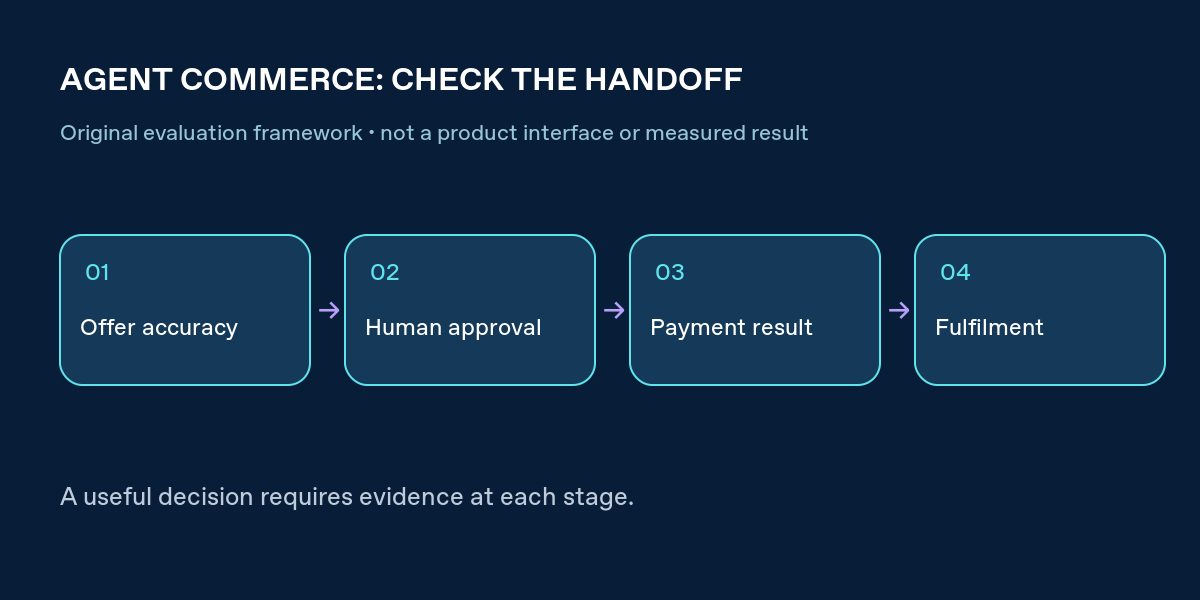
Original explanatory visual created for this article, not an OpenAI interface or measured funnel. Its four labels are Offer accuracy → Human approval → Payment result → Fulfilment. Connections require evidence; a payment result is not proof of correct fulfillment. The announcement supplies news context, not a guarantee of this proposed journey.
Use this map as a checklist rather than a claim that all stages are automatically linked. For each stage, write the observable event, its owner and the evidence retained. If an order cannot be connected confidently to an earlier interaction, label the relationship unknown. A visually complete funnel built by guessing is less useful than an incomplete map with honest boundaries.
Design a small test matrix
Begin with ordinary, non-sensitive test cases. Include an available product, an unavailable variant, a changed delivery destination and a cart whose total changes after an option is selected. Add a case where the right outcome is to stop and ask for clarification. These scenarios are hypothetical recommendations, not statements about specific capabilities available in any payment product or account.
For every case, specify the expected result before running it. Record the displayed offer, selected variant, final total and observed endpoint. Keep failures reproducible without retaining unnecessary personal information. A test that merely records whether a page opened misses the more important question: did the journey preserve the customer's constraints and reach an appropriate result?
Measure correctness before measuring speed
Time saved matters only when the outcome remains correct. Define a small number of failure categories: wrong variant, unexplained charge, inconsistent promise, duplicate order, missing confirmation and unresolved support handoff. Adapt the categories to the business rather than adopting them as a universal standard. Track both the count and the denominator, and distinguish a critical error from a cosmetic inconvenience.
A shorter session with the wrong order is not a better customer experience. Include a review of the customer's intended task alongside completion time. When a clarification prevents a mistake, record that as a useful intervention rather than automatically classifying it as friction. This keeps optimization focused on dependable task completion instead of rewarding the fewest possible clicks.
Keep a hypothetical scorecard honest
Suppose an internal trial contains 100 attempted tasks. Seventy reach an accepted order, and 63 are later verified as correct and fulfilled. The accepted-order rate is 70%, while the verified-outcome rate is 63%. These invented numbers illustrate distinct outcomes with the same denominator of 100 attempts; they are not expected Wallet performance, a market benchmark or a claim about a campaign that has taken place.
If seven of the accepted orders are still awaiting fulfillment, do not quietly classify them as successful or failed. Show the pending group separately and update the report at a defined observation date. Record cancellations and corrections as well. A scorecard should make the maturation of outcomes visible rather than giving yesterday's incomplete cohort the appearance of a final result.
Do not confuse a comparison with causation
Comparing an assisted journey with ordinary checkout can generate useful questions, but a raw difference does not establish why it occurred. Customers may arrive with different intentions, baskets or prior knowledge. Start by documenting those differences and the limitations of the comparison. If a controlled experiment is feasible, agree its design and success criteria before examining the outcome.
Avoid choosing a favorable time window after seeing the numbers. Preserve the initial question, eligibility rules and exclusions. Report uncertainty when the sample is small. The business decision may simply be to repair a recurring error and repeat the test, rather than declaring a new acquisition channel superior on the basis of a small, self-selected group.
Include the cost of exceptions
An apparently smooth purchase can create expensive work later. Count the time spent investigating mismatched orders, correcting delivery details, answering confused customers and reconciling transactions. Separate one-time setup work from recurring exception handling. This helps the team distinguish a manageable launch investment from an operating cost that grows with every additional order.
Give support staff a clear path to identify the relevant order and explain what happened. Do not require them to reconstruct the customer's entire conversation or collect unrelated information. Review a small sample of exceptions jointly with marketing and operations. The purpose is to repair the cause, not to blame whichever team received the complaint last.
Treat the landing page as an operational promise
A campaign page should continue into a coherent offer, not disappear into a different set of conditions at checkout. Check that important limitations remain visible when the visitor moves between pages. If a promotion has ended, replace the promise promptly instead of relying on the checkout to reveal the disappointment. Content freshness is part of conversion quality, not merely a search concern.
Maintain a short change log for the pilot offer. When price, availability or fulfillment conditions change, identify which pages and messages must be updated. Test the journey again after material changes. This creates a practical connection between content governance and the actual customer experience, without pretending that a single content revision can solve every integration problem.
Adapt the learning carefully in healthcare
Healthcare marketing teams can use the same clarity audit for ordinary service information and appointment requests, without assuming that a retail payment journey is suitable for clinical decisions. Separate explaining a service from deciding whether it is appropriate for a particular person. Route clinical suitability questions to qualified staff, and avoid placing patient information in a generic marketing test.
A hypothetical clinic pilot might assess whether opening hours, location, booking instructions and the next step are consistent. It should not promise treatment eligibility, insurance acceptance or clinical outcomes unless the responsible team has verified them. The value of this exercise is better communication and a safer handoff, not replacing professional judgment with a simplified purchasing metaphor.
Agree ownership before expanding
Name one coordinator and a responsible owner for content, checkout, fulfillment, support and risk review. Define what each person must investigate when a test fails. Keep the escalation route short enough to use during ordinary work. A shared dashboard is not a substitute for someone having the authority and time to resolve the issue it displays.
Set a review date and a stop condition. For example, repeated wrong-item outcomes should pause expansion while their cause is investigated. This is a proposed operating rule, not a product requirement. A team that can stop, explain and repair a failed journey is better prepared to scale than one that only celebrates successful demonstrations.
The strategic takeaway
Treat agent commerce as an opportunity to improve the reliability of the offer-to-outcome journey. Begin with clear information, a bounded test and evidence that survives the handoffs between teams. Evaluate correct fulfillment, avoidable exceptions and customer understanding alongside speed. Do not attach an assumed revenue uplift to a launch announcement or equate a new payment possibility with a complete marketing strategy.
The immediate deliverable is modest and useful: one audited offer, a documented test matrix, a transparent scorecard and named owners for unresolved problems. Expand only when those pieces support a repeatable process. For a growth team, the strongest advantage is not being first to adopt a label. It is being able to show that more customers reach the right outcome with fewer preventable mistakes.
Comments
No published comments yet.