Announcement: October 29, 2026. Editorial review: November 1, 2026. This is an analysis of an earlier earnings release, not a product launch today.
The reported numbers, with the calendar attached
Amazon reported quarterly advertising revenue of $19.637 billion versus $17.703 billion a year earlier: 11% growth, or 12% excluding currency effects. It attributed timing distortions principally to Prime Day, which moved into Q2 in most major countries. Its Q4 advertising-growth expectation is in the high teens, not a completed result. Amazon’s official Q3 release.
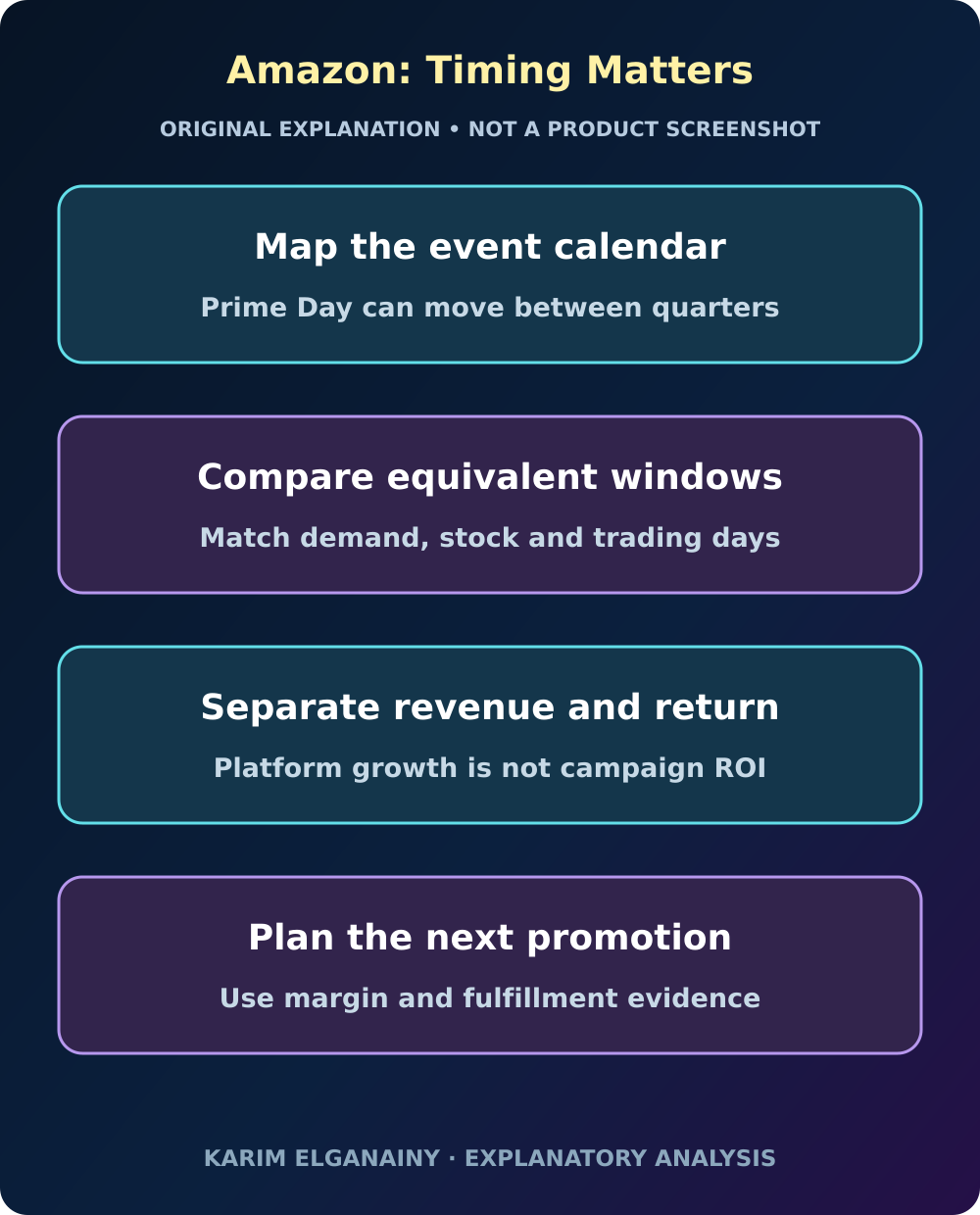
Original editorial framework; not a product screenshot or proof of campaign results.
Editorial analysis: an event can move while the quarter stays still
For an advertiser, the useful question is what belongs in the comparison. A calendar quarter is a fixed reporting container, whereas a shopping event can move between containers. Comparing the same named quarter does not necessarily compare the same collection of selling opportunities. That distinction matters when a team is deciding whether apparent softness requires more spending, a different promotion, or no immediate intervention. The accounting period and the commercial occasion describe different aspects of performance.
The following planning approach is original editorial analysis, not Amazon guidance or a reconstruction of its undisclosed advertising results. It asks advertisers to maintain two views: the financial calendar used for budgets and reporting, and an event-relative calendar used to examine demand around promotions. Neither should replace the other. The first preserves accountability to the approved spending period; the second helps explain whether the conditions inside that period are comparable. Keeping both visible is more useful than choosing whichever makes the latest result look strongest.
Build an event ledger before explaining a trend
Create a simple ledger for each market containing the promotion date, preparation window, advertised products, offer conditions, inventory availability and approved budget. Record whether each entry is confirmed or provisional. An event can have different practical meaning across countries, and a global label does not guarantee identical timing or participation. The ledger should reflect the business's actual campaigns and selling conditions, not a generic holiday calendar copied into every market plan.
Then connect the ledger to the financial reporting periods. Mark which preparation costs, delivery days and delayed outcomes fall outside the quarter containing the event itself. This can reveal why a creative invoice, media expense and completed sale appear in different periods. The purpose is not to move inconvenient expenses elsewhere. It is to retain the accounting treatment while adding a traceable explanation of the commercial sequence. A reviewer should be able to follow the explanation back to dated records rather than accept a broad statement that seasonality explains everything.
Compare by occasion without rewriting the financial report
An event-relative view can align the days before, during and after a promotion across years. Choose the windows based on the purchase journey and operational question, not after seeing which dates produce the most favorable chart. Separate preparation from active selling and follow-through where those stages have different roles. Retain the original calendar-quarter result alongside this view so that an adjustment does not become a quiet substitution for the reported performance.
Consider a hypothetical retailer that moves its major summer offer from July to June. Its July comparison may lose the promotion while June gains it. That does not, by itself, establish either declining customer interest or superior campaign execution. The team would examine comparable promotion stages, ordinary trading days and inventory conditions separately. This example illustrates a comparison problem; it is not a claim about Amazon's underlying daily data or a basis for calculating an adjusted advertising-growth figure for the company.
Do not invent the missing normalized number
A company can identify a timing effect without disclosing enough information to quantify its exact contribution to a particular revenue line. Resist filling that gap with a convenient estimate. In particular, an adjustment described for total company sales should not be transferred to advertising revenue. The two measures can respond differently to an event, and their respective baselines are not interchangeable. A plausible narrative is not a published reconciliation.
For the advertiser's own account, calculate an adjusted comparison only when the necessary records and method are available. State what was excluded, retained or realigned, and show the unadjusted result too. If the evidence supports only a qualitative conclusion, use a qualitative conclusion. “The periods contain different promotional windows” can be an accurate and useful statement without an invented percentage attached. This discipline prevents a planning note from acquiring false precision as it moves from an analyst's worksheet into an executive presentation.
Distinguish demand moved forward from demand added
A promotion can change when a customer orders without changing how much that customer ultimately buys. This is a hypothesis to investigate, not a universal claim about promotional events. Review the surrounding period for evidence that a strong event was followed by weaker ordinary trading, and examine whether replenishment patterns or repeat orders offer an alternative explanation. Do not assume every sale during the event represents a newly created unit of demand.
The commercial question may therefore extend beyond the event's immediate revenue. A team might want to know whether the promotion attracted customers who returned without another discount, cleared inventory that would otherwise have tied up resources, or simply pulled an expected purchase into an earlier reporting period. Those outcomes have different implications for the next budget. They require the business's own order and customer records, with appropriate access controls, rather than a platform-level earnings headline.
Separate inventory readiness from media appetite
An earlier event can compress the time available to receive stock, approve creative or update product information. Before reallocating media money, check whether the advertised items can actually support the planned demand. Document available quantities, delivery promises and alternatives when a promoted item becomes unavailable. An attractive audience opportunity has limited value if the campaign directs people toward an offer that cannot be fulfilled on the advertised terms.
Keep the inventory conversation specific. “We have enough stock” may conceal a shortage in the size, color, location or bundle featured in the advertisement. Assign an owner to reconcile campaign selections with sellable availability, and agree on the trigger for pausing or changing an offer. This is not an argument for avoiding promotion. It is a way to ensure that an earlier spending window does not outpace the operational work needed to turn interest into an acceptable customer experience.
Manage quarter boundaries as a cash-planning problem
Moving a campaign earlier can change when the business pays for production, inventory and media relative to when customer receipts arrive. Map those obligations before assuming that the same annual budget makes the change financially neutral. The annual total may remain unchanged while the short-term funding requirement becomes less comfortable. Finance and marketing should agree on the practical constraint rather than discover it after a campaign has already committed resources.
Separate a timing transfer from a budget increase in the approval record. If money is brought forward, identify the later activity that gives up capacity and the conditions under which that capacity would be restored. Otherwise, a temporary exception can quietly become an expanded annual plan. Show the remaining commitment after the event, not merely the amount already spent. This helps the team preserve room for ordinary trading and subsequent promotions instead of treating each occasion as an isolated request for additional funds.
Preserve a role for ordinary trading days
Event performance and ordinary-day performance answer different questions. A promoted offer may attract behavior that does not persist when the discount or deadline disappears. Maintain a view of non-event demand to understand whether the business can acquire and retain customers under its usual terms. Avoid calling the promotional result the new baseline unless subsequent evidence supports that interpretation. The strongest event can coexist with a less healthy underlying trading pattern.
Conversely, a quieter quarter may contain useful improvements on ordinary days that a missing promotion obscures. Look at product availability, customer service quality and the contribution of completed orders within comparable conditions. The goal is not to manufacture a positive story from a weak total. It is to identify which operating decisions can actually be improved. A quarter-level number is an entry point for diagnosis; it should not eliminate distinctions that matter when choosing the next action.
Review promotional economics after the applause
Use a contribution view that accounts for the cost of the offer as well as the cost of acquiring attention. Discounts, shipping support, fulfillment effort, cancellations and returns can alter what an apparently strong sales period contributes. Define the review period and maturity of the outcomes so that the team does not compare fully settled orders with a batch that has not yet had time to produce returns. Keep the treatment consistent between the periods being compared.
There is no need to attach a universal profitability threshold to this analysis. Different businesses have different margins, service obligations and customer-value patterns. Instead, document the minimum acceptable result for the particular decision and the assumptions supporting it. Where future repeat purchases are part of the justification, distinguish observed repeat behavior from an expectation. A forecast can inform planning, but it should not be relabeled as realized value simply because an event created an encouraging first-order count.
Treat the next-quarter outlook as a scenario input
An earnings outlook describes management expectations for the supplier's business. It does not reveal the price of a future auction, the availability of a specific placement or the performance of an individual advertiser's offer. Use it as context when considering possible conditions, not as an instruction to increase spend. The decision still requires evidence about the advertiser's customers, inventory, economics and capacity to execute.
Prepare a base plan and identify what would justify changing it. An opportunity to serve additional profitable demand, a capacity constraint, or a deterioration in completed-order contribution could each trigger a different response. Make the trigger observable and assign responsibility for reviewing it. Do not precommit the entire reserve merely because a supplier expects growth. A reserve is valuable precisely because it allows a later decision when the business has better information than it has at the start of the quarter.
End with a calendar-aware budget decision
The final review should fit on a page even if the supporting work is extensive. State the original financial result, the event-calendar difference, the comparison method and the resulting budget decision. Include what remains unexplained. A reviewer should be able to tell whether the team is shifting spend, adding spend, changing the offer or keeping the plan intact, and why the evidence supports that particular response rather than a more dramatic one.
Amazon's release is useful here because it exposes the danger of reading a quarter without its commercial calendar. The practical response is not to dismiss every change as timing or to calculate an adjustment from unrelated figures. It is to make event timing explicit, reconcile it with operational records and preserve the distinction between reported results, analytical interpretation and future expectations. That produces a budget conversation about real selling opportunities rather than a contest between mismatched reporting windows.
Comments
No published comments yet.