An excellent campaign can reach the right people and still fail when the organization tries to deliver what the ad promised. Imagine a clinic offering a clear route to an appointment within one working day. The ad is understandable and the request page is simple, but booking agents cannot see available slots, the clinic does not know when a campaign goes live, and the manager wants more requests without asking how many visits took place. Better design or a bigger budget is unlikely to solve that. The organization performs fragments of the promise, but the customer experiences them as one journey. McKinsey’s 7S framework helps diagnose this type of misalignment without blaming a single department for the whole result.
This lesson follows the 5Ms campaign resource lesson. That lesson asked whether there are enough people, money, time, materials and equipment. Here the question is whether decisions, teams, systems and behavior point in the same direction even when those resources exist. Unlike the marketing mix, the 7Ps, which helps design an offer and how it reaches the market, 7S examines whether the organization can execute what it chose. The aim is to leave the diagnosis with a bounded change, a named owner and evidence to follow up, not a broad report that says everything needs improvement or a seven-item score that declares the organization ready.
How do the seven elements fit together?
Strategy, structure and systems are commonly called the hard elements because plans, decision rights and procedures can often be observed, changed and documented. Leadership style, staff, skills and shared values are less readily observed or compared. Soft does not mean dispensable: you might replace a request form in a day while building a habit of escalating problems or teaching staff takes weeks. The course places shared values in the center of the diagram and introduces the more visible elements first when discussing marketing change. That is a useful way to organize a discussion, not an immutable order for fixing things. A single obstacle in leadership style can explain why a well-written procedure does not work.
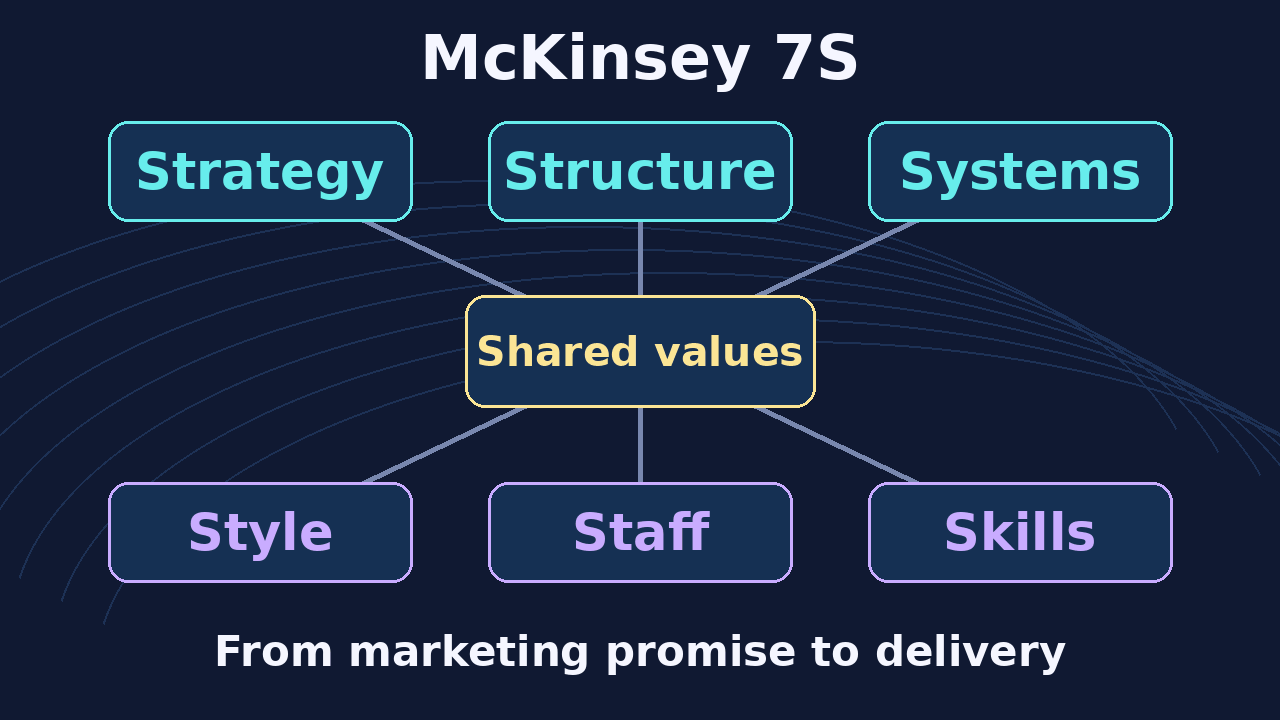
Shared values sit at the center, linked to the six other elements. Color distinguishes more documentable factors from those that require observing behavior; it does not indicate a score or sequence.
First choose a unit of analysis: one service, one branch, from the first request to a recorded outcome, over a stated period. Asking whether the organization is aligned produces opinions. Asking whether new campaign requests can be contacted and eligible appointments confirmed within a working day produces something testable. Map how the work actually happens, not how it appears in a presentation. Ask a marketer, a booking agent and an operations lead to describe a recent stalled request without personal details. Different accounts suggest where to look, not who is wrong. Record the disputed handoff, the evidence that could resolve it and who is authorized to obtain it.
Strategy, structure and systems
Strategy. State the real choice, not a general aspiration such as growing the business. A team might start with one branch and a relatively local audience, aim to convert in-scope enquiries into attended appointments, and decline to widen the campaign until the branch can fulfill its promise. That rules out advertising across branches whose capacity is unknown and separates the spending target from the service outcome. Ask what result would justify continuing and what the team would refuse to do even if it improved the platform dashboard. If each leader gives a different answer, there is no shared operating strategy yet, even if they all use the same objectives file.
Structure. An organization chart is not enough. Structure determines who makes decisions and where the work passes from one team to another. Marketing owns the promise and campaign scope; bookings owns intake and contact confirmation; operations owns capacity and the fallback under pressure. Give the marketing-to-bookings handoff one accountable owner rather than two teams waiting for each other. If the request queue stops updating on Tuesday morning, who detects it, who can reroute requests, and who can ask to delay expansion? A clear responsibility map may be enough without reorganizing departments. Simulate an interruption halfway through a shift to see whether the backup can actually respond in time.
Systems. This includes technology and also the routines and escalation rules that govern its use. A request reaching a generic inbox does not prove that customer-relationship management works. Run a synthetic request: does an internal ID appear, are duplicates recognized, are attempted contacts timestamped, and can agents tell no response from no capacity? Who checks the unassigned queue after the agreed time? Check the end of the shift, not a screenshot captured during a demonstration. Use only the data necessary for operations and give marketing appropriate aggregate outcomes. Diagnosing the service process does not require copying personal records into an advertising tool.
Leadership, staff, skills and values
Style. Leadership style shows up in the decisions a manager rewards and follows through on. A manager who asks for the number of leads every morning but ignores unworked requests invites the team to polish the first available number. Try beginning a short review with two questions: where did requests get stuck, and what can be fixed before the shift ends? Renaming the meeting does not make it useful. Observe whether agents can disclose a capacity shortage without blame and whether the manager really delays expansion if readiness drops. Record a decision, the person responsible and how the decision will be tested. That distinguishes a message encouraging candor from behavior that makes candor possible.
Staff. Ask who is available and when, how absences and demand peaks are covered, and how managers can support the people doing the work. Two people on payroll do not guarantee two available agents at the busiest time. Plot aggregate demand by hour where the data exists, and compare it with actual coverage and competing tasks. A backup for two hours may solve more than adding a permanent post immediately. A person on the rota, however, is not coverage if they are denied access to the appointment list. Daily averages obscure the crowded interval when requests have no owner.
Skills. This is what the team can perform reliably, not merely what training it attended. An experienced agent may be on shift but unable to explain the difference between an enquiry and a confirmed booking or to escalate an exception properly. Select a skill on the critical path and use a simulation to test it. For instance, two duplicate requests arrive for the same person when only one slot is available. Ask the agent to reconcile them under the agreed rules, explain the status without an unconfirmed promise, record the outcome and hand off the exception. Assess the task itself rather than attendance at a lesson or possession of a manual.
Shared values. What guides a choice when the metrics conflict? In this case a team might choose appointment clarity over a flattering report. Test the value when it costs something. Will the agent say a slot is not yet confirmed, even if fewer cases will count as booked? Will the manager delay expansion when capacity is insufficient rather than selling an expectation the team cannot meet? The culture iceberg is a useful analogy: the posters, scripts and visible rules are above water; assumptions about authority and rewards sit below. Do not try to map every habit. Pick a real trade-off and compare the declared principle with the choice that was accepted or rewarded.
First example: an appointment campaign that stalls before the clinic
Suppose a fictional campaign in one branch spends SAR 3,600. In a mature period it receives 240 unique deduplicated requests. Agents reach 120, confirm 72 appointments and record 48 completed visits. Reached means a two-way exchange, not an unanswered attempt. Booked means a confirmed appointment in the booking system, not a submitted request. Completed means a verified visit took place, not a name on a calendar. Here the stages can be linked within the same cohort. Do not combine counts this way when the cohorts cannot be reconciled or the windows differ. These figures illustrate a method, not results from a real clinic.
| Stage | Before change | After test | How to read it |
|---|---|---|---|
| Spend, SAR | 3,600 | 3,600 | Campaign spend for the period |
| Unique requests | 240 | 240 | After deduplication |
| Reached | 120 | 180 | Two-way contact |
| Confirmed appointments | 72 | 90 | Confirmed in the booking record |
| Completed visits | 48 | 63 | Verified attendance |
| Cost per request, SAR | 15 | 15 | Spend divided by requests |
| Cost per visit, SAR | 75 | 57.14 | Spend divided by completed visits |
A fixed cost per request concealed a sizable difference in delivery. Before the change, agents reached 50% and 20% of requests completed a visit. After the test, the figures are 75% and 26.25%. At the same time, confirmed bookings as a share of reached requests fell from 60% to 50%. This is not a mathematical contradiction. Reaching more people can include a less ready mix, and the branch may have fewer suitable slots. Cost per completed visit fell from SAR 75 to about SAR 57.14, but it represents advertising spend only, not profitability or the cost of handling enquiries. Keep both changing ratios visible instead of treating an improvement overall as improvement at every step.
Suppose review reveals a backlog of unassigned requests around the shift handoff. That is observable, but it does not establish a root cause. The system might rely on one frontline person, two people might share a task without the right to reassign it, or management might reward closing tickets instead of recording exceptions. Draw a tension between at least two elements: systems allow a request without ownership and structure does not assign a handoff owner; or staff are present but the required skills have not been established. Test the hypotheses before changing hiring or copy. A synthetic request that reaches the queue but is invisible to the backup poses a different problem from a request that never reaches the queue at all.
Turn the diagnosis into a small connected intervention. Operations assigns an owner and backup to each shift, systems flags aging requests, booking agents rehearse how to distinguish no response from no capacity, and the manager reviews stranded requests before discussing more spend. Keep the original outcome definitions and watch time to first successful contact and age of the oldest unassigned request, alongside completed visits. Name owners for the visit definition and the media numerator. Do not attribute the table’s difference to this intervention alone: weekday mix, available slots and request sources may vary. Hold offer, branch and comparison period as stable as possible, allow equal time for outcomes to mature, and seek stronger comparison evidence if expansion is costly.
Second example: collecting an online order in a store
A fictional online retailer offers same-day branch pickup. The product page is excellent, but staff see total stock rather than reserved stock and the manager records an order as successful as soon as it is paid. Of 80 orders eligible for the promised collection window, 52 were ready on time, or 65%. This does not mean 52 people picked up their orders. Ready means the order was prepared and the customer notified within the window. Collection is separate. Sample delayed orders to distinguish a genuine stockout, an invisible reservation and a missing notification. They have different owners and remedies.
The strategy is not immediate expansion to every branch. Start where stock can be reserved, and withdraw the promise when capacity is full. Structure assigns a reserved-stock owner; systems show inventory by reservation status and suppress an impossible promise; staff cover the post-work rush; skills allow a suitable substitute and a clear explanation of its price and timing. Leadership reviews why orders were late instead of blindly favoring whichever customer paid fastest. Shared values show up in a realistic window rather than a more attractive line of copy. If a later test makes 68 of 80 orders ready on time, readiness reaches 85%, up 20 percentage points. That is not a guaranteed benefit at every branch.
Agree in advance when enough cases have matured and watch preparation time and complaints together. Do not replace the inventory system, train every branch and redefine an eligible order in the same week. That would make changes harder to interpret. Run a bounded test with clear cases where same-day pickup should not be offered. If readiness improves because the rules exclude most orders, disclose the exclusions instead of celebrating a higher percentage. If delayed notifications turn out to be the only demonstrated failure, do not assume the whole structure needs replacing. The point is to select the right intervention while noticing what it depends on.
Turning diagnosis into a short execution plan
Start the meeting with present-state evidence: observed work, a synthetic test or a reproducible aggregate report. For each element write a future behavior or result, not an adjective. For structure, the authorized backup can reassign an orphaned request when the owner is absent. For systems, submitting the same request twice under agreed rules produces one ID. Identify the link most at risk and what happens if the team fixes one side alone. A new alert with no responder adds noise, while training on a rule that booking software cannot support teaches an action staff cannot perform. For each hypothesis name the evidence that would change your mind.
Prioritize by consequence for the journey, observability and effort, while putting safety and privacy obstacles ahead of dashboard improvements. Avoid a broad average that gives each element the same weight: six sound elements cannot compensate for a branch that cannot confirm appointments. Label each piece of evidence confirmed, assumed or unverified rather than assigning deceptively precise scores. Try a reversible change such as assigning a shift owner before buying software. Name the person with authority, the stop threshold and a review date with a concrete choice: repeat the test, repair a blocker or expand within a defined scope.
Use three types of measure. A process measure asks whether the request arrived and was assigned. An outcome asks whether the appointment was confirmed or order prepared within the promise. A guardrail asks whether complaints, duplicates or exceptions increased. Do not let speed improve because the team marks unfinished requests as successful. Pick measures you can interpret, compare under the same definitions, and note changes in capacity or operating hours. Track the share of requests with known outcomes and show cases that have not matured rather than deleting them or counting them as failures.
Put the promise, scope, owner, intervention, evidence, outcome and stop rule on one page. Say how to revert if something breaks and what happens to people who started the journey before the change. Understanding seven links does not mean imposing seven simultaneous fixes. A team might assign a shift owner, verify that person’s permissions and only then train a backup. That sequence suits this situation, not every use of 7S. Test after implementation because a queue that works for five synthetic requests can slow down at the busiest hour, and a trained backup who is not on shift cannot help.
A common error is treating the model as a way to blame teams. Booking says marketing sent too many requests, marketing says agents did not answer, and management says reporting is incomplete. Return to a handoff you can observe: who verifies the request arrived and who can solve the failure before more spend is requested? Another mistake is confusing personal skill with a healthy system. An expert who compensates manually for a failure during a few hours neither makes measurements stable nor ensures performance in their absence. Repeated workarounds are evidence of misalignment, not an unwritten requirement for everyone else.
To make a stop rule tangible, suppose the team agrees to suspend expansion if more than 12 requests remain unassigned at the end of two consecutive shifts. This is not a benchmark; it ties the test’s scope to that team’s capacity. On the first occurrence, the owner examines the cause. On the second, keep the scope unchanged and test a fix with operations. A privacy fault is different: do not wait for another shift. Specify what lifts the stop: evidence that the cause is gone under comparable operating conditions, not a nicer dashboard. This keeps the decision independent of enthusiasm for the campaign.
Exercise and feedback
Invent a campaign that promises a callback within one working day. In three lines define its audience, scope and verifiable promise. For each S write one observable piece of evidence and what you would do if it contradicted your assumption. Now assume 100 unique enquiries, 60 two-way conversations, 30 confirmed appointments and 18 completed visits at SAR 1,800 media spend. Calculate reach as a share of enquiries, completed visits as a share of enquiries, cost per enquiry and cost per visit. If the manager adds a shift whose staff cannot see available slots, which elements are out of alignment, and what is the smallest test that distinguishes insufficient capacity from missing permissions?
Worked answer: contact 60%, visits 18%, SAR 18 per enquiry and SAR 100 per completed visit. An extra shift addresses staff, but systems access or structural decision rights can still undermine it. Do not collapse the possibilities without evidence. With synthetic data and at the same time, compare the schedule seen by the backup and by an authorized agent. If both see no slots, check capacity. If only the authorized agent sees a slot in the same schedule, check permissions and coverage assignments before increasing spend. Record any approved fallback. Do not expect one fix to guarantee attendance, and decide in advance how long the attendance data needs to mature before interpretation.
The day after the change, ask two teams independently to describe the new process. If each can identify the owner and handle an exception in the same way, that suggests a shared understanding, not proof the campaign worked. If they disagree, run a full synthetic handoff and note where their routes diverge. Solving a problem once is different from making the solution sustainable. What training does a new employee need, who can amend the rule, and how will teams learn when operating hours change? Those questions connect a small operating practice to leadership style and values without making every adjustment a major reorganization.
The value of 7S is not memorizing seven words; it is understanding why an attractive promise fails in a misaligned organization. Return to observable work, name the owner and connect action to the value that protects the decision when incentives conflict. Measure the journey, not only the ad dashboard. Pick the tool that fits the question: the 5Ms for missing resources, the marketing mix for the offer and 7S for coordination. If the first hypothesis turns out wrong, that is useful progress. Revise the diagnosis rather than defending it, and do not widen a promise before seeing it work.
Sources and attribution
Course source: Digital Marketing Strategy explanatory materials, London School of Business Administration, lecture six by Jenna Tiffany, physical page 173, slide 21 of 25. For the general framework, see McKinsey’s explanation of the 7-S framework. The illustration, examples, exercise and operating interpretations were developed for this lesson. All figures are fictional and do not represent measured results or performance guarantees.
Comments
No published comments yet.