1. Before asking for a budget, define the decision
Three campaign proposals enter the meeting. The first increases advertising spend to generate more enquiries. The second repairs the booking journey at one location before promoting it more widely. The third delays promotion until the operation is ready. The first may have the most impressive slides, but none of the proposals can settle the underlying question by itself: what prevents us from reaching the goal today? Extra reach makes sense when people do not know the service exists. It might amplify the problem when half the enquiries already receive no useful response. And when only one location can consistently deliver the service, the offer itself may need to change, not merely the advertising budget.
The SAF framework breaks the evaluation of strategic alternatives into three tests: suitability, acceptability and feasibility. Suitability asks whether the option addresses the right problem in its present context. Acceptability asks whether the expected return, downside and stakeholder reactions are within tolerable limits. Feasibility asks whether people can deliver the option with the resources, skills, time and cash available. The tests inform each other but do not replace each other. A service launch can fit the market and have an acceptable financial case while being impossible to deliver by the deadline. A broad discount can be technically easy while addressing an unproven pricing problem. A focused offer may fit the audience and be operationally possible but still impose more risk on service quality than stakeholders are willing to take.
Pages 157 and 158 of the course's digital marketing strategy materials introduce SAF as a pre-implementation review and cite Johnson, Whittington and Scholes (2011). This lesson applies the framework instead of reproducing the slides or their examples. See the evaluating-strategies chapter in the edition listed by Pearson and ACCA's explanation of strategic planning. The numerical rules below are suggested applications, not weights or thresholds prescribed by the framework's authors. Both cases and all figures are hypothetical, not results from a real client or organisation.
2. Suitability: why this option in particular?
Start with a statement somebody could dispute: « We already receive qualified enquiries, but many do not become appointments because useful replies take too long after regular business hours. » Then ask what would prove it wrong. Duplicate messages may have been classified as new enquiries. Appointment availability, rather than response speed, could be the bottleneck. People may not understand what the offer covers. Review authorised recordings or aggregated data, compare shifts, channels and request types, and separate what the records show from the team's interpretation. Write two competing hypotheses and say what evidence could distinguish them. For instance, check whether people contacting the team earlier booked under comparable conditions without implying that such a comparison proves causation by itself.
Suitability concerns both the external and the internal environment. Look at customer expectations, alternatives people already use, shifts in demand and channel behaviour. Then return to what the business is for, what differentiates it, and which service promises it can credibly make. A TOWS exercise can help generate an option that uses a genuine strength to address a challenge. Competitive analysis can show whether the problem resembles what other providers are addressing or whether it differs. Do not turn this work into a museum of observations; connect each observation to a specific strategic choice. If one location completes bookings reliably but other locations have little headroom, that strength supports a focused test, not a claim that every location shares the same advantage. If the audience is abandoning the channel assumed in the plan, change the option rather than editing the campaign headline.
Consideration of internal capabilities can resemble feasibility. The distinction is that suitability examines the logic: is this capability a reason why the option fits the objective? Feasibility requires evidence that staff hours, funding and ownership exist on the required date. A strong team does not make every campaign suitable. Its ability to deliver under normal conditions does not make it available during another launch. Write a success hypothesis for each option, add a piece of evidence that would contradict it, and give the assumption an expiry or review date. If last week's records show a material change, do not approve last month's plan just because it was approved once. The digital feedback loop lesson explains how to test that assumption and bring observed outcomes back into the decision.
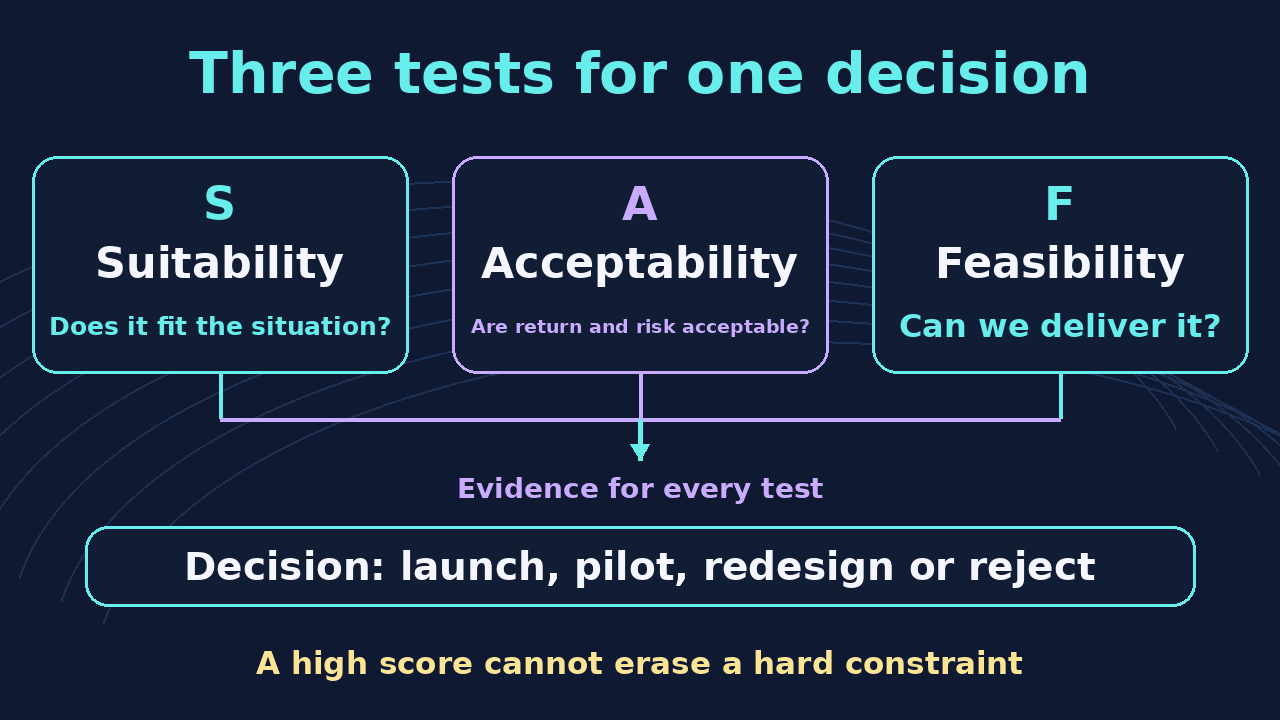
Three parallel tests. Each needs evidence, and a strong result on one does not cancel a hard constraint elsewhere.
3. Acceptability: what is the upside, what is the downside, and for whom?
When management says a proposal is acceptable, ask who accepts what. Finance may judge the return adequate while Operations accepts only if existing customers still receive timely service. Customers may expect a final price to be shown, while the business is calculating a headline price that excludes essentials. For each stakeholder, write down an expected benefit, an outcome they want to avoid, and a measure or condition they will review. Do this before assigning scores so that the meaning of acceptable is not rewritten once a powerful sponsor picks an option. People need not agree about taste. Record consequential objections, who is authorised to accept the downside, and the action if it materialises. In the clinic example, Operations approval means that someone accepts responsibility for monitoring response times and waiting times for existing demand, not that the team promises to help in general.
Calculate an economic result instead of relying on a revenue headline. Start with contribution per completed unit after variable costs, then deduct the incremental cost of running the test. Do not deduct a cost twice or count demand that would have occurred anyway as an additional effect. Distinguish break-even from a target: break-even recovers the defined costs; it does not tell you whether a result warrants the risk or the use of scarce team time. For a project extending across several years, net present value may be useful if Finance agrees which cash flows actually differ across options and what discount rate applies. A two-week pilot usually needs a simpler contribution, cash and downside estimate, provided it states what is counted and makes the trade-offs visible.
Explore a lower case before getting attached to the average. What happens if acquisition cost rises, a batch arrives late, or fewer people attend? Change one assumption and then check the effect of changing a related assumption with it. A backlog could reduce conversion and increase complaints at the same time. Do not label scenario outputs as probabilities without evidence. Agree the maximum loss, a service standard that must not deteriorate, and a minimum quality threshold that cannot be hidden by growing volume. When stakeholders disagree, identify whether they are disputing the estimate, its method or a willingness to bear the consequence. The first may need new observations, the second a better definition, and the third a decision by the right owner.
4. Feasibility: turn the promise into an operating schedule
Map the journey from first call to action to completed service or product delivery. For each transition, name the responsible role, the number of cases they can handle during the relevant window, and any equipment, system access or approvals they need. A bottleneck is often invisible in a weekly resource total; available hours on Monday and Tuesday do not solve the absence of Thursday evening coverage. Calculate net capacity after demand already committed, meetings, parallel work, and a reasonable buffer. VRIO may help you see which resources are worth building around, but calling a skill valuable or rare does not put a person on the schedule or set aside cash. Check an actual shift plan, test the system and confirm independently with the person accountable.
Test the sequence and timing too. A business can owe a supplier before it collects revenue. Total contribution can be positive while a cash gap exceeds its limit before the first collection. Write the dates of the first and last anticipated payments, the maximum cash gap across the period and who confirms the cash limit. Examine dependencies that need an owner and a deadline: activate the booking form, prepare a fallback if it breaks, and test the confirmation message before starting ads. Do not count unsigned approvals, training yet to happen or stock not yet received as present capacity. Record them as launch conditions with a date, an owner and evidence of completion. If a condition slips, postponing or reducing scope remains an option rather than quietly overriding the control.
Define constraints no average can offset: critical capacity, a required approval, a privacy obligation or a cash reserve that cannot be breached. For the options left after that screen, a scale from 1 to 5 can focus discussion if you distinguish « no evidence yet » from « available evidence contradicts the option ». Missing evidence need not mean definitive failure in every case. It may justify a safe inexpensive test, but not overriding an irreversible constraint on optimism alone. If each option meets the minimums, weights can make trade-offs explicit; rerun them with a second credible set of weights. A ranking that flips after a small reweighting exposes a fragile choice. It does not call for more decimal places.
5. Hypothetical case one: an appointment campaign at one location
An imaginary clinic network wants additional attended appointments over two weeks without making current customers wait longer. One proposal is a broad campaign with 400 qualified enquiries and 130 attended appointments. The alternative is a local pilot with 240 enquiries and 90 attended appointments. These are instructional estimates of additional attendance, not verified attributions. An illustrative initial check indicates that slow evening replies, rather than lack of demand, are the likelier issue. More reach before repairing that step is therefore less suitable. There is a third option: improve response without advertising now, and estimate the baseline before assigning all improvements to advertising. Do not assume that baseline costs nothing or produces nothing.
After checking the rota, the team finds it can handle 160 extra qualified enquiries each week, or 320 in two weeks if volume lands as planned. The broad campaign exceeds that capacity by 80. The pilot expects 120 a week and leaves a 40-enquiry weekly buffer. That does not guarantee daily feasibility; demand can arrive in bursts. The team must reserve coverage and try switching off the form near the daily limit. Define a qualified enquiry before launch: a unique request matching the service scope that can use the location. Measure the first useful response against every eligible request rather than selecting a convenient sample after seeing the outcome, and show unanswered requests separately instead of dropping them.
The pilot costs SAR 6,000. Each extra attended appointment contributes an illustrative SAR 100 after variable costs and before pilot expenses. Break-even is 60 additional attended appointments. At 90, net contribution after the pilot cost is SAR 3,000. At 50, the loss is SAR 1,000. The team hypothetically sets a review trigger if a useful first reply takes more than 30 minutes for over 10% of qualified enquiries during campaign hours, and accepts a planning loss of at most SAR 1,000 in the illustrated downside. It is not a guaranteed cap on losses. Act before the pilot ends if fresh evidence shows a worse downside. Name who can pause the ad and who will keep the backlog from growing. Set a follow-up window so that delayed bookings do not appear prematurely as absences.
| Option | Expected qualified enquiries in two weeks | Expected additional attended appointments | Capacity position |
|---|---|---|---|
| Broad campaign | 400 | 130 | 80 above capacity |
| Local pilot | 240 | 90 | 80 spare over two weeks |
Run a local pilot conditional on confirming capacity and measurement. Do not scale automatically because the initial number of forms is high. After two weeks, assess possible additional attendance, response and pressure on existing service against a clear baseline and a comparison group if practical. If you cannot isolate incrementality, call the result an observation rather than a proven causal effect. If the pilot breaks even but waiting times exceed the agreed threshold, returns alone do not justify the larger launch; change coverage first. Even when the pilot succeeds, do not jump from 240 to 400 enquiries without recalculating capacity at peak times and setting a review before committing the next spend.
6. Hypothetical case two: preorder or buy inventory now?
An imaginary home-goods brand wants to test demand without tying up cash. It can purchase 500 units immediately or test a capped preorder of 120 units with clear delivery and refund terms. Assume a price of SAR 120 per unit, direct unit cost of SAR 65 and another SAR 15 for packaging and payment. That is SAR 40 contribution for a completed order before test costs. A SAR 3,200 launch cost makes break-even 80 completed orders. At 100 orders, net contribution before overhead is SAR 800; at 60, it is minus SAR 800. This estimate assumes incomplete orders add no further costs. Check refund fees and reshipping costs before relying on the range.
For suitability, the capped test supports the objective by measuring willingness to buy, not just interaction with an ad. The result does not describe every market or an untested season. Distinguish those who saw the offer, started an order, paid, received it and kept it after the return window. If a discount draws people who would not buy at full price, preorder results do not estimate demand at the normal price. State the learning question: will this audience pay this price for these specifications and this delivery promise? For acceptability, keep an eye on reputation and refund amounts as well as break-even. The owner's willingness to accept downside does not excuse breaking a delivery or cancellation promise.
For feasibility, buying 500 units costs SAR 32,500 in supplier payments if the full direct cost is paid upfront, before packaging and payment fees. At the same unit cost, 120 units cost SAR 7,800 from the supplier; other costs do not disappear. If the supplier cash allocation is SAR 10,000, the larger order is out of bounds even if projected profit is higher. The smaller order is feasible only once the supplier has confirmed the short run and timing and the team can honour refunds. Separate liquidity from profitability; do not count order revenue as cash before collecting it, or depend on customer funds you could not refund. If these conditions cannot be met, a no-payment interest list is a more suitable interim test, with the explicit limitation that it is weaker evidence than a purchase.
7. Managing the decision: from the worksheet to a review date
Start with a one-page decision record. Put the goal, timeframe, status quo and concrete alternatives at the top. For each test write a short claim followed by its evidence, timing and limits. Include a calculation somebody else can reproduce and identify the source of each input. Distinguish past observation, controlled test, opinion and forecast. Name an accountable role and deadline for each constraint. Finish with one decision, whether to launch, run a bounded pilot, redesign or reject, and one sentence explaining why and under what condition you will review it. Do not hide unresolved disagreements behind a vague consensus line. A decision that can be reviewed is more useful than records showing that everyone said yes.
Build a dashboard around the decision, not the data that is easiest to collect. For the clinic, form submissions and booking-button clicks are intermediate indicators; verified attendance, response and pressure on current service inform the decision. For inventory, connect production, collections and returns to the cash limit and contribution from completed orders. Pick a period, starting point and one definition for every rate. Do not switch denominators: attendance out of enquiries is different from attendance out of confirmed bookings. Store the figures you had on review day and record delayed updates. When event counts are small, describe the uncertainty instead of announcing a large change on the basis of one or two cases.
When an option fails, distinguish the idea from its execution. The logic may be sound but its operating conditions never materialised. Alternatively, the work may have been executed as designed and demand still proved inadequate. The first calls for more capacity or a different design; the second calls for a new diagnosis rather than twice the spend. A compelling one-off result does not make a larger rollout suitable, acceptable or feasible if the original conditions cannot be reproduced. Record what changed between planning and launch, such as reduced capacity or different behaviour in a booking channel. Reassessment is part of strategy, not an admission that the first plan had no value.
8. Team exercise and limits of the model
Choose a real reversible decision this month: add a channel, change an offer or extend service hours. Write two options and the status quo. Spend ten minutes on each test and invite someone from a different role to name one reason an option might fail. Convert the reason into something verifiable. If a colleague says « there’s no time », ask how many hours are actually available, when, and who will take over existing work. If Finance says « unacceptable », ask whether it means return, downside or the cash gap. If Marketing calls something « more suitable », request evidence that distinguishes it from the alternative rather than a general market trend. A fact can affect more than one test, but explain what different question it answers in each.
Revisit the clinic example if handling capacity falls from 160 to 110 per week. Increasing the weight assigned to suitability is not the answer: the pilot forecasts 120 a week, above 110. Reduce the limit below 110 with sufficient headroom, or delay until a shift is confirmed. If you reduce volume, run the break-even and acceptability tests again; lower volume may mean fewer than the 60 additional attended appointments needed to break even. Do not carry the old sign-off across without checking it. Record the revised decision, why it changed and the trigger for a fresh calculation. A single review sheet can prevent a series of meetings from repeating the same opinions without new data.
SAF is useful when real options exist and a poor choice would carry costs, workload or delay. Do not use it to decorate a decision already made or create a committee for a tiny safely reversible test. It is not a substitute for financial analysis, research or a required professional approval, and filling out a table guarantees nothing. Its biggest danger is borrowing the authority of numbers to prove a preference, or turning every objection into endless analysis. Ask what evidence would genuinely change the decision. If an option's sponsor cannot name any, the worksheet is still documenting a wish.
At the end of the exercise, give the worksheet to somebody who missed the meeting and ask them to explain the decision in a minute without slides. If they cannot say what delays a launch or cannot reproduce the downside estimate, the decision is not readily auditable. Separate the date a forecast was written from the date it was verified; a staffing forecast submitted before the rota changed is not established capacity today. Also note what is held constant across comparison groups, such as the qualified-enquiry definition and observation window. Otherwise a change in counting can be mistaken for the effect of the option.
Keep a short record of assumptions that have previously gone wrong, to find recurring blind spots rather than grade people. Average response may look adequate while the peak repeatedly causes problems, or refund costs may have been missed on several launches. Pick one recurring assumption and make its verification a condition of the next approval. Do not keep the same checklist forever. When systems improve or projects change, revisit the purpose of a control. That is how a team learns what it can withdraw and what it must keep, instead of filing documents that merely defend past decisions.
A small team does not need to buy software for this. A versioned shared document, a calculation a second person can read, and a review appointment will do. A larger team may split responsibility across functions, but give one person ownership of each decisive condition and a way to escalate disagreements before the team spends money or makes a customer promise. Make it as clear who can stop the pilot as who can start it.
Comments
No published comments yet.