1. When is a campaign actually ready?
Imagine a marketing manager presenting a plan that looks complete on paper. The message is approved, the audience is defined, and the spending cap is prominent. The day before launch, the team discovers that the booking system does not forward requests to the queue customer service agents can see. It could be repaired within a week, but the contractor with permission to make the change is unavailable today. Does having the ad ready mean the campaign is ready? The team can buy impressions, but it cannot yet deliver the service the ad encourages people to request. If the campaign goes live, weak bookings might look like an advertising problem even though the bottleneck is downstream of the click.
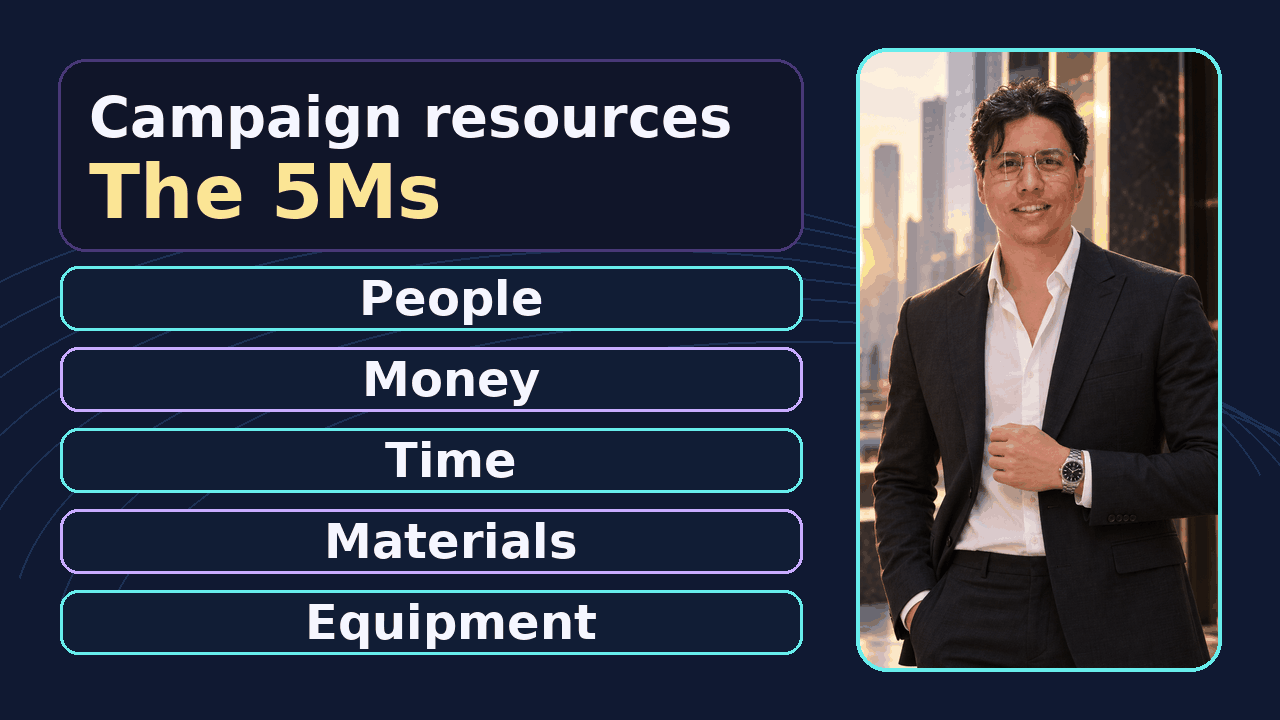
The 5Ms turn that concern into five concrete checks. People: who has the skills, authority and responsibility? Money: what approved funding pays for delivery and learning? Time: what is needed before and after the launch, and which dependency could delay the whole path? Materials: what must be produced and approved? Equipment: what must the team have available and keep working? These are not sequential stages. They are connected aspects of a single decision. If an answer depends on an assumption such as “someone will find a way,” you have identified a potential blocker, not proved readiness.
Lecture 6 of the course material on digital marketing strategy, physical PDF page 161, presents the five aspects in the context of an action plan. The introductory digital marketing material, lecture 7, physical PDF page 225, presents them too. Both use Men and Women for people and Minutes for time, not a requirement to plan literally in minutes. Machines means computers and equipment in the source. Here we apply it to the operational readiness of necessary systems as well, since their failure can have the same consequences as broken equipment. The numerical examples, tests and stop criteria in this lesson are teaching proposals, not requirements from the course sources or outcomes from real organizations. After evaluating the strategy with SAF, use the 5Ms to turn the feasibility question into testable commitments.
2. People: start with who owns delivery
Assign one accountable person to accept or reject each deliverable instead of naming an entire department. One marketer might write the offer, a designer might build the page, and several people may review the wording. Someone still has to own the decision that the version can go live. The accountable person need not do every task. They must know which decisions they can make, who helps deliver the work, and when to escalate rather than wait. An expensive mistake is assuming that the project manager's mental ownership chart matches the permissions, time and training colleagues have in the actual system.
Verify available capacity within the same window in which requests will arrive. “We have four agents” tells you nothing about who handles evening requests when the ads go live. It ignores leave, existing work, breaks and specialist transfers. Distinguish scheduled hours from usable processing time. Run a short rehearsal near the launch date and observe how an agent handles an ordinary request, a duplicate and a person who does not meet the offer conditions. This gives you a practical sample for estimating time and staffing needs; it does not guarantee that future demand will have the same mix.
Design the handoff with the same care as the landing page. At what status does marketing pass a request to service? What are the minimum fields? Who removes duplicates? How does marketing learn the number of confirmed appointments without receiving personal details it does not need? A handoff record might include request status, arrival time in the agreed zone, campaign source and a simple appointment status. Provide a backup and clear authority for each shift. Keep shared reports aggregated and restrict system access according to need. Do not expect a newly named tool to take over a missing training or accountability function on its own.
If an owner or trained backup cannot be scheduled, spending more is not the only option. Restrict the launch to defined hours, narrow the service scope, or contract a specific function before expanding. Compare those options with adding a staff member. Choose the response that improves actual delivery capacity, not whichever one is easiest to sign off today.
3. Money: separate platform spend from what delivery costs
Start with a decision budget, not a platform budget. Some funds buy distribution, some pay to design or produce materials, and some are needed to operate the campaign, handle demand and measure results. Certain obligations remain if you stop the ad today, such as a production invoice already approved. Other costs never appear on an ads dashboard, including extra processing shifts and required software fees. Record each cost, who approves it, and when the commitment is made. Specify whether figures include tax and use the same treatment across options.
Calculate the cost of the actual goal agreed with management. If the goal is a confirmed appointment, dividing channel spend by registrations does not produce a cost per appointment. Track a media cost per request and a full pilot cost per appointment side by side if both are useful. They can both be valid if their numerators, denominators and time windows are clear, but they answer different questions. For an economic comparison, be consistent about fixed and shared costs; do not charge the same common cost to only one option without a reason. Spend is not revenue, revenue is not contribution margin, and a booked appointment is not a completed visit.
Leave a contingency with a stated purpose and an owner. A low first-day cost does not mean the reserve should be spent. A failure in the intake system is not automatically a reason to buy more impressions. Deciding what not to fund now is part of planning. Agree on a pilot size that can test its hypothesis. If funding cannot support that test, do not compensate with a more ambitious headline target. Narrow what you are testing to something measurable, or defer the decision until there is evidence.
Test sensitivity before the last approval meeting. Recalculate at different conversion rates and flag any cost that changes when demand doubles, such as a person covering another service window. A conservative case may change the decision even if the base case still works. Agree ahead of time on what evidence would justify expansion, and what cost or service standard would make you stop.
4. Time: plan for day two before launch day
A campaign has three time windows: the work beforehand, the period in which you can detect and fix issues, and the time needed for the outcome to mature after spending ends. Make all three visible. “The ad stopped” does not mean “the reporting is final.” If a request comes in on Thursday evening and is confirmed on Saturday, counting confirmed appointments when the ads stop can temporarily understate results. Define eligibility by receipt time, the time allowed for an outcome to mature, and when the figures will be closed. Use consistent time zones across advertising, service and reporting and explain any differences.
Work backward from launch. In a hypothetical workweek, the page team starts on Monday, gets approved wording on Wednesday, checks the mobile journey on Thursday, and trains customer service on Friday before a Saturday launch. Can design start before approval? The team may prepare the structure and colors but should not put unapproved claims or prices onto a live page just to test them. That is a dependency: the next task cannot be completed without evidence from the previous one. A one-day margin may cover design but may be too short when a fix requires support whose working hours differ from yours.
An early launch is not always a success. A poorly staffed opening at a busy time can cost more than a limited delay to resolve a known fault. On the other hand, delaying a campaign for a week over an imperfect button color can waste an opportunity without reducing a material risk. Distinguish true blockers from things that can improve after launch. Define a small rehearsal in a window when the authorized person is available. Set two review points: one in the first hour to check the flow of work, and one after enough outcomes have had time to mature to assess performance.
Avoid rewarding the speed of one team at the expense of the whole journey. Time to upload a video measures production, time to answer a request measures service, and time to confirm a booking measures follow-through. All three can change; determine which limits your objective today. If receiving the materials a day earlier does not free up time to make calls, faster production is not evidence that the campaign can handle more demand.
5. Materials and equipment: what goes out, and what makes it work?
Materials are versioned items you can review: a page, copy, images, videos, terms, an approved price, a confirmation message, an agent script, and FAQs or a short reference guide. Mark approved versions clearly and assign each asset an owner. When the ad disagrees with the booking page or the agent script, problems arise even if every system functions. Read the three items in the visitor's order on a real phone and an ordinary connection. Check whether someone can understand the offer and their next step without a marketer explaining it to them.
Equipment and systems make those materials usable when they are needed. A digital campaign may rely on devices, internet access, intake and booking software, user permissions, request forwarding and visibility into failures. A physical event may require a backup connection, screen, power supply, display unit or ticket scanner. Confirmation wording is a material; its delivery system is equipment; checking its arrival is someone's responsibility within a time window; and the monthly invoice belongs in the money plan. Do not waste a meeting choosing a single category for each item. Capture its role in every relevant decision without counting its cost twice.
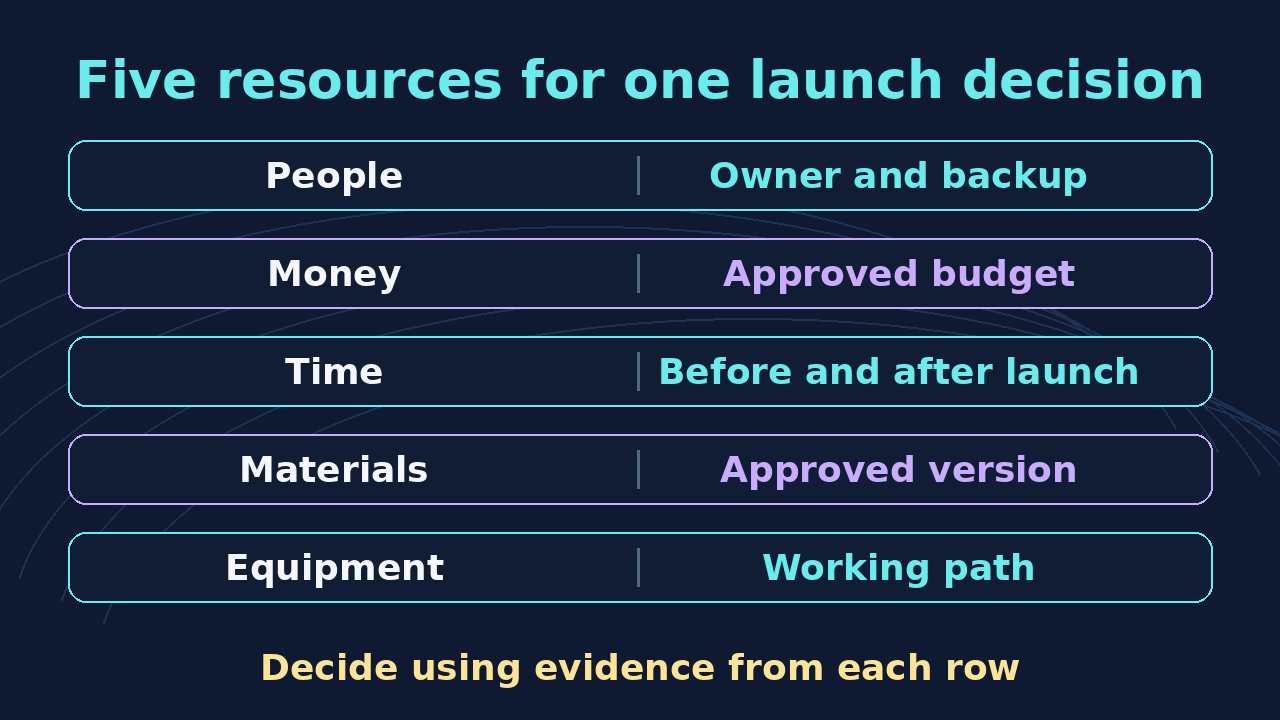
Check all five resources together instead of treating them as successive stages.
Rehearse the end-to-end journey with a known test request that operations can observe. Did a signal reach the correct dashboard? Can an agent mark it confirmed? Does the report count it exactly once? If the request is not handed over, what does the visitor see, and who can stop promotion? Test page failures, repeat submissions, shift changes and each transition between systems or owners. Do not use real personal information simply to run a test. Do not create unprotected backup copies as a substitute for an approved continuity plan.
System access and safe use are not the same thing. A tool may expose all the data even though most staff do not need it. Have the person testing a connection use an appropriate access level. Decide on a safe fallback if systems fail: narrow the promotion or suspend requests temporarily rather than collect information in an unauthorized file. The W3C guidance on accessible forms is useful for labels, feedback and errors. It helps you build a usable workflow; it does not prove that a particular page works in every situation.
6. Worked example one: an appointment campaign at a hypothetical clinic
A team wants to find out whether it can turn requests into confirmed appointments in a seven-day pilot. It allocates SAR 2,400 to media, SAR 600 to materials, and SAR 400 to operations and measurement. The total is SAR 3,400, without adding assumptions about tax or revenue. The team measures results 48 hours after the last eligible request so that routine processing delays do not erase an outcome from the count. At this point it has no attendance or revenue figures. Cost per confirmed appointment alone cannot establish profitability.
One agent handles incoming requests two hours a day during the pilot. Breaks, transfers and other assigned duties take 30 minutes, leaving 90. At a planning estimate of six minutes per request, one agent can handle 15 requests a day, or 105 over seven days if the person and their time are available each day. Expecting 120 during the week would put the plan above its theoretical limit before accounting for surges. Capacity on paper is not a promise: a total of 100 can still create a queue if 24 show up on one day. Repeat calls can also increase processing time and cost.
The team considers starting with lower media spend so shifts can absorb peaks, or agreeing on defined extra coverage before spending more. Marketing and service agree to exchange a daily request-status report, and the operations supervisor runs the flow from a phone without an admin session. The material owner checks the offer headline and terms in the published version. The systems owner confirms that the test request shows up once in the agent queue and once in the aggregated report. This puts the focus on coordination across the handoff rather than how fast the ad can be turned on.
| Metric | Numerator in SAR | Denominator | Result in SAR |
|---|---|---|---|
| Media cost per request | 2,400 | 100 requests | 24 |
| Full pilot cost per confirmed appointment | 3,400 | 30 appointments | 113.33 |
Suppose the hypothetical run ends with 100 requests and 30 confirmed appointments. If only 20 book at the same cost, the second row becomes SAR 170. If 40 book, it becomes SAR 85. These are sensitivity calculations, not predictions or industry benchmarks. Thirty bookings are not necessarily 30 actual visits, so the team should track attendance, or the next outcome it is authorized to measure, before making an economic judgment. If the request handoff fails in real operation, relying solely on a platform's totals does not solve the problem: first establish where cases were lost and what counts as a booking.
7. Worked example two: an in-person product launch with limited slots
A small brand plans to demonstrate a product at a pop-up store. Its goal is not the largest possible view count; it wants visitors to experience a full demonstration and to record orders they agree to place. The team has two days with five usable hours a day. There are two stations, and a demonstration takes an average of 12 minutes. Theoretical capacity is 2 × 2 × 5 × 60 ÷ 12 = 100 demonstrations. The team opens 80 advance spots and leaves 20 theoretical spots for contingencies or walk-ins. That is not a promise that there will be 20 walk-in spots; a long demonstration, absent employee or faulty station could shrink the buffer.
The hypothetical budget is SAR 900 for local promotion, SAR 700 for materials, and SAR 1,400 for operation and equipment rental, totaling SAR 3,000. Do not remove rental from the model because ad platforms do not track it. If 72 people attend and 18 place orders meeting the definition, the full cost per order is approximately SAR 166.67. An order is not a paid sale. Dividing media spend of SAR 900 by those 18 orders gives SAR 50 as a descriptive ratio, not proof that ads caused all 18: some people may already know the product or have walked in from the street.
People include an operator at each station and someone responsible for orders and queue management rather than demos. Time includes installation and training the evening before and the handoff after the shop closes. Materials include the specification sheet, operating instructions, order confirmation wording and the approved price card. Equipment includes two display stations, power, connectivity and the means to record orders. The plan depends on both stations working. A stronger ad cannot repair a failed one. Losing one station for a whole day brings theoretical capacity down to 75 demos, below the 80 bookings even before allowing for variability.
A workable fallback is to offer to reschedule affected reservations with visitors' agreement and stop taking more bookings for that window. Do not hide the delay or promise a time the team cannot honor. Afterwards, review the show rate among booked visitors, separate walk-in counts, actual demo times, station downtime and qualifying orders. These results help distinguish whether growth needs an ad, a third station or a shorter demonstration. Build the plan so you can tell these explanations apart with observations and numbers instead of attributing everything to the advertising.
8. A one-page exercise: produce a decision, not a longer meeting
On one page, write the goal, the version under test, the start and end boundaries, and who owns the launch decision. Add five rows for people, money, time, materials and equipment. For each one record what is required, what is already available, the gap, the evidence that will close it and the deadline. “We contacted someone” is not evidence of readiness. A test request visible in the booking system, an approved invoice, a confirmed shift backup or a page successfully checked from outside the office network can be. The GOV.UK Service Manual on service performance can help you estimate system capacity and test performance under peak demand.
Pick a campaign you intend to start this week. Record one condition per row that would prevent you from launching. Then change one assumption: first-day demand is twice the forecast. Record where the bottleneck appears first. Does the agent's assignment stop at first response or at confirmed booking? Are extra shift funds available or committed to production? Can the team modify the page without improvising unapproved terms? Repeat the exercise with equipment failure and with a material awaiting approval. The point is to test dependencies, not to manufacture a new crisis for every meeting.
Suppose the first campaign sets an operational stop rule: if more than 15 requests are untouched at shift end, the team does not raise media spend until it confirms coverage. This is a teaching threshold for that pilot, not a universal standard. The financial threshold is separate. With a budget of SAR 3,400 and a cost ceiling of SAR 120 per confirmed booking, you need at least 29 confirmations: 3,400 ÷ 120 = 28.33, rounded up to the next whole booking. You must also protect service quality and the minimum evidence needed for measurement. Achieving 29 does not automatically make an excessive backlog acceptable.
At review, go back to the alternatives: run as planned, pilot smaller, redesign the path or wait. You can record platform conversions and withhold judgment until a comparable internal figure is ready. Note the reason for the decision, ownership of follow-up, and the date to revisit it. If the model answers who will do what, with which funds, at what time, using what material and equipment, and has evidence for each answer, you have a basis for execution. If one unresolved blocker remains behind a balanced-looking table, the framework has done its job by exposing a fix while there is still time to change course.
At the end of a pilot, do not start the review by asking why a number went up or down. Present the cohort first: what entered, what was excluded under the agreed definition, and what is still awaiting an outcome. Then reconcile the advertising view with what operations received. Ask the process owner where errors recurred most often. The answer might be an unclear form field, a new staffing window, or an objective that needs to move from raw requests to verifiable appointments. Express the next change as a hypothesis, and agree on which measure will stay fixed so the result can be interpreted. Changing messaging, budget and staffing together may help but makes it harder to attribute any gain to one change.
When you reuse the campaign card with a different audience or at another location, do not let earlier pilot figures turn into promises. Check changes in opening hours, available skills, technical capacity and materials that require local approval. Keep the assumptions that worked in their original window, but note when they were reviewed, who approved them and what changed later. The clinic case shows that delivery extends to the person confirming the time; it does not set a reasonable cost for every clinic. The shop case demonstrates how station count and time limit theoretical capacity; it does not predict visitor behavior. Clear boundaries make it easier to see which insights transfer and what must be verified again.
Comments
No published comments yet.