
Budget intentions are a question, not a spending instruction
LocaliQ’s report, updated November 16, 2026: 53% plan larger budgets. Survey: 389 respondents, September 28–October 12, 2026; 98% US/Canada. This is commercial self-reported research, not peer-reviewed evidence of returns.
Should your own business spend more? Only if an explicit business case survives a test against your constraints. An intention is neither an executed investment nor a measured return. It cannot establish causation or represent Saudi and Gulf customers. The framework below is original practical analysis, not further findings from the survey or a claim that we conducted these experiments. Its purpose is to turn a planning conversation into a decision that can be checked and reversed.
Write the decision before choosing a channel
Start with one sentence describing the business problem. For example: we can serve additional qualified customers, but too few suitable enquiries reach the booking team. That differs from a situation where enquiries already arrive and nobody follows them up. The first may justify a demand-generation test; the second may call for operational repair before extra advertising. Both need evidence rather than a preferred channel looking for a justification.
Specify an owner, a capped budget, an observation window and the point at which the decision will be reviewed. Record what stays unchanged, including the offer, qualification definition and service area. If these change during the test, document when and why. A clear decision note prevents a campaign from drifting into a different project while continuing to claim the original success criteria.
A useful readiness check also asks whether the team can explain what it would do with a favorable result. If more qualified enquiries arrive, who will respond, what appointment or delivery capacity is genuinely available, and what information will the customer receive? If the answer depends on a future hire or an unfinished service page, make that dependency explicit. Conversely, ask what an unfavorable result would change. A test with no plausible decision attached can become a reporting ritual rather than an experiment. Invite the person handling enquiries into the planning meeting, not only the person managing advertising. They may identify a mismatch between the advertised offer and the questions callers actually ask. Record that observation as a hypothesis to investigate, not as proof that every prospective customer has the same problem.
Build a complete cost boundary
A media-only number is useful for managing media, but it is not automatically a customer-acquisition cost. Decide whether the experiment includes creative production, agency work, staff time and software directly needed for delivery. Explain allocations instead of hiding shared costs. Count distinct acquired customers within a stated window, not form submissions, repeated enquiries or existing clients making another contact.
Keep financial terms separate. Revenue is not contribution after delivery costs, and neither is cash already collected. A campaign that looks attractive before service costs may be impractical for a capacity-constrained business. Ask operations whether additional demand can be served at the promised quality, then ask finance which cost boundary and payment timing matter for this particular decision. Do not invent future customer value to rescue an unfavorable first result.
Create a short classification sheet before the first enquiry arrives. It might distinguish a duplicate contact, an existing customer, an eligible new enquiry, a confirmed new customer and an unresolved case. Specify how corrections are made and who can review ambiguous records. A person who submits two forms should not become two acquired customers simply because two platforms report conversions. Equally, an enquiry that has not yet matured should not automatically become a failure at the reporting deadline. Keep its status visible and agree on a later follow-up window. This discipline is deliberately modest: it does not require collecting an intrusive history of the person. It requires consistent business definitions and enough authorized information to avoid double counting. Include exclusions in the report so that a better-looking denominator cannot quietly replace the one agreed at the start.
A hypothetical calculation that changes the discussion
Imagine a fictional service business spending SAR 4,000 on media, SAR 1,000 on creative and SAR 2,000 on staff time. Total included cost is SAR 7,000. With ten new customers, the stated-window acquisition cost is 7,000 ÷ 10 = SAR 700. A proposal increases media to SAR 6,000 while keeping the other assumed costs unchanged, making total cost SAR 9,000.
If the proposal still produces ten customers, cost becomes SAR 900 each. Even with twelve customers, it is 9,000 ÷ 12 = SAR 750, above the original SAR 700. These invented scenarios illustrate a denominator and cost boundary; they are not forecasts, causal estimates or company results. Keeping staffing fixed is an assumption to test, not permission to ignore extra work. No claim about profitability is possible without delivery economics and a defensible comparison.
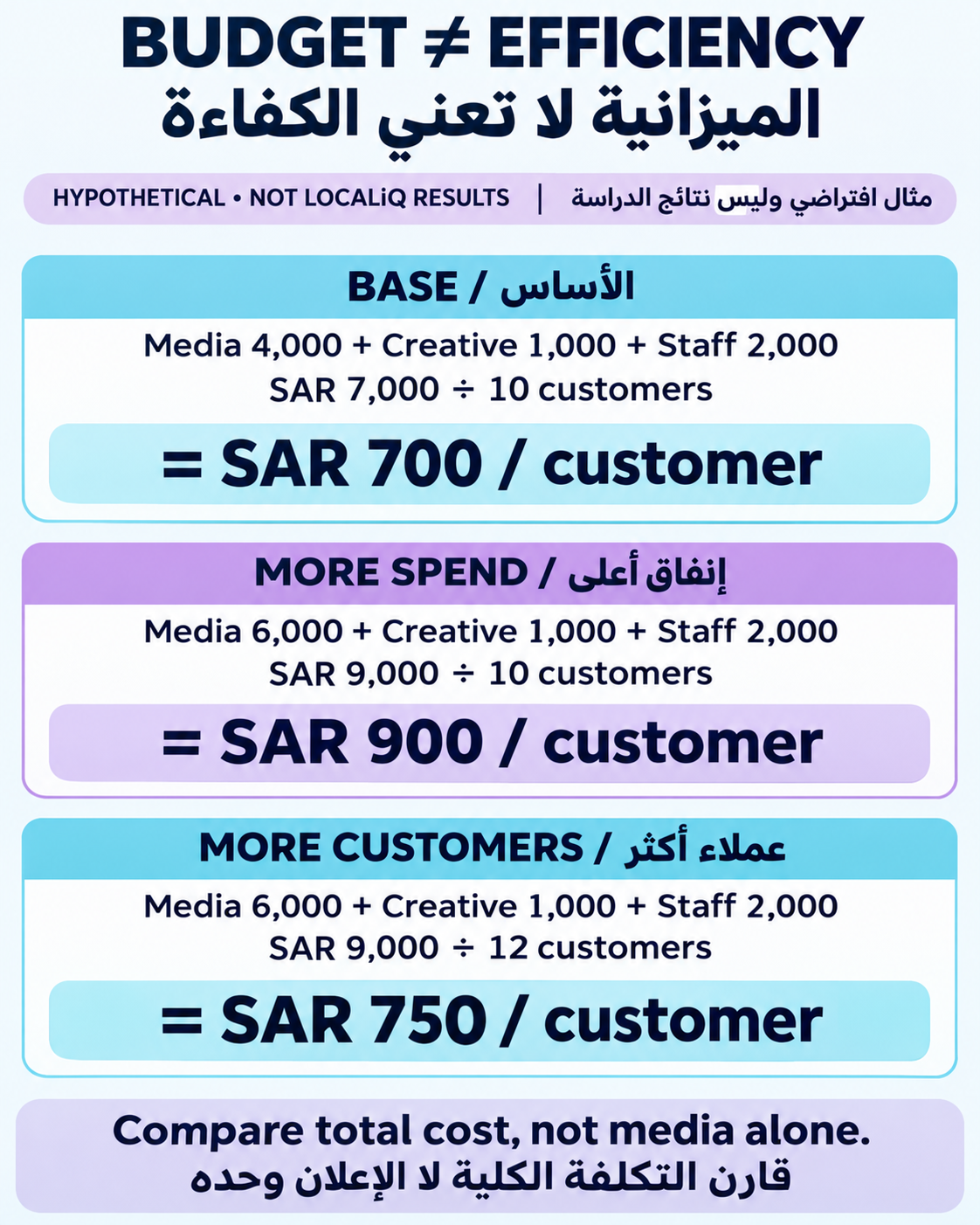
Original analysis figure, not a survey chart. Baseline: SAR 7,000 and ten customers; proposed scenarios: SAR 9,000 with ten or twelve customers. The figure shows arithmetic under stated assumptions, not a predicted response to spending.
Test the marginal change, not the whole company
Choose a limited audience, service or geography where comparison is operationally sensible. Agree on qualification rules before reading results. Where feasible, retain a comparable unchanged group and inspect differences in demand, timing and available appointments. Random allocation can strengthen a suitable design, but merely calling a campaign a test does not make a comparison causal. Avoid mixing several simultaneous changes into one explanation.
Track the extra work as well as the extra customers. Log unanswered enquiries, delayed replies, cancellations and reasons for ineligibility. Review a small sample manually to check that labels mean what the dashboard implies. If the data cannot distinguish new customers from repeat contacts, fix that limitation before claiming acquisition efficiency. A transparent inconclusive result is more valuable than an impressive number with an unstable definition.
Before comparing periods, check whether the business was actually open for the same opportunities. A campaign can generate apparently weaker results during a week with fewer available appointments, a slower response rota or a temporarily unavailable service. Those conditions belong in the interpretation even when the advertising settings did not change. Do not delete inconvenient days after seeing the numbers; define exclusions in advance when possible, and disclose any later correction. Keep a simple timeline linking campaign changes to operational events. If several explanations remain plausible, list them and choose the next observation that could distinguish between them. The aim is not a complicated model that produces a confident answer from thin evidence. It is a comparison that another colleague can understand, challenge and repeat without relying on the campaign owner’s memory.
Set a stop rule before money moves
Write down the conditions for continuing, changing or stopping the experiment. A useful rule can combine qualified demand, acquisition economics and service capacity rather than one attractive traffic metric. Set a review date appropriate to the sales cycle. A short trial cannot settle an outcome that takes months to mature, so separate early diagnostic observations from a final commercial verdict.
Protect a reserve rather than committing every available amount at launch. Assign someone authority to pause spend when the agreed cap is reached or essential tracking fails. Record decisions, not just charts: what happened, what remains uncertain, what will change and who owns the next action. This is a proposed control process, not a universal allocation formula or a recommendation to increase any particular budget.
At the review, use a short decision memo with separate spaces for observation, interpretation and action. An observation might be that eligible enquiries increased while the response backlog also grew. An interpretation might be that capacity limited the benefit, but other explanations remain possible. An action could be to repair the response process before testing another spending increase. Keeping those statements separate prevents an inference from becoming an established fact as the memo is forwarded. Give the action a named owner and a date, and state what evidence would lead to a different decision. Archive the original brief with the final definitions so the next team can see what was learned. A paused experiment is not wasted effort if it prevents a larger poorly understood commitment or reveals a constraint that can be repaired.
Apply local judgment without importing a benchmark
For a Saudi or Gulf business, build the case from its own language, customer needs, capacity and sales process. Compare like periods and explain seasonal or operational differences. Do not assume a foreign respondent group describes local competitors or customer demand. In healthcare, distinguish a marketing enquiry from clinical suitability and completed care; a low enquiry cost is not evidence that treatment is appropriate.
Keep personal information out of presentation examples and collect only what the authorized workflow needs. Use aggregated operational counts where they answer the question. If patients or customers describe experiences, consent to service does not automatically authorize a public testimonial. Local adaptation means understanding the operating context, not adding a city name to an imported spending recommendation.
Make the next decision smaller and clearer
A useful planning meeting should end with one bounded question, an accountable owner and a credible way to learn. It might approve a limited test, repair response handling or retain the existing budget until better evidence arrives. All three can be rational outcomes. The objective is not to imitate the direction of a survey response, but to improve the quality of the business’s own decision.
My strategic takeaway is to increase the quality of the spending argument before increasing the spending itself. Keep the hypothesis, cost boundary, customer definition and stopping conditions visible together. Then evaluate the observed result with the same definitions used at launch. This creates a repeatable learning process without pretending that uncertainty has disappeared or that larger budgets guarantee growth.
Comments
No published comments yet.