
What the announcement establishes
AdMaven's November 16, 2026 release describes Mave as a dashboard assistant requiring approval for changes, rolling out by invitation account by account. Company release. An earlier company blog is dated November 15. This November 17 article offers an original evaluation framework, not a hands-on review or a claim of improved advertising returns. Confirm access directly before building a dependency into a live campaign plan.
The useful question is not whether a conversation feels easier than a dashboard. It is whether an operator can understand exactly what will change and establish that the intended result occurred. A faster interface is valuable only when it preserves an intelligible decision boundary.
Separate three questions at the outset: what the vendor says is available, what the team actually observes in its account, and what the business is willing to authorize. Those questions require different evidence. A release can establish an announcement; an account inspection can establish access; an approval policy can establish internal responsibility. None substitutes for the others. This separation also prevents a pilot report from sounding more definitive than the work supports. Keep the evaluation record explicit about its scope, including tasks not attempted and situations not encountered. A useful assessment can recommend a narrow next step without declaring the entire workflow ready for unrestricted use across every campaign.
Write a change brief before asking
Use a short brief containing the business objective, named campaign, observation period, proposed adjustment and explicit exclusions. Avoid requests such as improve everything, because the reviewer cannot compare an unlimited instruction with a bounded result. Distinguish investigation from execution in the first sentence. Someone asking why costs increased has not necessarily decided to change spending.
In a hypothetical test, an operator might investigate one campaign while leaving every other campaign untouched. That boundary should remain visible in the proposal and the final check. Record the starting configuration before requesting anything, so the team can distinguish a genuine change from a description of existing settings.
A stronger brief also names the condition that would invalidate the request. For example, if the reporting window is incomplete or the campaign owner has changed the objective, the operator should return to analysis rather than proceed with the old proposal. This is a proposed stop rule, not a product capability claim. Write the reason for the adjustment in a way a colleague can challenge: the observed issue, the alternative explanation and the evidence needed to distinguish them. That habit makes review a decision rather than a ceremonial click. It also helps a new reviewer understand why a superficially similar campaign should remain untouched while the selected campaign is investigated.
Make the evidence comparable
A persuasive summary can still compare unlike periods. Check reporting timezone, event definition, attribution window and completeness before deciding that a campaign deteriorated. A delayed conversion is not equivalent to an absent conversion. A cheap click is not necessarily a useful business enquiry. These are proposed analytical checks, not findings from an evaluation of this product.
Use the same definition on both sides of the comparison. If the team changes its qualification criteria midway, annotate the break rather than presenting a continuous improvement curve. Keep an export or dated snapshot with the decision record. Evidence that can be revisited is more useful than a confident sentence that nobody can reconstruct.
Consider the unit of comparison as carefully as the headline metric. A country-level average can hide a mix of devices, audience situations or landing destinations. Before acting on an average, ask whether the comparison describes a consistent population or a changing mix. This does not require endless segmentation: choose the smallest useful breakdown that can answer the specific question, and avoid slicing until a convenient pattern appears. Record why that breakdown was selected before reviewing the result. If the available evidence cannot distinguish a delivery problem from a measurement problem, state that uncertainty. An unresolved distinction is a reason to narrow the proposed action, not to strengthen the language used to justify it.
Review the difference, not the prose
A useful approval surface should make the previous value, proposed value, affected scope and consequence easy to compare. Treat a missing field as a question to resolve, not a gap to fill by intuition. The reviewer should be able to explain what remains unchanged as well as what changes. Assign one accountable decision owner rather than allowing several people to assume somebody else checked the details.
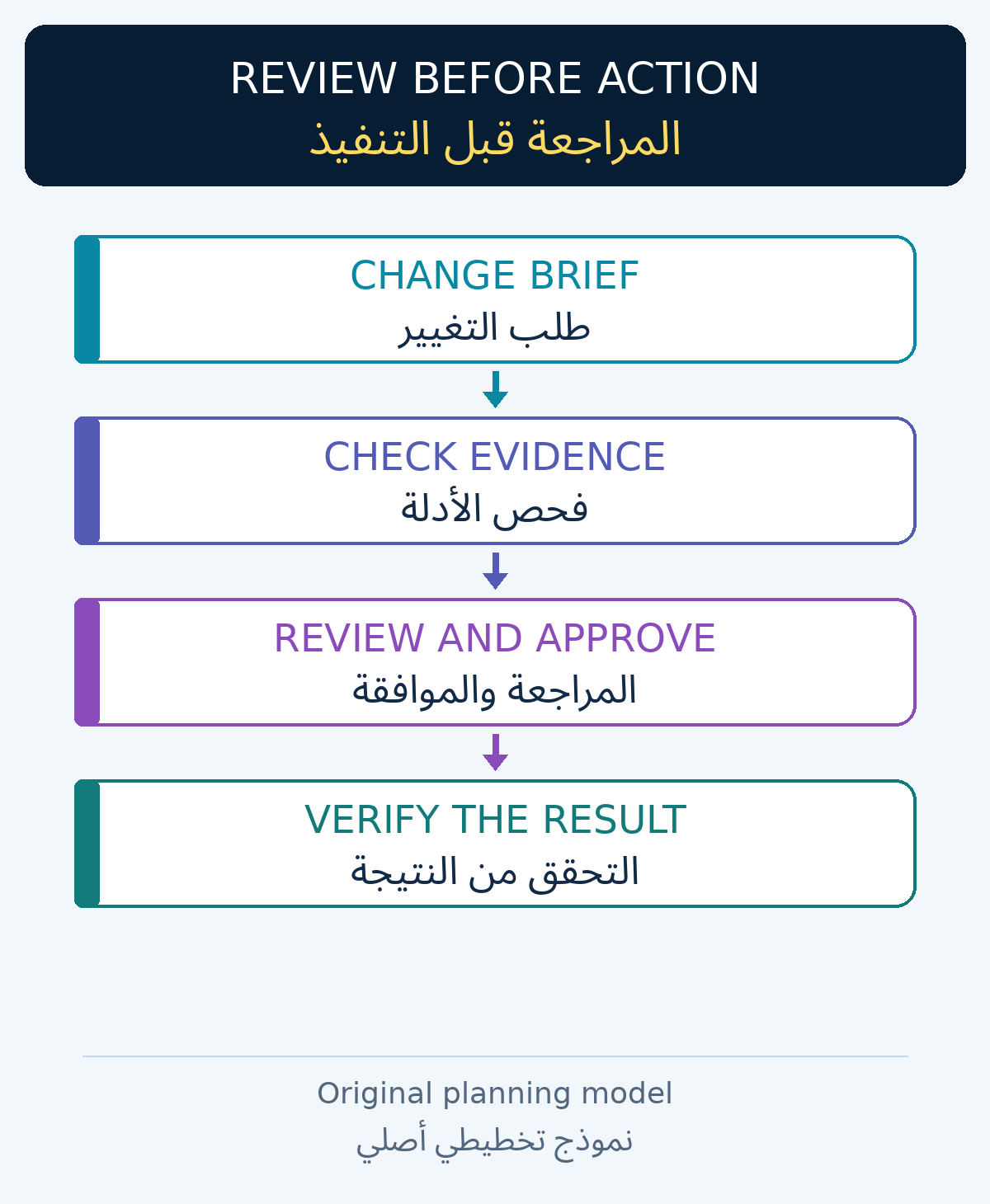
Original editorial planning diagram by Karim Elganainy: define the change, inspect evidence, approve and verify. It is not a product screenshot or a complete feature map. News context: company announcement.
Review fatigue deserves its own test. If every proposal looks similar, a reviewer may begin to approve by familiarity rather than by inspection. Ask a colleague to review a sample of harmless draft proposals containing deliberately different scopes, without sending them for execution. Can the colleague identify which campaigns and settings would be affected? This is an internal training exercise, not a test performed on the product. Its purpose is to assess the team's reading discipline. Improve the brief and checklist when reviewers overlook a material difference. Adding another approval step is not automatically safer if both reviewers are reading the same vague summary and neither owns the final decision.
Verify execution independently
An accepted request is not sufficient evidence that the desired state exists. Reopen the relevant settings and compare them with the approved proposal. Separate proposed, approved, applied and verified states in the team's own log. This recommendation describes a general operating discipline, not an assertion that every state is exposed by the assistant.
If the result differs, stop additional changes until the discrepancy is understood. Preserve the decision record and the current configuration. A recovery plan should identify who can restore the previous setup and how the team will check restoration. Do not assume that a conversational instruction provides a universal undo mechanism.
Verification should also distinguish a setting change from its later effect. Confirming a new configuration answers whether execution occurred; observing subsequent campaign behavior answers a different question. Keep those timestamps separate. A campaign can have the correct setting while the commercial hypothesis remains unproven. Conversely, a favorable performance movement does not prove that the requested change was correctly applied or caused the improvement. Use a short handover note that names the verified state, the unresolved outcome and the next observation point. This prevents an operations team from closing the entire business question merely because its configuration task is complete, and gives the performance reviewer a clear starting point.
Measure useful work instead of activity
Run a bounded pilot using comparable tasks and a predefined acceptance checklist. Record time spent drafting, reviewing, correcting and verifying, not just the time needed to generate a proposal. Count a task as complete only when its final state matches the approved scope. Keep rejected proposals in the record; excluding them would make the workflow look easier than it was.
For a hypothetical calculation, 12 verified tasks completed in 180 minutes equal 15 minutes per verified task. If correction adds 60 minutes, the full cost becomes 20 minutes per task. These figures are illustrative, not product results or benchmarks. Campaign performance requires a separate evaluation because operational speed does not prove incremental commercial value.
Include the cost of coordination in the pilot. If a proposal saves the operator time but creates a longer explanation burden for the approver, the team may have moved work rather than removed it. Ask both roles to record effort using the same task boundaries. Compare routine tasks with routine tasks, and unusual cases with similarly unusual cases. A pilot dominated by easy requests should not be generalized to complex accounts. Review failure patterns qualitatively as well as counting them: repeated misunderstanding of scope calls for a different response from occasional missing data. Set the expansion decision before seeing results so that a pleasing anecdote does not become the acceptance standard.
Keep sensitive context out of routine prompts
For a healthcare marketer, a campaign review can usually be framed using aggregate operational measures rather than identifiable patient information. As an editorial safeguard, keep individual health details outside a routine advertising prompt and use approved internal review channels for sensitive issues. This is a workflow recommendation, not a legal determination or evidence of any vendor certification.
Regional teams should test terminology, currency, date conventions and language with their own reviewers. Translating an instruction is not the same as aligning its business meaning. Ask the reviewer to restate the intended change plainly before authorizing it, especially when several teams share one account.
Agree a vocabulary for ambiguous business terms. A qualified enquiry, an active campaign and a completed conversion may mean different things to different departments. Maintain a small glossary beside the operating checklist and have reviewers flag language that could produce more than one interpretation. Do not paste an entire internal document into a prompt merely because one definition is needed; provide the minimum approved context required for the task. When an instruction crosses languages, retain the relevant field names or identifiers alongside the explanation so the reviewer can locate the same object. The goal is operational clarity, not a preference for one language over another or a claim that translation removes all ambiguity.
The strategic decision
Karim's recommendation is to evaluate the quality of the decision boundary before expanding the volume of delegated work. Continue only when reviewers consistently understand the scope, evidence is reproducible and applied changes can be checked. A pilot that exposes ambiguous instructions can still be useful even if it produces no immediate time saving.
The announcement is a starting point for asking better operational questions, not proof that a team should replace its controls. Retain a clear distinction between vendor-described availability, independently observed behavior and the workflow proposed here. Scale the process only after the evidence supports the next step.
A final pilot memo should contain a bounded recommendation, not a collection of screenshots. Summarize the task types observed, the acceptance criteria, the main failure modes and the remaining questions. State whether the recommendation is to continue, revise the process or stop, and explain what evidence would change that decision. Retain the option to use the ordinary dashboard when it provides clearer control for a particular task. Choosing a conversational route should be an operating decision, not a commitment to use it everywhere. The most durable benefit may be better-defined requests and more accountable review, even when the eventual interface choice varies between teams and campaign situations.
Comments
No published comments yet.