
Connecting marketing and sales is valuable only when the next person can act on a reliable understanding of the customer's need. A faster transfer of unclear information merely moves confusion downstream. The practical question is not how many tasks a system connects, but whether the connection produces a useful, accountable next step.
The news and the evidence boundary
Deloitte announced Converge Front Office on November 16, 2026, initially covering marketing and sales. This analysis is published November 17. Read the original announcement.
Everything below is an independent operating framework, not a product review or a report of tested results. The hypothetical pilot does not describe Deloitte or a client. A launch announcement cannot establish whether a particular organization's data and responsibilities are ready for integration.
An evaluation should therefore keep three statements separate: what was announced, what the organization proposes to test, and what the test later observes. Mixing them makes a planning document sound like a success story before any work has been measured. Assign one person to maintain those boundaries in presentations and reporting. When a demonstration looks persuasive, ask which parts used prepared data and which parts represent an ordinary working day. A convincing example can help formulate a hypothesis, but it does not remove the need to test incomplete information, disagreement or an unexpected customer request under realistic conditions. The goal is to learn the process boundaries, not prove the starting idea regardless of the observations.
Start with the receiving team's decision
Choose one handoff that currently creates avoidable work, such as an inquiry passed to a salesperson. Before discussing automation, ask what the recipient must decide: whether to contact the person, which question remains unanswered, and which promise needs checking. Document the smallest information set that makes that decision possible.
Do not include every available field. A long record can hide ambiguity. Separate what the customer explicitly requested from what a team inferred. Preserve the original wording where permitted, identify its date and state what remains unknown. The recipient should not have to reverse-engineer an attractive summary to discover its evidential basis.
Observe several recent transfers before designing the new template. Ask the receiving colleague to explain where they paused, which information they checked again and which assumption they could not safely make. This is process discovery, not employee scoring. If people fear that an honest account of confusion will be used against them, they may conceal the very exceptions the pilot needs to reveal. Record the reason for delay separately from its duration. Waiting for a customer answer is different from searching for an internal document; only the latter may be solved by a clearer internal handoff. Do not turn every wait into a technical problem before understanding why the next step is blocked.
Define a small handoff contract
A practical contract contains the task, supporting evidence, responsible owner and next permitted action. It also defines rejection: the recipient must be able to return missing, contradictory or out-of-scope information. A rejected transfer provides useful feedback, rather than necessarily indicating failure by the receiving team.
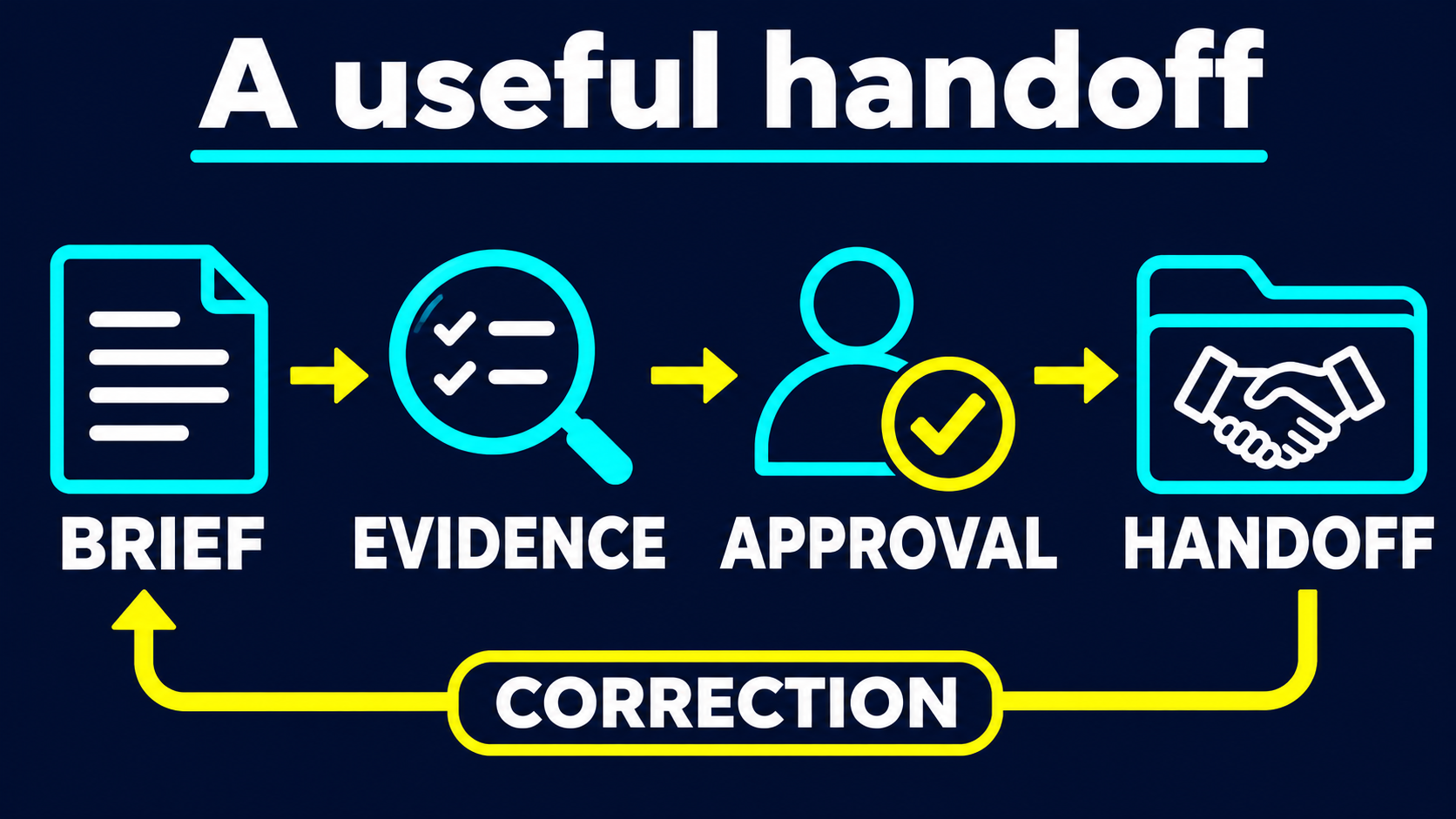
Original explanatory illustration by Karim Elganainy: Brief → Evidence → Approval → Handoff, with Correction returning to the beginning. This is our proposed evaluation workflow, not Deloitte architecture or a screenshot. News context: Deloitte announcement.
Define each field plainly. “Ready for contact” should mean agreed prerequisites were checked, not that someone opened an email. Specify who can correct a mistake and how that correction reaches people already using the previous version. Otherwise, integration can multiply an error instead of resolving it.
The contract also needs a definition of completion. A sender pressing a transfer button is not the same as a recipient accepting responsibility. Decide how acknowledgement is recorded and what happens when nobody accepts the item. Avoid leaving the customer between teams while both systems display a successful technical event. A useful record can state that responsibility is pending without inventing a new owner. For urgent or time-sensitive requests, establish an escalation route through the organization's existing authorized process. The test should examine that route explicitly instead of assuming that a connected tool automatically supplies an accountable fallback. Technical transfer success cannot compensate for the absence of a person who knows they must act.
Separate recommendation from authority
Recommending a proposal differs from permission to send it. Establish which actions remain drafts, who approves them and which changes require another review. Price, scope, recipient and promised timing deserve explicit attention: a small wording change can create a different commercial commitment.
Begin with a reversible boundary. Prepare drafts and supporting notes while an authorized colleague decides whether to use them. Record the accepted version and reasons for rejection. A generated draft is not delivered value until someone can use it correctly.
Review effort should be proportional to the consequences of an error. Correcting an internal draft heading is not equivalent to changing an external price or interpreting a sensitive request. Group actions by consequence and reversibility rather than by how easy a button is to click. A reviewer also needs enough context to make a real decision: the proposed wording, intended recipient, relevant evidence and any unresolved disagreement. A confirmation screen that hides those details can produce habitual approval rather than meaningful control. During the pilot, record where reviewers had to leave the workflow to find essential context. These steps belong to the cost of correct execution even when they do not appear inside the evaluated tool.
Run a hypothetical paired pilot
Imagine two comparable groups of 40 inquiries, handled during the same period under the same contact rules. The existing process produces 28 handoffs accepted without clarification; the proposed process produces 32. The rates are 28 / 40 = 70% and 32 / 40 = 80%, a difference of 10 percentage points, not proof of revenue growth.
Suppose preparation and correction take 240 minutes in the first process and 280 in the second. Minutes per accepted handoff are 240 / 28 = 8.57 versus 280 / 32 = 8.75, rounded to two decimals. More accepted handoffs coexist with slightly higher labor per accepted item. A team prioritizing volume may accept that tradeoff; a team promising efficiency must not conceal it.
Keep the comparison honest by deciding what counts as clarification before seeing the results. A missing mandatory fact should count even if the recipient obtains it through an informal message. Otherwise, the new process can appear better simply because correction work moved outside the measured channel. Use the same acceptance definition in both groups and retain the reasons for nonacceptance. Do not remove difficult inquiries after the fact or compare a quiet shift against a peak period without reporting that difference. The arithmetic is simple; consistent inclusion rules determine whether the calculation answers a useful operational question. An easily calculated indicator is not a reason to ignore work outside the visible record.
Measure the next useful outcome
Follow accepted records beyond transfer. Did the customer receive an accurate response? Did the recipient discover repeated questions or unsupported promises? Define an observation window and keep unresolved records visible rather than treating them as successes. Do not reassign a conversion outside that window merely to improve the comparison.
These small hypothetical groups cannot establish causality or general performance. Inquiry quality, staff experience and workload may explain differences. A stronger test balances those factors and specifies the decision rule beforehand. Include software, review, training and correction costs. Distinguish labor minutes from cash savings that can actually be realized.
A measurement sheet should distinguish the numerator from the population actually eligible for it. Some inquiries may be unsuitable for contact under the agreed rules; excluding them from the contact denominator can be appropriate if the same rule is applied consistently and the excluded count remains visible. Do not label that exclusion as a lost sale. Review both successful and unsuccessful records rather than selecting only impressive examples for a presentation. Ask whether the improvement remains after correction work is included, and whether the customer's experience deteriorated in a way that a neat internal dashboard would fail to show. A metric designed for one decision cannot describe the whole journey or justify ignoring obvious harm outside its scope.
Adapt the boundary to sensitive work
For a Gulf healthcare organization, an illustrative starting point could be a business inquiry about an employer service, not a patient record. Use synthetic or appropriately minimized information during evaluation. Local privacy, professional and contracting requirements need qualified review before real information or outbound activity enters the workflow; this article does not establish compliance.
Language is also part of the handoff. Check that an Arabic request and an English internal summary preserve scope, dates and unanswered questions. Fluent translation can still change a promise. Provide an authorized clarification route rather than forcing the recipient to trust the summary or restart the conversation.
Minimization should be practical, not merely a statement at the top of a document. Identify each piece of information needed for the chosen decision and remove unrelated detail from the evaluation copy. Establish who can see that copy, who can correct it and when it is no longer needed. Do not transfer a sensitive history merely because another team might find it interesting later. If a real request falls outside the pilot's scope, use the existing authorized route rather than improvising a new automated treatment. This preserves the test boundary while allowing ordinary service to continue appropriately. It also prevents a limited experiment from unintentionally expanding data access or authority before the consequences are reviewed.
The strategic takeaway
My recommendation is to connect one well-defined decision before connecting an entire department. Write the handoff contract, identify the authorized approver and test the correction path with an intentionally incomplete example. Stop or narrow the pilot if a missing fact becomes a confident claim or an unapproved action.
Expand only after evidence that the next team and customer are better served, with acceptable cost and clear ownership. Useful connections reduce uncertainty without hiding it. That is a more durable standard than automated-step counts, an elegant demonstration or response-generation speed.
Before expansion, hold a joint review with the people who send, receive and approve the work. Compare their definitions of success and surface any tradeoff rather than collapsing everything into a single score. The sender may save time while the recipient carries more verification work. A useful next iteration might simplify the brief instead of adding another automated action. Record the chosen change, its owner and the evidence that would justify keeping it. This turns the pilot into a learning process with a stopping rule, not a demonstration that must be declared successful regardless of what the team discovers. A useful decision may keep a smaller scope or redesign the handoff rather than automatically expanding automation when the test period ends.
Comments
No published comments yet.