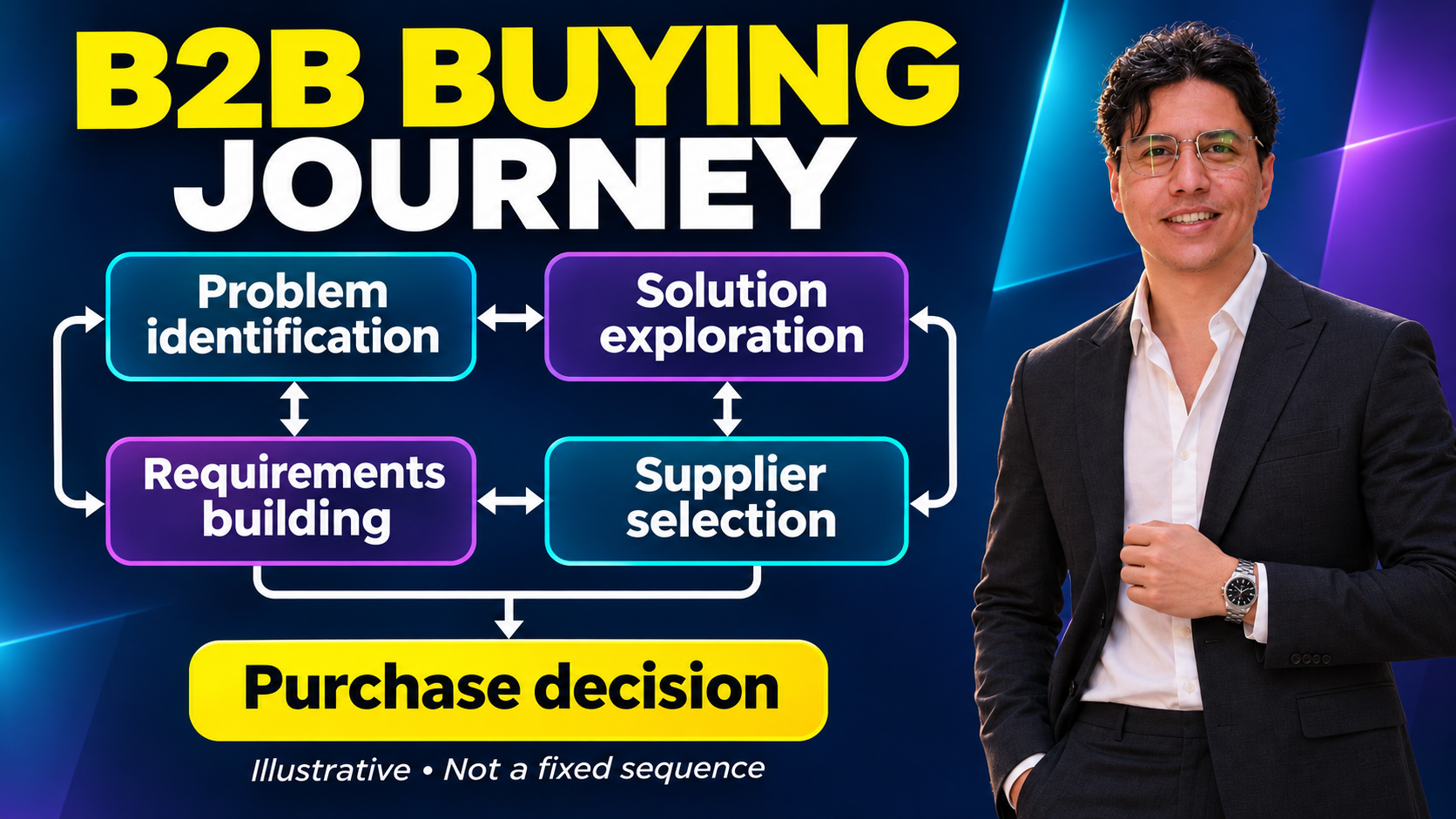
What is the B2B buying journey, and what does it help us understand?
The business-to-business buying journey is a map that helps us understand the work an organizational buyer needs to complete before choosing a solution and supplier. We are not dealing with one person who sees an advertisement and clicks a purchase button, but with an organization that may include a user, a manager, a finance representative, a technical team and procurement. Each participant has different questions, and their answers may not align at the same time. The map's value therefore lies in revealing the unresolved question, the evidence its owner needs and the step that could make the decision clearer, rather than pushing every account to the end of a predetermined diagram.
We will use four main tasks: problem identification, solution exploration, requirements building and supplier selection, with a purchase decision as a possible outcome after the necessary issues have been addressed. Buyers can move back between these tasks; they are not a test that everyone passes once in the same order. Procurement might begin comparing suppliers while the user still questions the problem definition, or a budget review might return the discussion to the type of solution. Good marketing reduces uncertainty and supports an appropriate choice, rather than converting every interaction into a readiness signal or treating a decision not to buy as the customer's mistake.
The source and the limits of the model used in this lesson
This lesson is based on physical page 155 of the supplied course document, “Explanation of the Introduction to Digital Marketing,” in the customer journey lecture. It presents an image titled the B2B buying journey, describes it as illustrative, and brings together the four tasks and a purchase decision with return paths and multiple events. The slide refers to Email on Acid's article on customer journey map examples, published on February 18, 2021. That article attributes the illustration to Gartner, but we do not infer from this a documented invention date or a standardized model that every organization must follow.
The operational definitions, calculations, examples and exercise below are an original proposed educational treatment, not details copied from the slide or results from real businesses. The aim is to turn the idea of a complex journey into an understandable working method. To broaden the view to what happens after a contract is signed, see the Arabic lesson on the infinite loop customer journey. This lesson focuses on building a purchase decision between organizations, while the previous lesson helps connect acquisition with onboarding, adoption and retention. They can be used together without merging their metrics or assuming that a successful decision guarantees successful subsequent use.
Read the diagram as connected tasks, not a compulsory route
When you see four adjacent boxes, resist the temptation to place every customer in a single box and then move them to the next one. Each box represents a business question, and more than one may remain open within the same account. Problem identification asks what needs to change; solution exploration investigates ways to respond; requirements building defines acceptance conditions; and supplier selection compares candidates' ability to meet those conditions. A purchase decision comes when the commitments are appropriate and approved, and the responsible decision may instead be to postpone or not buy a new solution.
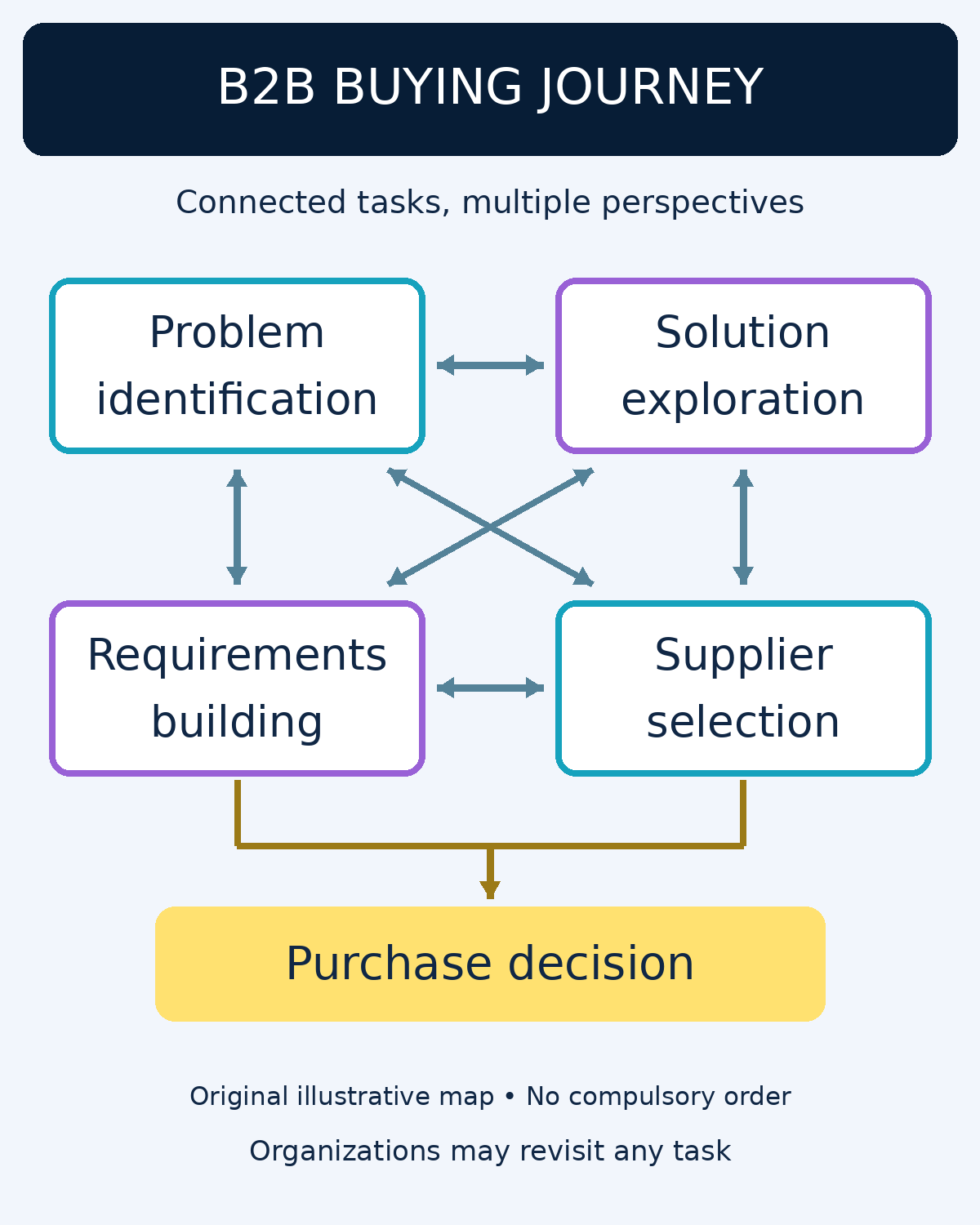
Original educational illustration by Karim Elganainy, with task labels based on physical page 155 of the course material. The return paths show that questions can be revisited; they do not impose one order on every buyer. Slide reference: customer journey map examples. This is an original simplification, not a republication of the slide image.
Use the map at two complementary levels: the account level to understand the commercial decision required, and the stakeholder level to understand who needs what. Do not make disagreement between two participants look as though the whole organization has moved backward. A manager may agree on the need while the technical team requests additional implementation evidence. Recording that distinction is more accurate than describing the account as “cold.” It also helps you direct content toward the right question, rather than sending a general introduction again to people who have already completed a substantial amount of internal work.
Define the unit of analysis before collecting interactions
Start by defining what you call a buying opportunity. Is it an entire company, a project within that company, or a contract renewal for a particular site? The same company might be looking for a training service and accounting software simultaneously; combining those journeys because the organization has one name would be incorrect. Establish a definition that includes the need, scope, approximate period and responsible party. Then connect people to that opportunity according to their actual participation, without assuming that every employee with the same email domain belongs to the buying committee or is authorized to receive its information.
Separate activity, decision and evidence. Downloading a document is an observed activity; requesting a specific comparison may reveal an open task; and approving a requirements list is stronger evidence of a particular internal agreement. Do not let a numerical engagement score replace an understanding of context. Record the information's source and date, and whether the customer stated it or your team inferred it. When you do not know, record that it is unconfirmed. Acknowledging the gap protects planning from building messages and promises on an assumption that may sound plausible but has not been confirmed by the decision-maker.
Problem identification: what situation deserves to change?
In this task, we want an examinable description of the problem before proposing the product. “We need digital transformation” is not enough to define a decision. Ask what work is disrupted, who is affected, how the impact appears and what happens if nothing changes. The pain might be delayed reporting, repeated data entry or difficulty tracking requests. Each has different boundaries, and the cause may be the allocation of responsibilities rather than a missing tool. The marketer's job is to help name the problem clearly without exaggerating it or turning every daily irritation into an argument for purchasing a larger offering.
Suitable content here could be a diagnostic guide or questions comparing the current and desired situations. But do not use generic cost figures as though they were a confirmed customer loss. Ask for an estimate from the customer's records if appropriate and permitted, and distinguish wasted time from costs that can actually be saved. A useful output is a short document on which the relevant participants agree: the problem, its boundaries, the expected impact and what we need to learn next. If they disagree about the problem, do not bypass that disagreement with an attractive demonstration; the product may succeed at a task that the budget owner does not consider a priority.
Solution exploration: compare responses before supplier names
Solution exploration goes beyond browsing a list of competitors. An organization might compare training the team, changing an existing process, outsourcing a service, buying software or combining selected options. Help it understand what each approach does and does not solve. Do not present your option as the only answer before defining the conditions. If improving the current process is sufficient, acknowledging that keeps the recommendation honest and prevents a deal that creates unfulfillable expectations. The relationship can remain useful even when the person does not become a customer now.
Suitable material explains alternatives, comparison criteria and the effort required by each. Avoid a comparison table designed to make your product win every row without context. Explain what depends on organizational size, readiness or data quality. Exploration may produce a new question that changes the problem definition; that is learning, not automatically a setback. Record the alternatives the customer actually discussed, not every imaginable alternative. Then identify a small experiment or decisive piece of information that helps eliminate an unsuitable option, instead of overwhelming the buyer with dozens of papers that add decision burden without clarity.
Requirements building: turn wishes into acceptance conditions
Requirements building means turning general discussion into conditions that can be checked. Separate essentials from preferences, and identify each condition's reason, owner and testing method. “We need better reports” is vague; specifying the report, required data, timing and approval owner makes the discussion practical. Do not overlook operational, support, training and data-exchange requirements, because purchasing an available feature does not mean the organization can use it. This task may reveal a need to reconsider the solution type if implementation requirements exceed available resources or conflict with the desired way of working.
Make the requirements list versionable and revisable. When someone adds a condition, record its impact on scope, time and cost, and do not allow different versions to circulate between teams without clarity. Marketing can provide a template that helps the customer think, but should not fill it in on the customer's behalf solely to benefit the supplier. Useful evidence for moving forward is not the list's page count, but the necessary stakeholders' agreement on its definitions and verification methods. If a key condition still lacks an owner or a test, address that gap before sending a final proposal promising something that has not yet been defined.
Supplier selection: compare delivery capability, not just presentation quality
During supplier selection, the question becomes who can deliver the appropriate commitment within the approved conditions. Depending on the decision, the buyer might examine a demonstration, work sample, implementation plan or references that may legitimately be shared. Do not equate presentation quality with delivery capability. Ask to see exceptions: what happens when data is missing, a participant is late or a step fails? A supplier who explains limitations may support a more secure decision than one who accepts every request without defining it. Equally, do not turn every question into a complex test disproportionate to the contract's value and risks.
Define the comparison method before viewing results so that criteria do not change to favor the most persuasive presentation. Illustrative internal weights can be used, but the final score cannot compensate for an unmet decisive condition. Record the basis for the judgment, what remains a promise requiring evidence, and who has authority to accept residual risks. If a condition changes after the comparison, reassess the affected alternatives rather than retaining the old ranking. Supplier selection does not end marketing's responsibility: the promise that helped persuade the buyer must transfer clearly to those delivering the service after agreement.
Multiple stakeholders: do not reduce an organization to one contact
Draw a simple map of roles, not a long list of names. Who uses the solution? Who is affected by the change? Who assesses fit? Who approves expenditure? And who coordinates procedures? One person may hold several roles, and a person's role may change during the project. Do not infer authority from a job title alone. Ask respectfully about the decision process and who needs to join the next review. Having an enthusiastic supporter does not mean everyone else has agreed; a request for another opinion does not necessarily mean that supporter has lost confidence or the deal is over.
Give each participant content that serves their question while maintaining one consistent truth about the promise. The user needs to understand daily work, the technical reviewer needs integration boundaries, and the finance representative needs cost assumptions. Do not offer contradictory versions of value to please everyone. If a disagreement arises, frame it as a question requiring a shared decision: is speed the priority, or broader scope coverage? That is better than applying more sales pressure to your supporter. Do not contact their colleagues outside the agreed arrangement merely because their details are available; coordination and respect for communication boundaries are part of a trustworthy buying experience.
Content and automation: connect the message to the question, not the counter
Use the map to build a small library of decision-support materials, not a sequence whose aim is to keep your name in front of the customer at any cost. Each item should have a clear question, an intended beneficiary and a condition making it appropriate to send. Someone building requirements may need a checklist, while someone exploring options may need a comparison of working approaches. Automatically sending a quotation after three email opens confuses activity with readiness. A better flow asks for appropriate confirmation or offers a useful choice, while respecting communication preferences and not sending without a clear reason.
Before activating a message, examine the signal's source, validity and freshness. An employee might open a file for a colleague, and the organization might return to the problem after you previously sent supplier details. Provide a way to correct the status or stop the sequence, rather than making the customer endure irrelevant messages because the system missed the latest conversation. Measure the material's usefulness through the question it helped settle or the gap it revealed, not opens alone. And do not let engagement measurement justify collecting more information than this communication's defined purpose needs.
First hypothetical example: scheduling software for a maintenance company
Every figure in this example is hypothetical for learning, not an actual result or market benchmark. Suppose a company selling scheduling software to commercial maintenance teams tracks 30 defined opportunities over a 60-day window. The proposed problem is manually rearranging visits. Initially, 18 organizations in the cohort agree on a clear problem description with the relevant participants, while 12 do not. The agreement rate is 18 / 30 = 60%. We do not automatically call the rest uninterested: some may be unsuitable for the solution, need information or not currently prioritize the change.
Of the eighteen organizations, 12 discuss specific response alternatives, then 9 approve a requirements list, 6 reach supplier comparison and 4 sign a contract within the window. If these are genuinely nested cohorts according to the record, the conditional rates are 12 / 18 = 66.67%, 9 / 12 = 75%, 6 / 9 = 66.67% and 4 / 6 = 66.67%, rounding to two decimal places where needed. The contracting rate from the original cohort is 4 / 30 = 13.33%. That last rate must not be presented as equivalent to the success rate among comparers alone.
Reading the first example: why transition rates are not enough
The previous figures describe a hypothetical cohort arranged for calculation; they do not require a real journey to take that form. Suppose two of the nine organizations with requirements return to exploration after a need for offline operation emerges. Retain the earlier requirements milestone in the history while recording the currently open task, rather than deleting the return to display a cleaner path. Do not total visits to tasks as though they were unique organizations. Nor should the two organizations be added to the original thirty: they belong to the same cohort, and their return changes the work required, not the underlying cohort's size.
Also suppose the four contracts are worth 12000 Saudi riyals each annually, making total contract value 4 × 12000 = 48000 riyals. This is not necessarily immediately recognized revenue, profit or collected cash. If the defined marketing and sales test costs 18000 riyals, cost per signed contract in this cohort is 18000 / 4 = 4500 riyals. We do not infer a causal marketing return from that, or calculate profit without service-delivery costs. The proposed decision is to test material explaining the offline requirement and then monitor its effect on requirements clarity, not promise doubled sales because one box looks weak.
Second hypothetical example: packaging supply for a private food factory
This different hypothetical example concerns a private food factory reviewing a packaging supplier. The problem is not buying software, but reducing variation in packaging performance during operations. Production, quality, procurement and finance participate. Production may seek a smoothly running packaging line, while quality needs a specific test and finance wants to understand total cost. The journey starts by defining the use scope and conditions, then comparing modifications to existing packaging, changes to specifications or selection of a new supplier. We do not declare a product suitable for use merely because it receives the highest marketing score in a seller's presentation.
Suppose two samples, each containing 500 units, are tested under comparable documented operating conditions. There are 20 unacceptable units in the first sample and 10 in the second, giving rejection rates of 20 / 500 = 4% versus 10 / 500 = 2%, a difference of two percentage points. The relative reduction is (4% - 2%) / 4% = 50%. Both expressions are mathematically correct but describe different things. We do not claim from one sample that the result will always recur, or use these figures to determine food safety; an appropriate technical judgment requires standards, checks and qualified responsible people according to the actual situation.
Reading the second example: connect the decision to cost and uncertainty
Suppose a planned commercial order contains 10000 units, with hypothetical prices of 2 riyals per unit for the first option and 2.10 riyals for the second. Purchase costs become 10000 × 2 = 20000 riyals and 10000 × 2.10 = 21000 riyals. The purchase difference is 1000 riyals. If, solely for this scenario, we assume the sample rates recur, the mathematically expected numbers of unacceptable units are 400 versus 200. If additional handling costs 3 riyals per unacceptable unit, that becomes 400 × 3 = 1200 riyals versus 200 × 3 = 600 riyals. Do not confuse this cost with the unit purchase price already counted.
The limited total for these items is therefore 20000 + 1200 = 21200 riyals versus 21000 + 600 = 21600 riyals. Despite the assumed improvement in rejection rate, the second alternative remains 400 riyals more expensive in this scenario. Other considerations might justify choosing it, but we do not invent them to force the figures toward a preferred result. The assumptions that the sample rate recurs and handling costs remain unchanged need testing; shipping, downtime, inventory and payment terms are also excluded. The marketing lesson is that a quality proposition should explain the trade-off, and requirements building may reopen when testing reveals a question that price comparison alone did not settle.
The measurement dashboard: separate current states from historical progress
Build a simple dashboard showing unique opportunities, open tasks, updated evidence, the reason for delay, and the next step and its owner. If simultaneous tasks are allowed, do not require current-state counts to total the number of opportunities; explain that one account can appear in more than one task. Conversely, when calculating a rate based on nested cohorts as in the first example, verify that nesting in the data before dividing. Do not compare counts from different periods or divide new contracts by all visits without defining the relationship between them.
Useful measures include the proportion of opportunities with an agreed problem, the proportion of requirements with verification evidence, time to resolve a particular question, correction counts and the proportion of decisions still pending after the window. Show total time alongside waiting reasons, and distinguish waiting on the customer from an internal delay that can be addressed. If calculating an average, examine long-running cases too so they do not disappear behind one number. Define what no decision means: postponement, poor fit, missing information or selection of an alternative. Each reason leads to a different action, and they should not be merged into one box called loss.
A practical implementation plan from the first meeting to review
Start with a narrow scope: one service type, a defined organizational segment and a decision you want to understand. Gather recent examples of opportunities that purchased, others that did not and others still open. Read available notes with proper authorization, and ask the team what it knows and what it infers. Design an initial map no broader than you can review, then verify it with those dealing with the customer. You do not initially need new software; an organized record and shared definitions may suffice, provided access is appropriate, update responsibility is clear and sensitive data is not duplicated unnecessarily.
Next, choose one obstacle and a small experiment: clarify a condition, improve a handoff, test a sample or change a qualification question. Before starting, define the success criterion, its source and its window, and record what the experiment cannot prove. Assign one owner to content and another to status updates if those responsibilities are separate. At review, ask whether the decision became clearer, rework decreased or a new cost or problem appeared. Do not expand merely because the team used the model for two weeks; expand when you can explain a tangible benefit and its limits, remaining willing to modify the design if it does not serve the intended decision.
Practical exercise: where should the intervention begin?
Imagine a professional training provider for private companies with 24 defined opportunities at the start of a trial month. Of these, 15 agree on a clear performance problem, 10 from that group discuss alternatives, 8 approve requirements, 5 compare suppliers and 3 sign within the window. Four of the eight organizations with requirements still need confirmation of employee availability, and they may overlap with the comparers; do not assume the new categories are separate. The defined activity costs 9000 riyals. All these data are hypothetical, and they tell us nothing about training quality or its subsequent effect on the purchasing organizations' work.
Your task is to write a decision before proposing a campaign: calculate the contracting rate from the original cohort and among comparers, then cost per contract. Identify the appropriate denominator for the proportion lacking availability confirmation and explain why they are not added to total opportunities. Propose one piece of material that helps address this obstacle without assuming financial approval is complete. Then write a question to test whether timing is actually causing the delay, and identify the evidence that would change the status. Finally, state a conclusion the data do not allow, so that successful arithmetic does not become excessive confidence in your interpretation of events.
Exercise answer: calculation serves the decision; it does not replace it
The contracting rate from the original cohort is 3 / 24 = 12.5%, and among comparers it is 3 / 5 = 60%. The defined cost per contract is 9000 / 3 = 3000 riyals. The proportion of requirements holders lacking availability confirmation is 4 / 8 = 50%. We do not add the four to the opportunity count because they are part of the cohort, or add them to the five comparers as though they were nine different people. Having a requirements list also does not prove every item is settled; the list can be approved in terms of definitions while the implementation date still needs later practical confirmation.
The proposed material is a short participant-availability planning template that explains scheduling options and what needs internal approval, not a discount offer to force the decision. The useful question is: is availability confirmation the remaining obstacle, or are there other requirements or approvals? Evidence that changes the status is specific confirmation from the authorized participant, not opening the scheduling file. We do not infer that sending the template will raise contracting to a particular rate or that training will deliver a guaranteed return. After testing, timing decisions and rework can be compared using a stable definition, while recognizing differences between cases and avoiding causal claims from a small uncontrolled comparison.
Limits of use and mistakes that deserve a pause
Not every purchase needs a dense map. Reordering a familiar item under stable conditions may need a simpler route, while a complex, expensive decision merits broader understanding. The map does not read people's intentions or give the marketer authority over the organization's decision. Your data may also be biased toward people who respond, missing participants who influence the decision without direct contact. Review assumptions instead of turning missing information into invented personas. Use only the necessary data, respect access and communication boundaries, and consult specialists when an application touches contractual or professional requirements this lesson does not define.
Common mistakes include equating one person's activity with account readiness, repeating messages from an old stage, changing the success definition after seeing the figures, or hiding returns because they spoil the funnel's appearance. Other mistakes include imposing a requirements list that serves only the supplier, treating contract value as profit or presenting a small experiment as a performance guarantee. When these problems appear, pause to correct the definition or promise before increasing automation. Journey quality is not the absence of questions, but an honest way to answer them or declare what we do not know, with clear responsibility for the next step and its boundaries.
The practical takeaway: help the organization make a better decision
Use the B2B buying journey to ask about each opportunity: what task is open now, who needs to resolve it, and what evidence makes the next step appropriate? Begin by defining the problem before defending the solution, compare alternatives before amplifying product features, and build testable requirements before ranking suppliers. Accept that tasks overlap and discussions return to an earlier point. Not every return represents lost momentum; sometimes it is how the buyer prevents an unsuitable commitment and how you prevent a promise that will be difficult to fulfill after contracting.
My practical choice is to start with the question causing the most rework in one journey, not to rebuild the entire marketing system. Write a clear definition of the state, evidence and responsibility; test a small piece of content or process; and review the result with the team receiving the work. Keep calculations understandable and examples labeled as assumptions, and do not replace dialogue with an automated score. When purchase occurs, transfer the promise and its conditions to delivery, then follow the actual value afterward. In this way, the map becomes a tool for making a decision and serving a relationship, rather than simply an attractive drawing that justifies more messages or decorates a sales report.
Comments
No published comments yet.