
A faster route to marketing-mix modeling is useful only if it leads to a better spending decision. The important question is not how quickly a dashboard appears, but whether the team can explain the outcome being modeled, the uncertainty around the recommendation and the conditions under which a budget change would be reversed. Kochava’s new AIM Essentials offers an occasion to define that decision process before adopting another measurement system.
This article separates the verified announcement from original practical analysis. The proposed workflow, examples and decision rules below are editorial recommendations, not descriptions of Kochava customer implementations or guarantees about its product. They are relevant to teams considering any measurement platform, including those whose current reporting produces contradictory answers across search, social and offline channels.
What was announced, and what remains a claim
On November 11, 2026, Kochava announced AIM Essentials, a streamlined version of its Always-On Incremental Measurement platform, available immediately worldwide. Its company-issued release describes a combination of marketing-mix modeling, last-touch attribution and incrementality testing. It says the product analyzes one to two years of daily event and media-spend data and can be deployed in one to two weeks with one day of marketing-team setup and no internal data-science or engineering resources.
Those implementation statements are vendor claims. The announcement also describes performance improvements from AIM deployments, but it does not provide enough public study detail to treat them as a forecast for a new buyer. No independent product test is presented here. Immediate product availability should not be confused with guaranteed data readiness, causal identification or financial benefit for a particular organization.
Write the decision before selecting the model
Begin with a concrete question: should a defined amount move from one channel to another next month while total spending stays fixed? Specify the market, product, customer group and decision date. A question this precise gives the analyst something to answer and gives finance a way to judge whether the answer was useful. Asking for a universal ranking of channels tends to hide the fact that a channel can be productive at one spending level and weak at another.
Write down the current plan as the baseline. Record who may approve a change, the maximum change permitted during a pilot and the business conditions that would invalidate it. If inventory becomes unavailable or service capacity falls, the original recommendation may no longer apply. A model cannot repair a decision brief that silently changes halfway through implementation.
Choose an outcome that survives reconciliation
An advertising platform’s conversion count and the organization’s business outcome need not mean the same thing. Decide whether the target is completed orders, retained subscriptions, attended appointments or another verifiable event. For revenue, specify refunds, discounts, taxes and cancellations. Keep the definition unchanged throughout the comparison, and document any unavoidable revision with a dated bridge between old and new series.
For a healthcare organization, an inquiry is not an attended appointment, and an attended appointment is not a clinical outcome. A marketing evaluation should avoid implying that more leads demonstrate better care. Use appropriately aggregated operational measures and authorized data only. A useful measurement plan explains which decision each stage supports without moving private patient details into a marketing tool merely because a connector makes that possible.
Audit the data before celebrating speed
Build a daily reconciliation sheet linking spend, delivery dates and the selected outcome. Identify currency, timezone, missing days, duplicated records and changes in tracking. A missing value is not automatically zero. Likewise, a platform-reported purchase should not be added to the finance ledger as though it were an additional transaction. Reconcile totals at the source before exploring a more sophisticated explanation for discrepancies.
Create a separate event calendar for price changes, promotions, stockouts, service interruptions and major distribution changes. These records help analysts distinguish media activity from other changes that happened alongside it. If the available history is short or dominated by one unusual period, state that limitation. A product’s setup timetable does not eliminate the time needed to establish whether the underlying data can answer the question.
Give each measurement method a different job
For the proposed workflow, use marketing-mix modeling to explore aggregate relationships and possible budget ranges, attribution to inspect the path that reporting rules assign to individual conversions, and controlled experiments to test a specific incremental effect. These are complementary questions, not three votes on an identical proposition. Agreement can be reassuring, but disagreement can reveal incompatible outcome definitions or different observation windows.
Do not average conflicting numbers simply to produce one executive figure. Ask first what each number counts, which population it covers and which assumptions make it meaningful. A last-touch report may credit demand that already existed, while a poorly designed experiment can be contaminated by overlap between groups. Naming the method does not establish validity. The evidence must remain inspectable by someone who did not build the dashboard.
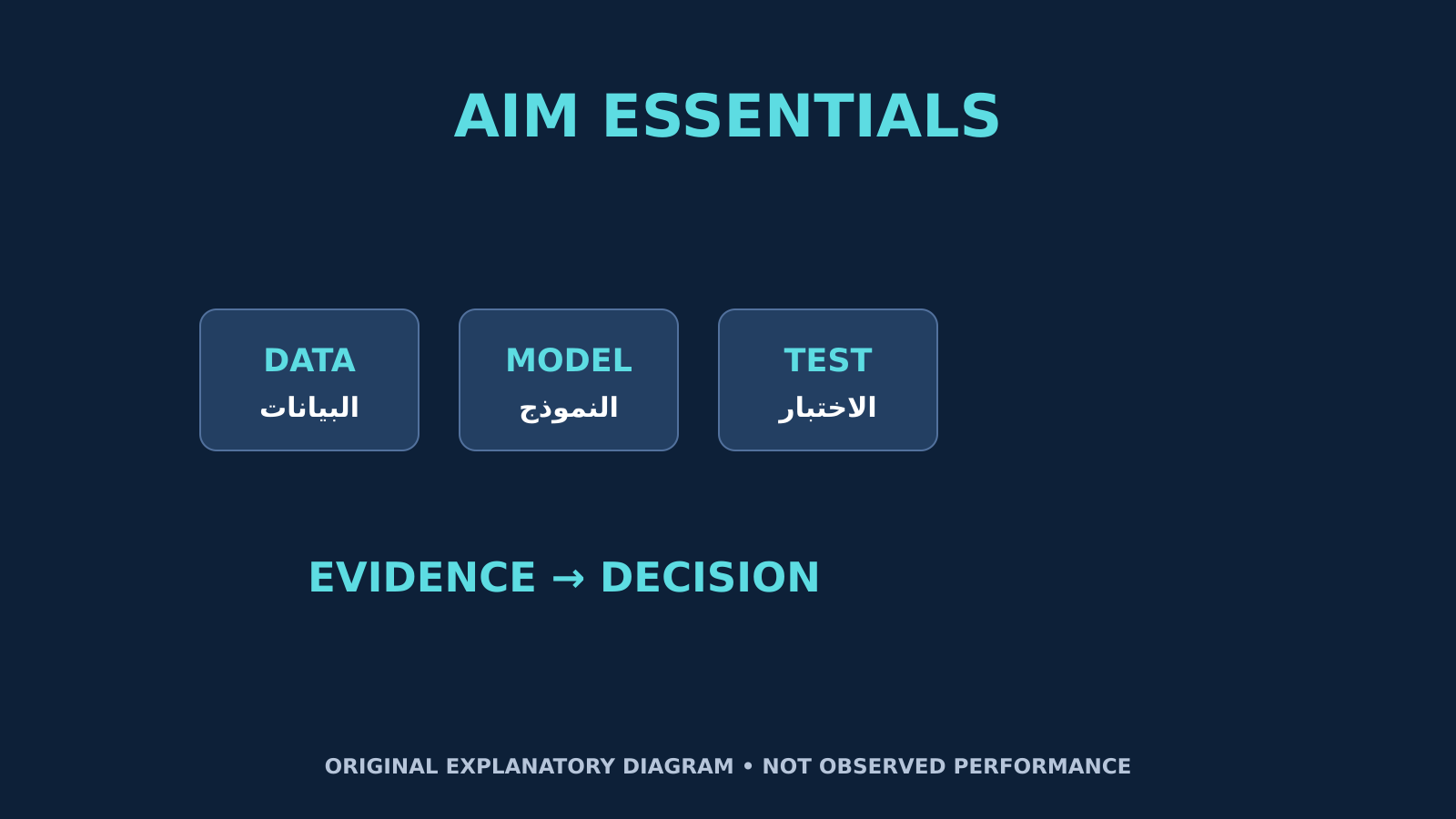
Original conceptual diagram: DATA, MODEL and TEST identify three stages; EVIDENCE → DECISION states the purpose. This is an editorial explanation, not Kochava’s internal architecture or an observed performance result.
Ask about uncertainty, not just the recommended number
A budget recommendation should include a range, its assumptions and the circumstances under which it changes. Ask how the result responds to alternative treatment of promotional weeks, different lag assumptions or removal of an unusual period. If a small modeling choice reverses the preferred channel, that fragility belongs in the decision discussion rather than in a technical appendix that no budget owner reads.
Request a clear distinction between interpolation within observed spending levels and extrapolation beyond them. A recommendation to move modestly within familiar conditions is different from a forecast for doubling a channel that has never carried that budget. Neither should be advertised as certainty. The purpose of uncertainty is to choose a proportionate next action, not to bury the decision under so many caveats that nothing can be tested.
Treat response curves as hypotheses with boundaries
A response curve can help discuss where additional spend might become less productive, but the curve is not a promise that the next purchase will arrive at a fixed price. Record the historical spending range, the business period represented and the capacity constraints. Ask whether the proposed change relies on audience conditions, creative quality or offers that are no longer present.
Connect the media forecast to the operation that must fulfill the demand. A service business with no available appointments can generate more inquiries without generating more completed visits. A retailer with unavailable sizes can increase clicks while disappointing shoppers. Include those constraints in the decision note so that marketing is not rewarded for creating demand the business cannot serve economically and reliably.
Design the smallest credible experiment
Choose a test that can distinguish the competing decisions, not simply demonstrate activity. Depending on feasibility, a qualified analyst may propose a randomized holdout or a geographic comparison. Define eligibility, the treatment, the outcome window and the analysis before starting. Assess whether audiences, sales activity or other campaigns can spill across groups. A convenient group is not necessarily a comparable one.
Set an operational stop rule for genuine harm or implementation failure, but avoid declaring victory whenever a favorable daily fluctuation appears. The duration and scale should follow expected variability and the effect worth detecting, not an arbitrary promise that all tests finish quickly. When the feasible test cannot detect a business-relevant difference, say so and choose a smaller-risk decision rather than describing an inconclusive result as proof of equivalence.
A hypothetical budget discussion, with transparent arithmetic
Consider a fictional service business planning monthly advertising spend of SAR 100,000. Search receives SAR 60,000, paid social SAR 30,000 and local outdoor SAR 10,000. The team is considering moving SAR 5,000 from search to social without increasing the total. These are illustrative numbers, not Kochava results or a recommendation for any real organization.
Suppose a suitably designed evaluation estimates 25 additional completed, non-cancelled transactions from the changed allocation, with substantial uncertainty. At an assumed contribution of SAR 180 per transaction, the central estimate is SAR 4,500 of additional contribution. If implementation and measurement add SAR 2,000, the illustrative net difference is SAR 2,500 before other costs. The transferred SAR 5,000 is not added again as new spending because total media expenditure stayed constant. Different margins, displacement or uncertainty could reverse the decision.
Decide what would make the team say no
Before the test, state a minimum worthwhile benefit, a tolerable downside and a service-quality constraint. Avoid choosing these thresholds after seeing the result. A positive central estimate may still be insufficient if the plausible downside is large, capacity is tight or the operational burden is disproportionate. The sensible next step may be another bounded test rather than a permanent reallocation.
Also define what failure teaches. Missing outcome data calls for repairing measurement; campaign delivery failure calls for fixing implementation; a sufficiently informative result that finds no business-relevant incremental effect argues against the proposed spending change under the tested conditions. These are different conclusions. Labeling every disappointing outcome a data problem allows a team to avoid learning and makes a measurement subscription hard to evaluate honestly.
Use a scorecard that cannot hide denominators
Report total spend, eligible population, completed outcomes, contribution assumptions and uncertainty together. Keep attributed conversions in a separate column from estimated incremental outcomes. If the outcome is a rate, display its numerator and denominator. A higher conversion rate among a smaller selected group is not automatically greater total business value, and a lower acquisition cost can coexist with fewer valuable customers.
Add implementation measures such as missing-data days, reconciliation differences and time required to act on a recommendation. These do not replace business impact, but they explain whether the process is usable. A platform that produces an interesting model but requires an unmanageable maintenance effort may not fit a small team. Conversely, faster reporting is an operational benefit even when incremental financial impact remains unproven; report it under its proper name.
Keep ownership and access explicit
Assign an owner for the outcome definition, an analyst for the evidence and a budget approver for the action. Record who can connect data, change model settings and authorize spending. Start with the minimum necessary access and inspect exports before they leave the approved environment. Procurement should include questions about retention, deletion, security responsibilities and whether the proposed inputs are appropriate for the intended purpose.
Retain a decision log containing the model version, data cutoff, recommendation, approval and actual change. Without this record, a later performance review can accidentally compare a recommendation with a campaign that was never implemented. Preserve the baseline and the reversal plan as well. Governance is not an obstacle added after analysis; it is what makes the analysis traceable enough to trust.
Buy a learning process, not a certainty label
A pilot review should answer three questions: did the data meet the agreed standard, did the evidence change a real decision, and was the resulting process worth its full cost? Include staff time, implementation work and future maintenance, not only the subscription. Ask the supplier to explain limitations in language the budget owner can use rather than relying exclusively on technical credentials.
Kochava’s announcement is a reason to investigate a potentially more accessible workflow, not a reason to abandon skepticism. The strongest outcome may be a justified reallocation, a decision to keep the current mix or evidence that the organization needs better operational data first. Each can be valuable. What matters is whether the team learns something defensible about the next spending decision and can show exactly how that learning was obtained.
Source and scope
The factual launch digest comes from Kochava’s November 11, 2026 announcement. The workflow and hypothetical financial example are original editorial analysis. No product trial, customer interview or independent verification of vendor performance claims is asserted.
Comments
No published comments yet.