A brand can publish more with generative AI and still leave customers unsure why they should choose it. Production speed answers an operating question; confidence, distinctiveness and willingness to buy are different questions. A newly published consumer study offers a useful reason to separate those layers instead of treating engagement as proof that the commercial problem has been solved.
This article reads the publisher’s accessible abstract and publication record, not the complete paper. It then proposes an independent, hypothetical workflow for a marketing team. The workflow is not a method tested by the researchers, a report of the author’s experience or a promise that AI will improve sales.
What the new publication establishes
Jamil, Wang, Mustafa and colleagues published their study in Humanities and Social Sciences Communications on November 11, 2026. It uses responses from 620 Chinese consumers and structural equation modelling to examine relationships between generative-AI-enabled social media marketing, customer–brand engagement, brand equity, relationship equity and purchase intention. The publisher reports positive associations, with brand equity playing a central intermediary role and relationship equity principally supporting purchase intention. However, customer–brand engagement was not significantly associated with purchase intention, and relationship equity did not significantly affect engagement. These non-significant relationships matter: interaction should not be treated as a demonstrated route to buying. This is an early, peer-reviewed accepted version subject to further edits, not the final Version of Record.
The available ethics record dates the survey to October 1–December 31, 2024, in Beijing, Shanghai, Wuhan and Chengdu. The publication is new; the observations are not a November 2026 market snapshot. The accessible record does not provide enough detail here to verify sampling quality, coefficients or model robustness. These are associations, not established causal sales effects, and purchase intention is not completed purchasing. Publisher abstract and publication record.
Turn an interesting finding into a bounded question
The practical question is not whether every company should use more AI. Ask which uncertainty prevents a particular audience from taking a particular next step. Imagine a fictional supplier of maintenance services for diagnostic equipment. Prospective customers read its posts and request brochures, but some hesitate before arranging a technical assessment. The team suspects that the offer is difficult to distinguish from competing services. That is a hypothesis, not a finding about real customers.
Write the decision before writing new content: should the supplier explain service scope more clearly, demonstrate capability more concretely, or revise how enquiries are handled? Each option belongs to a different part of the journey. Give the investigation one decision owner and a deadline. Otherwise, a broad discussion about brand equity can become a collection of attractive slides with no operational consequence.
Separate the concepts before choosing metrics
For this hypothetical project, define brand equity operationally as the audience’s recognition of the supplier, its perceived relevance and the credibility of its differentiating promise. Define relationship quality separately through confidence in continued support, clarity about responsibilities and the expectation that enquiries will be handled reliably. These working definitions guide the project; they do not claim to reproduce the study’s questionnaire or statistical constructs.
Engagement is another layer. A saved post may indicate practical usefulness, curiosity or an intention to revisit it. An assessment request is closer to a commercial action but still does not establish an order. Keep recognition, understanding, trust, enquiries, qualified opportunities and completed contracts in separate columns. Combining them into one success score can hide a deteriorating outcome behind an improving activity measure. Explain each measure in language the sales and service teams can challenge.
Audit the promise against the service
Before testing messages, ask operations to verify what the supplier can actually deliver. A statement about rapid support needs a defined geography, coverage period and relevant exclusions. A claim about technical expertise needs appropriate evidence and permission to use it. AI can help organize approved material, but it cannot create credentials, customer endorsements or service capacity. Remove unsupported promises before any comparison begins.
Create a short evidence register linking every important claim to its owner and current supporting material. Mark claims that require qualification, expiry checks or contractual review. If the service proposition is inconsistent, resolve that first rather than testing which wording makes the inconsistency more persuasive. This step can reveal that the obstacle is not weak advertising at all: the organization may need a clearer offer or a more reliable handover process.
Build a fair comparison, not an AI beauty contest
Prepare two message approaches from the same approved facts. One could describe the service in general terms; the other could explain the same scope through a practical buyer question. Keep the price, eligibility, geographic coverage and call to action unchanged where the design permits. Document every intentional difference. The goal is to investigate understanding and choice, not to reward the version that looks more technologically impressive.
If the team wants to evaluate AI-assisted production, separate that question from message strategy. Otherwise, changing the wording, design, targeting and production method together makes interpretation difficult. A clearer explanation might work regardless of who drafted it. Record human preparation, review and correction time alongside generation time. Compare accepted, accurate outputs rather than the number of drafts produced. Do not describe the comparison as causal unless its design genuinely supports that conclusion.
Ask buyers questions that can reveal disagreement
Begin a small exploratory review with relevant prospective buyers who have consented to participate. Ask what they think is included, what remains unclear and what they would need before requesting an assessment. Invite them to describe the offer in their own words before showing a list of possible benefits. This helps distinguish comprehension from agreement with the interviewer’s phrasing. Keep the recruitment approach and participant characteristics visible in the report.
Do not recruit only enthusiastic followers and then generalize to the whole market. Include appropriate variation in purchasing roles and familiarity with the service, without collecting unnecessary personal information. Preserve negative and ambiguous responses. If someone finds the promise credible but has no current need, that is different from distrust. The project should explain those differences rather than turning every non-conversion into a branding failure.
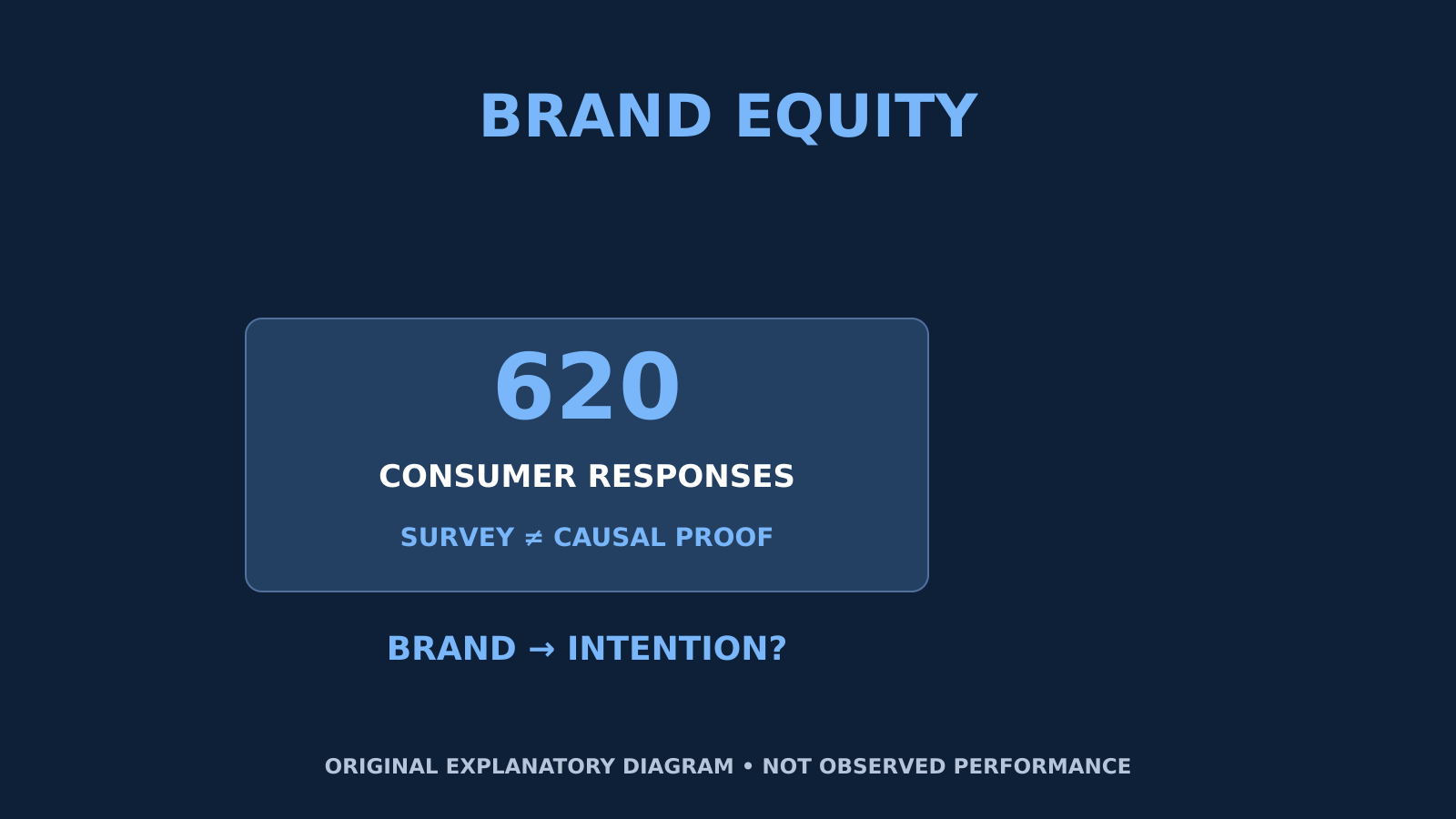
Independent conceptual graphic, not a reconstruction of the study’s statistical model. “620 / CONSUMER RESPONSES” identifies the sample; “SURVEY ≠ CAUSAL PROOF” warns that a survey does not establish causality; “BRAND → INTENTION?” poses a question rather than claiming an effect. The arrow and question mark do not represent an estimated coefficient or a proven causal path.
Design a field test only when the conditions support it
If traffic and operational capacity permit a controlled comparison, agree on allocation, observation periods and analysis rules before launch. Keep audiences and service conditions as comparable as possible. Ask a qualified analyst to assess sample requirements and uncertainty rather than choosing an arbitrary target because a dashboard can display it. Avoid stopping the test the moment one version temporarily looks better.
Where random allocation is not feasible, describe the comparison honestly as observational. Campaign timing, audience composition, competitors and service availability can affect results. Record these conditions and consider alternative explanations. A useful pilot can identify a problem or inform the next experiment without estimating a universal uplift. If the sample is too small to separate plausible explanations, report that limitation and preserve the evidence instead of manufacturing certainty.
Connect the enquiry to an outcome without invading privacy
Agree what counts as a qualified enquiry before reviewing results. In this fictional example, the buyer might need a relevant facility, an eligible equipment category and a genuine assessment request. Those criteria should reflect the business decision rather than being adjusted to make the campaign look successful. Record rejected or duplicate enquiries consistently, and avoid confusing repeated contact from one organization with independent demand.
Use a proportionate, authorized measurement process to connect marketing activity with later commercial stages. Limit data access and retention, and do not introduce patient information into a marketing test. Report aggregated results wherever appropriate. Separate the marketing team’s contribution from sales follow-up and delivery capacity. If enquiries rise but appointments cannot be scheduled, the remedy may be operational; producing more posts could simply increase an unresolved queue.
Examine the pattern, not a single headline number
Consider several possible outcomes without predicting which will occur. Better comprehension with unchanged enquiries may mean that the offer is clearer but currently irrelevant to the audience. More enquiries with lower qualification may indicate that the message attracts the wrong needs. Improved qualification with fewer total enquiries could still be useful if the business serves a narrow segment. None of these patterns should be interpreted without context and sufficient observations.
Prepare a readout that puts the decision, evidence, uncertainty and next action together. Include denominators, observation periods, missing records and changes in operational conditions. Discuss unexpected responses rather than presenting only the most favorable metric. When evidence conflicts, identify what additional information could resolve the disagreement. A recommendation to pause, repair the offer or repeat a test can be more valuable than a premature recommendation to scale.
Localize the proposition, not just the words
An Arabic, English, simplified Chinese or Italian version should preserve the same factual promise and its limitations. Translate technical terms with reviewers who understand the service. Check that examples, support expectations and calls to action remain appropriate for the intended audience. A fluent translation does not establish that a proposition works in another market, and the Chinese survey is not a substitute for local customer evidence.
Keep translation variants linked in the evidence register so that an operational correction reaches every version. Review the meaning of qualifications as carefully as the headline. Do not make one language sound more certain, more comprehensive or more clinically authoritative than another. For healthcare-related services, distinguish commercial explanations from clinical advice and let the responsible specialists review regulated or contractual claims before publication.
Decide what to retain and what to investigate next
Finish with an explicit decision log. State which message is retained, what evidence supports that choice, what remains uncertain and who will review the next outcome. Preserve the approved inputs, comparison conditions and corrections. This makes it possible to learn from the work when the service changes instead of treating each campaign as an unrelated creative exercise.
The useful lesson is modest: do not assume that faster content production answers questions about customer understanding or commercial value. The new study is a prompt to investigate those connections, not permission to claim a sales effect it has not established here. Keep the published evidence separate from the proposed workflow, and let the organization’s own ethically collected, decision-relevant evidence determine its next step.
Sources and reading boundary
- Jamil and colleagues: publisher abstract, dates and available research record, published November 11, 2026.
- Permanent DOI.
The complete paper and numerical model results were not available for verification in this reading. All proposed procedures, the fictional supplier and the schematic are independent editorial analysis, not additional reported findings.
Comments
No published comments yet.