Published November 8, 2026. The original launch announcement is dated November 5, 2026.
Is another retail-media platform worth testing?
Only if it offers a clear way to investigate a business question that existing activity does not answer well. A retailer, packaged-goods brand and unrelated advertiser should not enter a retail-media conversation with the same brief. They face different customer decisions, different evidence requirements and different ways an apparently successful campaign can disappoint commercially.
On November 5, Just Eat Takeaway.com announced JETads for restaurant and grocery partners, FMCG brands and non-endemic advertisers. Its release describes search and browsing visibility, basket-related advertising and post-checkout placements, with closed-loop reporting. These are company-described capabilities, not independently established performance gains. Read the original announcement.
My recommendation is a bounded evaluation, not an automatic budget increase. Define the customer decision you want to influence, the commercial result you would count, and the comparison that could challenge your explanation. The analysis below proposes an advertiser operating framework. It does not describe a tested JETads configuration, infer unpublished product controls, or assume the same access and conditions in every market.
Choose the commercial job before choosing the placement
A media brief becomes more useful when it identifies a job rather than merely an audience label. A restaurant might need additional profitable orders during a quiet period. A packaged-goods business might want trial among suitable households. An advertiser outside the shopping category might need awareness among people with a relevant occasion, rather than an immediate basket transaction.
These examples imply different outcomes. Filling unused capacity is not the same as moving orders from one channel to another. Trial is not the same as discounted repeat buying from existing customers. Awareness is not the same as a click made while someone is looking for an order update. Decide which distinction matters before reviewing placement options.
Write the job in one sentence and name the owner who will judge it. Then ask what would make the campaign a bad investment despite a strong platform metric. This question exposes hidden costs and prevents the buying team from inheriting a success definition designed for somebody else’s commercial objective.
Match the message to the customer’s immediate task
A shopping environment contains several kinds of attention. Someone choosing a meal is resolving a different problem from someone checking an order’s progress. The practical issue is not whether the person is technically reachable. It is whether the message helps, distracts or interrupts at that particular moment. Treat contextual fit as a hypothesis to examine, not an automatic benefit of a placement.
Build an occasion brief with three fields: the task already under way, the additional decision requested and the evidence needed to make that decision. If the requested action is far removed from the current task, simplify the proposition or reconsider the placement. A persuasive execution cannot remove every mismatch between the advertiser’s objective and the customer’s purpose.
Review the entire interaction, including what happens when the person ignores the advertisement. A campaign should not depend on confusing a service update with a commercial message. Clarity about the offer and the next step protects the usefulness of the surrounding experience while giving the advertiser a cleaner interpretation of genuine engagement.
For restaurants, distinguish demand creation from demand relocation
A restaurant should examine where additional orders would come from and whether the kitchen can serve them economically. Advertising that concentrates orders in an already overloaded period may create an attractive sales report and a worse customer experience. Discuss preparation capacity, stock, delivery constraints and margin before making a larger demand commitment.
For a hypothetical restaurant planning exercise, choose one quiet service period and an offer that operations can fulfil consistently. Record the normal pattern, relevant promotions and unusual closures or disruptions. An increase after advertising is an observation; it is not automatically evidence that advertising caused all of it. Other channels, local events and ordinary variation may also affect demand.
Inspect the result beyond order count. Consider retained contribution, cancellations and service problems, using definitions agreed with finance and operations. Ask whether the campaign attracted genuinely additional business or mostly redirected people who would have ordered through another route. Both can have strategic value, but they should not be presented as the same outcome when deciding whether to repeat the investment.
For packaged goods, make trial and repeat purchase distinguishable
A packaged-goods brief needs a clear account of the behaviour the brand wants to change. Introducing a product to a suitable household differs from encouraging a larger basket or replacing a competitor’s item. Each requires a different comparison and may have different implications for promotional funding, distribution and the value of a later purchase.
Define trial carefully using the data the parties are actually entitled and able to observe. A customer new to one measured channel is not necessarily new to the brand. Keep that limitation explicit. If a reporting system cannot establish previous purchases elsewhere, do not silently translate its channel-specific label into a statement about the customer’s complete history.
Separate the media effect from the offer effect as far as the design allows. A large discount, improved availability or changed pack size can influence the result. Keep a record of these conditions and inspect whether the apparent gain survives after the commercial costs are included. This is an analytical recommendation, not a claim that any particular platform supplies all the necessary data.
For unrelated brands, earn the right to interrupt
An advertiser outside the immediate shopping category should explain why its message belongs in the moment. Reaching someone does not establish that the context is useful for the brand. Start with a recognizable occasion or need rather than a broad assumption that all commerce audiences are valuable for every product category.
Imagine a hypothetical advertiser promoting an event to people who might genuinely consider attending. The useful brief would state the relevant location, timing and reason to care, then offer a clear route to more information. It should not rely on disguising the promotion as a transactional notification or exploiting uncertainty about an order already in progress.
Choose evaluation that fits the purpose. Awareness work may require a suitable research design rather than an immediate sales ratio; response work needs a destination and qualification rule. Agree what evidence the supplier can provide and what remains unmeasured. An easy-to-read dashboard is not a reason to replace the intended brand objective with whichever short-term number happens to be most available.
Turn reporting access into a measurement agreement
Closed-loop reporting can connect activity with transactions inside a measured environment. That connection is useful, but attribution and additional effect remain different questions. Specify the eligible transactions, observation window, treatment of returns and cancellations, and definition of advertising cost. A ratio without those definitions is difficult to compare with another channel or a previous campaign.
Consider a hypothetical budget worksheet, not a market benchmark or measured result. AED 4,000 in total advertising cost and AED 12,000 in attributed revenue produce a reported revenue-to-cost ratio of three. That arithmetic does not establish profit or how much revenue would have occurred without advertising. Product costs, fulfilment and the comparison design still matter.
Ask for the denominators and the boundaries of the dataset. Can finance reproduce the calculation from approved aggregate records? Are promotional costs counted consistently? Which purchases fall outside observation? These questions help turn a reporting promise into a usable decision tool. They do not require unnecessary personal records or justify collecting data simply because a provider can expose it.
Design the pilot before negotiating the scale
A bounded pilot should have a defined question, eligible activity, spending limit and decision rule. Where feasible, compare reasonably similar groups or periods while keeping important commercial conditions aligned. If the design cannot support a causal conclusion, say what it can support instead, such as operational feasibility or a descriptive comparison worth investigating further.
Avoid changing the offer, creative, geography and measurement rule halfway through and then interpreting the results as one stable experiment. Necessary corrections should be recorded. An urgent service problem deserves action, not preservation merely for the sake of a test. The analysis can acknowledge a disrupted experiment without forcing a confident verdict from unsuitable evidence.
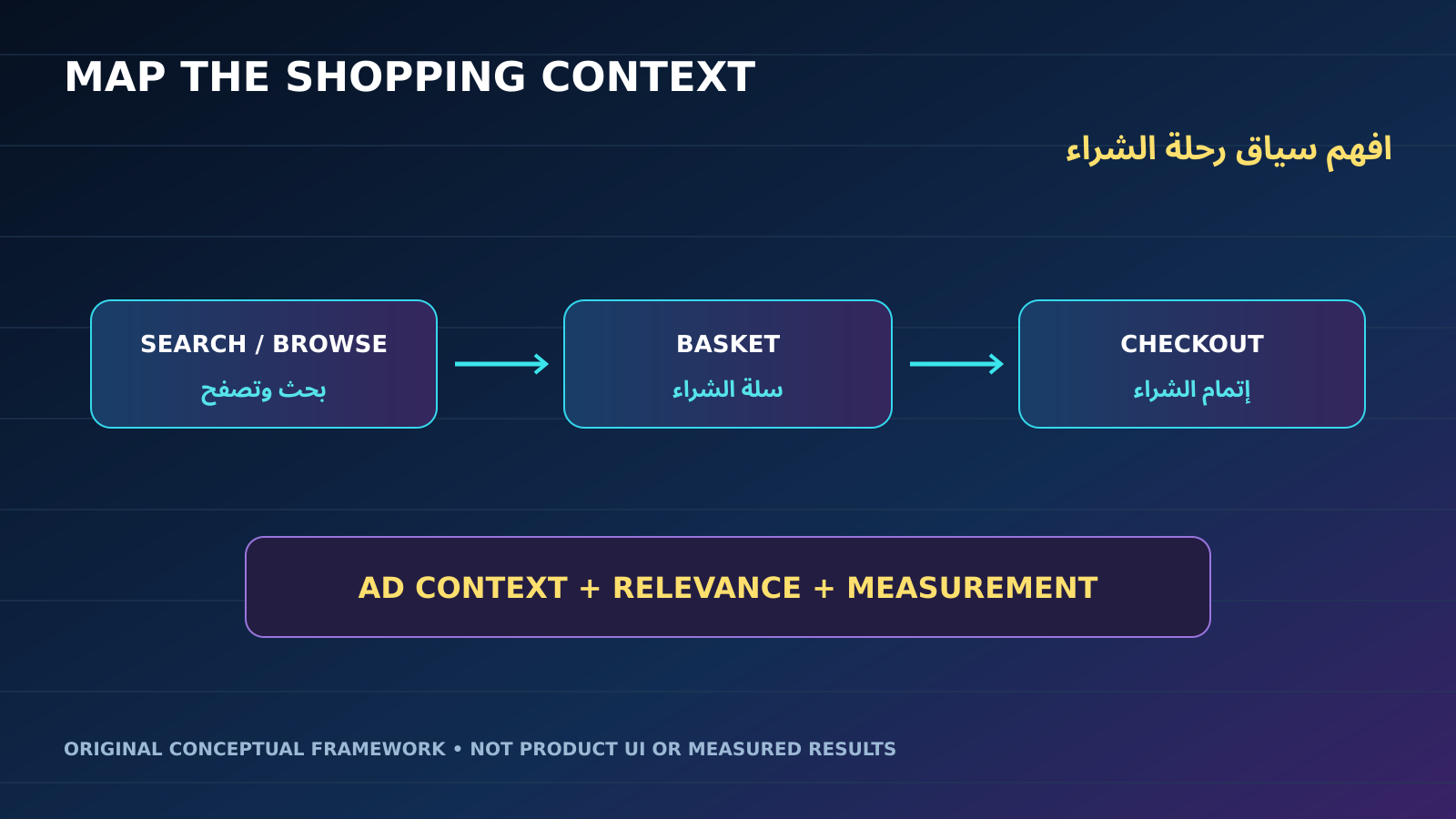
Original conceptual illustration created for this article. It maps shopping contexts from discovery to basket and checkout. It is not a JETads interface or official platform architecture.
The pilot should end with a decision the organization is willing to make: stop, repair, repeat or cautiously expand. A plan that can only produce a recommendation for more spending is not a credible evaluation plan.
Translate the operating model, not just the creative
For a Gulf advertiser, the transferable idea is a disciplined retail-media brief, not an assumption that every overseas service is accessible locally. Verify market access, inventory, commercial arrangements and measurement before committing a campaign. A local alternative may involve different interfaces and data, so reuse the decision framework rather than copying an implementation description.
Use a hypothetical bilingual campaign review to inspect whether Arabic and English communicate the same offer, eligibility and next step. Review the conditions alongside the image and destination. A phrase can be linguistically accurate while creating a different expectation about timing, included items or service coverage. Local review belongs before production is treated as complete.
The earlier analysis of multilingual creative governance explains a complementary approach to keeping claims stable across variants. Here, the additional task is matching each execution to its commercial job and shopping occasion. Neither translation quality nor a familiar format demonstrates that a particular placement will deliver the intended outcome in a new market.
Review commercial and data boundaries before activation
Ask for a written account of what the proposed arrangement includes. Separate media, data, technology, creative and measurement costs where relevant. Clarify minimum commitments, cancellation conditions, reporting access and what happens when inventory or the offer becomes unavailable. These are due-diligence questions, not assertions that any supplier uses a particular fee structure or contract term.
Data review should be equally concrete. Identify the information needed for the campaign, its origin, who receives it and how long it is retained. Prefer useful aggregate reporting when it answers the question. Have the appropriate privacy and legal owners assess the proposed workflow in the relevant jurisdictions rather than treating a broad privacy statement as a complete assessment.
Name the people who can stop activity when an operational or brand problem appears. Define how corrections reach the creative team, buying team and customer-facing staff. A clear intervention route matters as much as the launch checklist because the campaign will operate amid changing stock, prices, service capacity and customer expectations.
The decision is whether the evidence justifies the next step
At the end of the evaluation, separate observation, interpretation and action. Observation records what happened under the agreed definitions. Interpretation explains which conclusions are supported and which alternatives remain plausible. Action states what will change next, with an owner, a limit and a review point. Retain inconclusive and unsuccessful tests alongside the encouraging ones.
The strongest reason to try a platform is not a promise that commerce context automatically converts. It is a specific opportunity to learn whether an appropriate message, in a suitable moment, improves a result that matters to the business. If the offer, operating capacity or measurement remains unclear, fixing those foundations may be more valuable than buying additional exposure.
JETads is the dated news event; this framework is the independent recommendation. Choose the commercial job first, demand interpretable evidence, and let the result determine the next investment rather than allowing the availability of inventory to determine the strategy.
Comments
No published comments yet.