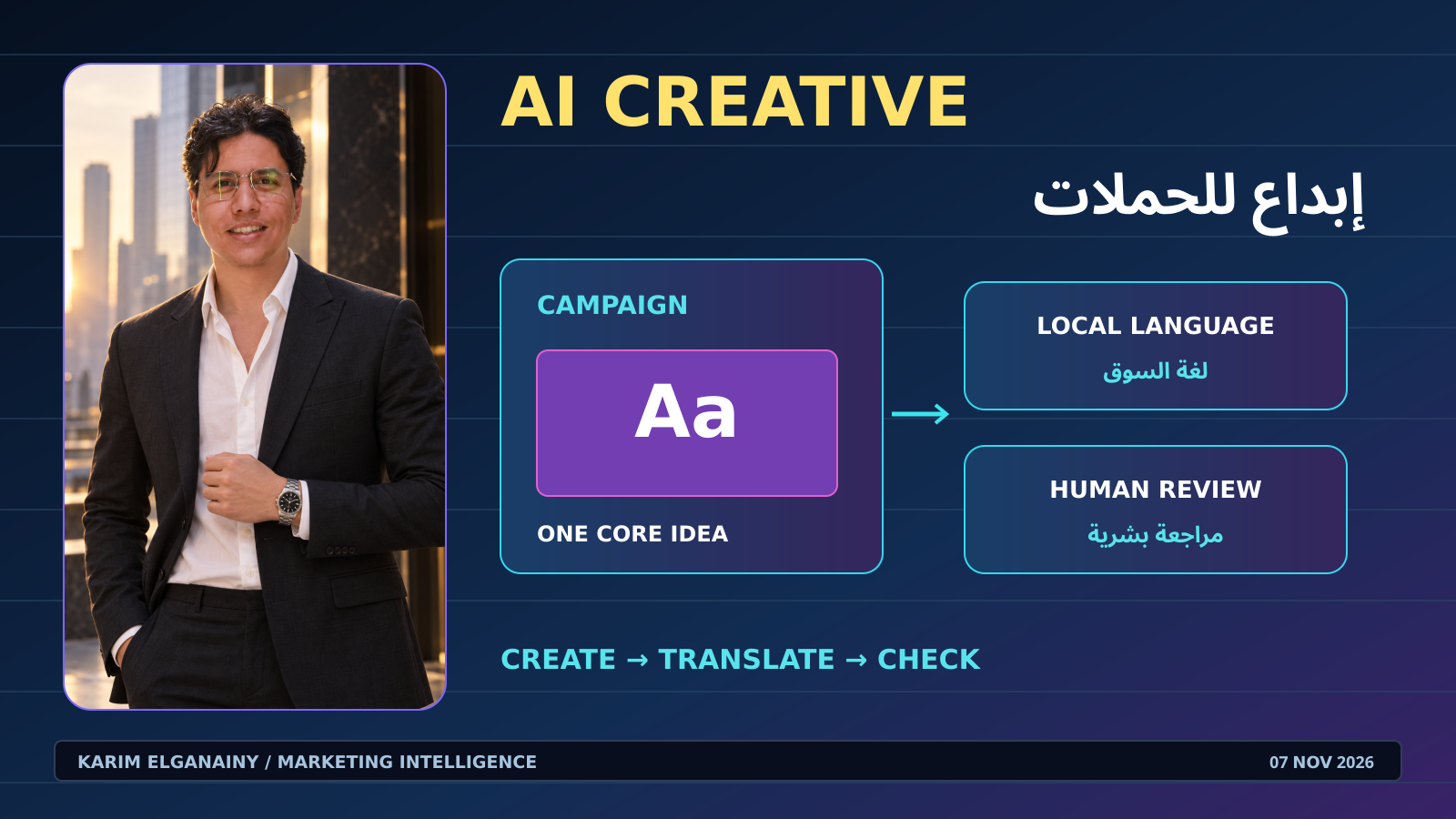
Published November 7, 2026. Source announcement: November 5, 2026.
The news, and the decision behind it
Google’s November 5 Creative Drop #2 introduces AI campaign translation across 15 languages, brand-guideline input for Asset Studio, and updated video generation. Those are the announcement’s central developments. The analysis below is an independent operating framework, not a description of guaranteed product performance or a claim that every account has identical access.
For a marketing leader, the useful question is not how many additional assets a team can generate. It is how many distinct customer situations the team can serve without weakening its promise. A campaign can become larger while becoming less coherent. The operational advantage comes only when faster production is paired with clear decisions about audience, offer, evidence, and ownership.
My recommendation is to treat this release as a reason to review creative governance before expanding output. Start with one commercial objective, one audience distinction that genuinely matters, and a named reviewer who can reject an attractive but inaccurate execution. That creates a manageable learning loop instead of an untraceable library of variations.
Separate translation from market judgment
Translation answers what a sentence means in another language. Market judgment asks whether that sentence deserves to run in that market at all. A direct rendering of an urgency claim may be grammatically correct while sounding pushy, unfamiliar, or implausible. A joke can survive the dictionary and still lose the intended relationship with its audience.
Before producing variants, write a short market brief containing the customer’s problem, the promised benefit, the proof available, the price conditions, and the action requested. Ask a local reviewer to evaluate that brief before reviewing individual lines. Otherwise, the team may spend its attention polishing language around a proposition that was never suitable.
Keep three approval questions separate: Is the meaning accurate? Is the offer true here? Does the voice fit this audience? A single overall quality score hides disagreements between these questions. Record which question failed and why. Those explanations become useful instructions for the next draft rather than merely another round of subjective feedback.
Build a message contract before an asset library
A message contract is a short internal document that states what must remain true across every execution. It should identify the product, customer problem, offer boundaries, evidence, prohibited claims, and destination. Unlike a mood board, it tells reviewers which changes are acceptable and which would alter the substance of the campaign.
Divide the contract into fixed and flexible elements. Price eligibility, availability conditions, and essential disclaimers normally belong in the fixed group. Opening lines, visual composition, and the order of supporting benefits may be flexible. This distinction lets designers explore without asking legal or commercial teams to reopen settled decisions for every minor edit.
For example, imagine a hypothetical GCC homeware retailer promoting delivery before a family gathering. “Delivery before your event” should not become a universal promise if service depends on postcode and ordering time. A creative team can vary the emotional scene, but the eligibility rule must travel with the claim. This is an illustration, not a reported campaign.
Give every variant a useful identity
A filename is not a measurement plan. Names such as final-new-vertical-two make it difficult to reconstruct what actually ran. Give each asset a stable identifier and record the proposition, language, visual idea, format, offer version, reviewer, and approval date. The point is not administrative completeness; it is making future decisions traceable.
Use a small shared register that connects an asset identifier to its landing-page version and campaign settings. If a headline changes the apparent offer, update the register rather than silently replacing the old file. A team should be able to answer whether weak results came from a particular message or from a different destination, price, or audience.
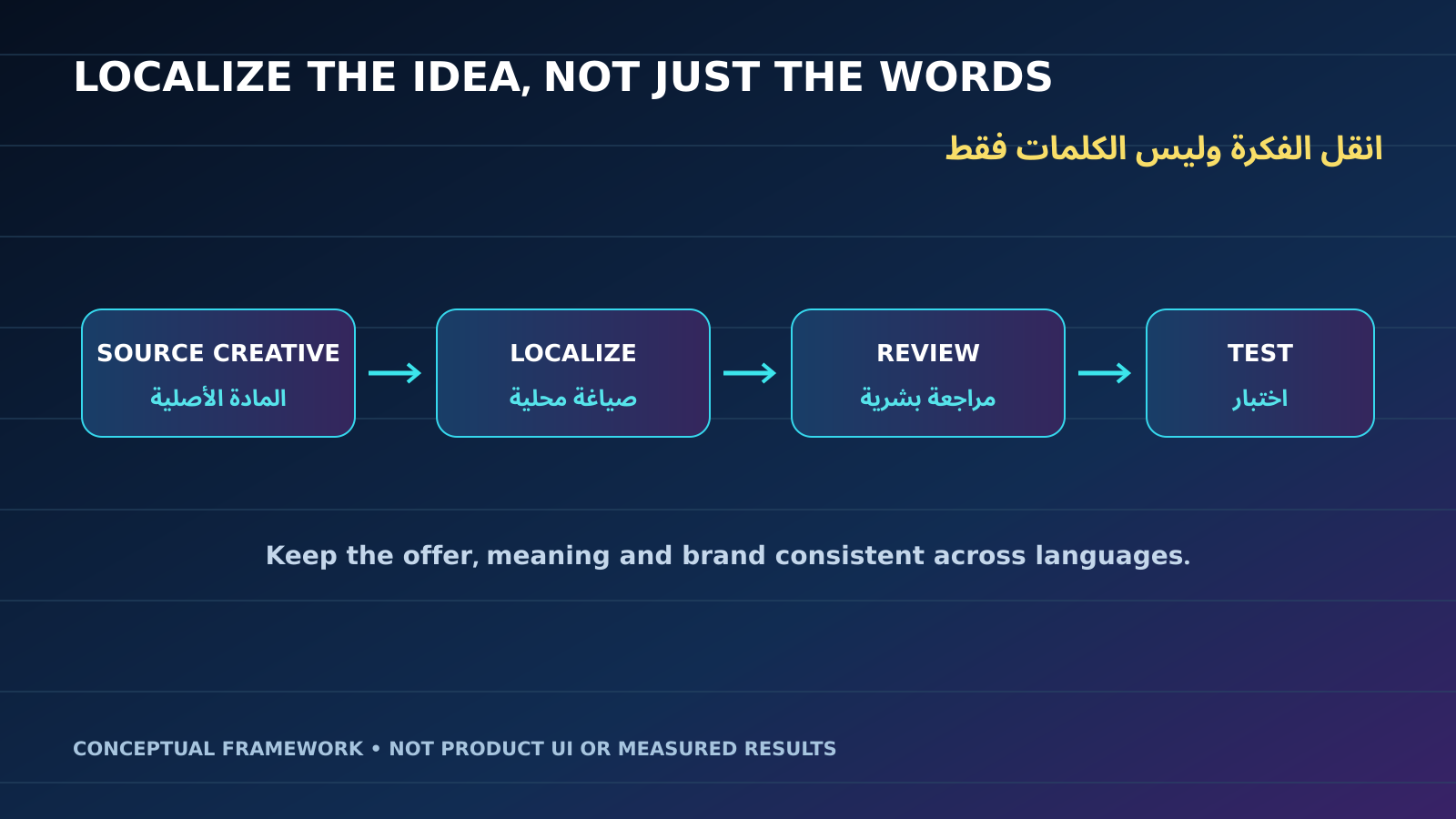
Original conceptual illustration: a suggested review and learning workflow, created for this article. It does not depict Google’s interface or an official product architecture.
Keep the register lightweight enough that a producer can update it during normal work, not after a separate reporting exercise.
Test a hypothesis rather than a pile of outputs
A creative test should begin with a sentence that can be disproved. “Showing the practical benefit first will improve qualified demand” is more useful than “Try more content.” The first statement identifies a mechanism and an outcome. The second produces activity without telling the team what it is trying to learn.
Choose the smallest meaningful contrast. If two executions differ in language, offer, visual scene, and destination, the result cannot isolate a creative explanation. That does not make the comparison worthless, but it changes the conclusion: the team has compared two packages, not discovered which ingredient mattered. Label the test accordingly before launch.
For a hypothetical Dubai furniture campaign, compare a room-size demonstration with a lifestyle opening while keeping the product, offer, audience, and destination consistent. Define success as qualified enquiries meeting a stated requirement, not every submitted form. Decide in advance what evidence would justify another test, a broader rollout, or stopping the idea altogether.
Measure the commercial consequence, not just attention
Attention is useful when it advances a commercial objective. It is not a substitute for one. A more intriguing opening can attract people who enjoy the idea but have little reason to buy. A campaign dashboard should therefore connect early signals to downstream outcomes rather than treating every improvement in engagement as a victory.
Select a primary outcome close enough to the business to matter and frequent enough to evaluate responsibly. For a service advertiser, that might be eligible consultations rather than raw leads. For a retailer, it might be completed orders with cancellations examined separately. Define the denominator, attribution window, and qualification rule before comparing results.
Use guardrails alongside the primary outcome. Watch whether apparent progress is accompanied by more refunds, weaker margins, unsuitable enquiries, or customer confusion. These are not reasons to avoid experimentation. They help distinguish a genuinely clearer proposition from an execution that attracts attention by creating expectations the business cannot fulfil.
Make Arabic review a production responsibility
Arabic quality should not be treated as a final proofreading task after the campaign is effectively approved. The reviewer needs authority over meaning, register, and visual presentation, as well as spelling. Otherwise, problems that require a new layout or a different proposition will surface when the team has the least appetite to change them.
For a GCC-focused workflow, decide deliberately whether the communication needs formal Arabic, a locally familiar conversational tone, or a bilingual treatment. There is no single correct answer for every audience. Use the customer situation and the brand’s established voice to decide, then document that choice so successive drafts do not drift between registers.
Inspect the whole execution on the devices and placements intended for delivery. Check right-to-left flow, number presentation, line breaks, subtitles, and the relationship between text and image. A linguistically sound sentence can still fail when essential conditions are visually detached from the promise. Assign this review to an identifiable person, not an abstract “localization” stage.
Put commercial boundaries around synthetic scenes
A generated scene can make a product easier to imagine, but imagination should not quietly rewrite what the customer receives. Review whether the image changes size, material, accessories, packaging, or the implied use case. The relevant standard is not whether a picture looks plausible. It is whether the finished advertisement creates an accurate expectation.
Create a simple escalation rule for uncertain representations. If a scene could imply an unsupported capability, require a product owner’s review before release. If resolving the uncertainty would take longer than the campaign allows, choose a simpler execution using material the team can confidently stand behind. Production speed does not erase the cost of correction.
Consider a hypothetical Gulf travel offer illustrated with an appealing hotel interior. The team should not allow a conceptual room to appear to be the booked accommodation. A useful creative brief specifies which elements may be illustrative and which must correspond to the purchased service. This example is a risk scenario, not an allegation about any vendor.
Design the handoff for people under time pressure
Holiday deadlines expose weaknesses in approval systems because people have less time to infer missing context. A handoff should therefore contain the asset, its intended audience, the offer conditions, the destination, and the exact decision requested. “Please approve” is less useful than “Please verify the delivery claim for these locations and dates.”
Set different review paths for different risks. A colour adjustment to an already approved layout should not require the same discussion as a new savings claim. Conversely, a small wording change can carry a large commercial implication. Classify changes by what they alter, rather than by how many pixels or words were edited.
Keep an escalation owner and a fallback execution available. When a last-minute claim cannot be verified, the team should know which simpler message can run safely. This is especially important across time zones, where a missing approver can turn a small question into hours of delay. A prepared fallback preserves momentum without making uncertainty invisible.
Start with a bounded pilot and a reusable lesson
The first rollout should be intentionally narrow. Choose one product family, one market pair, and a limited set of propositions. Complete the message contract, reviewer assignment, variant register, and measurement plan before producing the full set. This sequence makes problems easier to diagnose because the operating model is tested alongside the creative work.
At the end of the pilot, document more than the winning execution. Record which assumptions were wrong, which review steps prevented rework, and which variations taught the team nothing. Remove low-value steps, strengthen useful checks, and decide whether the next expansion should add an audience, a proposition, or a format. Adding everything at once weakens the lesson.
The takeaway is practical: use faster creation to make better-controlled decisions, not simply more assets. A team that can explain what changed, why it changed, and what happened afterward has built something more durable than a seasonal content burst.
Primary source: Google’s Creative Drop #2 announcement. The official announcement index dates the release November 5, 2026.
Comments
No published comments yet.