Published November 8, 2026. The announcement discussed here dates to November 6, 2026.
What should brands do about shopping by text?
Prepare product information that can support a reliable purchase decision, rather than assuming a new advertising channel is available. That is the immediate recommendation for retailers considering conversational shopping: make the offer understandable, keep its conditions accurate, and learn which customer questions remain unanswered before committing additional budget.
Amazon’s November 6 announcement introduces Alexa for Shopping through text to a small, invitation-only U.S. group, with wider rollout planned. It describes product discovery, cart building and purchasing. It does not establish sponsored advertising formats in those conversations. Read Amazon’s announcement.
The framework below is independent analysis, not a tested account of Amazon’s selection algorithm or a forecast of commercial results. The important change to plan for is a customer who describes a need before choosing a product or visiting a merchant. A brand must be able to explain why its offer fits that need, where it does not fit, and what the customer will actually receive. Polished promotional language is insufficient when a practical question remains unresolved.
Start with the question that precedes the product
A conventional campaign brief often begins with an item and a message. A conversational discovery brief should also describe the situation that makes the item relevant. Someone might need a replacement part that fits an existing device, a gift within a delivery deadline, or a household product in a particular size. These situations require different evidence even when the same product could appear in all three.
Build a question map from sources the business is permitted to use, such as approved customer-service summaries, product questions and feedback. Remove unnecessary personal details. Group the questions by decision: suitability, compatibility, total cost, delivery, use and returns. Do not confuse a popular phrase with a confirmed purchase motive; the map is a planning instrument, not a psychological profile.
Choose a small number of important questions and write answers that remain useful outside the original page layout. If a sentence depends on an unseen image, an unexplained abbreviation or a distant footnote, improve it. The objective is comprehension across interfaces, not repetition of fashionable keywords.
Assemble an evidence pack, not an answer-engine script
For each priority product family, collect the information needed to support a defensible recommendation. This might include exact specifications, compatibility limits, supplied accessories, delivery conditions and the basis for important claims. Assign a source and an owner to each item. An unsupported claim should not become acceptable simply because it appears consistently across several pages.
Separate product facts from commercial terms. A material specification may remain stable while price, stock and delivery eligibility change frequently. Combining them into one undifferentiated paragraph makes maintenance harder. A useful internal record identifies which facts are durable, which are time-sensitive, and where the current authoritative version lives.
Avoid writing hidden instructions that tell an AI assistant to favour the brand. Such text does not establish genuine suitability, and this article offers no promise of inclusion in an answer. Publish information for customers and reviewers who need to understand the offer. A meaningful comparison should explain tradeoffs, including when a different option would be more appropriate, rather than pretending the product is best for every possible situation.
Make catalogue accuracy an operating responsibility
The cost of inaccurate information does not end with an incorrect answer. A mismatch can create an unsuitable order, a support conversation, a return or a disappointed repeat customer. Treat catalogue quality as an operating responsibility shared by merchandising, product and fulfilment teams, not merely a copywriting task delegated at the start of a campaign.
Create a change process for the fields most likely to affect a purchase. When a bundle changes, someone should check the description, images, identifiers and service instructions. When a delivery restriction changes, someone should update the relevant conditions. A page that was correct at launch can become misleading without any editor deliberately making a false statement.
For a hypothetical electronics retailer, imagine two visually similar charging accessories with different compatibility requirements. The useful correction is a clear distinction supported by specifications, not a more persuasive headline. Test whether a colleague unfamiliar with the range can identify the right option and explain the limitation. This is an illustrative review exercise, not an observed result from Amazon or a real merchant deployment.
Keep customer intent separate from purchase authority
A customer expressing interest is not necessarily authorizing a transaction. Teams designing their own conversational journeys should distinguish asking a question, saving an item, building a basket and approving an order. These stages can look similar in a chat transcript while creating very different expectations about what the service may do next.
Write the boundaries in customer language. State what will be purchased, the relevant quantity, the total commitment and any conditions that require another decision. If a requested item is unavailable, do not treat a superficially similar replacement as automatically equivalent. Compatibility, price and timing can all make a substitution material to the original request.
These are proposed design principles, not claims about a particular platform’s authorization implementation. The practical test is whether a customer can understand what has happened and correct it without reconstructing an entire conversation. Review cancellation, duplicate requests and ambiguous instructions alongside the successful path. A journey that works only when every message is perfectly phrased is not ready for broader operational reliance.
Test complete decisions rather than isolated answers
An answer can sound useful while failing to support a successful purchase. Build test scenarios that continue beyond the first recommendation: inspect the product detail, verify the conditions, check the destination and examine the next step. A team should know whether the same promise survives as the customer moves between interfaces.
Use hypothetical or approved internal scenarios. One might involve a product fitting a stated device; another might involve a gift needed by a particular date. Record the input, observed answer, supporting information, unresolved questions and final outcome. Do not present a manually selected successful example as evidence of typical behaviour or broad platform coverage.
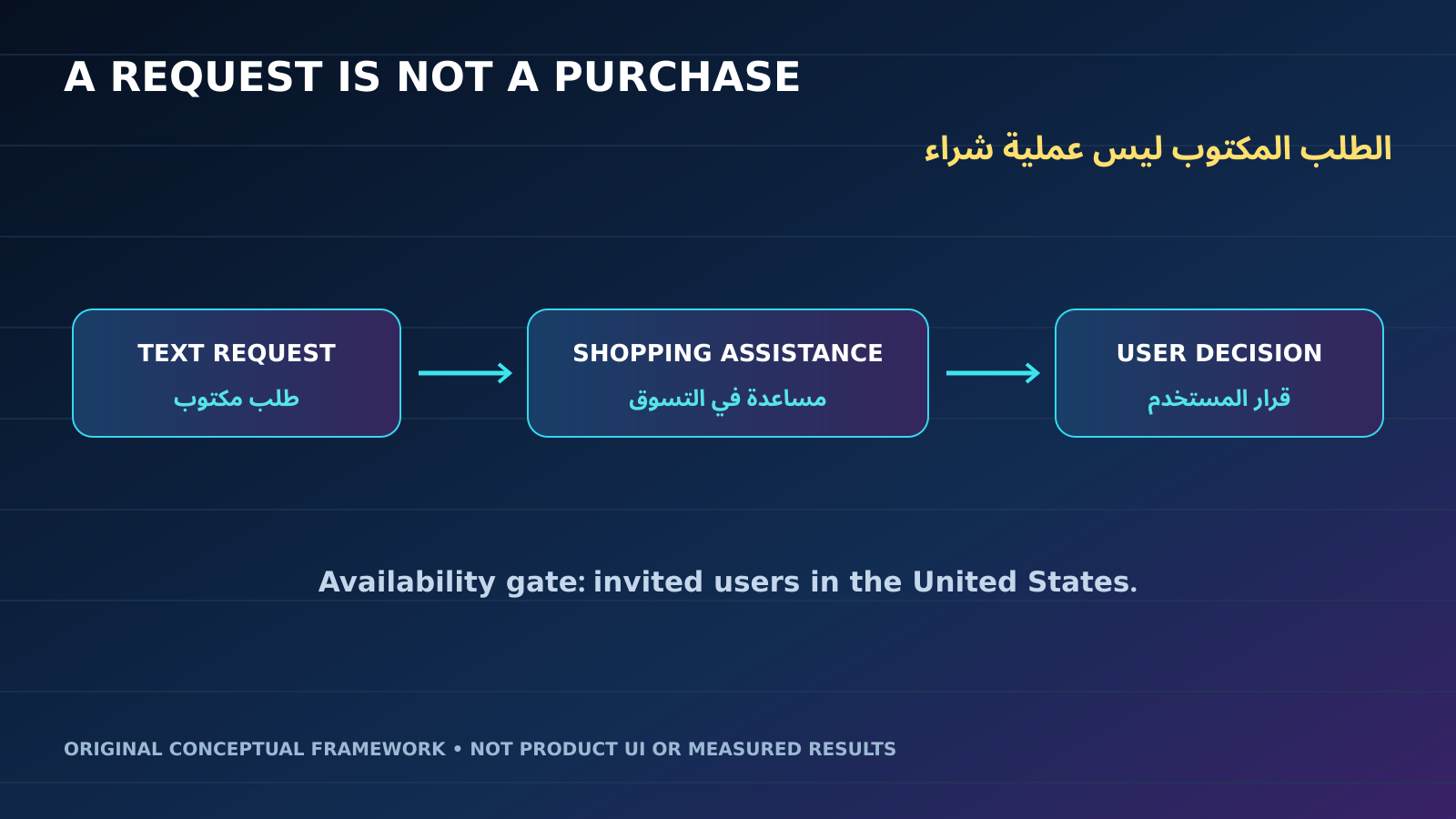
Original conceptual illustration created for this analysis. It separates a text request, shopping assistance and the user’s decision. It is not an Amazon interface, ranking model or verified product architecture.
Feedback from these tests matters: if a test reveals conflicting information, fix the underlying record before generating more promotional content. Otherwise the team is improving the presentation of an unresolved problem rather than improving the decision itself.
Separate discovery observations from business results
Seeing a product in an AI response is an observation, not proof of a stable recommendation position. Record the question, date, service, context and any visible citation. Keep that evidence separate from crawler access, indexing, referral visits and sales. These describe different stages and should not be collapsed into one vague visibility score.
For a merchant-controlled destination, define the meaningful business outcome and inspect the path that leads to it. A referral visit, a qualified enquiry, a completed order and a retained purchase each answer a different question. Some journeys may be difficult to observe fully. Document those gaps rather than assigning all unexplained sales to the newest interface.
Use a modest question sample that reflects real decision needs and can be repeated consistently. Include questions where the product should not be recommended. That helps expose misleading suitability claims as well as missing information. No checklist can guarantee placement in ChatGPT, Alexa or another assistant. The purpose of this exercise is to improve evidence and customer usefulness, not manufacture a universal ranking statistic from a few selected responses.
Connect the conversation to a credible destination
A clear conversational explanation loses value when the destination contradicts it. Review the receiving page for the same product, price conditions, eligibility and next step. Remove avoidable ambiguity about what is included and what remains optional. The handoff should help the visitor continue a decision, rather than force them to start again with a different interpretation of the offer.
A page does not need to imitate a chat window to support this journey. It needs to answer the practical questions that a short exchange may leave open. Organize important evidence where it is easy to find, and check the mobile experience using a realistic task rather than a visual inspection alone.
The earlier landing-page measurement analysis provides a complementary framework for connecting a page action with a fulfilled outcome. The relationship is conceptual: easier discovery and easier page production do not establish business value by themselves. The team still needs an accurate offer, interpretable measurement and an operation capable of delivering what was promised.
Treat Gulf relevance as a separate planning question
A Gulf business can examine conversational-commerce readiness without assuming a particular overseas release is available locally. Start with the channels the business actually operates and the product information it controls. Verify platform access, supported transactions and service conditions separately before designing a commercial plan that depends on an external capability.
Consider a hypothetical UAE homeware seller serving Arabic and English shoppers. A useful exercise could ask whether both languages explain the same dimensions, included parts and delivery restrictions. The customer’s location, preferred language and intended use should remain distinct inputs. Inferring one from another can produce an apparently personalized answer that is wrong for the actual purchase.
Review local terms with people who understand the intended audience. A familiar expression may be clearer than a literal translation, but it must not change the product claim or commercial condition. These examples are readiness exercises, not reported deployments or performance predictions. The transferable lesson is disciplined explanation; it is not a claim that every market has the same shopping interfaces or discovery opportunities.
Choose one readiness project and a clear stopping point
Start with one commercially meaningful product family and a limited set of customer questions. Identify the authoritative records, resolve contradictions, improve the destination and run the review scenarios. Assign owners who can correct product information and fulfilment conditions. This produces a concrete improvement even if access to an external channel remains limited or its commercial role is still uncertain.
At the end, write a short decision note separating completed fixes, observed behaviour and remaining assumptions. Decide whether the next investment should improve another product family, repair a handoff or investigate measurement. Do not automatically expand content production because the first set of pages now looks more complete.
The central answer remains straightforward: prepare to be accurately understood before paying to be more visible. The most useful merchant response is a reliable chain from customer question to product evidence, commercial conditions and fulfilment. That foundation supports responsible experimentation without pretending that an announcement supplies a proven acquisition strategy.
Date reference: Amazon includes the announcement in its official November 6, 2026 news roundup.
Comments
No published comments yet.