Should sales data change how you select creators?
Yes, sales evidence can improve a creator shortlist, but it should not become the only selection rule. A useful decision combines attributable commercial results with audience relevance, creative quality, cost, rights and the uncertainty in the measurement. A creator who receives credit for purchases is not automatically the creator who caused the most additional purchases. This article explains how to build a selection workflow that respects that distinction and still produces an actionable brief. It is published on November 8, 2026, and examines an announcement dated November 6, rather than presenting the announcement as a new event today.
Verified announcement: what Hyperstar says
Hyperstar announced an AI agent for selecting creators using sales evidence. Its November 6 release describes connections to order channels including Amazon, Shopify and TikTok Shop, and queries through Claude or ChatGPT. These are supplier-described capabilities, not independent proof of commercial improvement. Read Hyperstar’s original announcement.
Independent analysis: define the purchase you want
Start with a commercial question more precise than finding influencers who sell. For a replenishment product, the question might be which partnerships acquire customers who return without repeated discounts. For a new category, it might be which creators explain an unfamiliar use case well enough to produce qualified first purchases. These are illustrative scenarios, not outcomes reported by Hyperstar. Write the desired customer action, the market, the product and the evaluation period before looking at a leaderboard. Otherwise a convenient measurement can quietly replace the objective, and the team may optimize for what is easiest to count rather than what the business needs.
Define the unit of analysis as well. A creator, a post, a campaign and a customer cohort are not interchangeable. One strong post may reflect a particularly good offer, while the same creator’s broader history tells a different story. Conversely, a creator entering a new category may have little directly comparable history despite excellent audience fit. Keep a record of which evidence belongs to which unit. The shortlist should explain why each candidate is relevant to this brief, not merely attach a universal score. This makes the recommendation useful to a creative director as well as a performance buyer reviewing acquisition economics.
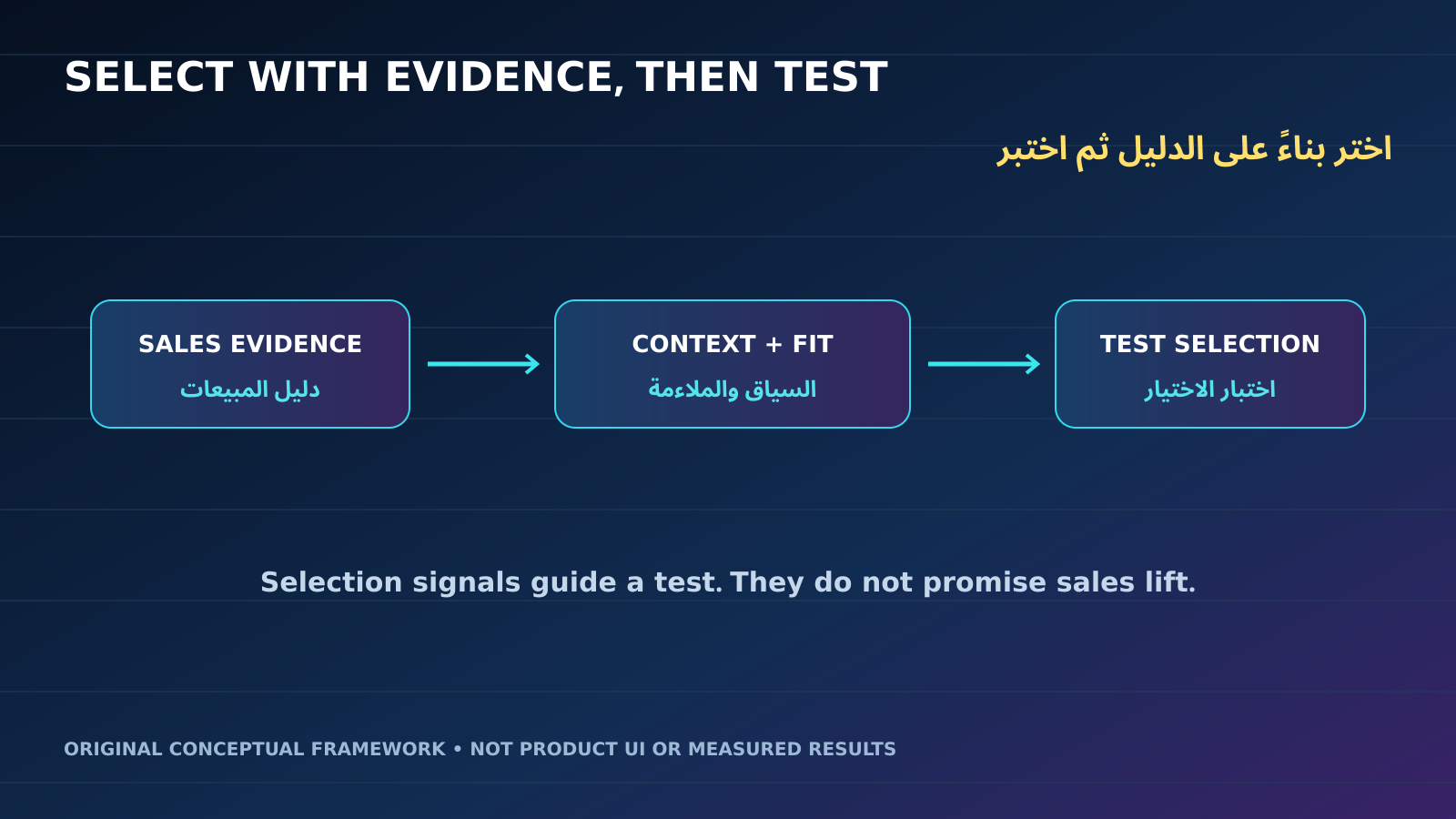
Original conceptual diagram of the editorial workflow below. It is not a product screenshot or evidence of measured campaign results.
Build a measurement dictionary before connecting orders
Ask the analyst and finance team to define a valid order, net revenue, cancellation, return, discount and new customer. A sale appearing in a platform report may later be refunded, and a coupon can change margin without changing the apparent number of orders. Decide which costs belong in the evaluation, including creator fees, production, product samples, licensing and paid amplification. Keep definitions identical across candidates wherever possible. If historical records cannot be reconciled, label the comparison incomplete rather than disguising the gap with a single score. A documented limitation is more useful than an apparently precise ranking built from incompatible inputs.
Use a data-quality check before discussing which creator wins. Inspect missing order identifiers, inconsistent dates, currency handling, duplicate transactions and the treatment of multi-product baskets. Select a small permitted sample and trace aggregate totals back to the approved source records. This is a proposed quality-control step, not a request to expose personal customer information. Keep access limited to people who need it, and prefer aggregated outputs for the selection meeting. A flawed order feed can make an excellent selection model look ineffective or a weak one look impressive. Fixing the feed is often the prerequisite to learning anything useful from the campaign.
Separate credited revenue from additional demand
A tracking link or code can identify a path associated with a purchase. It does not, by itself, establish what the customer would have done without the creator. Existing customers may use a newly discovered discount, and codes may circulate beyond the original post. Agree on the attribution rule before launch and retain the same rule when comparing candidates. Review whether different credit windows materially change the ranking. Treat a dramatic change as a signal to investigate, not an invitation to choose whichever window makes the preferred partner look best. The aim is a stable business interpretation, not the most flattering report.
Where the budget and audience permit, plan a credible test of additional effect with an analyst. A holdout or an appropriately designed comparison can provide more information than an uncontrolled before-and-after chart. The exact design depends on the buying and distribution setup; a label alone does not make the test causal. Document overlap between creators, paid media support and any major promotion running at the same time. When a clean experiment is not feasible, state that limitation and use the available evidence for a narrower decision. You can choose a modest pilot without pretending that uncertain attribution has already proved incremental growth.
Preserve the creative and audience judgment
Sales history should inform the shortlist, not erase the reason people trust a creator. Review whether the person can demonstrate the product honestly, explain its limitations and maintain a style that fits the intended audience. Watch representative work rather than relying only on a category tag. A partnership can look efficient historically yet be inappropriate for a new offer or market. Include brand suitability and disclosure requirements in the review, and avoid making unsupported assumptions about personal characteristics. The purpose is to select a suitable commercial collaboration based on relevant work, not to infer private traits or reduce people to a mysterious numerical label.
Create a brief that leaves room for authentic execution while protecting factual accuracy. Specify the substantiated product promise, required disclosures, prohibited claims, destination page and approval process. Distinguish essential information from optional wording so the creator does not sound like a scripted spokesperson reading a compliance checklist. Agree on how revisions will work before production begins. A strong creator may know how to explain the product in a way the brand has not considered, but that expertise does not remove the need to check claims. Treat creative review as a collaboration with clear responsibilities, not a late obstacle after money has been committed.
Compare economics at a realistic operating scale
An inexpensive partnership with a high apparent return may not support the volume the business needs. Review absolute qualified purchases and contribution alongside efficiency ratios. Ask whether the next increment of spend would reach new people or mostly repeat exposure to the same audience. Do not assume a successful small test scales proportionally. Build a staged plan with an initial learning budget, a defined review point and a separate decision about expansion. If a partner is useful only for a narrow product or audience, record that insight precisely. A bounded success is valuable without turning it into a universal acquisition strategy.
Consider the full asset arrangement. A fee for one organic post is not equivalent to a package that includes production files, editing permission, paid usage or a longer licensing term. Compare proposals with the same rights assumptions and have the appropriate reviewer confirm the agreement. Do not infer permission to reuse a creator’s image or work simply because the brand paid for publication. Also plan the internal time needed for coordination and review. A low quoted fee can create a costly workflow if the brief is unclear or the approval process repeatedly changes. These operating costs belong in the decision even when they do not appear in a media dashboard.
Use the AI agent as an assistant, not a contracting authority
An agent-generated shortlist should preserve the evidence behind each recommendation. Ask for the relevant period, product category, market, data completeness and main uncertainty in a format a human can inspect. Separate recommendations from actions that contact creators, offer payment, change a campaign or accept terms. Give execution authority only through an explicit approved workflow. This is a recommended governance model, not a claim about Hyperstar’s permission controls. A conversational interface can make a consequential step feel as easy as a search query, so the operating procedure needs to keep the distinction visible to every person using the system.
Keep a simple decision log. Record the original question, the shortlist, the exclusions, the reviewer and the reason for the final choice. If the agent’s recommendation changes, capture what changed in the underlying evidence rather than assuming the newer answer is better. When the available data does not support a confident ranking, ask for a comparison with uncertainty instead of forcing a winner. The log should be concise enough to maintain during real work. Its value is practical: it allows the next campaign manager to distinguish a deliberate decision from an accidental default and to revisit assumptions without reconstructing an entire conversation.
Localize the pilot instead of copying another market
For an Arabic-language or Gulf-market campaign, review product availability, delivery promises, customer support and the destination page before approving the collaboration. A creator can generate interest that the business is not ready to serve. Check whether the proposed language and examples fit the actual audience rather than treating a country label as sufficient localization. Confirm that the measurement channels and order connections needed for the pilot are available for the specific account and territory. Do not assume a capability described in a global announcement applies automatically to every local setup. Obtain operational answers before allowing the campaign plan to depend on them.
Finally, judge the pilot with a short memo separating observations, interpretation and next action. Include the agreed commercial metric, data-quality limitations, creative learning and whether the result warrants stopping, revising or cautiously expanding. Preserve unsuccessful tests alongside successful ones so the team does not build its future expectations from winners alone. My recommendation is to use sales evidence to make creator selection more accountable while retaining human judgment about fit and a disciplined view of causality. The better question is not who has the largest following or the highest dashboard total. It is which collaboration deserves the next controlled opportunity to demonstrate useful business value.
For a related measurement example, see how to distinguish reported returns from causal improvement in CTV. The channel differs, but the need to define the comparison remains relevant.
Comments
No published comments yet.