
Publication: November 8, 2026. This is a follow-up analysis of Al-Dawaa Medical Services' results announced on November 4, not a new announcement today. It covers the third quarter ended September 30, 2026. All financial amounts are in millions of Saudi riyals, and comparisons must use the same period and the disclosure's stated accounting basis.
What was reported
Q3 revenue was 1,632.784 versus 1,702.802 in Q3 2025; net profit was 47.662 versus 69.064. Compared with Q2 2026, revenue was slightly lower than 1,635.929, while net profit rose from 30.263. Republished issuer disclosure.
The group gross margin increased sequentially from 33.4% to 34.6%. This is distinct from the retail-segment margin of 36%; the two measures must not be interchanged. Argaam coverage.
Keep the accounting wording precise
The disclosure identifies an unmodified auditor's opinion, not a qualified opinion. Its other-matter paragraph concerns another auditor's work on the 2025 annual statements. An other-matter paragraph should not be relabelled as a qualification. Disclosure text.
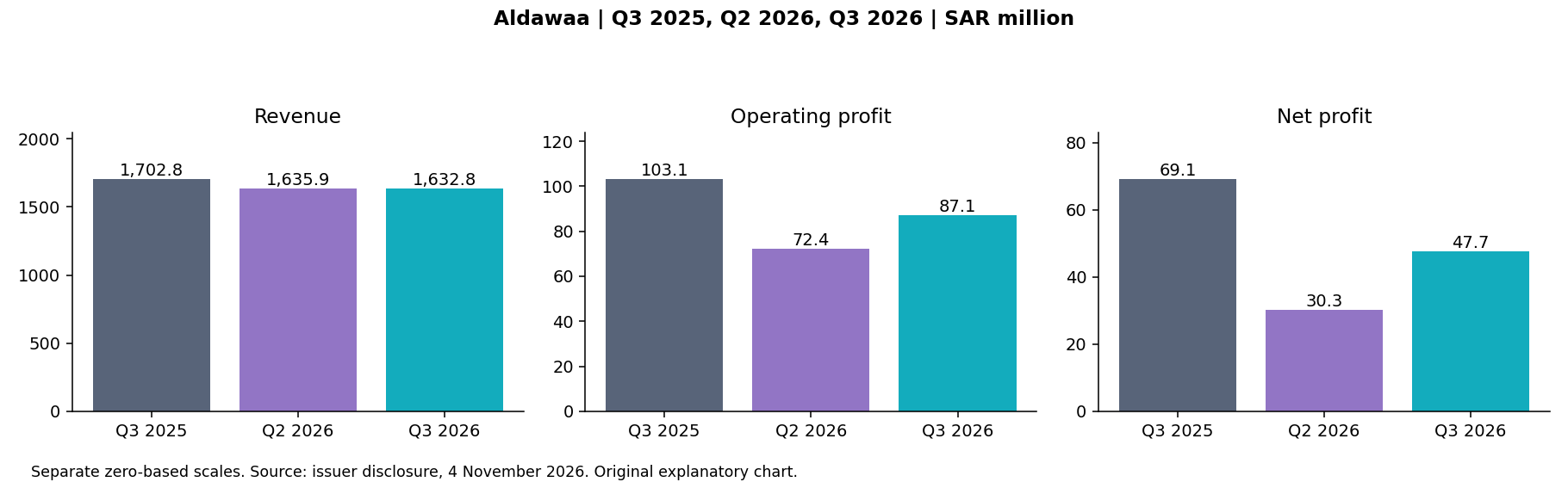
The chart uses separate zero-based scales for each metric. This original chart is a reading aid, not a valuation model. It preserves the period and measure labels. A quarterly movement cannot be substituted for the nine-month trend, and neither establishes the return generated by a particular campaign.
Analysis: growing sales and earning a return are separate tests
The following interpretation and proposed actions are independent analysis. They do not describe Al-Dawaa's internal management processes or establish the effectiveness of its marketing.
For a pharmacy growth team, reported sales are the beginning of a conversation. Transaction economics vary with product mix, discounts, fulfillment and returns. A consolidated revenue total cannot reveal those differences. Before changing a marketing budget, ask which part of the customer journey the intervention is meant to improve and what evidence would establish that it worked.
The two comparison periods add a second discipline: the comparison base needs an owner. Finance should identify the period and definition behind each figure. A dashboard that silently mixes year-on-year and sequential movements can tell conflicting stories from accurate numbers. Marketing should record the comparison used for a decision rather than selecting whichever direction makes the presentation look stronger.
These issues call for proportionate testing, not paralysis. A business can improve the clarity of its service information and the reliability of order fulfillment while evaluating the economics of individual services. What it should avoid is using a broad corporate result to claim that a specific discount, channel or customer segment caused growth.
Follow the order beyond the advertising click
An operational view can connect an eligible visit to a product page, a valid order, fulfillment, returns and the contribution remaining after the agreed variable costs. Define these stages consistently across channels. A purchase recorded at checkout may later be cancelled, refunded or only partly fulfilled. Counting it as a final outcome too early can flatter acquisition performance.
Availability also needs to be part of the same discussion. A promotion that reaches people in an area where the item cannot be fulfilled wastes attention and can damage trust. The merchandising, pharmacy, operations and marketing teams should agree on the availability signal and the promises a page is allowed to make. This is a proposed control, not an allegation that Al-Dawaa has an availability problem.
Separate commercial convenience from clinical decisions. Prescription requirements, pharmacist review and product suitability should follow the appropriate professional and regulatory process. Do not design advertising that encourages unnecessary medicine use, implies an unverified treatment benefit or turns a person's health condition into a targeting shortcut. Sensitive prescription and health information does not belong in advertising-platform event payloads.
A hypothetical test: improve collection clarity
Imagine a fictional pharmacy retailer examining an eligible non-prescription retail category. This example is unrelated to any disclosed Al-Dawaa initiative and contains no claimed results. The team wants to test whether clearer store-collection information helps customers complete orders reliably, without introducing a larger discount.
First, it checks that the selected stores can support the promised collection process. The product page explains the location, expected readiness and what confirmation the customer will receive. Any exclusions are visible before checkout. The experiment changes the clarity of that information while keeping price and the core offer stable where practical.
Second, it defines a decision period long enough to observe fulfillment and normal returns. The primary measure could be fulfilled, non-returned orders per eligible visitor. Supporting measures include cancellations caused by availability, customer-service contacts about collection, fulfillment time and contribution per fulfilled order. The team documents how costs are included rather than calling revenue after advertising spend “profit.”
Third, it uses a credible comparison. Random assignment may be feasible online; a store-based test needs comparable locations and careful attention to local differences. Document concurrent changes and avoid treating an uncontrolled before-and-after difference as proof of causality.
Finally, it sets guardrails before reading the outcome. More orders do not justify expansion if collection delays or complaints deteriorate. If the test improves clarity but the contribution result remains uncertain, the team can retain a helpful service explanation without claiming a proven financial uplift. The next experiment should answer the remaining question, not manufacture a success story.
Give management a decision-ready view
A useful review can fit on one page: the disclosed financial context and comparison periods; the operating question; the experiment and its comparison; and the action supported by the evidence. Distinguish commercial orders from unique customers, and avoid interpreting a repeat purchase as improved health or treatment adherence. Those require different evidence and safeguards.
Assign clear owners: finance for accounting, operations for fulfillment, pharmacy and compliance for relevant claims, and marketing for test design and honest reporting.
The practical lesson is to make growth legible. Growth needs reliable fulfillment, mature outcome measurement and visible accounting limitations.
Sources and limits
The Saudi Exchange announcement could not be retrieved directly. This review used the full disclosure republication and Argaam coverage linked above. No internal campaign or customer data was available. Financial results alone cannot establish advertising effectiveness or the cause of a customer-level change.
This article offers business and healthcare-marketing analysis, not personal investment advice, a clinical recommendation or a claim of professional engagement with the company.
Related reading: [Nahdi results and expansion economics](/articles/nahdi-q3-nine-months-results-2026-10-29).
Comments
No published comments yet.