
The verified news, dated November 5
PMG and RMTLabs announced motivational-fit CTV buying through curated FreeWheel deals. Their release reports 25% higher ROAS than the campaign average for a Carl’s Jr. Q3 campaign, using PMG purchase-data measurement. This is a supplier-reported comparison, not independently established incremental lift. Read the original announcement.
Independent analysis: ask what would change your buying decision
A relevant television advertisement should make sense to its audience, not merely arrive on a technically eligible screen. That is a useful creative principle. Turning the principle into a buying rule, however, requires evidence about economics, not just a persuasive description of relevance. The practical question for a marketing director is whether adding a new selection signal improves the outcome of the whole plan after its costs, constraints and tradeoffs. The following framework is our editorial analysis. It is not a description of undisclosed methods used in the announced campaign, and it does not predict results for another advertiser.
Start by writing the decision in plain language. A restaurant might want to acquire profitable new customers rather than increase credited transactions from existing loyal customers. A retailer might want additional contribution during a specific trading period rather than inexpensive completed video views. These distinctions determine the eligible audience, comparison group, reporting window and acceptable price. Without a defined decision, a team can celebrate a better media metric while making a worse commercial choice. Put the business question at the top of the brief and ask the buyer, analyst and creative lead to sign off on the same wording before selecting inventory.
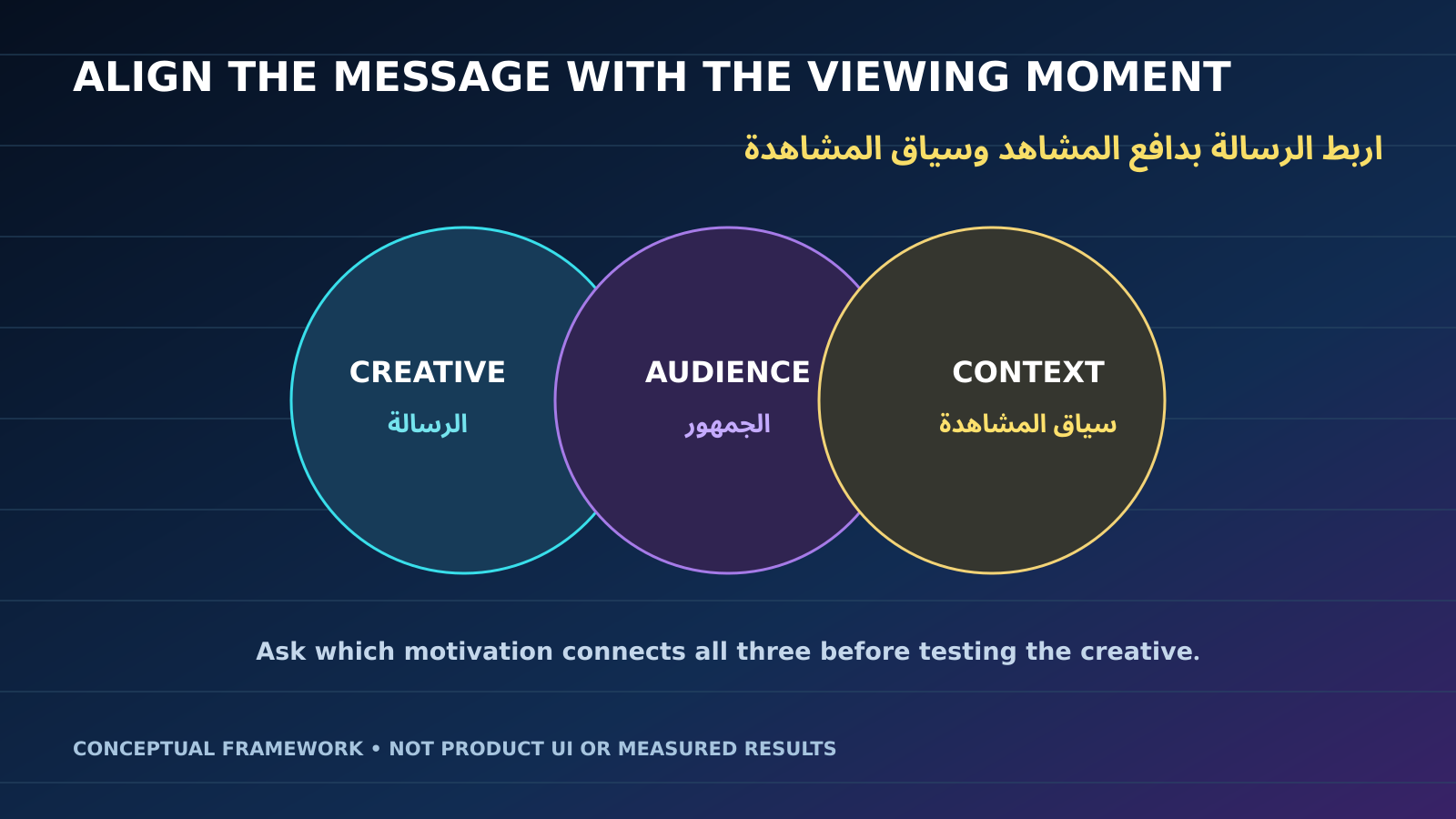
Original explanatory diagram: a proposed evaluation framework, not a product interface or evidence of measured performance.
Separate the selection signal from the outcome
A score that describes fit is an input. Sales, margin or a qualified customer action are outcomes. Treating the input score as proof of the outcome makes the experiment circular: the selected inventory appears successful because it scores well on the rule used to select it. Instead, record the signal as a treatment definition and evaluate it against an independently specified result. Ask what the score is intended to capture, how often it changes, and whether a human can understand a representative example. You do not need access to every proprietary model parameter to demand a coherent testable buying proposition.
Create a short creative audit before requesting a large audience plan. Identify the concrete promise, the emotional tone, the intended action and the evidence supporting the offer. A team may discover that an advertisement combines incompatible messages or hides the actual purchase proposition. Better inventory cannot reliably repair an unclear offer. Have reviewers describe the advertisement without seeing the campaign brief; differences between their interpretations reveal ambiguity worth resolving. Keep this audit separate from the vendor’s scoring process. Independent qualitative review is useful precisely because it can challenge assumptions rather than repeat the language already embedded in the buying system.
Inspect both sides of ROAS
Return on advertising spend divides attributed revenue by advertising cost. Before comparing ratios, specify what belongs in each part. Is revenue gross or net of returns, discounts and taxes? Does cost include only working media, or also data, technology, curation and measurement fees? Different definitions can make two apparently identical figures commercially incomparable. Ask for a calculation sheet with consistent definitions, not merely a dashboard screenshot. Finance should be able to reproduce the arithmetic from an approved aggregate dataset. If a provider cannot supply enough detail for that check, label the result provisional rather than promoting it into the investment case.
A higher ratio can also accompany a smaller useful business outcome. Narrowing a campaign to a tiny group of likely buyers may improve reported efficiency while reducing additional reach or total contribution. Review the ratio alongside spend, eligible impressions, unique reach, customer count and absolute revenue. Distinguish a strategy that finds a valuable small pocket from one that supports broad expansion. Both may be useful, but they answer different questions. Set a minimum meaningful volume before launch so a striking percentage from a very small sample does not dominate the post-campaign discussion. Do not substitute a percentage for the underlying commercial scale.
Choose a comparator that answers the question
An overall campaign average is descriptive context, not automatically a control group. Ask whether the comparison includes the selected activity itself, whether other placements had different budgets, and whether the periods and creative assets match. A mixed average can conceal differences in device, geography, frequency, pricing or audience composition. None of those differences alone invalidates a reported observation. They do limit what the observation can establish about the reason for the result. The right response is to request a more informative comparison, not to assume either that the technology works universally or that the result has no value at all.
Where feasible, design a controlled comparison before spending. Define eligible opportunities and allocate comparable groups to the new rule and a clearly documented existing buying approach. Keep material creative and commercial conditions aligned. If random allocation is impractical, discuss a defensible alternative with an analyst and state its limitations in advance. Geographic comparisons, for example, require attention to differences between areas and changes over time. Do not call a design randomized unless it really is. Decide what size of effect would change the budget and whether the available sample can reasonably detect it; otherwise the exercise may produce noise rather than a decision.
Examine overlap, frequency and attribution
A person exposed through one buying route may also encounter other campaign activity. That overlap can blur differences between groups and inflate the confidence of a simple comparison. Request aggregate overlap and frequency diagnostics appropriate to the available permissions and measurement method. Ask whether the test changes the number of opportunities to see an advertisement, the kinds of people reached, or both. A result caused mainly by higher exposure is different from a result caused by improved selection at equal exposure. Document exclusions and deduplication rules before launch, including how households and devices are treated when the measurement cannot establish individual identity.
Attribution answers which activity receives credit under a chosen rule. Incrementality asks what happened because the activity occurred. Those are related but distinct questions. Agree on the observation window and treatment of repeat transactions before results arrive. Inspect whether a longer credit window changes the apparent ranking and whether an existing customer’s routine purchase is being counted as success. A holdout can help investigate additional effect when it is feasible and properly designed, but a holdout label alone is not a guarantee of valid inference. The analyst should explain allocation, contamination, missing observations and uncertainty in language the decision maker can actually use.
Protect people while evaluating relevance
A relevance project does not justify collecting every possible attribute. Ask what data categories enter the process, where they originate, which parties receive them, how long they are retained, and how people can exercise applicable choices. Prefer the minimum data needed to answer the commercial question. Do not turn a marketing workshop into a request for raw purchase histories or sensitive personal inferences. Have the responsible privacy and legal teams review the specific proposed workflow for the jurisdictions involved. A supplier’s general privacy statement is a starting point for diligence, not a substitute for understanding the actual transfer and processing arrangement.
Put operational boundaries into the brief. For example, the team can prohibit creative that exploits vulnerability, avoid sensitive inferred categories, and require review when an audience description implies personal circumstances the brand has no legitimate reason to use. These are recommended governance choices, not claims about the announced product. Assign someone authority to stop an unsuitable activation even if an efficiency report looks attractive. Also keep audience learning separate from customer-service records unless an approved purpose genuinely requires a connection. Relevance should improve the fit between a useful offer and a viewing moment, not become a rationale for unnecessary surveillance.
Do not import a result into the Gulf unchanged
For a Gulf-market campaign, treat language, creative interpretation, inventory and transaction measurement as local questions to verify. Arabic and English versions should communicate the same promise without assuming that a literal translation carries the same tone. Review the work with people who understand the intended market and audience rather than using nationality as a shortcut for motivation. Confirm which publishers, devices and buying routes are actually available in the proposed territory. Do not assume that a workflow described elsewhere is offered locally with the same coverage, commercial terms or measurement options. Obtain specific answers before making the media plan dependent on it.
A local pilot should fit the business’s operating reality. Check whether customers can complete the advertised action in the relevant locations, whether stock or service capacity differs, and whether the offer has the same value across the test period. Coordinate with operations so a temporary fulfillment problem is not mistaken for a creative failure. Conversely, an unrelated promotion can make a media treatment appear stronger than it is. Maintain a simple change log covering price, distribution, promotions and major creative revisions. The point is not to explain away every unfavorable result, but to make interpretation accountable to known changes in the business.
A practical decision memo
At the end of the pilot, write one page that separates observation, interpretation and action. Observation contains the measured results and the agreed definitions. Interpretation states which explanations are supported, which remain plausible, and where uncertainty is too large for a strong conclusion. Action specifies whether to stop, refine, repeat or cautiously expand, together with a budget limit and a review date. Retain unsuccessful tests in the same learning log as successful ones. A portfolio containing only winners is not a reliable record of how a selection method performs, and it encourages the next team to overestimate the certainty of the evidence.
My recommendation is to treat relevance-based CTV buying as a hypothesis worth examining when the offer, measurement and privacy foundations are sound. Do not purchase the headline percentage. Purchase a bounded opportunity to learn whether a clearly defined selection rule improves a business outcome that matters to your organization. If a provider supports transparent definitions, a credible comparison and a manageable pilot, there is a useful conversation to have. If the pitch depends on skipping those questions, improving the basic campaign and measurement setup is the better next investment. The strongest result is not the most impressive chart; it is a decision you can defend and repeat.
Comments
No published comments yet.