What should an agency actually measure in AI search?
An agency should measure how a defined set of relevant questions is answered, whether the brand is represented accurately, which sources are cited and whether the observations inform a useful client decision. It should not sell a universal AI ranking or promise inclusion in an answer. Visibility is an observation within a particular sample, not a permanent property of a brand. That distinction is the starting point for evaluating any new monitoring platform. This article, published on November 8, 2026, examines a November 6 announcement and offers an independent workflow for agencies that want evidence rather than another impressive-looking score.
Verified announcement: Heading becomes publicly available
Unusual Group announced Heading, an agency-focused platform for tracking brand presence in AI answers, competitor comparisons and reporting. The November 6 release describes public availability, while prospecting tools and an agency marketplace are planned for later this month. Those future features should not be treated as already delivered. Read the original announcement.
Independent analysis: begin with the client’s decision
Before collecting answers, ask what the client needs to decide. A software company might want to know whether buyers encounter an outdated product description. A retailer might need to understand whether answers mention products unavailable in its market. A professional-services firm might care about whether recommendations cite verifiable expertise rather than an old directory entry. These are illustrative questions, not results from Heading. Each requires different observations and a different response. A single visibility percentage cannot explain all of them. Put the business question in the project brief, together with the audience, territory, language and the action the agency would consider if a problem is found.
Choose a narrow first scope. It is usually more useful to examine a coherent group of buying questions thoroughly than to collect a large unstructured list that nobody can interpret. Define which product category and stage of the customer journey matter. Separate informational questions from requests for comparisons, local recommendations and purchase advice. An answer to a broad educational question may correctly omit every brand, so treating absence as failure would distort the diagnosis. The agency’s first contribution is therefore editorial and analytical: choosing questions that represent a meaningful decision, not merely feeding a tool enough prompts to produce a dashboard with activity on it.
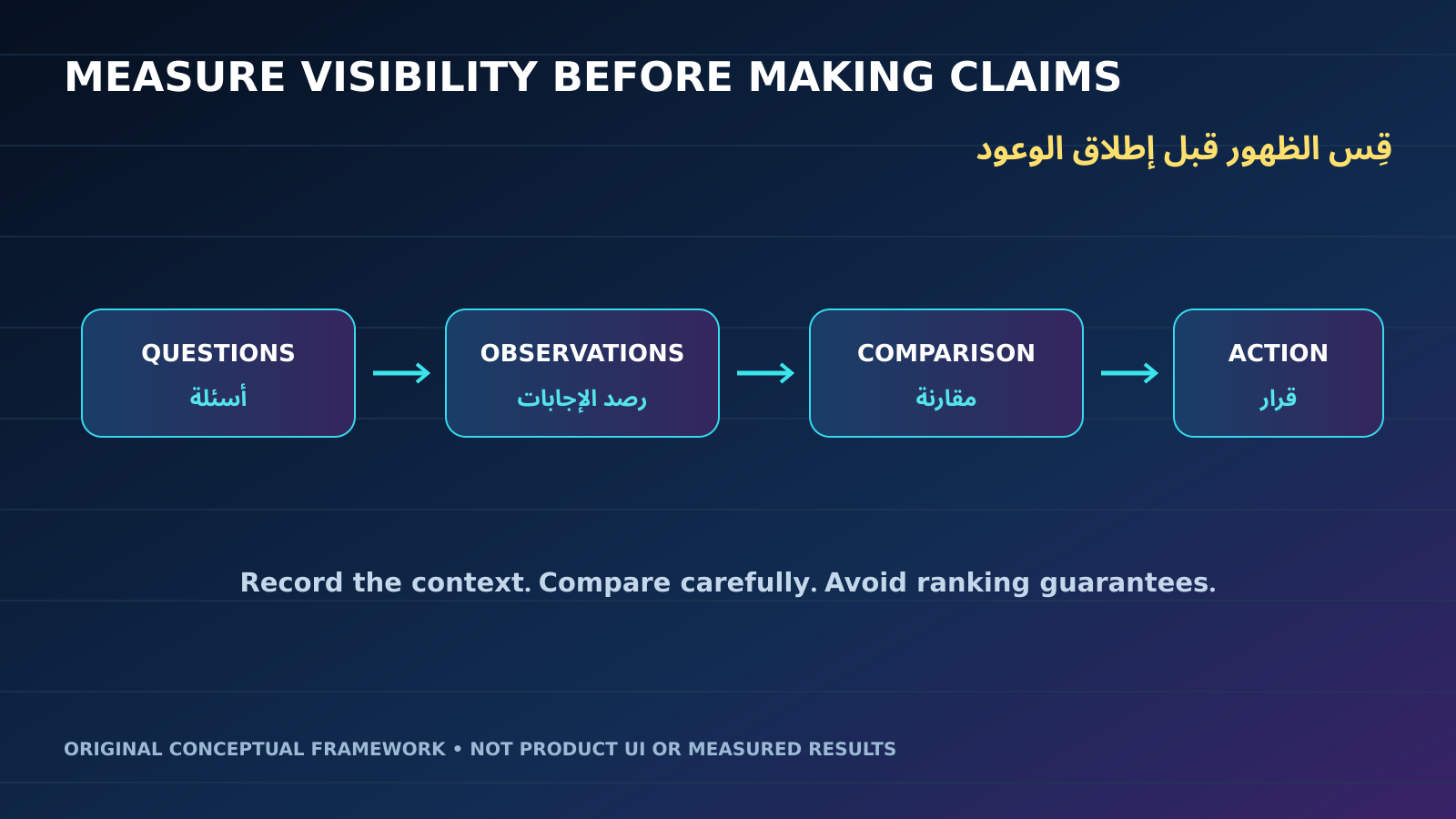
Original explanatory diagram of a proposed agency measurement process. It is not a Heading interface or a claim about observed search performance.
Build a question set that can be reviewed
Write questions in the language a prospective customer would naturally use. Avoid adding the client’s name to every prompt, because a branded question answers a different problem from an unprompted recommendation. Include practical constraints such as market, use case or budget only when they genuinely belong to the scenario. Have a client-facing colleague review whether the sample sounds plausible. Do not quietly modify questions after seeing an unfavorable result. Keep a versioned list so later comparisons can distinguish a change in the question set from a change in the observed answers. This simple discipline prevents an attractive trend line from becoming a record of moving goalposts.
Document the sample’s boundaries. A list chosen by the agency is not automatically representative of all buyers, all languages or all AI services. Explain why each question group was included and which important situations remain outside the study. If the client has approved customer research or search-query evidence, use it to improve the question design without exposing private information unnecessarily. If no such evidence exists, describe the sample as an editorial starting point rather than a measured portrait of market demand. Honest sampling language makes the report more credible, because it allows readers to understand exactly what has been observed and what still needs investigation.
Record the conditions, not just the answer
For each observation, retain the question, date, service, relevant mode and any visible citations. Where appropriate, record territory and language settings that affect the interpretation. Do not imply that observations from different products or modes are identical measurements. An answer generated with live search may have a different evidence path from one produced without it. If the tool cannot expose a material condition, note that limitation rather than inventing it. The goal is not to collect every technical detail available. It is to preserve enough context for another analyst to understand the observation and decide whether a comparison with an earlier run is reasonable.
Use repeat observations when the decision warrants them. One answer can identify a factual issue worth checking, but it is a weak basis for claiming a durable competitive position. A repeated sample can reveal whether an issue persists under the chosen conditions. Define the review cadence before the project starts and avoid constant checking that creates activity without a decision. Save representative evidence in a format the client can inspect. When answers vary, report the variation rather than selecting the best or worst example as if it describes the whole system. Variability is part of the finding, not an inconvenience to remove from the presentation.
Keep distinct evidence categories separate
A site being accessible to a crawler, a recorded crawler visit, an indexed URL, an observed citation and a referral visit are different kinds of evidence. Do not collapse them into a claim that the brand is recommended. A successful page request shows that a particular request worked; it does not prove inclusion in future answers. Similarly, a citation may support one factual statement without recommending the company as a supplier. Define each metric in plain language and show the denominator. If a report says a brand appeared in part of the sample, readers should know which questions, services and observations are counted in that statement.
Separate mention quality from mention frequency. A brand can appear often with an incorrect description, or appear less frequently in answers that are accurate and useful. Create a review rubric that distinguishes factual accuracy, relevance to the question, citation quality and commercial suitability. Include an explicit category for cases that cannot be judged from the available evidence. Have humans review consequential errors rather than allowing an automated sentiment label to become the final verdict. The purpose is not to make the client feel successful with a large number. It is to identify what, if anything, should change in the information that prospective customers encounter.
Diagnose the information problem before proposing work
When an answer contains an outdated or unsupported claim, trace the visible source where possible. The problem may belong to the client’s own page, an external source, ambiguous product naming or the question itself. Do not assume every unfavorable answer requires more content. Sometimes the useful action is correcting a contradictory specification, removing an obsolete offer from a current page or making an existing explanation easier to find. Distinguish changes the client controls from external issues that may require a separate, authorized process. This keeps an audit from becoming an automatic justification for a large publishing package regardless of the actual cause of the problem.
Prioritize corrections by business impact and confidence. A wrong service area or outdated eligibility statement may deserve attention before a minor wording preference. For each proposed action, write the observed issue, the evidence, the responsible owner and the expected benefit. Label that benefit as a hypothesis until it has been evaluated. Do not present ordinary content improvements as guaranteed ranking interventions. Strong source material, accurate pages and clear navigation are worthwhile because they help people understand the business; they do not create a contractual right to appear in an AI answer. A good agency can explain that limitation without making its work sound less useful.
Set boundaries for agent-assisted execution
If a platform recommends or performs optimization work, establish which steps require review. Drafting an explanation is different from publishing it, contacting an external site, changing access controls or editing commercial claims. Require approval for consequential changes through the client’s agreed workflow. Keep a record of what was proposed, what was approved and what actually changed. These are recommended operating controls, not assertions about Heading’s permission model. The convenience of an agent should reduce routine effort while preserving accountability. A client should never have to reconstruct an invisible chain of automated actions to learn why a page or public claim was altered.
Reject shortcuts that undermine trust. Hidden instructions aimed at answer engines, fabricated endorsements, fake backlinks and content that shows different claims to people and crawlers are not a defensible visibility strategy. Do not change security protections merely to improve discovery. Likewise, do not present an additional file or schema block as a required switch that guarantees AI inclusion. Start with useful public content, truthful metadata and a site people can navigate. Where authorized diagnostic access exists, check indexing and sitemap evidence; where it does not, state the boundary. A missing verification should remain a missing verification, not become a confident sentence in a sales report.
Design the agency report around an action
A useful monthly report can be short. Begin with the client question, the scope of the sample and the most important verified observation. Then show a small evidence table and the recommended actions, with owners and review dates. Keep methodology available for anyone who needs to inspect it. Compare like with like and explicitly mark changes in scope. If nothing material changed, say so rather than creating a new urgency to justify the retainer. The report should help the client decide what to do next, not require the client to interpret a collection of scores without knowing what any of them means commercially.
For an Arabic and English program, treat the language samples as related but distinct. Use natural questions in each language rather than assuming literal translations capture the same intent. Review product names, place names and factual descriptions consistently across the client’s pages. Avoid claiming that success in one language proves the same visibility in another. My recommendation is to evaluate a platform through a bounded pilot with a clear question set, inspectable evidence and a useful action log. The service worth buying is disciplined learning and correction. It is not a promise that an agency can control what every AI assistant recommends tomorrow.
For complementary evidence limits, read the review of digital attention and financial outcomes. It explains why visibility and business performance should not be treated as interchangeable.
Comments
No published comments yet.