What the announcement establishes
The FTC announced an inquiry on October 28, 2026 into personal information used for pricing and compensation. Nine companies received information orders. This is a United States information-gathering exercise, not a ban on personalized pricing or a finding that recipients broke the law. FTC announcement.
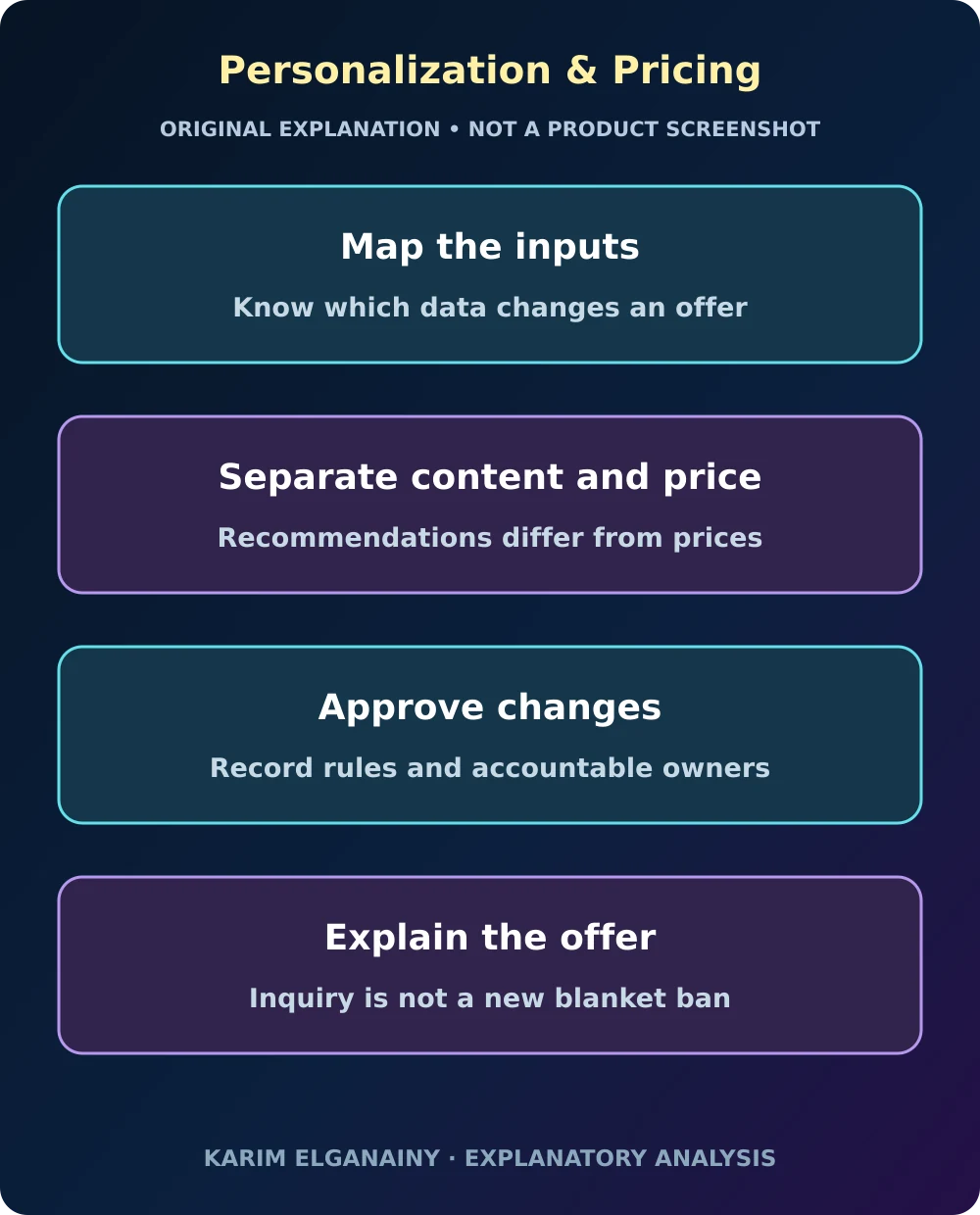
Original editorial framework; not a product screenshot or proof of campaign results.
Original analysis: start with the promise, not the algorithm
The following framework is our editorial analysis for marketing and operating teams, not an account of what the inquiry will discover or legal advice. A pricing system is often described through its technical components: a model, an experiment, a segment, or an optimization target. Customers encounter something simpler: a promise about what they will pay and what they will receive. Begin a review with that promise. Ask a colleague unfamiliar with the system to describe the advertised offer after seeing the actual mobile advertisement and checkout. Compare that description with the rule that produced the price. A mismatch deserves attention even when the model performs exactly as its developers intended.
A useful working document contains the displayed claim, the price-setting rule, the information entering that rule, and the person accountable for each. This is not a claim that every difference is improper. It is a method for finding situations in which no one can explain a difference without consulting several disconnected teams. Explanations should be available before a complaint, not assembled only after one.
Separate targeting from the amount charged
Advertising relevance and transaction terms should be reviewed separately. A system can choose which product to show without changing its price. Another can decide which promotion a person sees. A third can calculate an individual offer. Those choices may share infrastructure while creating different customer experiences. Labeling all of them personalization makes a review less precise. For internal analysis, classify each workflow by the decision it makes, rather than by the vendor's product name.
Build a simple journey map from audience selection through recommendation, offer display, checkout, renewal, and support. Mark the points at which the amount can change and the team that owns each point. Include discounts, delivery charges, service bundles, and renewal conditions where relevant. The purpose is to identify the complete commercial experience. A favorable headline discount does not explain the final amount if a later stage introduces a different condition. Likewise, different final totals do not alone establish individualized pricing; the underlying products and transaction circumstances must be compared.
Define comparable transactions before testing
A screenshot showing two prices can start an investigation, but it cannot finish one. An internal test needs an explicit definition of comparability. Are the product, location, delivery window, membership status, inventory state, taxes, and time of observation the same? Which differences are intentional and documented? Which are unknown? Record these assumptions before collecting examples so that an interesting result does not tempt the team to change the comparison afterward.
Use synthetic or approved test accounts where possible, and obtain the necessary internal permissions before testing live journeys. Avoid collecting unnecessary personal information simply to make the test appear realistic. Repeat observations when the commercial conditions genuinely allow it. Preserve both the displayed offer and the final payable amount. If the evidence is inconclusive, say so. The strongest output may be a clear list of unresolved variables rather than a dramatic conclusion about a system the team has not yet isolated.
Make the data inventory decision-specific
A broad inventory that says a platform uses customer data is not enough for operational review. Ask which fields influence which decision. Distinguish data used to calculate a price from data used for measurement, fraud prevention, service fulfillment, or reporting. Trace derived scores as well as raw inputs. A harmless-sounding field name may conceal several transformations, while an obviously personal field may be present in a database without entering the pricing rule at all.
For each input, write its source, purpose, refresh cycle, retention approach, owner, and proposed fallback if it becomes unavailable. Record whether the organization can actually inspect the transformation or only receives a vendor output. These are recommended governance questions, not statements about a legal requirement in every market. They help teams avoid a familiar operational failure: approving a tool for one purpose and later discovering that the same integration supports an additional commercial decision that nobody consciously reviewed.
Give vendors a concrete explanation task
A request for general assurance usually produces general assurance. Instead, ask a supplier to explain a small set of representative offer decisions in plain language. What was the relevant input? What rule or model version applied? What alternative would have been displayed without that input? Which aspects can the customer-facing team explain accurately? If the supplier cannot disclose a proprietary model, ask what evidence it can provide about the decision boundaries and available controls.
Do not treat an attractive dashboard as proof of understandable operation. A dashboard can report outcomes while obscuring the cause of a particular offer. The buyer needs a workable division of responsibility: who monitors unexpected differences, who investigates complaints, who can stop a feature, and who supplies records. Put these operational expectations into the procurement conversation before expansion. Where contractual or privacy questions arise, route them to qualified specialists rather than allowing a marketing performance target to settle them implicitly.
Replace a single revenue objective with a balanced decision
A pricing experiment can raise short-term revenue while creating support costs or weakening repeat purchase. That possibility is an analytical consideration, not a prediction about the companies in the inquiry. Define the commercial benefit and the potential costs before the test. Include conversion, net contribution, cancellations, refunds, support contacts, and customer understanding when those measures are relevant and available. Do not combine them into a single score that hides a serious deterioration behind a small revenue gain.
Assign guardrails and a person authorized to act when one is crossed. A guardrail should have a meaningful interpretation: for example, an unexplained rise in complaints about inconsistent offers triggers review, not an automatic assertion of wrongdoing. Establish a comparison period and note changes in stock, staffing, promotions, or acquisition mix. Without that context, a team may credit the pricing feature for an improvement caused by a different campaign or blame it for a service issue that started elsewhere.
Write explanations that survive the real interface
An explanation should be tested where the choice occurs, not only in a policy document. Review how it appears on a narrow screen, in a translated interface, and after a user returns from a saved link. Ask whether a person can distinguish a generally available price, a membership benefit, and a conditional offer. If a claim depends on eligibility, the condition should not vanish when the creative is cropped or republished by an affiliate.
This recommendation concerns clarity; it is not a universal disclosure formula or a legal safe harbor. The wording appropriate to a particular system depends on its actual operation and applicable rules. Marketing teams can still do useful preparatory work: eliminate claims that the organization cannot explain, keep commercial terms consistent across surfaces, and make escalation easy. A polished sentence is not a substitute for a coherent underlying offer. If the business rule remains unclear internally, rewriting the sentence is unlikely to solve the problem.
Keep compensation review distinct
Where an organization also designs offers to workers or service providers, do not assume a customer-pricing review covers that relationship. The relevant outcomes, information needs, and operational consequences may be different. Build a separate map of how an offer is generated, presented, accepted, changed, and disputed. Ask whether the recipient can understand the work involved and the amount offered before making a decision. Keep any evaluation within the organization's authority and obtain specialist advice for employment or contractual questions.
For a marketing team, the practical boundary is important. Recruitment and earnings messages should match the underlying process rather than borrowing optimistic examples from a different context. A campaign that attracts more applicants is not automatically successful if the resulting experience contradicts their expectations. Analyze complaints and withdrawal reasons without treating every negative response as evidence of a defect. Look for repeatable patterns, document alternative explanations, and involve the team responsible for the actual working arrangement.
Saudi teams should transfer questions, not jurisdiction
A United States inquiry does not by itself create a Saudi rule, establish a local violation, or determine how a specific Gulf business should operate. Saudi teams can nevertheless use the news as a prompt to improve their own decision records. The transferable questions are practical: can we explain an offer, identify the data that influenced it, reproduce a decision, and correct an error? The legal answers require review of the actual market, activity, contracts, and relevant local requirements.
A bilingual business should also check semantic consistency. An English offer described as conditional should not become unconditional in Arabic. Currency presentation, included services, and renewal language should remain aligned across versions. Ask reviewers to test meaning rather than literal translation. When a customer moves between languages during checkout, the commercial promise should remain coherent. This is an original operational recommendation, not a claim that the FTC announcement prescribes a particular Arabic wording or applies directly to Saudi advertising.
A practical review sequence
Start with one material journey rather than every system at once. Choose an offer with enough transaction volume to inspect and a clear owner who can coordinate the work. Assemble marketing, product, analytics, customer support, and the appropriate specialist reviewers. Document the current journey before suggesting a redesign. A short, accurate baseline is more valuable than a large speculative risk register that nobody can maintain.
Next, reproduce a small set of decisions, identify missing explanations, and agree which gaps prevent a responsible expansion. Separate immediate corrections from questions requiring deeper technical work. Finish with a decision log that records the evidence, uncertainty, responsible owner, and condition for revisiting the decision. An acceptable outcome may be no change, a narrower experiment, a clearer offer, or a pause pending review. The point is not to manufacture urgency from a regulatory headline. It is to make commercial decisions explainable enough that the business can defend, improve, or discontinue them on evidence.
What to watch next
Future official material may clarify the inquiry's scope or results. Until then, do not convert the existence of information orders into claims about any recipient's behavior. Keep updates separate from this practical framework and date any factual additions. For an internal team, the most useful next evidence is often closer to home: a verified decision map, a reproducible offer, and a record showing that the advertised promise matches the experience. Those artifacts remain valuable whether the external inquiry produces new findings, recommendations, or no conclusion relevant to a particular business.
Comments
No published comments yet.