Editorial review: October 31, 2026. This is analysis of an earlier announcement, not a launch report dated today.
Verified news: a narrow factual baseline
Reddit released its third-quarter results on October 29, 2026, reporting advertising revenue of $847 million, up 54% year over year. Reddit's primary earnings release.
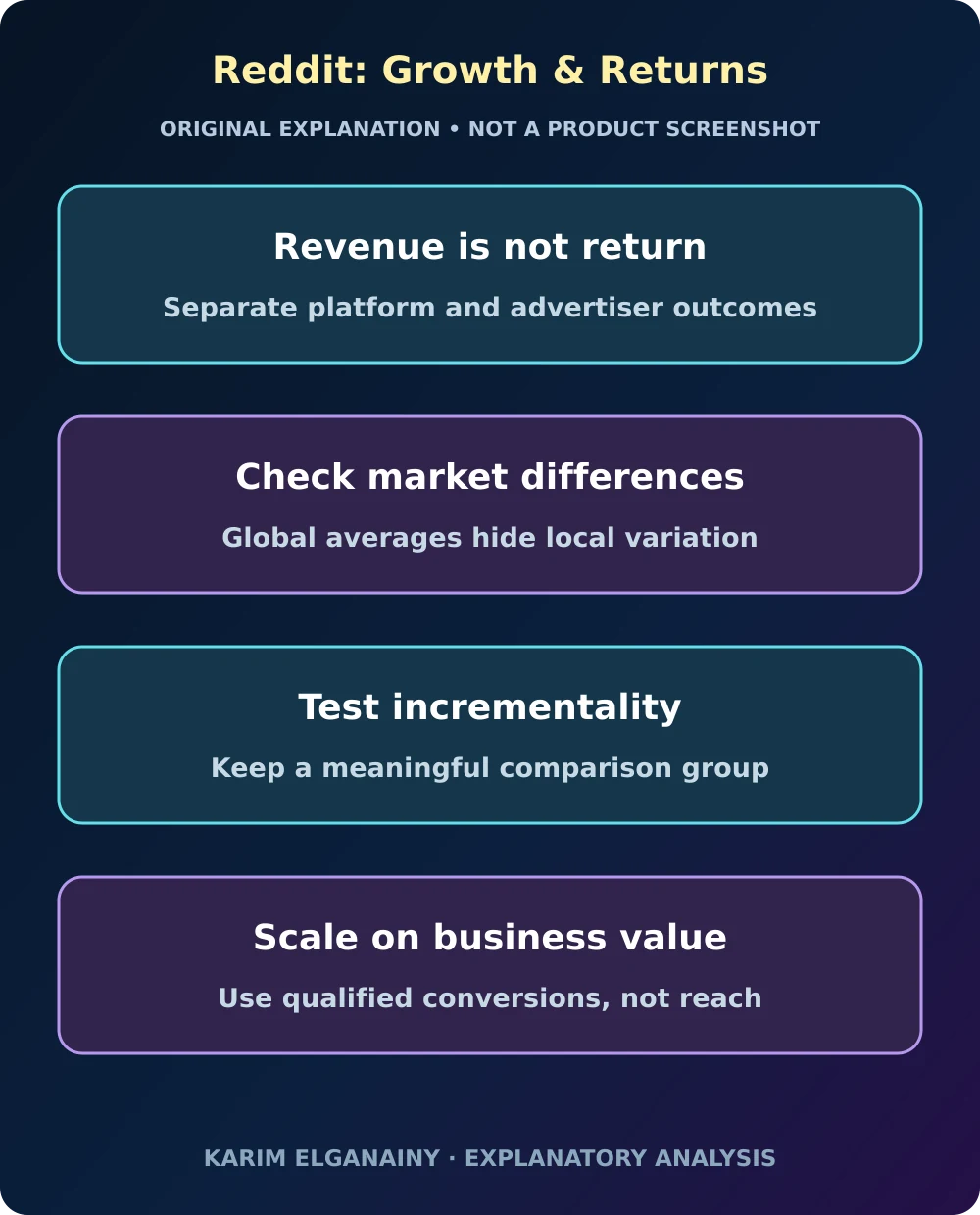
Original editorial framework; not a product screenshot or proof of campaign results.
Editorial analysis: what an advertiser should do with that information
The following framework is original editorial guidance, not an account of additional Reddit announcements or a claim about any advertiser's results. A platform's commercial momentum can justify taking a closer look, but it cannot select your audience, establish your economics, or prove that moving money will improve your business. Treat the news as a reason to ask better questions rather than a reason to bypass them.
A useful planning meeting starts with a deliberately uncomfortable question: what evidence would persuade us not to run this campaign? If the team cannot name any, it is preparing a justification rather than a test. Write down the decision before developing the creative. A retailer might want to learn whether detailed comparison messaging attracts suitable first-time customers. A software company might want to understand whether a particular professional problem deserves its own landing page. Those are narrower, more actionable questions than whether a growing platform is good for marketing.
1. Separate the business headline from your business case
Build two columns in the planning document. The first contains the external observation and its date. The second contains the internal assumption you are considering. Do not draw an unqualified arrow between them. Advertising revenue is a platform-level commercial measure; qualified demand, contribution margin, and customer retention belong to the advertiser's operating model. They need different evidence.
For example, the statement that a channel deserves investigation can be reasonable without implying that it deserves additional budget immediately. Investigation might consist of reviewing existing account data, checking available campaign settings, or interviewing sales colleagues about recurring customer questions. These activities can reveal that the channel is already well tested, that a tracking problem prevents interpretation, or that the business lacks a relevant offer. In each case, postponing expenditure may be a more useful response than launching quickly.
2. Define audience relevance as a problem, not a stereotype
Describe the buying situation in plain language. What is the person trying to decide? Which constraint makes that decision difficult? What information would help them distinguish between alternatives? A useful audience hypothesis might concern people choosing a tool that must work with an existing system. It should not presume that everyone discussing that tool is a buyer, has purchasing authority, or lives in your service area.
If reviewing public discussions, record themes rather than building dossiers on individual participants. Do not treat a username or a casual comment as permission for direct solicitation. Avoid extracting sensitive personal details into audience planning documents. A compact research note can capture the question, the uncertainty it reveals, and the answer your business can substantiate. That is enough to guide a content hypothesis without turning community observation into intrusive profiling.
3. Audit what you can actually offer
Create a claim-and-proof sheet before writing ads. For every proposed statement, list the evidence, its owner, any limitation, and the date for review. A compatibility claim requires a maintained compatibility list. A delivery promise requires an operational commitment for the relevant destination. A comparison requires clearly defined criteria and a fair presentation of material limitations.
This exercise often exposes a deeper problem: the proposed ad is confident while the destination is vague. Someone clicks to learn whether a product fits their circumstances and finds only a generic slogan. Fixing that mismatch may be more valuable than changing the media mix. Make price conditions, exclusions, eligibility, and the next step easy to find. Do not conceal important qualifications in a separate document that a reasonable visitor would not think to open.
4. Distinguish paid communication from community participation
Paid creative and participation in a discussion require different preparation. A campaign can have a controlled message and a defined destination. A conversation can invite questions the original brief did not anticipate. Neither format should depend on employees pretending to be independent customers or manufacturing consensus.
Where your team participates, make affiliation clear and check the relevant community rules before contributing. A helpful answer should remain useful even if the reader never purchases. If the question asks about a limitation, address that limitation rather than redirecting immediately to a sales page. Staff should know when they can answer, when they need a specialist, and when silence is preferable to an improvised assurance. Genuine uncertainty is less damaging than an authoritative answer that later has to be withdrawn.
5. Make the creative test explainable
Choose one meaningful distinction for the first comparison. For instance, one concept could explain how to evaluate a purchase while another demonstrates a particular use case. Keep other important conditions as consistent as practical. If the offer, audience, destination, and schedule all change together, the result may be commercially interesting but difficult to interpret.
Write a short creative rationale for each concept. Identify the question it answers and the evidence it presents. Avoid rewarding novelty alone. A dramatic opening that attracts attention from unsuitable visitors can create an attractive surface metric and an expensive operational problem. Review the ad and landing page together, including the experience on a small screen. The test is not merely between two pieces of copy; it is between two complete explanations offered to prospective customers.
6. Decide what counts as a worthwhile response
Select a primary outcome tied to the business question, then define the supporting measures needed to diagnose it. For a lead campaign, a form submission might be only an intermediate event. Specify what makes a lead serviceable and who assesses that quality. For a retailer, distinguish an order from an order that survives cancellations and returns.
Document the evaluation window before reading the results. A long consideration cycle should not be judged as though every useful interaction becomes a purchase immediately. Conversely, a delayed outcome should not become a permanent excuse to ignore weak evidence. Agree on when enough follow-up will have occurred to evaluate the initial cohort. If volume is too low to reach a dependable conclusion, report that limitation explicitly rather than converting a handful of responses into a confident channel verdict.
7. Validate measurement before expanding the test
Walk through the conversion journey using authorised test procedures. Confirm that events represent the actions their labels imply, that duplicate submissions are handled appropriately, and that relevant consent choices are respected. Compare platform reporting with the business's own records at a level that does not require unnecessary personal data sharing.
Expect different systems to answer different questions. One may attribute an interaction within its own reporting framework while another records the final transaction. The existence of a discrepancy is not proof that either system is broken. Document the definitions, timing, and exclusions before trying to reconcile totals. If you cannot establish a reliable primary outcome, the sensible next step may be measurement repair rather than more traffic. Additional spend does not make an ambiguous event definition more trustworthy.
8. Set boundaries for spend and interpretation
A test budget should reflect what the organisation can afford to learn, not what would make the announcement feel important. Establish a maximum authorised commitment, the person allowed to change it, and the conditions requiring a pause. Distinguish operational stop conditions, such as a broken destination, from commercial review conditions, such as consistently poor lead fit.
Also define the comparison you intend to make. A historical campaign from a different season or promotion is not automatically a fair baseline. Where a clean comparison is impractical, acknowledge the limitation and use the results as directional learning. A disciplined test can still inform creative development or sales conversations without proving incremental revenue. The danger is not imperfect evidence; it is presenting imperfect evidence as something more decisive than it is.
9. Localise the decision journey, not only the headline
For an Arabic-speaking audience, translation should cover the actual decision conditions: service geography, currency, delivery expectations, support language, and the terminology customers use for the product. These items require business verification. A global platform announcement does not establish local demand, account eligibility, or product availability in a particular market.
Have a fluent reviewer inspect the complete mobile journey, including forms, error messages, confirmation screens, and right-to-left presentation. A polished ad cannot compensate for a form that fails to accept a local phone format or a response team that cannot handle the promised language. Keep versions aligned when offers change. If one language gives a clearer account of exclusions than the other, the problem is not merely stylistic: customers may be making decisions on materially different information.
10. Prepare for objections before buying attention
Create an objection register with three categories: questions that can be answered from approved material, issues needing an operational specialist, and concerns requiring a pause or correction. Assign ownership and a reasonable internal response process. Do not promise public response times the team cannot sustain.
Use repeated questions to improve the destination rather than forcing every visitor through the same private explanation. A question about installation might justify a diagram; a question about limitations might justify a comparison table. Keep examples accurate and avoid exposing identifiable customer information. A critical comment can contain useful product feedback even when its tone is uncomfortable. The aim is not to eliminate disagreement, but to respond in a way that is accurate, proportionate, and consistent with what the business can actually deliver.
11. Write the learning memo before the next budget request
The final review should explain the hypothesis, execution, observed outcomes, measurement limitations, and resulting decision. Include creative examples and any changes made during the test so that later readers can understand what was actually evaluated. Separate a positive signal from a demonstrated business result.
There are at least four legitimate outcomes: expand within an authorised plan, revise the message, repair an operational weakness before retesting, or stop. None should be preselected because the platform's headline was impressive. Retain the research and creative learning even if the media test does not justify continued spending. The durable value of responding to this news is a clearer account of your customer's problem and a better standard of evidence for your next decision—not an unsupported promise of performance.
Comments
No published comments yet.