
Announcement date: October 29, 2026. Editorial review: October 31, 2026. This article examines an announcement made earlier this week; it does not describe a new launch today.
What Walmart actually announced
Walmart says its shopping-based audiences can now be used in Vibe’s self-serve connected-TV campaign builder. Categories include recent buyers and people showing purchase-intent signals. Walmart maintains the audiences; Vibe manages campaign delivery and reporting. Measurement described in the announcement includes advertisers’ own-site purchases and incrementality testing through Vibe. Walmart’s October 29 announcement.
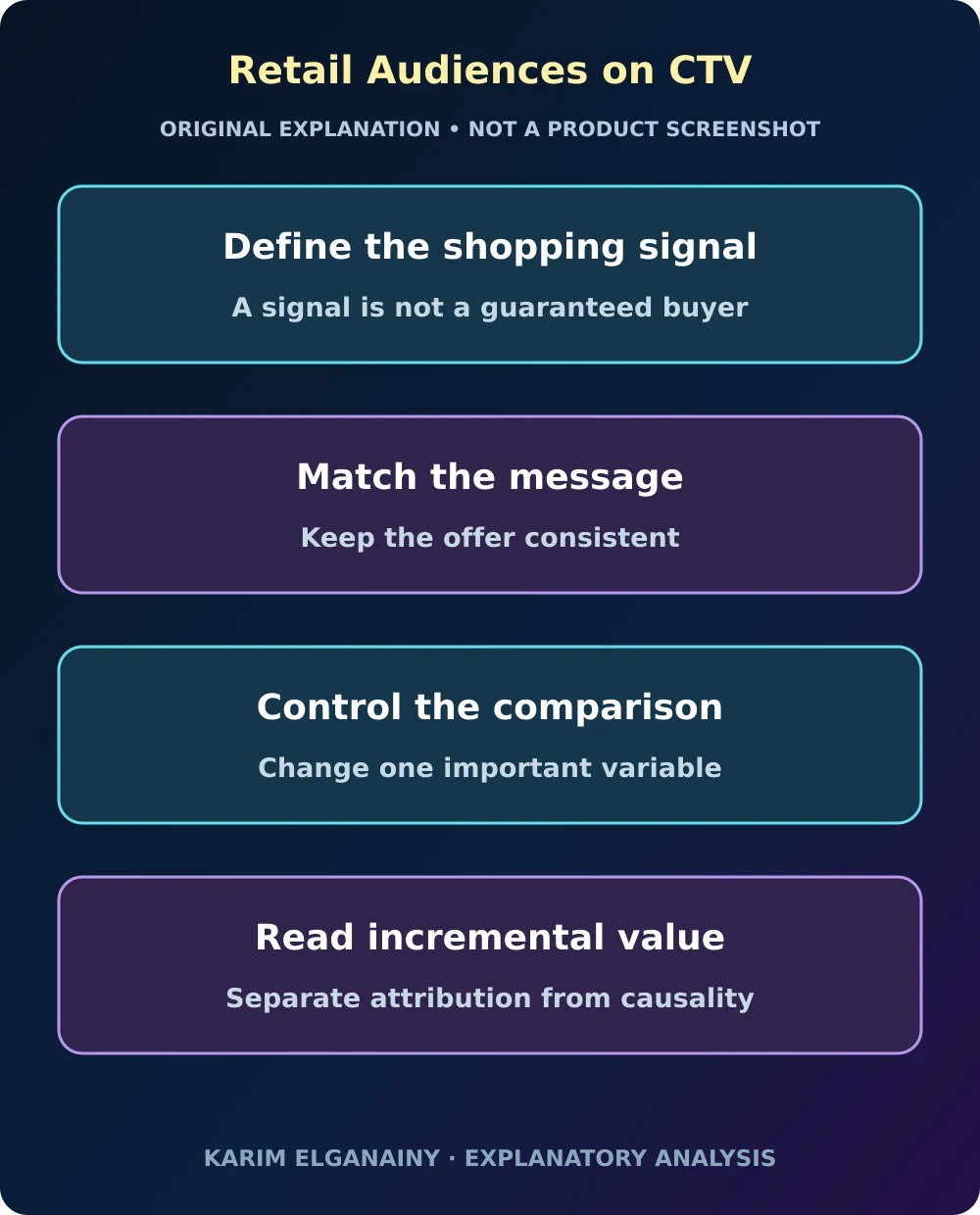
Original editorial framework; not a product screenshot or proof of campaign results.
Editorial analysis: start with the decision, not the segment
The interesting planning question is whether a different way of choosing households can improve a specific business outcome. It is not whether a familiar retailer’s name makes a campaign sound more precise. Before opening a campaign builder, write down the decision that the experiment should support. A useful version might be: should we move a defined portion of prospecting investment from broad category interests to purchase-informed audiences? That question provides a comparison. “Should we try retail data?” does not tell the team what evidence would justify continuing.
Begin with an operational constraint as well as a commercial ambition. A business might need to sell inventory in a limited service area, increase first orders without increasing discount dependence, or reach customers whose purchases can be fulfilled reliably. Those are different tasks. They require different eligibility checks and may lead to different exclusions. The audience label is only one component of a plan that also includes geography, product availability, creative, delivery frequency and the customer's next step.
Distinguish a plausible audience from a profitable customer
A category relationship can support a sensible hypothesis, but it is not a statement about willingness to buy a particular brand. Someone interested in a category may already be satisfied with a competitor, be outside the delivery area, or care about a benefit the advertiser cannot credibly offer. A team should therefore identify why its proposition is relevant before assuming that a narrower audience is inherently better. The creative should explain a meaningful reason to consider the product rather than simply repeat the category name.
Consider a hypothetical home-storage retailer. The team believes a household transition creates a useful moment to explain its installation service. Its test should connect that hypothesis to available service coverage and appointment capacity. A campaign that generates inquiries in unsupported locations has not solved the business problem, even if a reporting interface shows attractive engagement. This is an illustrative planning scenario, not a Walmart or Vibe customer result, and the same distinction should accompany every invented example used in an internal presentation.
Make the first experiment answer one question
The cleanest initial comparison changes the audience approach while holding other material choices as steady as practical. Use comparable creative, offer, geography and timing. Record any differences that cannot be removed, including different delivery patterns or reach constraints. If the team simultaneously introduces a new audience, a discount, a landing page and a new video, the outcome may be useful commercially but it cannot isolate the contribution of the audience choice.
Write a short experiment brief before launch. Include the hypothesis, eligible population, comparison approach, primary outcome, costs, relevant exclusions and decision rule. Specify who can authorize changes while the test is running. This prevents well-intended optimizations from quietly turning the experiment into a different question halfway through. Where a credible controlled design is unavailable, describe the work as a directional campaign comparison and keep the strength of the conclusion proportional to the evidence. A polished dashboard cannot repair a weak comparison after the fact.
Choose an outcome the business can explain
The main outcome should represent useful progress rather than the easiest event to count. For a retailer, that may mean completed orders after cancellations and returns are accounted for. For a service business, it might be qualified inquiries within a supported geography that progress to an appointment. Define the event before comparing campaigns. A change from all inquiries to accepted inquiries can make performance look different even when the underlying customer behavior has not changed.
Keep a second layer of diagnostic indicators without allowing them to replace the primary outcome. Visits can help explain whether people found the destination; product views may reveal interest; checkout starts can expose friction. None is automatically equivalent to a sale or a new customer. Use the business's own records to understand whether orders are valid and fulfillable. Decide how delayed outcomes will be handled so that a recently launched campaign is not judged against a mature campaign whose conversions have had longer to appear.
Separate attribution from the counterfactual
Attribution assigns observed activity to marketing touchpoints under a set of rules. The question of incrementality asks what would have happened without the intervention. These are different questions, and both can be useful when their limitations are understood. Do not call every attributed order an additional order. A customer who was already planning to purchase can still encounter an advertisement, and a reporting system may associate the purchase with that encounter without establishing that the advertisement caused it.
For a proposed lift study, ask how comparison groups are formed, what outcome is measured, how exposure is handled and whether other campaigns could contaminate the comparison. Ask who can review the method, not just the final percentage. If the available evidence cannot distinguish incremental demand from demand that would have arrived anyway, say so. The appropriate decision may be to continue learning with limited exposure rather than declare a winner. Uncertainty is an input to a budget decision, not a formatting problem to hide in a footnote.
Budget for a learning result, not a dramatic headline
A test budget should be tied to a useful decision and the organization's tolerance for loss. There is no universal spend amount that makes a campaign comparison valid. The relevant considerations include expected outcome frequency, variation in customer value, the available comparison design and how much confidence the decision requires. Agree in advance on what would count as a practical improvement, and avoid treating a small favorable movement as compelling simply because it is positive.
Include costs beyond media. Video production, landing-page work, measurement support and staff time belong in the learning budget. A team may discover that an audience strategy performs adequately but requires more operational effort than its expected value supports. Conversely, a modest campaign result may still justify a simpler workflow if the organization can document the saving. Keep those evaluations separate: lower operating effort is not proof of incremental sales, and higher sales are not automatically profitable after fulfillment, discounts and service costs.
Use television creative to make the next step understandable
An audience choice cannot rescue an unclear message. The advertisement should identify the brand, establish the relevant benefit and give viewers an understandable next step. Test whether the message can be understood without assuming detailed prior product knowledge. If a visual device or short phrase is central to recognition, ensure that the destination uses the same language and imagery so the viewer does not have to reconstruct whether they reached the right business.
Review the experience after the advertisement with equal care. A mobile visitor should be able to find the advertised item or service, understand the price conditions and check availability. If the campaign promotes a category rather than one product, the destination should help visitors choose instead of abandoning them on an unrelated homepage. Any illustrative creative used during planning should be clearly marked as a concept. Do not allow prototype claims, unapproved prices or temporary availability statements to enter a live campaign simply because the media setup is ready.
Protect the meaning of customer data
The availability of a targeting option does not settle whether every planned use is appropriate. Teams should understand the purpose of any customer data they contribute, who approves its use and which people can access the relevant tools. Avoid copying unnecessary personal information into experiment notes or presentation slides. A useful decision record generally needs the segment definition and outcome logic, not a collection of identifiable customer histories.
Sensitive contexts require additional care. A marketer should not infer a person's health condition, financial difficulty or other private circumstances merely because a category seems commercially relevant. Obtain qualified internal review where the campaign, product or data use raises specialized requirements. This article does not determine the legal status of a particular implementation. The operational point is to resolve the purpose and boundaries before activation rather than assume that a platform menu supplies all necessary authorization.
Preserve regional and language boundaries
An English-language product announcement is not evidence that every advertiser, country, account or service category can use the same capabilities. Confirm eligibility and practical delivery conditions for the actual campaign before allocating resources. A regional team should also verify that its business can serve the households it intends to reach. Availability, currency, fulfillment and customer support all affect whether an otherwise plausible media experiment has a meaningful destination.
For bilingual campaigns, review the offer and the response journey in both languages rather than translating only the headline. A clear advertisement can still fail if the destination changes language unexpectedly or the inquiry response does not match the promise. Use a reviewer who can evaluate meaning, tone and commercial conditions, not just spelling. Record language as part of the test setup so that differences in comprehension are not casually attributed to the audience data.
Decide in advance what happens after the test
At review time, return to the original question. Summarize the primary outcome, commercial costs, uncertainties and implementation effort. Distinguish an encouraging pattern from a supported conclusion. Document alternative explanations such as a promotion, inventory change or concurrent campaign. The review should permit three outcomes: expand cautiously, redesign the test, or stop. If every result leads to more spending, the exercise has become a justification process rather than an evaluation.
If expansion is warranted, preserve a way to detect whether results change as the campaign grows. Broader reach, a different creative mix or a longer period can change the conditions that produced the initial result. If the test is stopped, retain the reason and the reusable learning instead of treating the expenditure as a failure that must be concealed. Walmart's announcement offers a new planning option; the durable advantage comes from asking a clear question, protecting the comparison and making a decision that the evidence can support.
Comments
No published comments yet.